PART 2: THE BICYCLE HE NEVER BOUGHT AND THE SECRET THAT CHANGED EVERYTHING
I stood frozen in the diner kitchen, staring at the things scattered across the floor.
There were grocery receipts, pharmacy bags, handwritten notes, and a small photograph that looked painfully familiar.
But it was the folded piece of paper lying beside my son’s backpack that made my knees go weak.
Across the top, in Evan’s careful handwriting, were five words.
“FOR MOM’S HOUSE. DO NOT TOUCH.”
I looked at my thirteen-year-old son.
“Evan,” I whispered. “What is this?”
His face crumpled.
“Mom, please. I can explain.”
Sal stepped forward, his expression filled with something I couldn’t understand.
“Ma’am,” he said quietly, “your boy hasn’t spent a single paycheck on himself since he started working here.”
I stared at him.
“Then where has all his money gone?”
Sal looked at Evan, who was already shaking his head.
“Please don’t,” my son whispered. “I was almost finished.”
“Finished with what?” I demanded.
Nobody answered.
Then I noticed something sticking out of one of the pharmacy bags.
A prescription receipt.
My name was printed across the top.
My breath caught.
Six months earlier, I had been prescribed medication for a heart condition that developed after my husband’s death.
The medication wasn’t cheap, and although I tried to hide my financial worries, Evan had occasionally heard me arguing with the insurance company.
There had been weeks when I told him I didn’t need to refill it yet.
Weeks when I pretended I had simply forgotten to pick it up.
I thought he believed me.
But now, looking at those receipts, I realized he had noticed everything.
“Evan,” I whispered, “why do you have my pharmacy receipts?”
He stared at the floor.
“Because you kept saying you were fine when you weren’t.”
My eyes filled with tears.
“What?”
He swallowed.
“That night you got dizzy in the kitchen, remember? You told me you hadn’t eaten enough.”
I remembered.
It had happened four months earlier.
I had been standing at the sink when the room suddenly spun.
Evan had rushed over, terrified, and helped me into a chair.
I had blamed exhaustion.
I had smiled and told him not to worry.
But he had seen the nearly empty prescription bottle beside the sink.
“I called the pharmacy the next day,” he whispered. “They told me how much your medicine cost.”
My chest tightened.
“So you’ve been buying my medication?”
He nodded.
“Not all of it. I couldn’t. But I started putting money aside so you wouldn’t have to choose between that and groceries.”
I covered my mouth.
Sal turned away, wiping his eyes.
But something still didn’t make sense.
The money I had seen in Evan’s bedroom was far more than the cost of my medication.
And the muddy clothes?
The torn sleeve?
The packages?
I looked down at the photograph.
It showed our old house.
The house my husband and I had bought when Evan was just three years old.
The house we had almost lost after his father died.
And suddenly I remembered something I had said one evening while sorting through overdue notices.
“If I can just get the mortgage caught up before winter, we’ll be okay.”
I hadn’t known Evan was listening from the hallway.
I picked up the folded paper.
There was a list inside.
Mortgage shortage: $2,400.
Medicine: $680.
Winter heating bill: $390.
Emergency savings: $500.
And beneath those numbers, written in smaller letters:
“Bike can wait. Mom can’t.”
Something inside me broke.
I sank onto a kitchen chair.
“Evan…”
He began crying.
Not loudly.
Not dramatically.
Just quiet, exhausted tears that made him look like the little boy I used to carry upstairs when he fell asleep watching cartoons.
“I didn’t want you to lose the house,” he whispered.
I pulled him toward me, but he hesitated.
“There’s more,” he said.
Sal nodded slowly.
“Tell her, son.”
Evan wiped his eyes with his sleeve.
“Remember when I came home covered in mud?”
I nodded.
“I wasn’t coming from the diner.”
My stomach tightened.
“Where were you?”
He glanced at Sal.
“Behind the old Miller property, near the creek.”
I stared at him.
“The abandoned house?”
He nodded.
“Mr. Miller’s grandson bought the property. He needed help clearing out the old shed and sorting scrap metal. Sal knew him, and I asked if I could help on weekends when you were working.”
I looked at Sal.
“He told me he was helping a family friend,” Sal said, “but I didn’t realize how much he was doing until I saw those bruises on his arms.”
Evan quickly spoke.
“I didn’t get hurt badly, Mom. I slipped carrying some boards, and my shirt caught on a nail.”
My heart twisted.
“You could have been seriously injured!”
“I know,” he whispered. “I’m sorry.”
I wanted to be angry.
I wanted to tell him how dangerous it was to wander around old buildings and work without telling me.
But every time I opened my mouth, all I could see was my thirteen-year-old son struggling to save a home that should never have been his responsibility.
Then Sal reached into his pocket and removed an envelope.
“There’s something else you need to know.”
He placed it on the table.
Inside was a cashier’s check.
For $2,600.
I stared at the number.
“What is this?”
Sal looked at Evan.
“Your son brought me two thousand dollars in cash this morning and asked if I could help him turn it into a cashier’s check.”
I looked at my son.
“Why?”
Evan’s lower lip trembled.
“Because I heard you on the phone with the bank.”
My blood went cold.
“What phone call?”
“The one last Tuesday.”
I remembered immediately.
The mortgage company had warned me that if I couldn’t bring the account current, the situation could move toward foreclosure.
I had taken the call outside.
Or so I thought.
Evan had been sitting near the open kitchen window.
“I heard you crying,” he whispered. “You said you just needed a little more time.”
I couldn’t breathe.
“So I counted everything I’d saved,” he continued. “I was short six hundred dollars.”
He looked at Sal.
“And Sal said he would help.”
Sal cleared his throat.
“I added the difference.”
I shook my head.
“No. I can’t accept that.”
The old man smiled sadly.
“Your husband used to come into this diner every Friday, didn’t he?”
I looked up sharply.
“Yes.”
“He always ordered the same thing. Black coffee, two eggs, and toast.”
Tears slipped down my cheeks.
“I remember.”
Sal nodded.
“One winter, my wife was sick. I was behind on rent here. Your husband found out and quietly paid what I owed.”
I stared at him.
“He never told me.”
“That’s the kind of man he was,” Sal said. “He told me if I ever got the chance, I should help somebody else who needed it.”
His voice cracked.
“I’ve been waiting for that chance for three years.”
The room went silent.
I looked at my son.
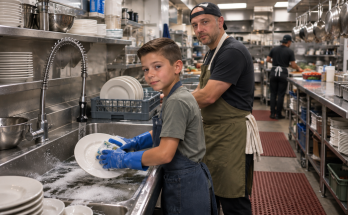
He was standing there in his worn sneakers, with red hands from washing dishes and a scrape on his cheek that hadn’t completely healed.
And suddenly I understood why he had kept telling me he was almost there.
He hadn’t been talking about the bicycle.
He had been talking about saving our home.
I grabbed him and held him against me.
“I’m so sorry,” I whispered.
He shook his head against my shoulder.
“You didn’t do anything wrong, Mom.”
“Yes, I did. I let you carry something no child should ever have to carry.”
He pulled back.
“But Dad always said we take care of each other.”
I began crying harder.
“I know, sweetheart. But taking care of each other doesn’t mean you have to become the grown-up.”
He looked confused.
“Then what does it mean?”
“It means you get to be thirteen,” I said, holding his face between my hands. “You get to ride bicycles. You get to make mistakes. You get to worry about homework and friends. And when something scares you, you tell me. You don’t have to fix it alone.”
He lowered his head.
“I just didn’t want you to cry anymore.”
Those words hurt more than anything else.
Because the truth was, my son had spent six months trying to protect me from the sadness of being a widow.
And in the process, he had lost six months of being a child.
That afternoon, Sal closed the diner early.
He sat beside us while Evan explained everything.
The pharmacy receipts.
The extra jobs.
The hidden envelopes.
The careful calculations.
And the money he had been too frightened to tell me about.
Then I asked the question that had been haunting me.
“Why were you shouting when Sal called?”
Evan looked embarrassed.
“Because I tried to give him the envelope without telling him what it was for. He found the mortgage notice in my backpack.”
Sal shook his head.
“He tried to leave with the money when I told him we needed to call you. I stopped him, and the old box of dishes beside the counter got knocked over. That’s what you heard crash.”
Evan looked at me.
“I thought you’d be mad.”
I wiped my cheeks.
“I am upset, sweetheart. Not because you wanted to help, but because you thought you had to hide all this from me.”
He nodded.
“And there won’t be any more secret jobs,” I added firmly.
“Okay.”
“Or climbing around abandoned buildings.”
“Okay.”
“Or lying about where you’ve been.”
He finally managed a small smile.
“Okay, Mom.”
For the first time in months, I felt like I had my little boy back.
But I knew this couldn’t end with a hug.
So on Monday morning, I took the day off work.
We visited the bank together.
I explained our financial situation and asked about repayment options.
With the money Evan had saved, Sal’s contribution, and a hardship arrangement the lender agreed to review and approve, we were able to bring the overdue mortgage payments current.
The relief I felt when the bank confirmed our account was no longer delinquent was impossible to describe.
I cried in the parking lot.
Evan sat beside me, holding my hand.
“Does this mean we get to keep the house?”
I turned toward him.
“Yes, sweetheart. It does.”
He smiled.
It was the biggest smile I had seen on his face since his father died.
But I wasn’t finished.
That evening, I made three phone calls.
The first was to my employer, who helped me apply for an employee assistance program I hadn’t known existed.
The second was to my doctor’s office, where a nurse helped me look into a more affordable way to obtain my prescription.
And the third was to a local family support organization, which connected me with financial counseling.
For the first time in three years, I stopped pretending that asking for help was the same thing as failing.
Because my son had taught me something I should have learned long ago.
Love isn’t measured by how much suffering you can hide.
Sometimes it’s measured by whether you’re brave enough to let someone help you.
Three weeks later, something unexpected happened.
It was a Saturday morning.
Evan was at the kitchen table eating cereal when someone knocked on our front door.
I opened it.
Sal was standing on the porch.
Beside him were two diner employees, Mr. Miller’s grandson, and several neighbors.
And right in the middle of them was a bicycle.
Matte black.
Orange lettering.
The exact bicycle Evan had been dreaming about.
I covered my mouth.
“Sal…”
He smiled.
“Don’t look at me. This was a community project.”
Evan appeared behind me.
“What is everybody doing here?”
Then he saw it.
He stopped breathing.
For several seconds, he simply stared.
Finally, he whispered, “Is that…?”
Sal nodded.
“That’s yours, kid.”
Evan shook his head.
“No. No, I can’t.”
Everyone went quiet.
“Why not?” Sal asked gently.
Evan looked at me.
“Mom still needs money.”
My heart broke all over again.
I knelt in front of him.
“Listen to me, Evan. Our bills are being handled. I have a plan. And I have people helping me.”
He hesitated.
“But what if something happens?”
“Then I handle it. And I ask for help when I need it. That’s my job, sweetheart.”
He looked at the bicycle again.
“But I didn’t pay for it.”
Sal chuckled.
“Son, you’ve already paid more than enough.”
One of the diner employees stepped forward.
“You washed dishes every weekend without complaining.”
Another smiled.
“You helped people who needed it.”
Mr. Miller’s grandson added, “And you reminded the rest of us what kindness looks like.”
Sal placed a hand on Evan’s shoulder.
“Your father helped me when I was struggling. You helped your mother when she was struggling. Now it’s our turn to do something for you.”
Evan’s chin trembled.
Then he asked a question that made every adult on that porch go silent.
“Would Dad be proud of me?”
I couldn’t hold back my tears.
I pulled him close.
“Sweetheart, your dad would be incredibly proud of your heart.”
I paused.
“But he’d also tell you something very important.”
“What?”
“He’d tell you that you never have to earn the right to be loved.”
Evan started crying.
And for the first time since his father died, he cried without trying to hide it.
I held him while the neighbors quietly looked away.
Eventually, he wiped his eyes, climbed onto the bicycle, and placed his hands on the handlebars.
“Go on,” I whispered.
He pushed off.
At first, he wobbled.
Then he found his balance.
He rode down the driveway, turned onto the sidewalk, and pedaled beneath the golden afternoon sunlight.
I watched him circle the block.
His laughter echoed down the street.
Real laughter.
The kind I hadn’t heard from him in three years.
And suddenly, I remembered something my husband had said on the day Evan learned to ride his first bicycle.
“One day, he’ll ride away from us. Our job is to make sure he knows he can always come home.”
I stood in the driveway with tears streaming down my face.
Because I finally understood.
My son had spent six months trying to save our house.
But what he had really been trying to save was the feeling of having a family.
And somewhere along the way, I had forgotten that a family isn’t held together by money, mortgages, or the walls around it.
It’s held together by people who love each other enough to stay.
That night, after Evan fell asleep, I went into his bedroom to put away his clean laundry.
His old backpack was sitting beside the desk.
I picked it up.
Inside, tucked into the smallest pocket, was a folded photograph of his father.
On the back, in Evan’s handwriting, were the words:
“Dad, I tried to take care of Mom like you did. I hope I did okay.”
I sat on the edge of his bed and cried.
Then I took out a pen.
Underneath his words, I wrote:
“You did more than okay, sweetheart. But from now on, let me take care of you, too. Love, Mom.”
I put the photograph back where he’d find it.
The next morning, Evan came downstairs holding that picture.
He didn’t say anything.
He just wrapped his arms around my waist and held on.
And I held him back.
A year later, the bicycle still sits in our garage.
Its tires are dirty.
Its orange lettering has a few scratches.
And Evan has already outgrown the helmet we bought that first summer.
But every time I see that bicycle, I remember the moment I discovered what my son had been doing with his paychecks.
I remember the fear.
The guilt.
The tears.
And the extraordinary kindness of people who refused to let a struggling family face everything alone.
Most of all, I remember what Evan said one evening as we sat together on the porch.
“Mom, do you think Dad knows we’re okay?”
I looked at the sunset.
Then I looked at my son.
“I think he’d be happy to see us smiling again.”
Evan leaned his head against my shoulder.
“Me too.”
And for the first time in years, the silence between us wasn’t filled with grief.
It was filled with peace.
My thirteen-year-old son spent six months saving for a bicycle he never intended to buy. He thought he needed to become the man of the house to keep our family together. But the greatest gift I could ever give him wasn’t that bicycle, or even the home he helped us save. It was the promise that he could finally stop being my protector and start being my little boy again.
Because a child should never have to sacrifice his childhood to prove his love. And sometimes, the most powerful words a parent can say are simply: “You’ve done enough, sweetheart. I’ve got you now.”
THE END.