My father casually inquired about the $200,000 he “sent me” during Sunday dinner. “You Said You Needed It for the House,” he said with a smile. However, after the bank verified that the account was opened from our home IP, two officers soon stood beneath our chandelier and asked who had committed a felony.
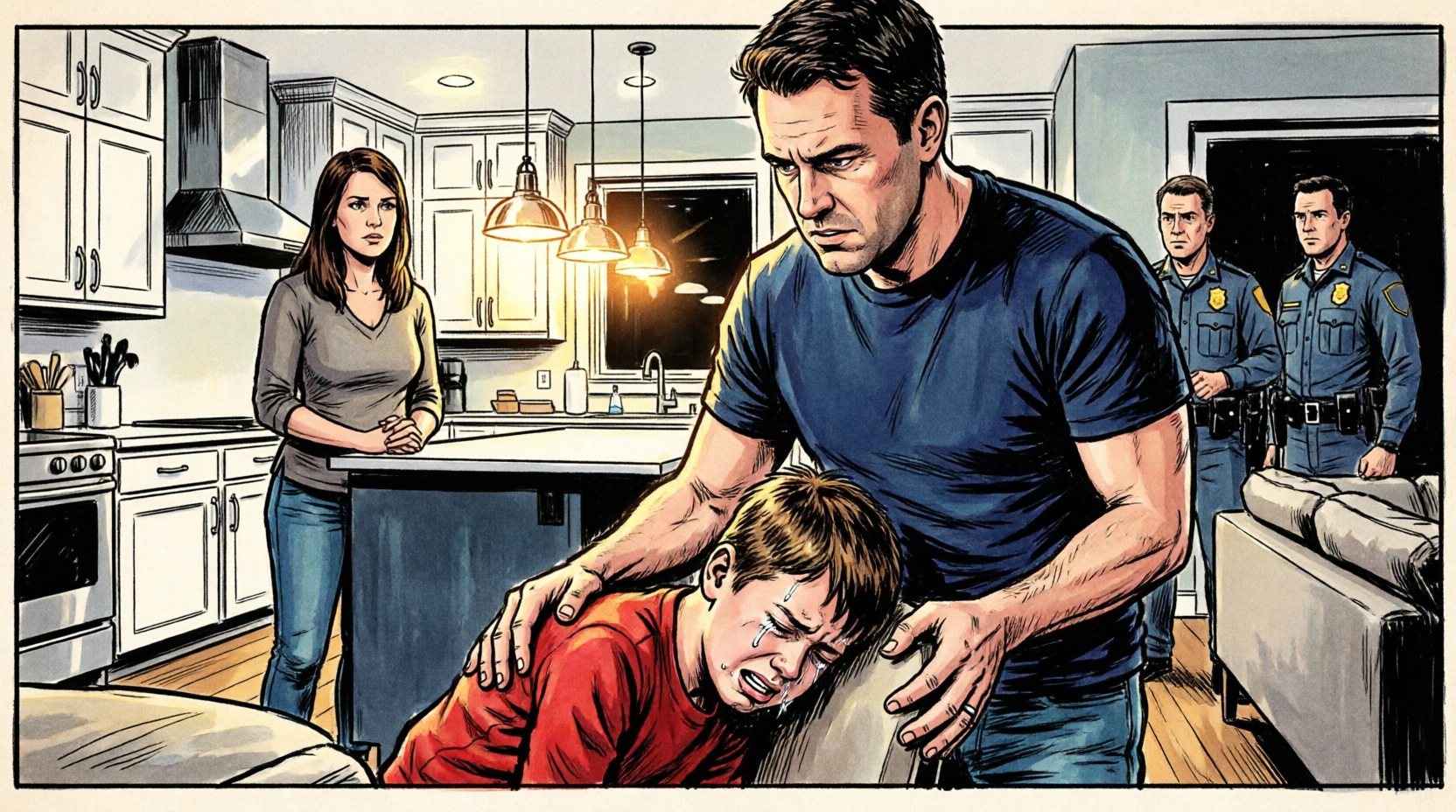
The chandelier above us had always been a symbol of our family’s warmth, a fixture that cast a golden, forgiving glow over decades of Sunday roasts and birthday toasts. But that evening, the light felt different—harsh, exposing, like an interrogation lamp swinging slowly back and forth. The air in the dining room was thick, suffocating, smelling of cooling roast beef and the metallic tang of fear.
It started with a question so casual it felt innocent. My father, his voice raspy with the comfort of a full belly and good wine, leaned back in his chair. He looked at me, then glanced toward my sister, Brianna, with a pride that made my stomach turn.
“So,” he began, wiping his mouth with a linen napkin. “How is the renovation coming along? That two hundred thousand dollars I wired over should have covered the down payment and the initial contractors, right? I wanted to make sure you had a solid foundation.”
The fork slipped from my hand, clattering against the china with a sound like a gunshot in the sudden silence.
I stared at him, my mind racing, trying to find the missing piece of a puzzle I didn’t know existed. “Dad,” I whispered, the word catching in my throat. “What are you talking about? You never sent me any money.”
The silence that followed wasn’t just quiet; it was a vacuum, sucking the oxygen out of the room. My mother stopped pouring water. Trevor, my brother-in-law, froze mid-chew, his eyes darting toward his wife.
Brianna didn’t flinch. She just took a slow sip of her iced tea, her expression a mask of practiced calm that I suddenly realized was a armor she’d been wearing for years.
“Don’t be silly,” Dad chuckled, though the sound was brittle. “I sent it last Tuesday. I have the confirmation right here.” He pulled his phone from his pocket, tapping the screen with a trembling finger before sliding it across the polished mahogany table.
I picked it up. The screen glowed with a bank transfer receipt. Two hundred thousand dollars. Sent to an account bearing my name. My Social Security number. My date of birth.
But the account number at the bottom… it wasn’t mine.
“I don’t understand,” I said, my voice shaking. “This says it went to an account in my name, but I didn’t open this. I’ve never seen this bank.”
Dad’s face drained of color. “But… Brianna gave me the routing number. She said you were busy with the architects and asked her to handle the transfer details so you wouldn’t be stressed.”
All eyes turned to Brianna. She set her glass down slowly. “I was trying to help,” she said, her voice smooth, devoid of any tremor. “You’re always so overwhelmed, sis. I just wanted to make sure the money got to the right place.”
“The right place?” I repeated, a cold knot tightening in my chest. “This isn’t the right place. This is fraud.”
We called the bank immediately. My father put the call on speaker, his hand shaking so badly he could barely hold the device. The representative’s voice was professional, detached, cutting through our panic like a scalpel.
“I’m looking at the account now,” the voice droned. “It was opened online three weeks ago. The identity verification was bypassed using high-quality scanned documents. We have the IP address of the device used to open the account and authorize the transfers.”
A heavy pause.
“The IP address traces to a residential location. Specifically, 1402 Maple Drive.”
Our address.
The blood left Trevor’s face so fast he looked like a ghost. He looked at Brianna, a plea in his eyes, begging her to say something, anything, that would explain this away. “Bri?” he whispered. “Tell them it’s a mistake.”
But the trap was already sprung. The representative continued, “The funds were drained within forty-eight hours of deposit. They were used for vendor payments to a luxury real estate firm and a certified check for a downtown penthouse condo. The account is now empty.”
A downtown condo. The same condo Brianna had been bragging about for months. The one she claimed was funded by a “lucrative new brand deal” with a skincare line. The one she said was the key to maintaining her “influencer status,” her “brand image.”
The room seemed to tilt. I looked at my sister—really looked at her. The perfect hair, the designer blouse, the calm demeanor. It wasn’t confidence. It was calculation. She had been watching us. She had been waiting. She had taken my identity, my father’s generosity, and twisted it into a lie to build a life she felt she deserved.
“It’s family money,” Brianna suddenly snapped, her mask cracking. She stood up, her chair scraping loudly against the floor. “Dad, you treat her like the golden child. You give her everything. I had to fight for every inch of my life. I needed the condo. My followers expect a certain lifestyle. If I lose the image, I lose the income. It was just a loan! I was going to pay it back once the brand deals came through!”
“You stole my identity,” I said, my voice barely audible. “You used my name. You made me a criminal.”
“I did what I had to do!” she screamed, tears finally spilling over, but they weren’t tears of remorse; they were tears of rage. “You have no idea what it’s like to be the backup plan! To be the one Dad calls when he needs someone to organize the holiday, but never when he’s proud!”
Dad stood up slowly. He looked older than he had ten minutes ago. The light in his eyes, the pride he had shown just moments before, was gone, replaced by a profound, hollow grief.
“Brianna,” he said, his voice breaking. “You could have asked. You could have just asked.”
But she couldn’t. Because asking would have meant admitting she wasn’t enough. It would have meant accepting that she was second. And for Brianna, being second was a fate worse than prison.
The sound of the doorbell didn’t register at first. It was just a noise in the distance. Then, the heavy knock.
Dad didn’t move to answer it. He didn’t have to. The officers who stepped into the dining room a moment later moved with the grim efficiency of people who had seen this scene play out a thousand times. Two officers in uniform, their faces unreadable, standing beneath the chandelier that had witnessed so much joy, now bearing witness to the end of us.
The digital trail hadn’t just led to the IP address. The bank, realizing the severity, had flagged the transaction for immediate investigation. The “vendor payments” were traced to a shell company registered to Brianna’s LLC. The certified check was in her hand, or it had been, before the freeze.
As the officers approached the table, the reality of the moment settled over us like a shroud. The half-eaten plates of food—roast beef, mashed potatoes, green beans—sat abandoned, congealing in the cooling air. A testament to the normalcy we had lost forever.
Brianna didn’t fight. She just looked at Trevor, who had turned away, unable to meet her gaze. She looked at me, her eyes wide, searching for the sister who used to braid her hair and defend her from bullies. But that sister was gone. I was just a victim now.
“I didn’t mean for it to go this far,” she whispered as the officer placed a hand on her shoulder.
“But you did,” I said softly. “You meant every bit of it.”
The weeks that followed were a blur of legal jargon and quiet devastation. The bank managed to recover a portion of the funds—the vendor payments were reversed, the condo deal collapsed before closing. But the damage was done. The money was gone, spent on deposits and fees that couldn’t be retrieved.
Brianna accepted a plea agreement. Identity theft, wire fraud, unlawful appropriation. Restitution, probation, community service. The influencer accounts were scrubbed. The “brand deals” vanished. The filters came down, revealing a girl who was just lost, and angry, and broken.
I visited her once, in the sterile visiting room of the county facility. She looked smaller without the rings, the makeup, the posture of a queen holding court.
“I hated feeling second,” she admitted, her voice flat. “I hated that Dad looked at you and saw success, and looked at me and saw… potential. I just wanted him to look at me the way he looked at you.”
I wanted to hate her. I wanted to scream. But looking at her, I just felt a deep, aching sadness. “Forgiveness and consequences can coexist, Bri,” I told her, my hand resting on the cold glass partition between us. “But both have to be earned. You stole more than money. You stole my trust. You stole Dad’s peace. You can’t just say sorry and get it back.”
She nodded, tears streaming down her face, silent sobs shaking her shoulders.
Dad helped me buy a house a few months later. A modest place, nothing like the downtown condo Brianna had wanted. We sat at the kitchen table, just the two of us, signing documents. Every line was read aloud. Every signature was witnessed. It was transparent. It was slow.
“We’re going to be okay,” he said, his hand covering mine. But his eyes were sad. They held the memory of the chandelier, the half-eaten dinner, the sight of his daughter being led away in handcuffs.
Family dinners changed after that. There were fewer performances. Less talking about careers and image and success. We talked about the weather. We talked about books. We talked about the small, safe things.
But sometimes, when the light hits the table just right, or when a phone buzzes with a notification, I wonder.
I wonder if Brianna is truly sorry, or if she just regrets getting caught. I wonder if Trevor will ever look at a woman with trust again. I wonder if Dad will ever wire money without trembling. And I wonder if I will ever look at my own name on a document without feeling a phantom pain, a reminder that the person who was supposed to protect me was the one who stole me.
That night wasn’t just about two hundred thousand dollars. It was about the cracks in the foundation we never saw. It was about the envy that festers in the dark, the pride that blinds us, the fear of being left behind.
And as I sit here, in the house bought with honest money, I realize the hardest part isn’t the loss. It’s the knowing. The knowing that blood doesn’t always mean safety. That the people who know your passwords, your secrets, your Social Security number… are the ones who can hurt you the most.
And I wonder, as the sun sets and the shadows lengthen across the room: Can a family ever really heal from this? Or do we just learn to live with the scar, tracing it with our fingers every day, remembering the moment the illusion cracked, and the truth came rushing in?