Chapter 1: The Eviction Banquet
The black ink on the dissolution decree hadn’t even fully bonded to the heavy parchment when I felt it—that distinct, hollow click of a heavy mahogany door swinging shut. For a fleeting second, I genuinely believed it was the sound of my hard-won freedom.
I was wrong. It was the sound of a trap attempting to snap shut on an empty cage.
For seven grueling years, I had functioned as the silent, bleeding investor in the Callaway family’s theatrical production of a dynasty. It was a miserable, high-stakes subscription service where I was the sole party footing the physical and psychological bill. I had signed the divorce papers at precisely 9:00 a.m. in an office that smelled oppressively of lemon polish and stale coffee.
By 10:30 a.m., my newly minted ex-mother-in-law, Cynthia, was already holding court at The Gilded Cask, the most obnoxiously exclusive restaurant in the valley. She was busy commandeering their VIP vault to host a $6,500 banquet. The guest of honor? My meticulously selected replacement.
If you found yourself in that precise psychological crosshair, what would you have done? Would you have driven back to a half-empty apartment to weep into a cardboard box of your remaining possessions? Or would you have killed the engine, gripped the leather steering wheel, and waited to see exactly what monetary value they placed on seven years of your sacrificed youth?
The suffocating silence of the law firm’s parking lot felt like a physical accusation. I remained entombed in the driver’s seat of my sedan. I stared blankly at my copy of the settlement sitting on the passenger cushion. My married name was already a phantom, brutally crossed out by my own trembling hand, replaced by my maiden signature.
Then, my phone violently vibrated against the plastic center console, shattering the quiet.
The caller ID flashed. It was Diane, my cousin-in-law. Out of the entire venomous, social-climbing orbit of the Callaway vineyard, Diane was the lone soul who still possessed a functioning moral compass.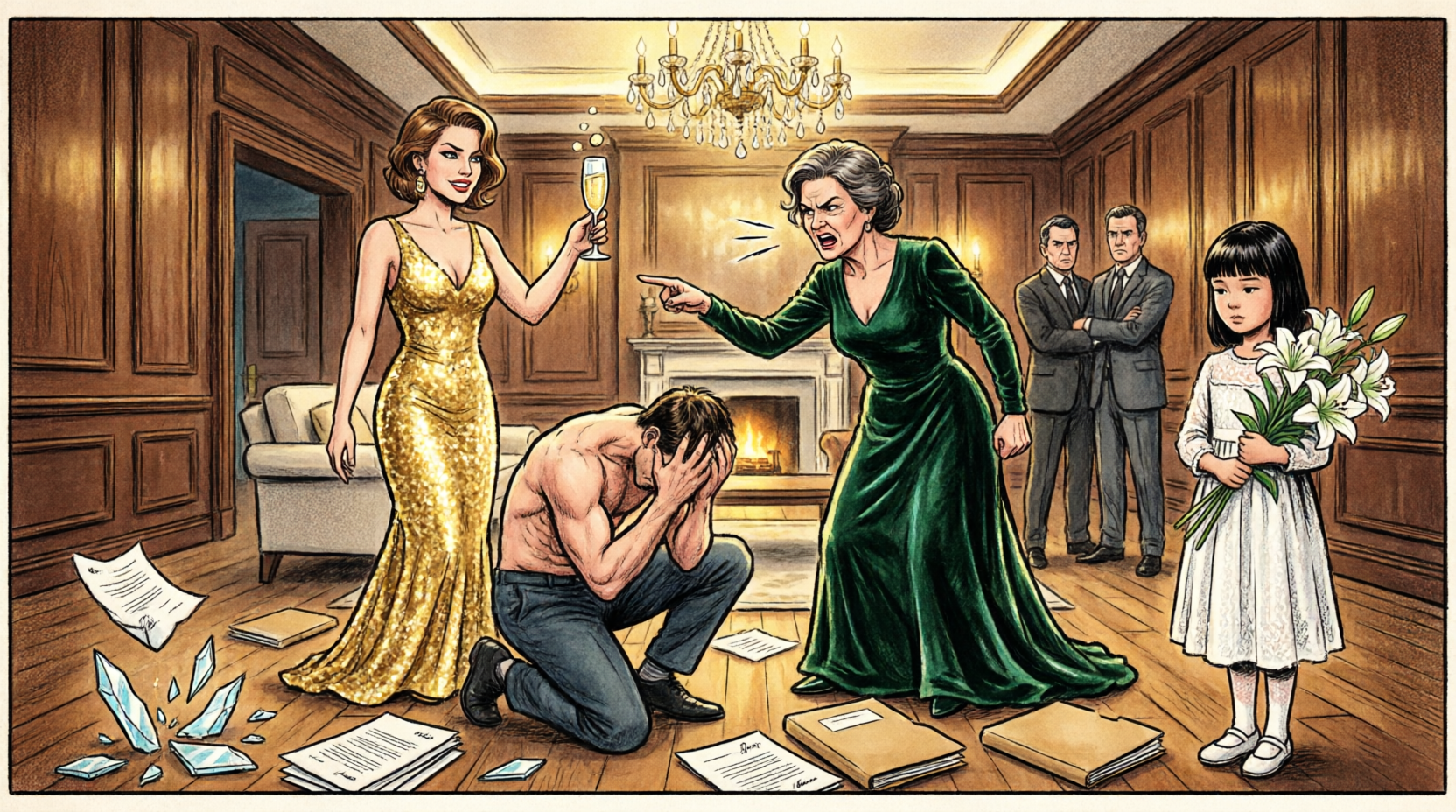 I answered, pressing the glass to my ear. Her voice was an urgent, rhythmic whisper, strained and breathless, as if she were frantically relaying enemy coordinates from a muddy trench. She was calling from the opulent, gold-leafed lobby of The Gilded Cask.
“Alyssa, you need to hear this,” Diane breathed, the ambient hum of a jazz pianist filtering through the receiver. “The florist just carted in three dozen white lilies. Your absolute favorites. They’re forming a canopy over the main table.”
Cynthia had moved with the ruthless, synchronized precision of a corporate hostile takeover. She had reserved the vault before the ink on my divorce was even dry. She was currently hosting a lavish gala for fourteen sycophantic guests. And the centerpiece of this grotesque celebration wasn’t the award-winning Cabernet I had coaxed from the earth.
It was a woman named Melissa.
According to Diane’s rapid-fire reconnaissance, Melissa was a decade younger than me, aggressively soft-spoken, and was already parading a familiar, emerald-cut diamond ring on her left hand. It was a ring that looked violently identical to a Callaway family heirloom I had once been promised, but was told had been “lost in a bank transfer.”
A dangerous, icy stillness settled deep into the lower lobes of my lungs. My pulse didn’t race. My palms didn’t sweat. This wasn’t the blinding, chaotic heat of a woman scorned. This was the cold, clinical, and unforgiving temperature of a forensic audit.
In that parking lot, the reality crystallized. Cynthia didn’t merely want me removed from her son’s life. She wanted to surgically extract my existence. She wanted to scrub the very soil of the estate from beneath my fingernails and seamlessly substitute me with a clean, compliant, country-club mannequin—a woman who would sip the wine but never possess the intellect to question the financial ledgers.
The women who pose the greatest threat to your survival are rarely the ones who scream in your face. They are the ones who tilt their heads, flash a collagen-plumped smile, and coo, “Of course, dear.” All while quietly dismantling the architecture of your life through whispered three-way phone calls and cleverly backdated memorandums.
Cynthia was the undisputed grandmaster of this domestic espionage. She had spent the better part of a decade treating me like a disposable tenant farmer in the landscape of my own career. And now, for her grand finale, she was attempting to use my primary business credit line to finance my own eviction party.
“The sommelier is bringing out the reserve list,” Diane whispered, her voice dropping an octave as footsteps approached her hiding spot. “The running tab is already cresting six thousand. Cynthia told the maître d’ to put the entire evening on the corporate platinum card.”
My corporate platinum card. The account I had personally opened. The one irrevocably tethered to my individual credit score. The very card I had spent thousands of sleepless hours justifying through brutal midnight harvests, frantic supply chain negotiations, and broken tractors. She genuinely believed the capital I had bled into existence was a community chest she could plunder for her own amusement.
I stared out through the windshield at the jagged, gray skyscrapers of the city skyline, my mind miles away, drifting back to the sprawling green vines waiting at the estate.
“They’re pouring the first course, Alyssa,” Diane reported, her voice thick with disgust. “Cynthia is standing at the head of the table. She’s tapping a crystal flute. She’s giving a toast to the true legacy of the Callaway name.”
A pause. A sharp intake of breath from Diane.
“Alyssa… she’s toasting with the Founder’s Reserve. The Northern Block vintage.”
My grip on the steering wheel tightened until my knuckles turned translucent. That specific vintage of wine shouldn’t legally or physically exist for public consumption for another two months. The fermentation cycle wasn’t complete on the official books.
Cynthia had no idea that while she was busy polishing her stolen diamonds and rehearsing her deceitful toasts, I hadn’t just been crying in the dark. She thought she was executing the perfect crime.
She didn’t realize I had already found the bodies.
Chapter 2: Roots in the Frost
To understand the depth of the theft, you have to understand the dirt.
While my ex-husband, Jackson, handled the glossy branding meetings in air-conditioned boardrooms, and Cynthia micromanaged the high-society tasting circles, I was the one who actually conversed with the earth.
I was the phantom in the dirt at 4:00 a.m., wearing mud-caked boots and a heavy Carhartt jacket, obsessively monitoring the subterranean moisture levels of the Northern Block. I knew the specific, complex chemical signature of our loamy soil long before the morning sun ever breached the horizon to hit the canopy. To the Callaways, my profound intimacy with the land was viewed with a mixture of amusement and disdain. They saw it as mere blue-collar labor, a dirty necessity, rather than the beating, technical soul of their entire business model.
I can admit, with the painful clarity of hindsight, that a quiet, suppressed part of my psyche recognized the imbalance years earlier than my heart was willing to accept.
I wasn’t building an equal partnership. I was an unpaid, live-in consultant, dutifully pouring the concrete foundation for a glittering legacy that Cynthia fully intended to keep strictly within her genetic bloodline.
The starkest illumination of this dynamic occurred during the brutal spring of 2022.
A freak, late-season frost descended upon the valley, a lethal blanket of freezing air that threatened to obliterate the entire budding harvest. If those fragile buds froze, the vintage was dead, and the vineyard would default on its massive operational loans.
Where was my husband during this existential crisis? Jackson was at a luxury golf retreat in Monterey with his mother, allegedly “discussing long-term marketing strategies” for a vintage that would literally cease to exist if I didn’t intervene.
I didn’t sleep for forty-eight consecutive hours. I lived in the rows. I frantically orchestrated the deployment of the massive, diesel-guzzling frost fans. I hauled portable heaters through the freezing mud until my shoulders screamed and my hands cracked and bled inside my gloves. I monitored the micro-climates of the valley floor, fighting a desperate, grueling war against the plunging mercury.
I saved the crop. I saved the Callaway family’s solvency.
When Jackson and Cynthia finally returned, deeply tanned and smelling of expensive gin, Cynthia didn’t offer a single word of gratitude. She didn’t acknowledge my bruised hands or the dark, bruised bags under my eyes.
She simply glided to the estate’s floor-to-ceiling windows, gazed out at the surviving, vibrant green vines, and sighed contentedly. “It is truly wonderful how miraculously lucky Jackson is with this piece of land.”
It was a systematic, deliberate airbrushing of my existence.
In glowing magazine profiles and press releases, I was relegated to the “supportive spouse.” In the grand, sweeping family anecdotes told at holiday dinners, I was merely the “diligent help” who kept the tractors running. I had become the ultimate silent investor in their fraudulent version of family. I provided the grueling technical expertise that won the gold medals, while they gleefully pocketed the prestige and the profits.
At the time, I foolishly convinced myself that I was just being patient. I operated under the naive belief that in a chaotic world of variables, professional competence was the ultimate armor. If I was indispensable, I was safe.
I was catastrophically wrong.
In a toxic ecosystem, your competence isn’t a shield; it is weaponized against you. They pile more crushing responsibility onto your shoulders because they know you won’t let the structure fall. Then, they actively use that resulting, bone-deep exhaustion to keep you too disoriented to notice they are systematically stealing the fruits of your labor.
I vividly remember the rainy November night I earned the brass Master Cellar Key.
The previous owner of the estate—a grizzled, silent man who valued the integrity of the vine far above the vanity of the name—had pulled me aside after I successfully rescued a highly volatile, difficult malolactic fermentation process that Jackson had nearly ruined.
He unclipped the heavy, antique brass key from his belt and pressed it firmly into my calloused palm. It was cold, jagged, and absolute. “You’re the only one here who actually hears them growing,” he had muttered.
Cynthia had watched this silent coronation from the doorway. She wore a smile that completely failed to reach her cold, calculating eyes. It was the exact expression of a starving predator watching a smaller animal unearth a piece of meat it intends to violently steal later.
Almost immediately after that night, she began a subtle campaign to frame my dedication as a domestic liability.
During Sunday brunches, she would sigh heavily and suggest to Jackson that my “obsession” with the harvest was taking a devastating toll on the romance in our marriage. She would delicately imply, over cups of Earl Grey, that a “softer, more present woman” would prioritize spending afternoons at the country club networking, rather than hiding away in the damp, pungent fermentation tanks.
It was a masterful, calculated psychological squeeze. She was engineering a dynamic where I was made to feel guilty and inadequate for performing the very backbreaking labor that was single-handedly funding her luxurious lifestyle.
Looking back, that specific detail feels sharper and more agonizing than the rest of the betrayal. I wasn’t just being marginalized. I was being actively, maliciously trained. I was being conditioned to accept significantly less, all while being demanded to produce exponentially more.
And the invisible noose was about to pull tight, beginning with a shadow named Melissa.
Chapter 3: The High-Performer Victim
The sabotage didn’t announce itself with a declaration of war. It seeped into the soil with the smallest, most imperceptible of shifts.
Roughly six months before the divorce papers were even a whisper in a lawyer’s office, Cynthia’s physical presence at the operational side of the vineyard amplified. It happened with the steady, insidious rhythm of a rising black tide. She no longer waited for a formal invitation to the tasting room or the administrative offices. She simply materialized.
She would float through the barrel rooms, draped in her impeccably tailored neutral blazers, leaving a suffocating trail of heavy floral perfume in her wake. And trailing closely behind her, notebook in hand, was Melissa.
Melissa was presented as a shadow Cynthia was actively training to take my shape. Cynthia spun a saccharine narrative, claiming the girl was an “intern,” a massive favor for a dear, old family friend who needed direction. But the reality was visceral. Every time I looked up from my microscope or my spreadsheets, there she was. It felt exactly like being strapped to a chair and forced to watch a stranger memorize the intricate choreography of my own life.
It was during this claustrophobic period that I started to notice the discrepancies in the Northern Block.
They were minor anomalies at first. Easy to dismiss if you weren’t looking closely. A discrepancy of a few cases here in the inventory logs. A crucial fermentation temperature record mysteriously misplaced from the main server.
When I finally compiled the data and brought the inconsistencies to Jackson, laying the printouts on his mahogany desk, he deployed a tactic he had spent years perfecting. He leaned back, rubbed his temples, and gave me a look of profound, exhausted patience.
“Alyssa, please,” he groaned, refusing to even glance at the numbers. “You are completely overstressed. You haven’t slept properly since the harvest. You’re reading malicious intent into basic clerical errors again. Just… let the admins handle the ledgers, okay?”
It is a very specific, highly destructive form of psychological taxation to be repeatedly told that your sharp, professional observations are actually manifestations of emotional instability. It operates like water dripping relentlessly onto porous stone. It slowly, agonizingly smooths away the sharp edges of your professional certainty, until you can no longer distinguish between your own razor-sharp instincts and the dull, confusing hum of self-doubt they have violently conditioned you to feel.
What I couldn’t articulate then was that I was hopelessly entangled in the invisible chains of the ‘high-performer victim.’
In healthy professional environments, we are taught that excellence is insulation. If you are the best at what you do, you are secure. But in a deeply toxic, narcissistic family system, your excellence is not a suit of armor. It is a subsidy. It is a resource to be mined until the vein collapses.
I stayed. I stayed because my logic was flawed. I genuinely believed that if I just out-produced Cynthia’s palpable disdain—if I just made the vineyard so wildly profitable that they couldn’t survive without me—the disrespect would eventually, magically cease.
I was dutifully paying down a cognitive debt that Cynthia never, for a fraction of a second, intended to settle.
The illusion shattered completely on a mundane Tuesday afternoon.
I had returned to my home office at the estate early to grab a forgotten soil-sampling kit. I opened the door softly, my boots making no sound on the hardwood.
Cynthia was standing behind my desk. She wasn’t just snooping. She was holding her gold-cased smartphone directly over my private, proprietary fermentation logs. The harsh, blue light from the digital screen reflected off her pristine pearl earrings as she rapidly snapped images of my highly confidential data.
When my shadow fell across the desk, she didn’t flinch. She didn’t drop the phone. She slowly straightened up, locked eyes with me, and flashed that flawless, empty department-store smile.
“I was just admiring your relentless dedication, dear,” she purred, slipping the phone into her designer pocket. “Melissa could learn so much from your meticulous nature. You really are so… organized.”
She breezed past me, leaving the scent of roses and rot in the air.
I didn’t argue. I didn’t scream. I didn’t throw a glass against the wall. A terrifying, absolute calm washed over my nervous system. I simply turned on my heel and walked down the hall to the supply closet to retrieve a new ledger book. It was a mundane errand to mask a seismic internal shift.
I reached up to the top shelf, pushing aside a stack of dusty, extra printer cartridges.
My fingers brushed against something smooth. A thick, manila folder that had been deliberately wedged out of sight.
I pulled it down into the harsh fluorescent light of the closet. It was pristine, heavy, and labeled in Cynthia’s elegant, unmistakable cursive script.
The label read: “Inventory Liquidation: Alyssa’s Share.”
I stopped being a wife at 2:14 p.m. on that Tuesday afternoon.
I stood paralyzed in the cramped supply closet, the stiff cardboard of the folder radiating a cold energy against my palms. I felt the crushing, suffocating weight of seven years of absolute miscalculation crash down upon my shoulders. I opened the folder. It was filled with drafted legal maneuvers, asset restructuring plans, and timelines designed to sever me from the vineyard with the absolute minimum payout legally possible.
I didn’t storm into the living room to confront Cynthia. I didn’t call Jackson sobbing.
I knew from years of managing high-stakes agricultural logistics and negotiating with ruthless distributors that a dramatic, emotional outburst is merely static noise in a professional negotiation. It is a tactical distraction that a predator immediately uses to recalibrate their attack.
If she wanted a war of ledgers, I would give her one. But I was about to rewrite the math.
Chapter 4: The Shadow Vintage
I began to move through my own life with the same clinical, sociopathic precision Cynthia had utilized to build my cage.
Three days after finding the folder, I quietly hired a man named Gerald Sims. Gerald was a bulldog of a forensic accountant, a man who spoke exclusively in spreadsheets and offshore routing numbers. I smuggled him onto the estate grounds under the highly plausible guise of a specialized “drip-irrigation consultant.”
For three agonizing weeks, while Cynthia was giddily occupied across the property helping Melissa select the “perfect” imported linens for the guest house, Gerald remained locked in my back office. He was methodically tracing the faint, digital ghost of my stolen labor.
It was an agonizingly slow excavation. Real, undeniable accountability rarely arrives in a single, cinematic moment of dramatic discovery. It is constructed through the tedious, patient accumulation of irrefutable, microscopic facts.
On the twenty-second day of the audit, Gerald asked me to close the office door and pull the blinds. He turned his laptop screen toward me, laying out the undeniable ledger of my betrayal.
He had unearthed the “Shadow Vintage.”
According to the official harvest reports—documents that Cynthia had aggressively pressured me to sign in extreme haste during a chaotic bottling week—approximately $285,000 worth of ultra-premium Cabernet grapes from the prized Northern Block had been tragically lost to an outbreak of early-season root rot.
But Gerald hadn’t just looked at the financial filings. He had cross-referenced my deeply buried soil sensor data and the encrypted Brix sugar-level logs.
“The data doesn’t lie, Alyssa,” Gerald said, his voice a low gravel. “Even if your family does. Look at the moisture readouts. Look at the sugar spikes.”
The grapes hadn’t succumbed to rot. They had been perfectly healthy. They had been secretly harvested in the dead of night, quietly diverted from the main pressing facility, fermented off-books, bottled, and securely stored under the umbrella of a dummy shell company. A company that Gerald traced directly to an LLC Cynthia had registered in the neighboring county six months prior.
Knowledge lands with a vastly different gravity when it has a definitive dollar sign attached to it.
Two hundred and eighty-five thousand dollars wasn’t an abstract concept of betrayal. It was seven years of my life, my youth, and my passion stolen while I slept in the bed of a man who facilitated the robbery. It was the physical, liquid embodiment of every freezing 4:00 a.m. alarm I had ever silenced, and every midnight frost I had battled alone in the mud.
The architecture of their plot finally became crystal clear. The sudden divorce papers Jackson had served me weren’t born of a broken marriage or irreconcilable emotional differences. They were a highly synchronized, timed financial maneuver.
Cynthia needed me legally and permanently detached from the vineyard’s asset pool just before this massive, secret vintage hit the high-end luxury market. They had siphoned the prestige, utilized the technical soul of the brand I built, and were preparing to brutally liquidate my share of the harvest.
I sat alone in my office long after Gerald left. The familiar, cloying scent of Cynthia’s floral perfume lingered in the hallway outside my door like a toxic territorial marker. She hadn’t just successfully replaced me in her son’s bed. She had systematically robbed me of my career’s greatest magnum opus. And her master plan relied on my utter compliance—that I would sign the settlement, walk away utterly defeated, and politely whisper, “Of course, dear.”
I stood up. I walked to the heavy iron safe in the corner of my office, spun the dial, and retrieved the brass Master Cellar Key.
The air in the subterranean cellar annex was thick, damp, and bitingly cold. Cynthia had ordered the heavy oak doors to this specific tunnel boarded up nearly two years ago, loudly claiming to the staff that the foundation was settling dangerously and the space was structurally unstable.
I should have pulled the county permit logs then. But I was still paying exorbitant emotional interest on a marriage I tragically believed was a mutual investment.
I slid the heavy brass key—the exact key Cynthia had spent years desperately trying to manipulate out of my possession—into the rusted iron lock. It turned with a dry, screeching mechanical protest that echoed off the stone walls. I pushed the door open and hit the harsh overhead fluorescents.
The darkness retreated, revealing massive, floor-to-ceiling wooden racks. They were fully occupied by hundreds of gleaming, perfectly uniform bottles of the Northern Block Cabernet.
The $285,000 Lost Harvest.
They weren’t merely stored in bulk. They were fully corked, foiled, and ready for immediate high-end distribution.
I walked slowly down the aisle, my breath pluming in the frigid air. I reached out and pulled a single bottle from the rack. The dark glass was freezing against my skin. I turned it over to examine the front.
The label was aggressively minimalist, printed on expensive, textured cream paper.
It read: “The Inspiration, Melissa.”
I stood in the freezing silence. I didn’t hurl the bottle against the stone floor. I didn’t scream into the void. I didn’t even feel the rising heat of a violent impulse. What washed over me was a profound, terrifying sense of tactical clarity.
The deepest wound wasn’t the theft of the financial margins. It was the audacious, sickening attempt to rebrand the blood and sweat of my labor as the romantic muse of the woman sleeping with my husband.
Some parasites are not content with merely draining your resources. They actively seek to colonize your identity, rewriting the history books until there is absolutely no trace left of the original architect.
I carefully slid the bottle back into its slot. I stepped out of the annex, locked the heavy door, and pulled my cell phone from my pocket. I dialed the direct line for Patricia Holt, the most ruthless agricultural compliance attorney in the state.
My voice didn’t waver a fraction of a decibel. “Patricia. The Shadow Vintage isn’t just paper. It’s physical. It’s fully labeled, and they are preparing to serve it.”
“Do not touch the inventory, Alyssa,” Patricia’s voice came back, a clinical, professional hum. “Maintain your current physical distance. We have the kill switch.”
She reminded me of a detail Cynthia had completely overlooked in her arrogance. My digital access to the estate’s temperature control systems and the inventory vault was legally tied to my state-issued professional viticulturist license. It was a rigorous credential I had earned long before I ever met Jackson, and it remained fiercely independent of any marital property decree.
“Legally,” Patricia continued, the trap snapping shut in her words, “under strict state agricultural compliance codes, your specific license grants you the unilateral authority to place an immediate health, safety, and quality quarantine on any wine inventory with disputed chemical logs. Since you have officially flagged the Brix levels and fermentation data as inconsistent with their new labels, that cellar is now a federally restricted zone until a full government audit is completed. If they move a single bottle, it’s a felony.”
I closed my eyes, leaning my head against the cold stone wall of the corridor.
Cynthia’s perceived power was nothing more than an unauthorized overdraft on my talent. She had spent seven years treating my elite expertise like a complimentary family perk. She never possessed the intellect to realize that the Master Key wasn’t just a piece of brass. It was an impenetrable legal boundary she couldn’t charm, bully, or manipulate her way across.
I left the wooden boards leaning against the wall exactly as I had found them. But as I walked back to my car, I opened the master control application on my phone. With three taps, I adjusted the digital security protocols for the entire estate, setting the main vault and the annex to a Level-4 Contested Asset Lockdown.
And just for good measure, I opened my banking app.
Click.
I quietly enabled a strict security protocol on the corporate platinum card, automatically restricting and declining all non-operational expenses over $5,000 without my secondary, biometric digital signature.
Which brings me back to the parking lot of the law firm, staring at my phone as a new notification pinged on my screen.
DECLINED: The Gilded Cask – $6,540.00.
Cynthia had just attempted to swipe the card to pay for her victory lap. And I was about to cut the microphone on her grand speech.
Chapter 5: The Declined Dynasty
My phone rang at exactly 10:47 a.m.
It was Cynthia’s personal cell number illuminating the screen. I swiped to accept the call, bringing the phone to my ear, but I didn’t say a word. I let her speak first.
The voice that filtered through the microscopic speaker was entirely stripped of its carefully curated social architecture. The sweet, condescending “Of course, dear” was annihilated. In its place was the raw, jagged, breathless panic of a woman whose massive line of fraudulent credit had finally been called in by the bank.
“Alyssa!” she shrieked, her voice echoing slightly, indicating she had locked herself in a restroom to hide from her guests. “There is a massive error with the corporate card! The manager out here is causing an unbelievable scene. He is refusing to run the tab, and he is no longer impressed by me telling him who we are!”
I sat in the quiet sanctuary of my car, watching the morning traffic glide by. I took a slow, deep breath.
“There is no error with the bank, Cynthia,” I replied, my voice projecting the serene, terrifying calm of a judge reading a verdict. “I initiated the block. The corporate account has been automatically flagged for a deep forensic review immediately following the filing of our dissolution papers at nine o’clock this morning.”
I stopped speaking. I deliberately let the heavy silence hang over the cellular connection. Through the background static, I could hear the faint, ambient noise of her ruined banquet—the awkward clink of expensive silverware from fourteen confused guests who were rapidly deducing that their wealthy host was suddenly insolvent.
“You vindictive little…” Cynthia hissed, the venom finally pouring out unfiltered. “And the vault! The restaurant manager just informed me that the special inventory we requested shipped over this morning is under a legal lockout! What have you done to the cellar?”
“I protected the assets, Cynthia,” I stated, my tone as flat and unyielding as a horizon line. “The Founder’s Reserve. The exact vintage you stole, hid, and arrogantly re-labeled as Melissa’s Inspiration, is currently registered with the state as contested inventory under a federal property protection order.”
I heard a sharp, choking gasp on the other end of the line.
“Until the two hundred and eighty-five thousand dollars you illegally diverted is returned in full to the vineyard’s primary operating account,” I continued ruthlessly, “that wine legally does not exist for consumption. If you break the seal on that annex, Patricia Holt will have you arrested for agricultural fraud before the appetizers are cleared.”
It was in that precise fraction of a second that I fully understood a universal truth: Inherited power is almost always an optical illusion, propped up entirely by the exhausted silence of the people doing the actual work.
Cynthia had spent decades strutting through the valley, genuinely believing she owned the vines. But she had only ever owned the paperwork. The absolute second the actual, technical labor was withdrawn and weaponized against her, her grand empire was exposed for what it truly was—a hollow collection of extraordinarily expensive habits entirely devoid of an internal engine.
There was a muffled scuffle on the other end of the line. Jackson had taken the phone. I could hear his breathing—heavy, erratic, and deeply uncertain.
“Alyssa, please,” Jackson begged, his voice cracking with the pathetic desperation of a boy who had finally been caught stealing from the cookie jar. “This is a massive public event. All our distributors are here. We can sit down with the lawyers and work this all out tomorrow. I promise. Just… just log in and authorize the charge so we can finish this dinner and save face.”
A cold, humorless laugh escaped my lips.
“You were always such a compliant, helpful boy, Jackson,” I said softly, the pity in my voice sharper than any insult. “Always twisting yourself into knots trying to keep everyone happy while your mother systematically emptied our future into her purse. But happiness isn’t a viable currency, Jack. It doesn’t pay the tab.”
“Alyssa…”
“If you want to finish that lavish dinner,” I cut him off, my voice turning to steel, “I highly suggest you empty your personal savings account. Or, better yet, perhaps Melissa has a platinum card that hasn’t been flagged by the federal government for embezzlement.”
“Alyssa, wait, you don’t understand—” he pleaded.
I pulled the phone away from my ear and tapped the red icon. I severed the connection.
I didn’t need to hear his manufactured excuses. I had spent seven years generously interpreting his chronic cowardice as a quirky form of quiet kindness. But the audit had cleared my vision. I could finally read his ledger perfectly. Jackson was the only ‘honest’ boy living in a sprawling mansion of liars. He had knowingly, willingly co-signed the fraudulent harvest reports to appease his mother, which made him the most dangerous, pathetic enabler of them all.
Five seconds later, a text message from Cynthia illuminated my screen.
You will never work in this valley again. I will see to it.
I stared at the glowing pixels. I didn’t type a response. I didn’t need to work in her valley ever again. They were keeping the dirt, but I was carrying the intellectual property of my own methods. I possessed the mastery, the instinct, and the grit that they could never, ever replicate without my calloused hands on their vines.
I put the car in drive, pulled out of the parking lot, and left the Callaway legacy to wither on the vine.
Chapter 6: The True Harvest
The vines have turned to a brilliant, fiery gold now.
Six months have evaporated since the morning I sat in my car and listened to the Callaway empire realize it was mathematically and socially insolvent. The air here, standing on the wrap-around porch of my new home, is incredibly crisp. It smells richly of damp, fertile earth and distant woodsmoke.
The District Attorney’s office ultimately declined to pursue felony criminal charges against Cynthia. It was a deeply frustrating result, though Patricia Holt had warned me from the beginning that criminal fraud in wealthy agricultural families was always a statistical uncertainty. The justice system is often lenient on women who wear pearls to their depositions.
However, the civil resolution was an absolute, blood-soaked massacre.
Backed into a corner by the irrefutable forensic evidence, Cynthia was legally forced to aggressively liquidate her private personal trust. Furthermore, she had to quietly sell off a massive block of her remaining shares in the estate just to generate the liquid cash required to repay every single cent of that $285,000—plus the exorbitant, punitive interest accrued over the fourteen months she hid the money.
She didn’t pay it back out of a sudden strike of moral clarity. She did it because Patricia threatened to submit the fraud referral directly to the ethics board of Cynthia’s highly exclusive, ultra-wealthy community church. It was a devastating price Cynthia was only willing to pay when her precious social capital was genuinely at risk of a total market collapse.
Sometimes, I’ve learned, that is exactly what modern justice looks like. It isn’t always the dramatic slam of a wooden gavel or a tearful confession in a courtroom. Very often, true justice is simply an ironclad paper trail that follows a corrupt person permanently, and a heavy door that closes quietly, legally barred from ever being reopened.
Jackson was ousted from the main estate. He moved into a cramped, sterile apartment complex on the less desirable side of the valley. He sent me exactly one email, arriving three weeks after the financial settlement was finalized and the ink was dry.
It consisted of two paragraphs of incredibly careful, clearly attorney-reviewed language. He claimed he was “deeply sorrowful for the miscommunications” and expressed his profound hope that I could “eventually understand he was just a man caught in an impossible crossfire between the two women he loved.”
I read the pathetic text exactly once on my laptop screen. I did not type a reply. I dragged the email directly to the trash bin.
There was absolutely nothing in those carefully sanitized lines that required my audit. It was a cowardly explanation, not genuine accountability. And the greatest gift the Callaways gave me was the ability to instantly tell the difference between a sincere apology and a desperate attempt to restructure a bad moral debt.
As for Cynthia, I have not heard a single syllable from her.
Through the inevitable, winding grapevine of the valley’s wine industry, I learned that Melissa and Jackson are still legally together. I also heard that Cynthia introduces Melissa at the country club luncheons with the exact same suffocating, sugary “Of course, dear,” that she weaponized against me for seven years.
The Callaway family has seamlessly reorganized itself around this new, compliant configuration. It is exactly what highly toxic families do when they vastly prefer the comfortable performance of harmony over the difficult reality of mutual respect.
I realize now that “keeping the peace” is very often just a polite, socially acceptable term for funding your own continuous exploitation. I had spent seven years of my prime believing that if I just out-produced their profound disdain, I would eventually earn a permanent seat at their gilded table. But some corporate ventures—and some marriages—are born to fail from the start, simply because the core partners are never invested in mutual growth. They are only invested in absolute control.
My new life bears no resemblance to the old one.
I accepted a position as the Regional Director for a massive, well-funded agricultural sustainability nonprofit. The role demands every ounce of intellect and grit I possess, but unlike the vineyard, it returns my investment with compounding interest. I currently manage a brilliant team of twelve agronomists. My corner office boasts an unobstructed, breathtaking view of the eastern mountain range—a view that absolutely no one can photograph, filter, and fraudulently claim as their own invention.
I stayed late at the office tonight. Not out of a crushing, guilt-ridden sense of obligation to prop up someone else’s failing legacy, but because I was genuinely, passionately absorbed in the vital work I was doing.
I arrived home in the cool darkness. I pulled into the driveway of this charming, historic house, and the wooden porch received me the exact same way my beloved vines used to—quietly, solidly, and entirely without condition.
I have been sitting out here in a rocking chair for over an hour, cradling a mug of dark roast coffee brewed to the exact, bitter strength I prefer. I am simply watching the pale moonlight slowly track across my backyard garden. The massive climbing rose bush clinging to the trellis has finally finished its vibrant summer bloom. It is currently settling into its dormant, thorny winter skeleton, already resting and preparing the soil for a spectacular spring harvest.
A harvest that will belong entirely, unequivocally, to me.
Leaving that toxic marriage and detonating that empire was the absolute only way to save the dying vines of my own identity. I had been so paralyzed by the fear of losing the prestigious vineyard that I almost entirely lost the woman who knew how to make it grow in the first place.
The heavy brass Master Cellar Key was never really about unlocking a physical door in a damp annex. It was always a metaphor for establishing the impenetrable legal, professional, and emotional boundaries of my own self-worth.
I have finally, permanently stopped interpreting Jackson’s cowardice as a form of kindness. I can see with 20/20 forensic clarity now that we were simply a terrible investment. We were a failing stock that I stubbornly held onto far, far past the point of diminishing returns.
Do I miss it? Sometimes, in the quiet moments, I miss the beautiful illusion of who I desperately thought we were. But I do not miss the agonizing pain of finding out we weren’t.
I turn my head and look through the window behind me. The interior of the house is brightly lit, radiating warmth, and it is entirely, legally mine.
That was enough. It was, as the ledger finally proves, more than enough.
Have you ever found yourself in a situation where you had to make the agonizing choice between keeping the peace and keeping your dignity? How did you execute your own audit? If this story resonated with your own journey, please like and share this post, and tell me your thoughts in the comments below. I’d really love to hear your perspective.