On the morning of my thirty-second birthday, my father stepped through my front door with a white bakery box in his hands and a smile already waiting on his face. The box had a red string tied around it, the kind of old-fashioned touch that still mattered to him. Inside was my favorite strawberry shortcake from the little family bakery near Maple Avenue, the same place he had taken me every year when I was a girl, after school, after dentist appointments, after report cards, after any ordinary day he decided deserved something sweet. He had come to celebrate me. Instead, he stopped just inside the kitchen and looked at my face. The smile left him so completely that for one still second he did not look like my father at all. He looked like a man who had walked into the wrong house and found the wrong ending waiting for him. “Sweetheart,” he said quietly, “why is your whole face covered in bruises?” The kitchen went silent. Sunlight from the back porch window lay across the tile floor in pale yellow bars. The coffee maker still hissed on the counter. Somewhere outside, a lawn mower moved down our quiet suburban street with that steady Saturday-morning hum people in our neighborhood seemed to trust more than church bells. Everything looked normal if you did not look too closely. The birthday napkins were stacked beside paper plates. A few pink balloons floated weakly near the doorway because I had blown them up myself before breakfast. The little vase of grocery-store roses sat in the center of the table, already drooping. And I stood there with concealer layered along my cheekbone and jaw, trying to hold the paper plates steady in hands that would not stop shaking. My husband, Derek, sat at the dining table as if nothing at all had happened. He was wearing an expensive gray sweater and the careless expression he saved for moments when he wanted everyone to understand that he was the most comfortable person in the room. One ankle rested over his knee. A ceramic mug sat in his hand. He had not helped decorate. He had not ordered a cake. He had not even wished me a happy birthday until his mother reminded him in a whisper. His mother, Linda, sat beside him with a pie she had brought from the supermarket, pretending to slice it with great attention. She kept her eyes lowered. She had seen my face that morning. She had seen it the night before. She had also seen the moment that caused it, but in Linda’s world, witnesses were allowed to become strangers whenever telling the truth would inconvenience her son. My father, Richard Bennett, gently set the bakery box on the counter. I opened my mouth. Nothing came out. The answer had been sitting behind my teeth all morning, but shame has a way of making the truth feel like a crime you committed against yourself. I had practiced several versions in the mirror. I walked into a cabinet. I slipped in the bathroom. I was tired and clumsy. We had a disagreement but it was nothing. Every excuse sounded thin, but after three years of marriage to Derek, I had become very good at offering thin excuses with a steady face. Before I could choose one, Derek laughed. It was not a nervous laugh. It was not regretful. It was short, smug, and mean enough to make Linda’s knife stop against the pie plate. “Oh, that was me,” he said. “Instead of congratulations, I gave her a slap.” The words hung in the kitchen like smoke. Linda released a brief, uneasy sound that might have been a laugh if someone had forced it out of her. Then she looked at the pie again, as if crust required all the moral courage she had left. Derek leaned back a little farther, clearly enjoying the attention he thought he had earned. He had always mistaken silence for permission. He had always confused politeness with weakness. Most of all, he had mistaken my father’s calm for softness. That was the first mistake he made that morning. Dad did not shout. He did not swear. He did not ask Derek to repeat himself. 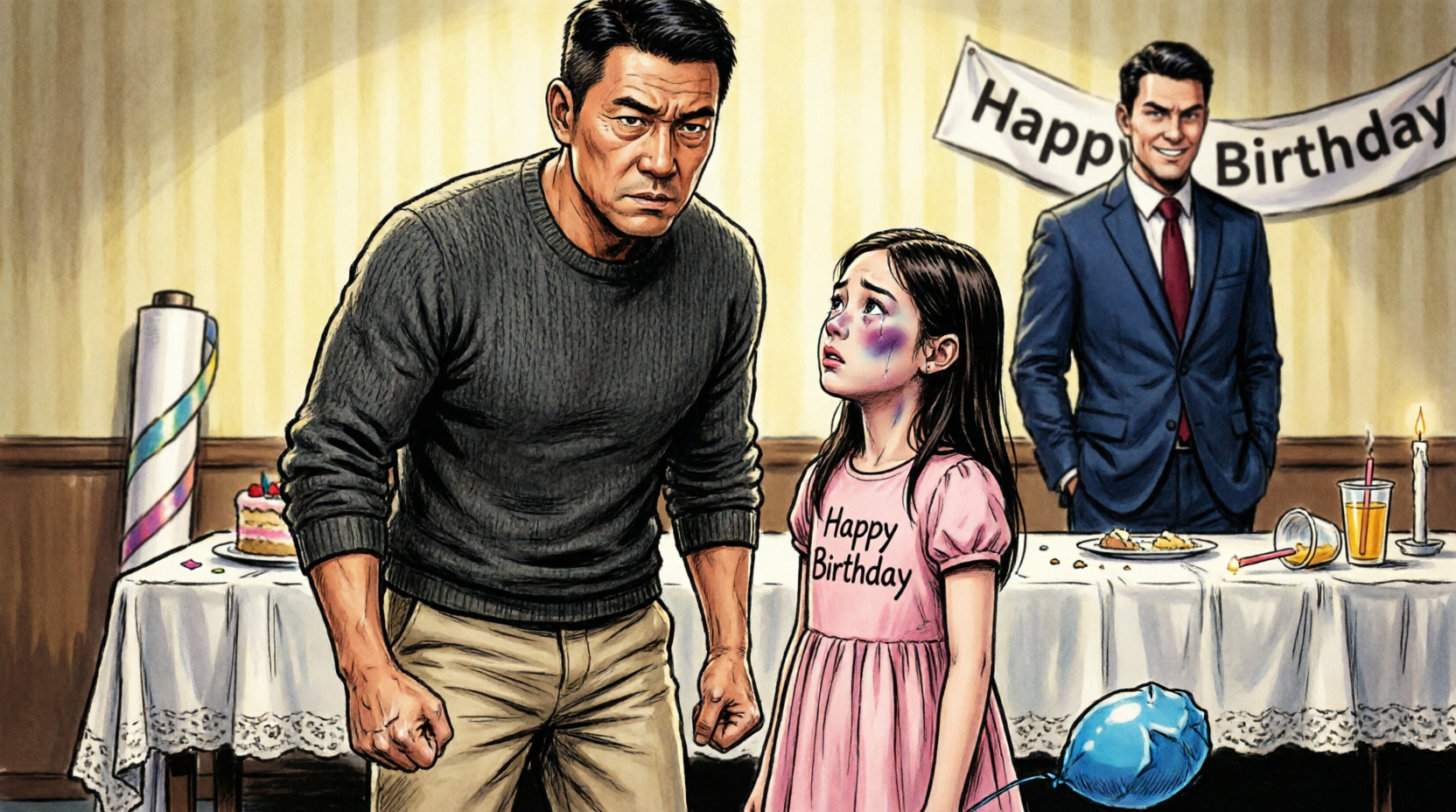 He only looked at him for a long moment, face still, eyes unreadable. Then he reached down to unclasp the silver watch from his wrist. It was a worn, simple watch with a scratched face and a brown leather band. He had worn it through oil changes, tax seasons, hospital waiting rooms, Little League games, and every birthday I could remember. He placed it carefully beside the bakery box. Then he rolled up the sleeves of his blue button-down shirt. He did it slowly, with the same careful focus he used when fixing old engines in the detached garage behind my parents’ house. Fold. Press. Fold again. There was no hurry in him, and somehow that made the air in the kitchen feel tighter. Derek’s smile thinned. “Richard,” Linda said faintly, “now, let’s not make this bigger than it is.” Dad did not look at her. He turned toward me. “Emily,” he said, keeping his eyes on Derek, “step outside.” For a second, I could not move. My body had learned Derek’s moods so well that even with my father standing there, some part of me waited for permission from the man who had hurt me. That realization embarrassed me more than the bruises. It made heat crawl up my throat. Then Dad said my name again, softer this time. I put the paper plates down and walked toward the back door. The porch boards creaked beneath my bare feet. The morning air was cool enough to sting my skin. Across the fence, Mrs. Callahan’s maple tree was beginning to turn at the tips, the first burn of fall touching the leaves. A pickup truck rolled past out front. A dog barked twice, then quieted. The world continued with its errands and lawns and coffee runs while my whole life narrowed to the kitchen window above the sink. Through that window, I watched Derek stand too quickly. His chair scraped against the tile. Linda pushed herself away from the table. Her napkin fell to the floor. Her loyalty, which had seemed so firm whenever I needed help, suddenly became very flexible now that consequence had entered the room. Wanting no part of what was about to happen, she dropped down awkwardly and scrambled away from the table, bumping into a barstool as she hurried toward the hall. It was not graceful. It was not dignified. It was the first honest thing she had done in months. Then my father moved toward my husband. What happened next lasted less than a minute, but it changed the entire direction of my life.
Dad did not charge at him. He did not lose control. That would have frightened me less, somehow, because rage is easy to recognize. What I saw instead was colder. He crossed the kitchen with the deliberate step of a man who had already decided where the line was and who had crossed it. He grabbed Derek by the front of his gray sweater and drove him back against the wall hard enough to make the framed family photo beside the refrigerator rattle on its hook. It was a picture from two Thanksgivings earlier, Derek smiling with one hand on my shoulder, me wearing a green dress and a careful expression. In the photograph, we looked like a couple who hosted dinners and sent Christmas cards. On the wall beneath that photo, Derek’s confidence collapsed. “You hit my daughter?” Dad asked. Derek’s face changed. The lazy arrogance vanished first. Then the color. His hand rose to shove Dad away, but my father held him there with one fist twisted in the sweater. “Hey, man,” Derek said, voice cracking at the edges. “Calm down.” Dad pushed him back against the wall again, not harder, but with enough control to make Derek understand that he was not in charge. “You put your hands on my daughter,” Dad said, “and then joked about it in front of me?” From the porch, I pressed my palm against my chest and tried to breathe. I had never seen my father like that before. He was not a violent man. He was the man who fixed neighbors’ snowblowers for free, the man who brought casseroles to funerals, the man who said thank you to cashiers and waved school buses through at four-way stops. He had raised me to believe that decency was not weakness. For most of my life, I believed him. Then I married Derek, and little by little, Derek taught me to doubt almost everything I had been raised to know. The memories came in pieces, fast and sharp. The first time Derek broke my phone, he said it slipped from his hand during an argument. He bought me a newer one the next day and told me I should be grateful because most husbands would not do that. The first time he called me dramatic for crying, I apologized to him. The first time he gripped my wrist too hard at a neighborhood barbecue, he smiled at the couple standing across from us while his fingers pressed into my skin beneath the edge of my sleeve. Later, when the marks darkened, Linda told me marriage had rough patches and that a smart wife learned which subjects to leave alone. I learned. I learned not to ask about money while he was drinking. I learned not to laugh too loudly when other men were present. I learned to answer texts quickly, to keep my phone unlocked, to dress in ways that could not be criticized, and to treat his anger as weather that had to be survived rather than behavior that could be named. The night before my birthday, Derek had been drinking bourbon in the den while I decorated a small cake I had baked for myself because he had forgotten to order one. I had bought pink candles at the Dollar General near the highway and strawberries from the Kroger on Franklin Road. It was such a small thing, a woman putting together her own birthday because she wanted the day to feel like it still belonged to her.
When I reminded him that my parents were coming in the morning, Derek accused me of trying to make him look bad. “You love performing for them,” he had said from the doorway, glass in hand. “Poor Emily. Perfect Emily. Everybody feel sorry for Emily.” I told him I only wanted a calm morning. He said I was making him sound like a monster. I said I had not used that word. That was when he crossed the kitchen. One strike made my head turn. The second came after I stumbled into the counter and grabbed the edge of it to steady myself. Linda stood in the hall, holding her purse, and said, “You should stop provoking him.” By sunrise, I had convinced myself I could cover the marks. By eight, I had convinced myself I could get through the cake, the coffee, the conversation, and the polite birthday smiles. By nine, I had convinced myself that if I just kept everything quiet for one more day, I could think clearly tomorrow. Standing on the porch, watching my father hold Derek against the wall, I realized the most dangerous lie I had been living with was not that Derek loved me. It was believing I still had time to fix him. Inside, Derek tried to regain his voice. “Richard,” he said, swallowing hard, “this is between me and Emily.” Dad’s answer was steady. “No. It stopped being between you two the moment you decided she was something you could break.” Linda reappeared in the hallway, clutching her purse against her chest. “Everyone needs to calm down,” she pleaded. “This is a family matter.” Dad finally looked at her. “No,” he said. “This is a police matter.” Then he turned his head slightly toward the window. “Emily,” he called, “get your phone. Call 911.” My hand went to the pocket of my cardigan. The phone was there. I knew it was there because Derek had checked it that morning before my parents arrived. He always checked. Messages. Call history. Banking app. Email. He said married people did not keep secrets. What he meant was that I was not allowed to have privacy. For a moment, my fingers stiffened around the phone. Not because I doubted my father. Not because I thought Derek deserved another chance. It was shame that froze me. Shame that it had reached this point. Shame that my father had to see me like this. Shame that my marriage, which looked so respectable from the outside, had rotted so badly behind closed doors. Then Derek looked through the window directly at me. His eyes were full of something I had seen before but had never named honestly. Not frustration. Not stress. Not wounded pride. Hatred.
“If you do this,” he said, voice low enough that I almost read the words from his mouth more than heard them, “you’ll regret it.” That was the moment the fear inside me changed shape. It did not disappear. Fear does not leave just because you decide to live. It stayed in my chest, sharp and cold, but beneath it something else rose, clearer and stronger. I had spent years shrinking myself to fit inside Derek’s moods. I had apologized for his temper, for his spending, for his cruelty, for his mother’s excuses, for the broken glass and locked doors and mornings when I wore long sleeves in July. I was tired of being smaller than the truth. I opened the back door and stepped into the kitchen. My voice shook when I spoke into the phone, but I spoke. “My name is Emily Harper,” I said. “I need police at my house.” The dispatcher asked if I was safe. I looked at my father, still standing between Derek and me. “For the first time in a long time,” I said, “I think I might be.” The police arrived before the candles on my birthday cake were ever lit. Two cruisers pulled up to the curb, their lights reflecting red and blue across the front windows and the brass kick plate on the door. The neighbors noticed, of course. In our neighborhood, people noticed new mulch, unfamiliar cars, and who forgot to bring in their trash bins. Curtains shifted across the street. A man walking his golden retriever slowed near the mailbox before remembering he had somewhere else to look. Two officers came inside. One was a woman with dark hair pulled into a low bun and a voice that stayed calm without becoming soft. The other was a broad-shouldered man who asked Derek to step outside. Derek immediately tried to become charming. “It’s a misunderstanding,” he said. “My wife is emotional. Her father got worked up. Everybody’s overreacting.” The female officer looked at my face, then at him. “Sir,” she said, “step outside.” Linda found her courage again only when uniforms entered the room. She began talking too quickly, telling them Derek was under pressure at work, that couples argued, that Emily was sensitive, that birthdays made people emotional. The officer cut through every word. “Ma’am,” she said, “bruises are not a misunderstanding.” After that, Linda closed her mouth. One officer took Derek out to the porch while the other sat with me in the living room. I remember the strange details more clearly than the big ones. The blue thread coming loose on the arm of the couch. The smell of coffee gone bitter in the pot. The birthday balloons turning slowly under the ceiling vent. My father standing near the front window with his arms crossed, watching the cruiser as if he could keep me safe by looking hard enough. The officer asked what happened. At first, I told her only about the night before. Then she asked, “Has this happened before?” That question opened something. The words came slowly, then all at once. I told her about the first shove six months after our wedding, when Derek said I had blocked the hallway and he only moved me out of the way. I told her about the laundry room door he struck hard enough to leave a hole shaped like his fist. I told her about the cracked bathroom mirror, the lamp he threw last winter, the way he monitored my bank account and questioned every purchase over ten dollars. I told her how he called my office repeatedly if I did not answer his texts fast enough, how he once showed up in the lobby with flowers and a smile so everyone would think he was romantic instead of furious. Then I told her about the folder.
My hands shook as I unlocked my phone. Derek had looked through it so many times that hiding anything felt impossible, but I had learned to be careful. In my notes app, there was a list titled “Weekly Groceries.” Under the first few ordinary lines—milk, eggs, coffee, paper towels—was a locked section where I had stored photographs, dates, and short descriptions. Bruises on my ribs. A close-up of my wrist. The cracked mirror. The lamp base lying beside shattered glass. A screenshot of twelve missed calls in twenty minutes while I was in a meeting at work. A bank notification from the day he drained part of our joint savings and told me I should not ask questions I did not understand.
I hated that I had collected proof of my own life.
I was grateful that I had.
The officer took notes. She asked questions without making me feel like I was on trial. When my voice broke, she waited. When Linda interrupted from the doorway, the officer told her to sit in the dining room or step outside. Linda chose the dining room and cried into a napkin as if she were the wounded party.
By late morning, Derek was placed in the back of a police car.
He looked at me through the window before the cruiser pulled away. The expression on his face was not remorse. It was disbelief. He had built our marriage around the assumption that I would always absorb the consequence for both of us. Watching him leave, I understood that men like Derek do not fear causing pain nearly as much as they fear being named for it.
After the officers left, I expected to collapse.
Instead, I felt strangely steady.
Dad went to the kitchen and poured out the cold coffee. Then he washed the pot, measured fresh grounds, and started another one because practical love had always been his first language. Mom arrived twenty minutes later in the old navy cardigan she wore when she was worried. Her hair was still pinned badly on one side, as if she had left the house before the mirror finished with her. She wrapped a blanket around my shoulders even though the room was warm.
“Oh, Emily,” she whispered.
That was all she could say.
No one mentioned the birthday anymore. No one sang. No one lit candles. The strawberry shortcake stayed in its white box until evening, when Dad carried it to the car along with my overnight bag, my passport, my birth certificate, a folder of bank papers, and the few pieces of jewelry from my grandmother that I refused to leave behind.
I walked through the house once before leaving.
It surprised me how ordinary everything looked. The couch where Derek watched football on Sundays. The framed print we bought at a street fair in Nashville. The hallway table where I placed mail every afternoon. The bedroom where I had learned to sleep lightly. The bathroom mirror I had replaced myself after telling the hardware store clerk that we had dropped a shelf.
I thought leaving would feel dramatic.
It felt quiet.
Maybe freedom often does at first.
At my parents’ house, we ate the birthday cake at the kitchen table on paper plates, the same way we had when I was little. My mother cut small slices because none of us had much appetite. Dad set his watchless wrist beside his coffee mug and looked at the pale mark where the leather band usually sat.
My face ached. My chest hurt more. But for the first time in years, the silence around me did not feel like a trap.
It felt safe.
The weeks after that were not clean or easy. People like to imagine that once a person leaves, the story becomes simple. It does not. Freedom comes with paperwork. Court dates. Phone calls. Password changes. Nights when you wake up sweating because a car door closed somewhere down the block. Mornings when you miss the version of your life you thought you were building, even while knowing that version never truly existed.
I stayed in my childhood bedroom for almost two months. The walls were no longer lavender; my mother had painted them soft gray years earlier, but the view from the window was the same. The crabapple tree still leaned toward the driveway. The neighbor’s flag still tapped against its pole when the wind came in from the west. On trash days, the whole street still smelled faintly of cut grass and diesel from the sanitation truck.
I returned to work with makeup and a careful explanation about a family emergency. My manager, Megan, did not push. She simply closed her office door and said, “Tell me what you need.”
I cried then, harder than I had cried in front of the police.
Megan became one of the people who helped me remember that I was not disappearing. She brought soup. She sat with me while I changed passwords. She drove me to pick up a replacement debit card. She once stood in line with me at the county courthouse, both of us holding burnt coffee in paper cups, while I filed another document I never imagined needing.
The divorce stretched over several months.
Derek’s lawyer tried to make me sound unstable, vindictive, emotional. The words were chosen carefully, dressed in legal polish, but I recognized them. They were Derek’s words with a tie on. Emotional. Dramatic. Sensitive. Difficult. Ungrateful. Words that had been used to make my pain seem like a personality flaw.
But facts are stubborn things.
Photographs do not care whether you are well-liked. Medical records do not soften themselves to protect a family’s reputation. A police report does not vanish because someone’s mother cries in a courthouse hallway. Statements from neighbors, call logs, bank records, the hidden folder on my phone, the officer’s observations from that morning—all of it built a story Derek could not charm his way out of.
Linda called often at first.
She left messages that began with tears and ended with blame. She said Derek was lost without me. She said I was destroying his future. She said every marriage had private struggles and that decent women did not invite police into family matters. The last message she left before the protective order was issued was almost calm.
“You will regret humiliating him,” she said.
I saved that one too.
After the order, the calls stopped.
The quiet that followed was not empty. It was space. I filled it slowly.
I rented a small house on the other side of town, a white place with green shutters, creaky floors, and a front porch just wide enough for two chairs. The kitchen cabinets stuck in humid weather. The water heater made a knocking sound when it worked too hard. The backyard had a patch of stubborn weeds and one lilac bush that bloomed as if no one had told it the place had been neglected.
I loved it immediately.
Every bill came in my name. Every key belonged to me. No one checked my phone. No one questioned why I bought expensive coffee or why I left a lamp on in the hallway at night. I learned the small luxuries of being unobserved. I took long showers. I played music while making dinner. I let dishes sit in the sink until morning and discovered that nothing terrible happened. I bought curtains with tiny blue flowers because I liked them, and for the first time in years, liking something was reason enough.
Derek eventually agreed to a plea deal. I did not attend the final hearing. I had spent enough time making my life revolve around rooms he occupied. My attorney called afterward and told me it was done.
For several minutes, I stood in my kitchen with the phone in my hand and watched rain move across the small backyard.
I expected relief to arrive like lightning.
It came like weather clearing slowly.
A year after the birthday that began with bruises and police lights, I celebrated again.
This time, the house was mine. Megan brought balloons and hung them from the porch railing even though the wind kept pushing them sideways. My mother baked a strawberry cake from scratch and complained that the frosting was too soft, which meant it was perfect. A few friends came by with flowers, takeout, and the kind of conversation that did not require me to defend anyone. We ate off mismatched plates. Someone spilled lemonade near the sink. I laughed before reaching for a towel.
Then Dad arrived early, as he always did.
He stood in the doorway holding a small wrapped box.
For a second, I saw him as he had looked one year before, stepping into my kitchen with a cake and losing his smile. I saw the watch on the counter. I saw his rolled sleeves. I saw the moment he told me to step outside because he knew I needed someone else to stand between me and the life I had mistaken for marriage.
This time, he smiled.
“Happy birthday, sweetheart,” he said.
I opened the box at the kitchen table.
Inside was a silver watch. Simple, elegant, not flashy. The face was small and clear. The band caught the light from the window.
“For new beginnings,” Dad said.
I could not speak right away.
He fastened it around my wrist himself, the way he had tied my shoes when I was five and fixed the clasp on my prom necklace when I was seventeen. My mother turned away quickly, pretending to check the cake. Megan wiped at her eye and said something about allergies, though it was September and none of us believed her.
I wear that watch every day.
Not because my father saved me. That is not the whole truth. He helped. He stood where I could not stand yet. He reminded me what love looks like when it refuses to make excuses for harm. But the call was mine. The evidence was mine. The leaving, the filing, the rebuilding, the quiet mornings after nightmares, the signatures on courthouse papers, the small brave acts no one applauded—those were mine too.
Sometimes people ask why I stayed as long as I did.
They rarely mean to be cruel. Most ask because they want to believe they would have left sooner. They want a clean line between themselves and women like the woman I used to be. They want to believe there is a kind of person who ends up in a house like that, and another kind who never would.
The truth is more uncomfortable and much more ordinary.
Abuse rarely begins with a slap.
It begins with an apology that sounds sincere enough to believe. It begins with a joke that lands wrong, then a criticism disguised as concern. It begins with your friends becoming “bad influences,” your family becoming “too involved,” your clothes becoming “too revealing,” your happiness becoming “selfish.” It begins with embarrassment, isolation, and the slow erosion of what you believe you deserve.
Then one day you look in the mirror and barely recognize the person apologizing back at you.
I recognize her now.
She is gone.
In her place is a woman who locks her own front door at night and knows exactly where the key is. A woman who drinks coffee on her porch before work and watches the school buses pass. A woman who buys her own birthday cake when she wants one, not because no one remembered, but because she is allowed to choose sweetness for herself.
And every time the watch on my wrist catches the light, I remember the morning my father walked in carrying strawberry shortcake and saw the truth I had tried so hard to hide.
I remember the question he asked.
I remember the answer I was finally brave enough to give.
Most of all, I remember that sometimes freedom does not begin with a grand speech or a perfect plan. Sometimes it begins in a quiet American kitchen, beside a birthday cake no one has cut yet, when one person tells the truth and another person believes her.
Part 2: The Investigation
The house felt colder after the police left.
Emily sat at the kitchen table, staring at the stack of documents that had fallen from Derek’s jacket. Her untouched birthday cake sat nearby, the pink frosting suddenly looking strange and unreal.
Her father stood beside her.
“Sweetheart,” he said quietly, “we’re going to figure this out.”
But neither of them was prepared for what came next.
Three days later, Detective Sarah Mitchell arrived at Emily’s parents’ house.
She carried a thick brown folder.
The moment Emily saw it, her stomach tightened.
“Mrs. Harper,” the detective said, taking a seat across from her, “I need to ask you some questions about your husband.”
Emily nodded.
The detective opened the folder.
Inside were photographs.
Bank records.
Phone logs.
Search histories.
And one image that made Emily’s blood run cold.
It was a screenshot from Derek’s laptop.
A calendar.
Her birthday was circled in red.
Underneath were four words.
“Everything changes tomorrow.”
Emily’s hands began to shake.
“What does that mean?”
The detective exchanged a glance with Richard.
“We’re still investigating.”
That answer scared Emily more than any explanation.
The next discovery came a week later.
Detectives searched a storage unit Derek had rented under a different name.
What they found changed the entire case.
Inside were boxes of documents.
Cash.
Fake identification papers.
And dozens of photographs.
Not of strangers.
Of Emily.
Pictures taken without her knowledge.
At the grocery store.
Leaving work.
Walking her dog.
Even standing in her own backyard.
Some photos had dates written on the back.
Others contained notes.
Emily felt sick.
“He was watching me?”
Detective Mitchell nodded.
“For a very long time.”
Then she revealed something even worse.
Many of the photographs had been taken on days when Derek claimed to be out of town for business.
He had lied.
He had been tracking her.
Studying her routines.
Learning exactly where she would be and when.
That night, Emily couldn’t sleep.
Every creak of the house made her jump.
Every passing car made her look through the curtains.
For years she had believed Derek’s abuse came from anger.
Now she was beginning to understand something terrifying.
This wasn’t anger.
This was planning.
Two weeks later, the detective called again.
Her voice sounded different.
More serious.
“Emily, we need you to come to the station.”
The drive there felt endless.
When she arrived, Detective Mitchell placed a digital recorder on the table.
“We recovered deleted audio files from your husband’s phone.”
Emily frowned.
“What kind of audio files?”
The detective pressed play.
At first there was only static.
Then voices.
Derek’s voice.
And another man.
A private investigator.
Emily listened in horror as they discussed her daily schedule.
Her workplace.
Her routes home.
The times she visited her parents.
The times she was alone.
Then Derek said something that made the room spin around her.
Something that stopped her breathing completely.
“After her birthday,” Derek said on the recording, “none of this will matter anymore.”
The recording ended.
Silence filled the room.
Emily stared at the table.
“No…”
Detective Mitchell’s eyes softened.
“We believe your father arriving that morning may have interrupted whatever Derek intended to do next.”
For the first time, Emily understood the full truth.
The bruises on her face had not been the worst thing that happened.
They had been a warning.
A glimpse of something much darker.
Something that had been growing quietly behind Derek’s smile for years.
And somewhere in a jail cell, Derek now knew the police were finding everything.
Every lie.
Every secret.
Every plan.
But what Emily didn’t know…
Was that Derek had one final secret nobody had discovered yet.
A secret hidden inside a safe deposit box across town.
A secret connected to a woman who had disappeared three years earlier.
And the moment detectives opened that box, the entire case would explode into a national headline.
To be continued in Part 3…
Part 3: The Safe Deposit Box
Three weeks later, Emily was finally beginning to sleep through the night.
Not every night.
But some.
The bruises had faded. The divorce was moving forward. Derek remained behind bars while investigators continued building their case.
Then Detective Mitchell called at 6:12 on a Tuesday morning.
“Emily,” she said, “we found the safe deposit box.”
Emily sat upright in bed.
“What was inside?”
For several seconds, the detective didn’t answer.
When she finally spoke, her voice was tight.
“Can you come to the station?”
Emily knew immediately.
Whatever they found was bad.
Very bad.
An hour later, Emily sat across from Mitchell in an interview room.
A thick evidence folder rested on the table.
The detective opened it.
Inside were photographs.
Letters.
Newspaper clippings.
And a picture of a woman Emily had never seen before.
She looked about thirty years old.
Dark hair.
Green eyes.
Beautiful smile.
“Who is she?” Emily asked.
Mitchell slid the photograph closer.
“Her name was Rachel Collins.”
Emily waited.
The detective took a deep breath.
“She disappeared three years ago.”
A chill ran through the room.
Rachel had dated Derek before Emily.
Not seriously, according to friends.
At least that’s what everyone believed.
The relationship lasted less than a year.
Then one day Rachel vanished.
Her car was found abandoned near a hiking trail.
No body.
No witnesses.
No answers.
The case eventually went cold.
Until now.
Inside Derek’s safe deposit box investigators found hundreds of pages related to Rachel.
Photos.
Private notes.
Copies of her bills.
Maps with locations circled in red ink.
Even a journal Derek had written.
Emily felt sick turning the pages.
The entries became increasingly obsessive.
Possessive.
Violent.
Then she reached the final entry.
The handwriting looked rushed.
Angry.
One sentence had been underlined three times.
“If I can’t control them, nobody will.”
Emily’s hands trembled.
“Dear God.”
But the worst discovery was still waiting.
Detective Mitchell removed another photograph.
This one showed a silver necklace.
A small heart-shaped pendant.
Rachel’s pendant.
The same pendant she was wearing the day she disappeared.
The same pendant police never recovered.
Until now.
Inside Derek’s safe deposit box.
The room became silent.
Emily suddenly understood why the detective had called her in personally.
This wasn’t a domestic violence case anymore.
This was something much larger.
Something darker.
Something that had possibly begun years before she ever met Derek.
That evening, news crews gathered outside the courthouse.
Reporters wanted answers.
Neighbors wanted answers.
Rachel’s family wanted answers.
And for the first time, investigators publicly announced they were reopening Rachel Collins’ disappearance.
National media picked up the story.
Derek Harper became the focus of a massive investigation.
Meanwhile, alone in his jail cell, Derek watched the evening news.
He saw Rachel’s face on television.
He saw detectives carrying evidence boxes.
He saw reporters discussing the safe deposit box.
And for the first time since his arrest…
Derek looked afraid.
Truly afraid.
Because he knew something investigators didn’t.
The safe deposit box was only one piece of the puzzle.
There was another location.
Another secret.
Hidden far outside town.
A place nobody had searched.
A place connected to Rachel.
And if police ever found it…
His life would be over forever.
To be continued in Part 4…
Part 4: The Hidden Property
Three days after the news broke, Detective Mitchell received an anonymous phone call.
The caller spoke for less than thirty seconds.
Then hung up.
But before disconnecting, he gave a single address.
A remote property nearly eighty miles outside the city.
The land belonged to a shell company.
The shell company traced back to Derek.
The next morning, investigators arrived.
The property sat deep in the woods.
Abandoned.
Silent.
A rusted gate blocked the entrance.
Tall grass swallowed the driveway.
The place looked forgotten.
But Detective Mitchell knew better.
Criminals rarely hide things where people are looking.
They hide them where nobody wants to look.
Search teams spread across the land.
Hours passed.
Nothing.
Then one of the officers found something unusual.
Fresh concrete.
A rectangular section behind an old barn.
It didn’t match the surrounding ground.
Mitchell felt her stomach tighten.
“Bring excavation equipment.”
The digging began.
Ten minutes later, workers struck metal.
Not a body.
Not a coffin.
A large steel storage container buried underground.
The lock was rusted but intact.
Everyone stepped back as it was opened.
Inside were dozens of boxes.
Financial records.
Hard drives.
Cash.
Fake passports.
And one black leather journal.
Every page was written by Derek.
As detectives read through it, the truth became horrifying.
For years Derek had secretly manipulated people around him.
Business partners.
Former girlfriends.
Employees.
Friends.
Anyone who challenged him became a target.
He tracked them.
Collected information.
Destroyed reputations.
Sometimes entire lives.
The journal wasn’t a diary.
It was a playbook.
Then investigators reached a section labeled:
RACHEL
The room fell silent.
Page after page described his obsession.
The entries became darker.
More disturbing.
More dangerous.
Then came an entry dated the week Rachel disappeared.
Detective Mitchell stopped reading aloud.
Her face turned pale.
Another detective looked over her shoulder.
“Oh my God…”
The journal described a meeting with Rachel at a remote lake.
An argument.
A threat.
Then several pages had been torn out.
Deliberately removed.
The missing pages covered the exact date Rachel vanished.
Police immediately returned to the lake.
Search divers entered the water.
Media helicopters circled overhead.
National news stations reported every update.
Emily watched everything from her living room.
Her hands shook as she held a cup of coffee.
Every new discovery made her realize how close she had come to becoming another victim.
Then came the breakthrough.
A diver found something buried beneath years of mud.
A purse.
Inside was identification.
Credit cards.
And Rachel Collins’ driver’s license.
The lake suddenly became a crime scene.
That night Derek was transferred to a maximum-security facility.
For the first time, prosecutors began discussing murder charges.
But Derek still refused to speak.
No confession.
No explanation.
Nothing.
Meanwhile, Emily tried to move forward.
She planted flowers in her backyard.
Started therapy.
Went back to work full-time.
Little by little, life began returning.
Until one evening, when someone knocked on her front door.
She wasn’t expecting visitors.
Through the peephole she saw an elderly man.
Gray hair.
Suit.
Briefcase.
A complete stranger.
When she opened the door, the man handed her an envelope.
“Ms. Harper?”
“Yes.”
The man swallowed.
“I was instructed to give this to you if Derek Harper was ever arrested.”
Emily froze.
“What?”
The man looked uncomfortable.
“I’ve been holding this letter for almost four years.”
Her heart pounded.
“Who are you?”
“I’m Derek’s former attorney.”
Silence.
The man pointed at the envelope.
“You need to read it.”
After he left, Emily sat alone at her kitchen table.
Slowly, she opened the envelope.
Inside was a handwritten letter.
At the top were six words that made her blood run cold:
If you’re reading this, I failed.
Emily stared at the page.
Then continued reading.
And what Derek revealed in that letter would change everything investigators thought they knew about Rachel Collins.
To be continued in Part 5…
Part 5: The Letter
Emily stared at the first line.
If you’re reading this, I failed.
Her hands trembled.
Outside, rain tapped softly against the kitchen window. The grandfather clock in the living room ticked loudly in the silence.
She continued reading.
Emily,
If this letter reaches you, it means something went wrong.
It means the police got involved.
It means somebody talked.
Or it means you finally stopped being afraid of me.
Emily felt sick.
Every word sounded exactly like Derek.
Cold.
Arrogant.
Certain.
Before you believe everything they tell you about Rachel Collins, understand one thing.
I didn’t plan for Rachel to disappear.
I planned for her to stay.
Emily’s heart stopped.
She turned the page.
Four years earlier.
Rachel Collins had discovered something.
A financial fraud scheme Derek had been running through several businesses.
Millions of dollars had been hidden.
Investors had been deceived.
Documents had been forged.
Rachel found evidence.
And she threatened to go to the authorities.
According to the letter, Derek begged her to stay quiet.
Rachel refused.
They agreed to meet at the lake.
The same lake investigators had recently searched.
The same lake where Rachel vanished.
I thought I could convince her, Derek wrote.
I thought she’d listen.
I was wrong.
Emily continued reading.
The argument became heated.
Rachel threatened to leave.
Threatened to expose everything.
Threatened to destroy him.
Then came a sentence that made Emily’s blood run cold.
She slipped.
At least that’s how it started.
Emily felt her pulse racing.
According to Derek, Rachel stumbled near the rocky shoreline.
She hit her head.
Fell unconscious.
For several minutes he believed she was dead.
Then she woke up.
Confused.
Injured.
Terrified.
And that’s when she saw the evidence Derek had brought with him.
The evidence that could send him to prison.
She said she was going to the police.
I knew my life was over.
The next paragraph ended abruptly.
Several lines had been scratched out with black ink.
Almost violently.
Emily could barely read them.
But one sentence remained visible.
“That’s when I made the worst decision of my life.”
Emily closed her eyes.
She already knew.
Even before reading further.
She knew.
The letter continued.
Rachel never left the lake.
Derek admitted it.
Not directly.
Not clearly.
But enough.
Far more than enough.
Tears filled Emily’s eyes.
Not because she loved Derek anymore.
Not because she felt sorry for him.
But because she suddenly understood something terrifying.
The man she married had not become dangerous.
He had always been dangerous.
She simply met him after he learned how to hide it.
Then she reached the final page.
And that’s when everything changed.
There is one thing the police still don’t know.
Rachel wasn’t the first.
Emily froze.
The room seemed to tilt around her.
She read the sentence again.
And again.
And again.
There was someone before Rachel.
Someone nobody ever connected to me.
Someone whose case was closed years ago.
Emily’s hands shook so badly she nearly dropped the letter.
Below the confession was a name.
A woman’s name.
One Emily had never heard before.
Olivia Mercer.
Underneath was a location.
An address.
And a date from almost ten years earlier.
Emily immediately called Detective Mitchell.
Twenty minutes later, detectives were racing toward the address.
Meanwhile, prosecutors reopened a decade-old death investigation that had once been ruled an accident.
But when investigators arrived at the location Derek listed…
They found something nobody expected.
Not evidence.
Not remains.
Not documents.
They found a woman.
Alive.
Terrified.
And carrying a secret she had been hiding for ten years.
A secret that could finally expose the full truth about Derek Harper.
To be continued in Part 6…
Part 6: The Woman Who Survived
Detective Mitchell’s team arrived at the address just before midnight.
The small farmhouse sat alone at the end of a gravel road.
One porch light glowed in the darkness.
Nothing seemed unusual.
Nothing seemed connected to Derek Harper.
Until the front door opened.
And a woman stepped outside.
She looked frightened.
Not surprised.
As if she had been expecting this moment for years.
“Are you Olivia Mercer?” Mitchell asked.
The woman nodded slowly.
Tears immediately filled her eyes.
“I’ve been waiting for someone to come.”
The detectives exchanged confused looks.
“Waiting for who?”
Olivia stared at the police cars.
“For the day Derek finally got caught.”
Silence.
Inside the farmhouse, Olivia told a story nobody expected.
Ten years earlier she had dated Derek.
Not long.
Only seven months.
But long enough.
Long enough to discover who he really was.
“He wasn’t violent at first,” Olivia explained.
“He was charming.”
“He remembered everything.”
“My favorite food.”
“My favorite songs.”
“My childhood stories.”
“He made me feel special.”
Emily listened through a speakerphone connection from Detective Mitchell’s office.
Every word sounded familiar.
Too familiar.
Then Olivia described the changes.
The criticism.
The jealousy.
The control.
The manipulation.
The monitoring.
The threats disguised as concern.
The isolation disguised as love.
It was almost identical to Emily’s marriage.
One night Olivia tried to leave.
That was when everything changed.
“He told me if I ever exposed him, nobody would believe me.”
She paused.
“He said he had already proven that.”
The room became quiet.
Mitchell leaned forward.
“What did he mean?”
Olivia’s face turned pale.
Then she stood up.
Walked to a closet.
And pulled out an old cardboard box.
Inside were newspaper clippings.
Police reports.
Photographs.
Court documents.
Ten years of evidence.
Evidence Olivia had spent a decade collecting.
Waiting.
Hiding.
Preparing.
Then she revealed the truth.
Years ago, Olivia reported Derek to police.
She reported stalking.
Threats.
Harassment.
Financial fraud.
Everything.
But Derek had money.
Connections.
A respected reputation.
The investigation went nowhere.
“After that,” Olivia whispered, “I disappeared.”
She changed cities.
Changed jobs.
Changed phone numbers.
Cut contact with nearly everyone she knew.
She spent ten years looking over her shoulder.
Ten years afraid Derek would find her.
Then she handed Detective Mitchell a photograph.
The moment Mitchell saw it, she stopped breathing.
The photo showed three women.
Olivia.
Rachel.
And another woman.
A woman nobody recognized.
“Who is she?” Mitchell asked.
Olivia swallowed hard.
“Her name was Hannah.”
“Was?”
Olivia nodded.
“She’s dead.”
The room fell silent.
According to Olivia, Hannah dated Derek between Olivia and Rachel.
Only for a few months.
Then she died in what police ruled a tragic car accident.
Case closed.
End of story.
Except Hannah had told Olivia something days before her death.
Something she never forgot.
“If anything happens to me,” Hannah had said,
“Derek did it.”
A chill spread through the room.
Three women.
Three separate cases.
Ten years.
One man.
Suddenly Derek Harper no longer looked like an abusive husband.
He looked like something far worse.
Meanwhile, inside his prison cell, Derek received news that detectives had located Olivia.
For the first time since his arrest, prison guards noticed something unusual.
Derek stopped eating.
Stopped sleeping.
Stopped talking.
Because Olivia possessed something he feared more than prison.
More than evidence.
More than witnesses.
A recording.
A recording Derek believed had been destroyed years ago.
A recording that captured a conversation he never expected anyone to hear.
A recording that could put him away forever.
And the next morning, Olivia finally handed it to the police.
To be continued in Part 7…
Part 7: The Recording
Detective Mitchell placed the recorder on the conference table.
Nobody spoke.
Olivia sat quietly in the corner, her hands clasped together.
For ten years she had protected this secret.
Now she was finally ready to let it go.
“This is the only copy,” Olivia said.
“I kept it hidden where nobody would ever find it.”
Mitchell nodded.
Then pressed play.
At first there was static.
The recording was old.
Damaged.
Barely audible.
Then voices emerged.
One belonged to Olivia.
The other belonged to Derek.
The conversation had been recorded during their final meeting ten years earlier.
The day Olivia ended the relationship.
The day she realized she was in danger.
“You think you’re leaving,” Derek’s voice said.
Calm.
Cold.
Controlled.
“But nobody leaves me.”
The detectives exchanged looks.
The recording continued.
Olivia’s younger voice sounded frightened.
“Derek, stop.”
“You’re scaring me.”
Then came a sound like glass breaking.
A chair scraping across the floor.
Heavy breathing.
And then the sentence that changed everything.
“You’ll end up like Hannah.”
The room froze.
Nobody moved.
Nobody breathed.
Mitchell immediately stopped the recording.
She rewound it.
Played it again.
“You’ll end up like Hannah.”
There was no mistake.
No misunderstanding.
No alternate explanation.
For years Hannah’s death had been considered a tragic accident.
Now detectives had a suspect threatening another woman with the victim’s name.
The investigation exploded overnight.
Old evidence from Hannah’s case was pulled from storage.
Boxes that had collected dust for years were reopened.
Forensic teams reexamined photographs.
Witness statements.
Vehicle reports.
Medical findings.
Everything.
And this time they noticed something investigators had missed a decade earlier.
A fingerprint.
One partial fingerprint recovered from Hannah’s damaged vehicle.
Too incomplete to identify back then.
But technology had advanced.
Now they had a match.
Derek Harper.
The news hit every major network.
Three women.
Three investigations.
One suspect.
Prosecutors immediately prepared new charges.
Meanwhile, Derek sat alone in an interrogation room.
For the first time, he asked for Detective Mitchell.
When she arrived, he looked different.
Older.
Smaller.
Less certain.
“You think you’ve won,” he said.
Mitchell remained silent.
Derek laughed bitterly.
“You still don’t know everything.”
“What don’t we know?”
His smile returned.
The same smile Emily remembered from years ago.
The smile that always appeared before he tried to hurt someone.
Then he leaned forward.
“There was someone else.”
Mitchell’s heart sank.
Another woman.
Derek nodded.
“A long time ago.”
“Who?”
For several seconds he said nothing.
Then he whispered a name.
Claire Morgan.
The room went silent.
Mitchell immediately checked the database.
Her blood ran cold.
Claire Morgan wasn’t dead.
She wasn’t missing.
She was a federal judge.
One of the most respected judges in the state.
And according to Derek…
She knew exactly who he was.
The next morning Detective Mitchell requested an emergency meeting with Judge Claire Morgan.
But when officers arrived at her home…
The front door was open.
The house was empty.
Her phone was inside.
Her car was in the driveway.
And on the dining room table sat a single envelope.
Across the front were four handwritten words:
HE FOUND ME AGAIN.
To be continued in Part 8…
Part 8: The Judge’s Secret
The envelope sat alone on Judge Claire Morgan’s dining room table.
Detective Mitchell stared at the four handwritten words.
HE FOUND ME AGAIN.
A chill ran through every officer in the room.
Claire Morgan wasn’t the kind of person who disappeared.
She was a federal judge.
Respected.
Powerful.
Careful.
Her entire career was built on control and preparation.
People like Claire did not leave their homes without telling someone.
Yet her phone remained on the kitchen counter.
Her purse was upstairs.
Her car sat untouched in the driveway.
There was no sign of a struggle.
No broken windows.
No blood.
Nothing.
Except one thing.
In her office, detectives discovered a hidden safe.
Inside were documents dating back nearly fifteen years.
And at the very bottom sat an old photograph.
The photograph showed a much younger Claire.
Standing beside a man.
A man smiling directly at the camera.
Derek Harper.
Mitchell felt her stomach drop.
The picture had been taken long before Olivia.
Long before Hannah.
Long before Rachel.
Long before Emily.
Claire had known Derek longer than anyone realized.
That afternoon a nationwide alert was issued.
Authorities searched airports.
Bus stations.
Hotels.
Train terminals.
Everywhere.
Then Claire called.
The call lasted only forty-seven seconds.
“I’m safe.”
“Judge Morgan, where are you?”
“I can’t tell you.”
“Why?”
Several seconds passed.
Then Claire whispered:
“Because if he finds out I’m talking, more people will die.”
The call ended.
Detective Mitchell immediately ordered the phone traced.
But Claire had already disappeared again.
Hours later investigators began reviewing the documents from Claire’s safe.
The deeper they looked, the worse things became.
Fifteen years earlier, Claire wasn’t a judge.
She was a prosecutor.
A young attorney assigned to a financial fraud case.
The main suspect?
A twenty-five-year-old Derek Harper.
Back then Derek had nearly gone to prison.
But the case collapsed.
Witnesses vanished.
Evidence disappeared.
Documents were mysteriously destroyed.
Everyone assumed Derek got lucky.
Now Claire’s notes revealed a different story.
Someone had helped him.
Someone powerful.
Someone connected.
For years Derek had protected that person’s identity.
Until now.
Hidden among Claire’s files was a single name.
A name so shocking that Mitchell had to read it twice.
Senator William Harper.
Derek’s father.
The room went silent.
Nobody had known.
Not the media.
Not prosecutors.
Not even Emily.
The senator had died eight years earlier and had been remembered as a respected public servant.
A man praised by newspapers.
Honored by charities.
Admired by voters.
But Claire’s evidence told a different story.
According to her investigation, Senator Harper had spent years covering up crimes committed by his son.
Threatening witnesses.
Influencing investigations.
Using political connections to make problems disappear.
And now Derek’s entire empire of lies finally made sense.
He had never believed consequences applied to him.
Because for most of his life…
They didn’t.
That night Emily sat in her living room watching the news.
The story had become national.
Reporters camped outside courthouses.
Television crews analyzed every detail.
Former associates came forward with accusations.
Then Emily received a text from an unknown number.
Just one sentence.
Ask Claire about the cabin.
Emily stared at the screen.
A second message arrived.
The cabin is where everything started.
Then the number went dead.
Police traced the message.
The signal originated from a prepaid phone.
One purchased three days earlier.
Inside the prison where Derek was being held.
But Derek had been locked in solitary confinement.
No phone access.
No visitors.
No communication.
Which meant someone else knew the truth.
Someone who had been helping Derek all along.
Someone still free.
And that person was now trying to send a message.
The next morning Claire Morgan finally agreed to meet investigators.
What she revealed about the cabin would uncover a secret buried for fifteen years.
A secret involving Derek.
His father.
And a crime so terrible that even Claire had spent years terrified to speak about it.
To be continued in Part 9…
Part 9: The Cabin
Claire Morgan arrived under federal protection.
Two black SUVs escorted her into a secure government building just before sunrise.
For fifteen years she had remained silent.
Now she was finally ready to talk.
Detective Mitchell placed a recorder on the table.
“Tell us about the cabin.”
Claire stared at the window for a long moment.
Then she closed her eyes.
“It started when we were nineteen.”
The room became silent.
Claire explained that Derek’s father, Senator William Harper, owned a remote hunting cabin deep in the mountains.
Officially, it was a family retreat.
Unofficially, it was where powerful people went when they didn’t want to be seen.
Politicians.
Businessmen.
Lawyers.
Wealthy donors.
No cameras.
No records.
No witnesses.
Every summer Derek accompanied his father there.
At first he was just a quiet teenager watching from the corner.
Learning.
Observing.
Listening.
Then one night something happened.
Something that changed him forever.
Claire swallowed hard.
“A girl died.”
The room froze.
Nobody spoke.
The recorder continued running.
A young woman named Rebecca Lawson had attended a party at the cabin.
She was twenty-one years old.
A college student.
Bright.
Ambitious.
Full of plans.
She never came home.
Her disappearance was reported.
Searches were conducted.
Newspapers covered the story for weeks.
But her body was never found.
The case eventually went cold.
Claire reached into her briefcase.
Slowly, she removed an old newspaper clipping.
The headline read:
LOCAL COLLEGE STUDENT STILL MISSING AFTER THREE MONTHS
Detective Mitchell felt her heart pounding.
“Are you saying Rebecca died at the cabin?”
Claire nodded.
“I know she did.”
“How?”
Tears filled Claire’s eyes.
“Because I was there.”
The room went completely silent.
Fifteen years earlier Claire had attended the same party.
She had seen the argument.
Seen Rebecca trying to leave.
Seen several powerful men trying to stop her.
And she had seen Derek.
Not participating.
Not helping.
Not stopping it.
Watching.
Learning.
Claire’s voice shook.
“That was the night he learned something.”
“What?”
“That powerful people don’t fear the truth.”
She paused.
“They fear witnesses.”
A chill spread through the room.
According to Claire, Senator Harper spent months making evidence disappear.
Witnesses changed statements.
Records vanished.
Investigations stalled.
Rebecca Lawson simply disappeared from public memory.
But Derek never forgot.
Because that night taught him a lesson he carried for the rest of his life:
If you have enough power…
You can make almost anything disappear.
Including people.
Detective Mitchell looked through the evidence Claire provided.
Old photographs.
Letters.
Statements.
Then she found something unexpected.
A photograph taken outside the cabin.
The image showed a group of people standing near a bonfire.
Most faces were familiar.
Senator Harper.
Several businessmen.
Young Claire.
Young Derek.
And one more person.
Mitchell’s eyes widened.
“No way.”
The man in the photograph wasn’t dead.
He wasn’t retired.
He was currently serving as Governor.
One of the most powerful politicians in the country.
The room suddenly felt smaller.
Because if Claire was telling the truth…
This case had just become bigger than Derek.
Much bigger.
That evening federal agents executed multiple search warrants connected to the cabin investigation.
News outlets exploded.
Political leaders denied involvement.
Lawyers issued statements.
And for the first time since his arrest…
Derek requested another meeting.
This time he looked exhausted.
Broken.
Defeated.
“I’ll cooperate,” he said quietly.
Mitchell stared at him.
“Why now?”
For several seconds Derek said nothing.
Then he looked directly at her.
“Because someone else is about to die.”
The room went silent.
“Who?”
Derek’s face turned pale.
“The person who sent Emily that text.”
Mitchell’s heart stopped.
“Who sent it?”
Derek leaned forward.
And whispered a name that nobody expected.
Emily’s father.
Richard Bennett.
To be continued in Part 10…
Part 10: The Truth About Richard Bennett
The interrogation room fell silent.
Detective Mitchell stared at Derek.
Surely she had heard him wrong.
“Richard Bennett?” she repeated.
“Emily’s father?”
Derek nodded slowly.
“He’s the one who sent the text.”
Mitchell’s jaw tightened.
“You’re lying.”
For the first time in years, Derek actually laughed.
Not arrogantly.
Not confidently.
Almost sadly.
“Check the prepaid phone.”
Mitchell immediately stood and left the room.
Within an hour, investigators were tracing every lead.
Every phone record.
Every purchase.
Every surveillance camera.
And Derek was right.
The prepaid phone had been purchased by Richard Bennett.
Mitchell sat in stunned silence.
Nothing made sense.
Richard was the hero.
The father who protected Emily.
The man who called the police.
The man who helped expose Derek.
Why would he secretly send messages?
Why hide it?
The next morning, Mitchell drove to Richard’s house.
Emily was already there.
Confused.
Scared.
Angry.
Her father sat quietly at the kitchen table.
The same kitchen where she had eaten birthday cake as a child.
The same table where he had comforted her after Derek’s arrest.
When Mitchell showed him the evidence, Richard didn’t deny it.
Emily stared at him.
“Dad?”
Richard looked down.
Then he whispered:
“I was trying to protect you.”
The room became silent.
“Protect me from what?”
Emily asked.
Richard slowly reached into a drawer.
He removed an old photograph.
Yellowed with age.
Edges worn.
The picture showed a group of teenagers standing outside a cabin.
Emily immediately recognized one face.
Young Derek Harper.
Then she noticed another.
Her father.
The blood drained from her face.
“No.”
Richard nodded.
“I was there.”
The cabin.
The party.
Rebecca Lawson.
Everything.
For a moment Emily couldn’t breathe.
“You knew?”
Tears filled Richard’s eyes.
“I never touched her.”
“Then why didn’t you tell anyone?”
Richard’s shoulders collapsed.
Because the answer had haunted him for fifteen years.
“I was a coward.”
The room fell silent.
Richard explained everything.
When he was twenty-one, he worked maintenance jobs for wealthy families during summers.
One of those jobs was at Senator Harper’s cabin.
On the night Rebecca disappeared, Richard witnessed the argument.
Witnessed the panic afterward.
Witnessed powerful men deciding how to cover everything up.
He wanted to go to police.
Then threats started.
Not against him.
Against his family.
Against his younger sister.
Against his parents.
And Richard backed down.
For fifteen years he carried the guilt.
Until Emily married Derek.
At first Richard didn’t recognize him.
Years had passed.
Derek looked older.
Different.
Then one Thanksgiving, Derek laughed.
A specific laugh.
A laugh Richard remembered from the cabin.
And suddenly he knew.
The boy from that night.
The boy who watched everything happen.
The boy who learned that powerful people could bury the truth.
Had become Emily’s husband.
Richard immediately tried to investigate.
Quietly.
Secretly.
He never told Emily because he had no proof.
Only memories.
Only fear.
Then the abuse began.
Richard suspected it.
But Emily kept protecting Derek.
Making excuses.
Hiding bruises.
Just like witnesses had hidden the truth years earlier.
And Richard saw history repeating itself.
The morning of Emily’s birthday changed everything.
The moment he saw her face…
He knew.
He wasn’t looking at bruises.
He was looking at the same silence that had protected Derek for fifteen years.
And he refused to let it happen again.
Tears rolled down Emily’s cheeks.
For a long moment nobody spoke.
Then Mitchell asked the question that mattered most.
“What aren’t you telling us?”
Richard looked terrified.
Because there was still one secret.
One final truth.
A truth so dangerous he had hidden it for fifteen years.
Slowly, he reached into his wallet.
Behind an old family photograph was a tiny storage key.
“I found this at the cabin the night Rebecca disappeared.”
The room froze.
“A storage locker?”
Mitchell asked.
Richard nodded.
“I was too scared to open it.”
“Until now.”
The key belonged to a locker untouched for fifteen years.
A locker rented under a false name.
A locker connected directly to Senator Harper.
And inside that locker was evidence capable of destroying powerful people.
Evidence that could finally reveal exactly what happened to Rebecca Lawson.
But as federal agents raced toward the storage facility…
They were already too late.
Because someone had broken into the locker just three hours earlier.
And security cameras captured only one thing.
A shadowy figure carrying a single evidence box out into the night.
To be continued in Part 11…
Part 11: The Evidence Box
Federal agents arrived at the storage facility just after dawn.
The manager was waiting.
Nervous.
Sweating.
Holding a set of security photos.
Detective Mitchell grabbed the images.
The first showed a hooded figure entering the building.
The second showed the same person opening the locker.
The third showed them leaving with a heavy black evidence box.
Then Mitchell stopped.
The fourth image showed the thief’s face.
And her blood ran cold.
It wasn’t a stranger.
It was Linda Harper.
Derek’s mother.
For a moment nobody spoke.
Emily stared at the photograph.
“No…”
But it was unmistakable.
Linda.
The woman who had spent years defending Derek.
The woman who looked away when Emily was abused.
The woman who insisted every problem was a misunderstanding.
She had known far more than anyone realized.
An arrest warrant was issued immediately.
But Linda had already disappeared.
Her house was empty.
Her phone turned off.
Her bank account drained.
Someone had warned her.
And investigators suspected they knew exactly who.
Derek.
Back in prison, Mitchell confronted him.
She dropped Linda’s photograph onto the table.
“Your mother took the evidence.”
Derek stared at the image.
Then something unexpected happened.
He smiled.
Not a cruel smile.
Not a victorious smile.
A terrified smile.
“You need to find her.”
Mitchell frowned.
“Why?”
For several seconds Derek said nothing.
Then he whispered:
“Because if she opened that box…”
He stopped.
Mitchell leaned forward.
“If she opened it, what?”
Derek’s face turned pale.
“She’ll know what my father did.”
The room fell silent.
Not what Derek did.
What his father did.
For the first time, Mitchell realized something.
Maybe Senator Harper wasn’t covering up a crime.
Maybe he committed it.
And maybe Derek had spent fifteen years protecting him.
The investigation changed direction immediately.
Meanwhile, Linda was driving north.
Alone.
Terrified.
The black evidence box sat on the passenger seat.
She had spent years defending her husband.
Then her son.
Then herself.
But now she needed answers.
By sunset she reached a remote motel outside state lines.
Locked herself inside.
And finally opened the box.
Inside were photographs.
Cassette tapes.
Financial ledgers.
Old police reports.
Witness statements.
And one videotape.
The label read:
CABIN PARTY – SEPTEMBER 14
Linda stared at it.
Her hands trembling.
She found an old television and VHS player in the motel office.
The owner let her use it.
At 8:17 PM she pressed PLAY.
The grainy footage flickered to life.
People laughed.
Music played.
Young men drank around a bonfire.
Then the camera shifted.
A young woman appeared.
Rebecca Lawson.
Alive.
Smiling.
Linda watched.
Unable to breathe.
Minutes later the mood changed.
An argument started.
Voices rose.
People gathered.
Then someone stepped into frame.
Senator William Harper.
Linda froze.
The powerful politician was clearly visible.
Clearly angry.
Clearly arguing with Rebecca.
Then the footage captured something nobody expected.
Rebecca pulled documents from her purse.
Evidence.
Financial records.
Illegal payments.
Fraud.
Bribery.
Everything.
She threatened to expose him.
The Senator’s face changed.
The camera shook.
Someone shouted.
And then—
The footage cut abruptly.
Linda’s hands were shaking so hard she nearly dropped the tape.
But there was another tape.
The label read:
PART 2
Slowly she inserted it.
The second tape began seconds later.
This time the camera angle was different.
Hidden.
Secret.
The footage showed chaos near the lake.
People yelling.
Running.
Then Rebecca appeared.
Trying to leave.
And someone grabbed her.
Linda leaned closer.
The picture sharpened.
Her heart stopped.
It wasn’t Senator Harper.
It wasn’t Derek.
It was someone nobody had ever suspected.
Someone still alive.
Someone still powerful.
Someone currently serving as Governor.
The same man from the photograph Claire had shown investigators.
Linda gasped.
And at that exact moment, a loud knock echoed against her motel door.
Three slow knocks.
Then a voice.
“Mrs. Harper…”
Silence.
“We know you have the tapes.”
Linda’s blood turned to ice.
Because she recognized the voice immediately.
The Governor himself.
To be continued in Part 12…
Part 12: The Governor’s Visit
The motel room became silent.
Linda Harper stood frozen beside the television.
The videotape was still spinning.
The image of the Governor remained paused on the screen.
Outside, rain hammered against the windows.
Then came another knock.
Three slow knocks.
Patient.
Confident.
Dangerous.
“Mrs. Harper,” the voice called again.
“We only want to talk.”
Linda’s heart pounded so hard she thought she might collapse.
For years she had protected powerful men.
First her husband.
Then her son.
She told herself loyalty was love.
She told herself silence was survival.
Now she understood the truth.
Silence had simply made her an accomplice.
The doorknob moved.
Once.
Twice.
Then stopped.
The Governor spoke again.
“You have something that belongs to me.”
Linda looked around desperately.
There was no escape through the front.
No escape through the bathroom window.
No time to call police.
Then she remembered something.
The motel office.
A young employee sat downstairs.
A college student working the night shift.
If she could reach him…
The lights suddenly went out.
Darkness swallowed the room.
Linda gasped.
Someone had cut the power.
Outside, thunder rolled across the sky.
Then came the sound of breaking glass.
Not from the front.
From the bathroom.
Someone was coming in.
Linda grabbed the evidence box.
Clutched it against her chest.
And ran.
She burst through the motel room door.
Sprinting down the hallway.
Barely breathing.
Behind her came shouting.
Footsteps.
Heavy footsteps.
Not one person.
Several.
The Governor hadn’t come alone.
Linda reached the stairwell.
Raced downstairs.
And nearly collided with the motel clerk.
“Call 911!” she screamed.
The young man stared in shock.
Then he saw the men entering the hallway above.
And immediately grabbed the phone.
Linda ran into the storm.
Rain soaked her clothes instantly.
She slipped across the parking lot.
Fell.
Got back up.
The evidence box nearly flew from her hands.
Then headlights appeared.
A black SUV.
It accelerated directly toward her.
Linda jumped aside.
The vehicle missed her by inches.
She hit the pavement hard.
The box burst open.
Photographs scattered across the wet asphalt.
Documents flew through the air.
Cassette tapes rolled beneath parked cars.
And one item slid directly beneath a streetlight.
A photograph.
Linda saw it.
The Governor saw it.
Everyone saw it.
The photograph showed something unmistakable.
Rebecca Lawson.
Alive.
Terrified.
Standing beside the lake.
And behind her stood three men.
Senator William Harper.
The Governor.
And Derek Harper.
All three together.
For fifteen years investigators believed Derek had merely witnessed what happened.
The photograph proved otherwise.
He had been there.
At the center of everything.
The Governor’s expression changed.
For the first time in decades…
He looked afraid.
Police sirens echoed in the distance.
Growing louder.
Closer.
The Governor turned toward his men.
“Get the box.”
But before anyone could move, another voice shouted from across the parking lot.
“Federal agents! Don’t move!”
Vehicles surrounded the motel.
Armed agents poured out.
Weapons drawn.
The Governor froze.
For a moment it seemed over.
Then he smiled.
A strange smile.
Almost relieved.
“You still don’t understand,” he said.
Detective Mitchell stepped forward.
“Understand what?”
The Governor looked at the photograph lying in the rain.
Then he said seven words that changed the entire case.
“Rebecca Lawson never died at the lake.”
The world seemed to stop.
Mitchell stared at him.
“What did you say?”
The Governor slowly raised his hands.
“You’re looking for a body that isn’t there.”
Silence.
Then he laughed.
A broken, exhausted laugh.
“Because Rebecca escaped.”
Everyone froze.
If Rebecca survived…
Then where had she been for fifteen years?
Why had she never come forward?
And who was buried in the unmarked grave investigators had recently discovered near the cabin?
As agents placed the Governor in handcuffs, he spoke one final sentence.
A sentence that left everyone speechless.
“Find Rebecca.”
He looked directly at Detective Mitchell.
“Before they find her first.”
To be continued in Part 13…
Part 13: The Woman Everyone Buried
The Governor’s words echoed in Detective Mitchell’s mind long after he was taken away.
“Rebecca Lawson never died at the lake.”
It changed everything.
Fifteen years of assumptions.
Fifteen years of investigations.
Fifteen years of lies.
The next forty-eight hours became a race.
Federal agencies reopened every file connected to Rebecca.
Every witness.
Every report.
Every lead.
Then they found something.
A mistake.
A very small mistake.
The kind people overlook for years.
In Rebecca’s original missing-person file was a bus ticket purchased three days after she supposedly died.
The ticket had never been investigated.
Why?
Because it was purchased under a different name.
A fake name.
But now investigators knew what to look for.
The trail led west.
Then farther west.
Across three states.
Through dozens of small towns.
Until it stopped in a quiet coastal community.
There, living under a different identity, was a woman named Sarah Reed.
Age thirty-six.
Teacher.
Volunteer.
Quiet life.
No criminal record.
No social media.
No photographs online.
And when agents knocked on her door, she opened it.
The moment Detective Mitchell saw her face, she knew.
Rebecca Lawson.
Alive.
For several seconds neither woman spoke.
Then Rebecca whispered:
“I knew this day would come.”
Tears filled her eyes.
Not tears of fear.
Tears of exhaustion.
She had spent fifteen years running.
Now she was tired.
Very tired.
Back in the interview room, Rebecca finally told her story.
Fifteen years earlier she had uncovered evidence of corruption involving Senator Harper, the future Governor, and several wealthy businessmen.
Millions of dollars.
Bribes.
Illegal contracts.
Money laundering.
She planned to expose everything.
The meeting at the cabin was supposed to be a confrontation.
Instead, it became a nightmare.
Rebecca revealed documents.
Threatened to go public.
And panic spread among the men.
An argument erupted.
Someone pushed her.
Someone grabbed her.
Someone shouted.
Then chaos broke out.
Rebecca managed to escape into the woods.
In the darkness she ran.
Fell.
Ran again.
Eventually she reached a road.
A passing truck driver picked her up.
She never went home.
Never called friends.
Never contacted family.
Because she knew something terrifying.
The people chasing her controlled everything.
Police.
Politicians.
Lawyers.
Money.
No matter where she went, they would find her.
So she disappeared first.
For fifteen years she lived as someone else.
And every day she expected them to come.
Then Mitchell asked the question everyone wanted answered.
“What happened after you escaped?”
Rebecca became quiet.
Very quiet.
Then she revealed the secret that shocked the room.
“There was another witness.”
Mitchell’s stomach tightened.
“Who?”
Rebecca looked down.
“A teenage boy.”
Silence.
“He was hiding near the lake.”
Mitchell felt her pulse quicken.
“What was his name?”
Rebecca swallowed.
“Derek Harper.”
The room froze.
According to Rebecca, Derek wasn’t an innocent observer.
He wasn’t merely watching.
He saw everything.
Every threat.
Every crime.
Every act of corruption.
And after Rebecca escaped…
Derek made a choice.
A choice that shaped the next fifteen years.
Instead of exposing the truth…
He joined them.
Protected them.
Learned from them.
Became one of them.
Emily sat in stunned silence when she heard the testimony.
Everything suddenly made sense.
Derek wasn’t born evil.
He had witnessed evil.
Then chosen it.
Again and again.
But Rebecca wasn’t finished.
“There was one more witness.”
Mitchell’s eyes widened.
“Another one?”
Rebecca nodded.
“He recorded everything.”
The room went silent.
“A recording?”
Rebecca slowly smiled.
“The original recording.”
Not a photograph.
Not a videotape.
A complete recording of the entire night.
The argument.
The threats.
The names.
Everything.
For fifteen years the recording had remained hidden.
Untouched.
Waiting.
And according to Rebecca…
Only one person knew where it was.
A man who had never appeared in any investigation.
A man nobody suspected.
A man now living quietly in Arizona.
The truck driver who saved her life.
And if that recording still existed…
It could destroy everyone involved once and for all.
But thousands of miles away, in a small desert town, an elderly truck driver had just received an unexpected visitor.
A visitor asking questions about Rebecca Lawson.
A visitor who arrived only hours after federal agents began searching for him.
A visitor carrying a handgun.
And when the old man opened his front door…
He immediately recognized the face.
Because standing there was Derek Harper’s younger brother.
A brother nobody knew existed.
To be continued in Part 14…
Part 15: The Chase for the Truth
The Arizona desert stretched endlessly before them.
Ethan Harper gripped the steering wheel.
Frank sat beside him, clutching the brass key.
Behind them, three black SUVs kicked up clouds of dust.
Getting closer.
Every minute.
“They’re gaining on us,” Frank said.
“I know.”
Ethan pushed the accelerator harder.
The truck rattled violently across the highway.
Miles away, Detective Mitchell sat aboard an FBI helicopter.
Her phone buzzed continuously.
Agents.
Federal prosecutors.
Washington officials.
Everyone wanted updates.
Because they all understood the same thing.
If Victor Kane got the recording first…
Fifteen years of truth would disappear forever.
But if Ethan reached the bank…
Everything would change.
The future of governors.
Judges.
Politicians.
Billionaires.
Entire careers.
All hidden inside one recording.
Meanwhile, Victor Kane sat in the back of a private jet.
Calm.
Collected.
Perfectly dressed.
To the world he was a respected Attorney General.
A man who built his reputation fighting corruption.
The irony almost made him smile.
His phone rang.
“They still have the key,” a voice reported.
Kane stared out the window.
“Then stop them.”
The call ended.
No anger.
No panic.
Just certainty.
For decades Victor Kane had solved problems.
And people were simply problems.
By noon, Ethan and Frank reached Phoenix.
The safety deposit box was located inside an old bank downtown.
The moment they parked, Ethan knew something was wrong.
The street looked normal.
Too normal.
A delivery truck sat across from the bank.
Three men stood near a coffee shop.
Another man pretended to read a newspaper.
But Ethan recognized them immediately.
Security operatives.
Watching.
Waiting.
“It’s a trap,” Frank whispered.
Ethan nodded.
Then he saw something else.
Federal vehicles approaching from the opposite direction.
Mitchell’s team.
For one brief moment, hope returned.
Maybe they could make it.
Maybe after fifteen years, the truth would finally survive.
Then the shooting started.
The first bullet shattered a storefront window.
The second struck a parked car.
People screamed.
Crowds scattered.
Chaos exploded across the street.
Victor Kane’s men weren’t trying to arrest anyone.
They were trying to eliminate the evidence.
And anyone carrying it.
Federal agents returned fire.
The city block became a battlefield.
Ethan grabbed Frank.
“Move!”
Together they sprinted toward the bank entrance.
Glass shattered behind them.
Sirens filled the air.
Frank stumbled.
At seventy-two years old, he couldn’t run much farther.
Ethan turned to help him.
And saw one of Kane’s men raising a rifle.
Directly at Frank.
Without thinking, Ethan shoved the old man aside.
The gun fired.
Pain exploded through Ethan’s shoulder.
He crashed to the ground.
Frank screamed.
“Ethan!”
Blood spread across Ethan’s shirt.
But somehow he was still conscious.
Still moving.
Still protecting the key.
Federal agents finally overwhelmed Kane’s team.
Several suspects surrendered.
Others fled.
Within minutes the shooting stopped.
Mitchell rushed across the street.
She found Ethan sitting against a wall.
Pale.
Bleeding.
Barely awake.
“The key,” he whispered.
Frank handed it over.
Mitchell stared at the small brass key.
Fifteen years.
Dozens of victims.
Countless lies.
All leading to this moment.
Inside the bank vault, agents located the safety deposit box.
The manager unlocked it.
Everyone held their breath.
Slowly the lid opened.
Inside sat a single cassette tape.
Nothing else.
No money.
No documents.
No photographs.
Just one recording.
The original.
Untouched for fifteen years.
Mitchell carefully lifted it.
And then noticed something written on the label.
A handwritten message.
Rebecca’s handwriting.
The message read:
“If you are hearing this, I survived.”
The room fell silent.
Back in Washington, Victor Kane received the news.
The recording had been recovered.
For the first time in thirty years…
Victor Kane looked afraid.
Because he knew exactly what was on that tape.
Names.
Dates.
Crimes.
Confessions.
Enough evidence to destroy everyone involved.
Enough evidence to send powerful people to prison.
Enough evidence to reveal what truly happened at the cabin.
That night, under maximum security, technicians prepared the recording.
Federal prosecutors gathered.
FBI officials gathered.
Detective Mitchell gathered.
Emily sat beside her father.
Rebecca sat quietly across the room.
Everyone waited.
The tape was inserted.
The PLAY button was pressed.
Static filled the speakers.
Then a voice emerged.
Not the Governor.
Not Senator Harper.
Not Victor Kane.
A woman’s voice.
Rebecca Lawson.
And her first sentence made every person in the room freeze.
“If you’re listening to this recording, one of us is already dead.”
To be continued in Part 16…
Part 16: Rebecca’s Recording
The room was silent.
No one moved.
No one breathed.
The old cassette continued spinning.
Then Rebecca’s voice returned.
“If you’re listening to this recording, one of us is already dead.”
Emily felt a chill run through her body.
Across the room, Rebecca lowered her eyes.
She remembered making the recording fifteen years ago.
She remembered believing she would never survive the night.
The tape crackled.
Then Rebecca continued.
“My name is Rebecca Lawson.”
“Today’s date is September 14.”
“I am making this recording because I believe powerful people may try to kill me.”
Several federal prosecutors exchanged stunned looks.
The recording wasn’t just evidence.
It was a time capsule.
A witness speaking directly from the past.
Rebecca’s younger voice continued.
“The people involved are Senator William Harper, Victor Kane, Governor Michael Rhodes, and others whose names will follow.”
Pens immediately began moving.
Every word was documented.
Every name recorded.
Then came something nobody expected.
The tape contained the entire confrontation.
Voices.
Arguments.
Threats.
Confessions.
One by one, powerful men revealed themselves.
They discussed illegal payments.
Election fraud.
Money laundering.
Destroyed evidence.
Bribed officials.
Years of corruption.
Captured in their own voices.
Then the argument escalated.
Rebecca could be heard demanding answers.
Demanding accountability.
Demanding justice.
And then another voice entered.
A young voice.
Nervous.
Afraid.
Detective Mitchell froze.
“Wait…”
Emily looked toward her.
The room replayed the section.
Again.
The same young voice.
Not one of the politicians.
Not one of the businessmen.
Someone else.
Someone nobody expected.
Richard Bennett.
Emily’s father.
The room fell silent.
Fifteen years earlier Richard had been there.
Exactly as he claimed.
But the recording revealed something he never told anyone.
He had tried to stop them.
The tape captured him shouting.
“Leave her alone!”
Then sounds of fighting.
Furniture falling.
People yelling.
For the first time, Emily understood why her father carried guilt for so many years.
He hadn’t stood by doing nothing.
He had failed to save Rebecca.
And he never forgave himself.
Tears rolled down Richard’s face.
The tape continued.
Then came the moment.
The moment everyone had spent fifteen years chasing.
Rebecca could be heard running.
Branches snapping.
Heavy breathing.
People shouting behind her.
Then a gunshot echoed across the recording.
Everyone froze.
A second gunshot followed.
Then silence.
For several seconds there was nothing.
Only wind.
Then a voice.
Victor Kane.
Calm.
Terrifyingly calm.
“Find her.”
The room went cold.
“If she talks, we’re finished.”
That single sentence destroyed every defense Kane could possibly make.
Direct evidence.
Direct intent.
Direct involvement.
The case was over.
Or so everyone thought.
Then the final sixty seconds of the tape began.
Rebecca’s breathing slowed.
She sounded injured.
Exhausted.
And then she said something that shocked even her present-day self.
“There’s another file.”
The room froze.
Rebecca frowned.
She didn’t remember saying that.
The younger Rebecca continued.
“If anything happens to me, the second file goes to Project Atlas.”
Detective Mitchell looked up immediately.
“What is Project Atlas?”
Nobody knew.
Not Rebecca.
Not Richard.
Not federal prosecutors.
Not even FBI officials.
The tape ended.
Click.
Silence.
The entire room sat motionless.
After fifteen years they finally had the truth.
But now they had a new mystery.
Project Atlas.
Whatever it was, Rebecca believed it was important enough to mention moments before she thought she might die.
Hours later investigators searched every document recovered from the case.
Every computer.
Every bank record.
Every archive.
Finally they found a reference.
One encrypted file.
Hidden in records connected to Victor Kane.
The file carried a single label.
ATLAS.
And according to the timestamp…
Someone had accessed it just six hours earlier.
Which meant one terrifying thing.
Someone else was still out there.
Someone powerful.
Someone who knew the truth was coming.
Someone desperately trying to erase the last secret before investigators reached it.
And that person had just disappeared.
With the entire Atlas file.
To be continued in Part 17…
Part 17: Project Atlas
The discovery of the Atlas file changed everything.
For months, investigators believed they were uncovering the end of a conspiracy.
Instead, they had found the beginning.
Detective Mitchell stared at the encrypted file.
One word.
ATLAS.
Nothing more.
Federal cybercrime specialists worked through the night.
Breaking encryption.
Tracing access logs.
Following digital footprints.
At 3:42 AM they finally succeeded.
The file opened.
The room fell silent…………………To be continue to next part 👇👇

