“DNA Test: Raymond Hernandez is not Louis’s stepfather… he is his biological father.” I couldn’t keep reading. The piece of paper felt like it was burning my hands. Three months earlier, when Mr. Raymond started turning yellow, when I noticed he would get exhausted just climbing two steps, I took him to get a full medical checkup in secret. He thought it was just a routine evaluation. I also requested a DNA test because I had found a letter from my mother inside an old box. An unsent letter. A letter where she wrote: “Raymond, forgive me for letting Louis grow up believing he isn’t yours.” Since then, that document had lived in my drawer. Not because I doubted him. But because I was terrified to confirm that the man who bled for me hadn’t just been a father out of love, but also by blood, and that nobody had ever told him. I followed Mr. Raymond to the small neighborhood chapel, a humble little place near a street that smelled of sweet pastries, gasoline, and the coastal salt air. He sat on a concrete bench outside. He took off his cap. And he wept. Not like men who want to be seen. He wept quietly, curled into himself, covering his face with both hands, as if he were still trying his best not to bother anyone. I stood behind a tree, holding the envelope. My wife, Mariela, stepped out of the car behind me. She was furious. “Louis, if this was supposed to be a surprise, it came across as absolute cruelty.” I didn’t answer. Because she was right. I approached him slowly. “Dad.” Mr. Raymond lifted his head. He wiped his eyes quickly, embarrassed. “Don’t call me that right now, son. It only makes my shame break me more.” I knelt down in front of him. People were walking right past us. A woman with grocery bags, a teenager selling shaved ice, two kids running past in their elementary school uniforms. Savannah was still moving along, with its sticky heat and coastal humidity, while my entire world stood perfectly still on a concrete bench. “I can’t. I’m not giving you a single penny,” I repeated. He closed his eyes. “I already understand.” “No. You don’t understand.” I pulled the first sheet out of the envelope. “I’m not giving you a single penny because I’m not lending you anything. Because you aren’t going to sell candy to pay me back. Because you won’t owe me a single dime.” Mr. Raymond opened his eyes. I placed the medical order right in front of him. “The surgery is paid for in full.” He didn’t speak. He just stared at the paper. “What?” “Savannah Memorial Hospital. Admission is this Monday. I already spoke with the surgeon. The procedure, the pre-op tests, the medications, and the recovery are all fully covered.” His lips began to tremble. “Son…” “And you aren’t going back to that tiny room by the river either.” I pulled out the property deed. “I bought a small house in the coastal neighborhood of Tybee Island. It’s not a mansion. It has a yard, a spacious kitchen, two bedrooms, and it’s just a few blocks from the ocean. It’s completely under your name.” Mr. Raymond recoiled as if I had physically shoved him. “No.” “Yes.” “I can’t accept that.” “Of course you can.” “No, Louis. This is entirely too much.” I let out a joyless laugh. “Too much? And selling your own blood for my textbooks wasn’t too much? Eating plain bread so I could wear a clean uniform wasn’t too much? Sleeping sitting up outside the Greyhound station when I left for Georgia Tech wasn’t too much?” He covered his mouth. “I was just the man tasked with looking after you.” “No.” I unfolded the third sheet. The proof. The one that had terrified me. “You were my father.” Mr. Raymond sat completely still. So still that for a moment I thought he hadn’t understood. I placed the paper in his hands. He read the very first line. Then all the color drained from his face. “No.” His voice came out broken. “This can’t be.” “It is.” “Your mother…” “My mother knew.” He pressed the document tight against his chest. “No. She would have told me.” “She wanted to tell you.” I pulled out the letter. That one was truly old, with moisture stains and worn, heavy creases. I had found it in an old biscuit tin where my mother used to keep photos, receipts, and a lock of my baby hair. Mr. Raymond didn’t take it at first. He was afraid. So was I. “Read it,” I said.
He shook his head. “If I read it, she dies all over again for me.” “Then let her finally speak the truth.” Mariela sat down right next to us without saying a word. Mr. Raymond unfolded the letter with trembling hands. My mother’s handwriting appeared like a voice returning from a vast distance. “Raymond, Louis is yours. Please forgive me. When I found out I was pregnant, my family had already pressured me into marrying Ernest. They kept saying you had nothing to your name. He had a family title and a house. I was a coward. Later, Ernest walked out on us, and you stepped in to take care of the boy without ever knowing he was your own blood. Every single time Louis calls you ‘Mr. Raymond,’ it tears my soul apart. I wanted to tell you so many times, but I was terrified that you would hate me for robbing you of his first years.” Mr. Raymond let out a sound that wasn’t a sob or a cry. It was something far more ancient. A wave of grief twenty years late. “I knew it,” he whispered. I froze. “What?” He kept his eyes fixed on the letter. “Not with official papers. Not like this. But when I first saw you as a baby… you had my ears. Your hands. That exact way of sleeping with one fist clamped tight. Your mother told me never to ask questions. So I never asked.” “Why?” He looked up at me, his eyes overflowing. “Because if I asked and she told me no, it would have utterly broken me. And if she told me yes, maybe I would have harbored bitterness. I preferred to just love you without needing a permission slip.”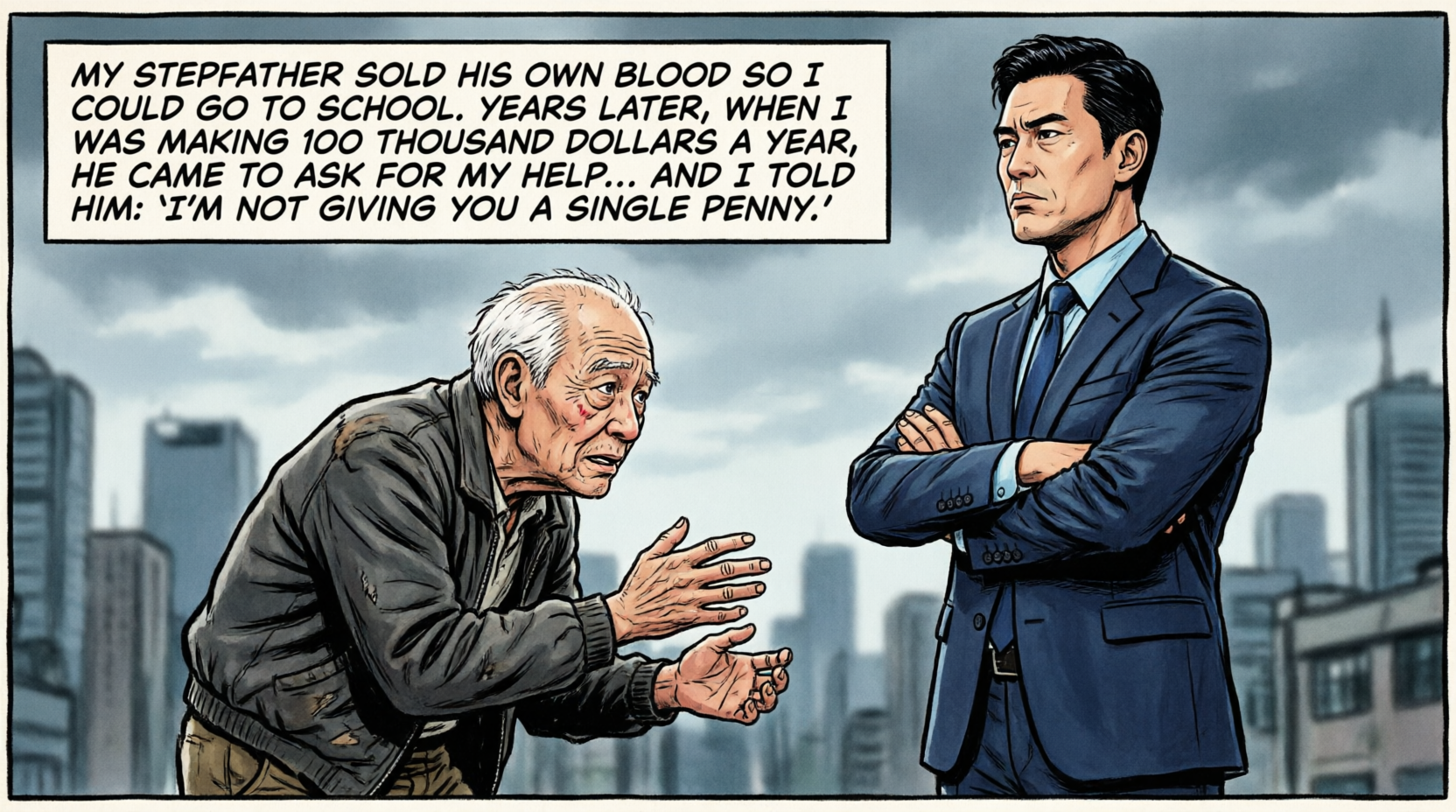
I couldn’t hold myself up anymore. I sat flat on the ground right in front of him. The man who had sold his own blood for me had known deep down his entire life that maybe I was his, and yet he had never once passed a bill to me for it. Not once. Not when I was a rebellious teenager and screamed at him that he wasn’t my real dad. Not when I left for Atlanta and would call him once a month, briefly, in a rush, as if his stories about the local market were a waste of my time. Not when I started making good money and felt embarrassed to invite him to my corporate events because his shoes were old and worn. How deeply ashamed I felt. What a wretched kind of poverty a person can hold inside, even while making a hundred thousand dollars a year. “Dad,” I said. This time, it wasn’t out of habit. It was the absolute truth. Mr. Raymond completely broke down. He pulled me into a tight embrace. I caught the scent of his old shirt, the sweat, the cheap soap, that sun-baked Savannah air he always carried on his clothes. And suddenly I was ten years old again, weeping for my mother, while he made me simple meals and pretended he wasn’t completely lost himself. “Forgive me,” I told him. “For what?” “For taking so long.” He gently stroked my hair. “You made it here, son. Men take a while to arrive at the places where they already belonged anyway.” Mariela was crying silently. Then she smacked me on the shoulder. “And don’t you ever play dramatic games with a sick elderly man ever again.” Mr. Raymond let out a laugh through his tears. “Your woman has some real fire in her.” “Way too much.” “Good. That way someone’s around to look after you whenever you act foolish.” We didn’t go back to the upscale apartment in Buckhead that day. We went down to the Savannah riverfront. Mr. Raymond said he wanted to take a walk before committing to any hospital bed. He walked slowly, one hand resting on my arm and the other holding his cap. The water was gray, moving with a heavy current, and the seagulls were fighting over scraps along the docks as if they had debts to pay too.
We passed families eating local snacks, tourists snapping photographs, elderly folks sitting on benches watching the container ships pass, and street musicians playing southern tunes for spare change. Mr. Raymond paused in front of a historic local coffee shop. “The day you got accepted into Georgia Tech, I wanted to bring you right here to celebrate with a proper southern breakfast,” he said. “But that day, I didn’t have enough on me.” My throat closed up. “Today we have more than enough.” We walked inside. We took a table right by the window. The waiter poured the hot coffee and steamed milk from high above, creating a small, beautiful foam—like a tiny ceremony. Mr. Raymond stared at the mug as if it were a luxury fit for kings. “You didn’t need to buy me a house,” he said. “Yes, I did.” “No.” “Dad, my entire life I lived in places that you paid for with your physical body. Now it’s your turn to have one that doesn’t cause you pain.” He went quiet. Then he asked: “And what if I die during the surgery?” Mariela squeezed my hand tightly. I took a deep breath. “Then you die knowing that your son finally read the absolute truth.” He offered a sad smile. “You turned out so dramatic.” “I get it from you.” “I’m not dramatic. I’m a coastal soul.” We laughed. And that laughter saved us a little bit.
The surgery took place on Monday. Mr. Raymond insisted on going in with a perfectly pressed shirt and polished shoes, as if he were entering a job interview. At the hospital, he apologized to the nurse for weighing so little, to the orderly for taking too long to get onto the gurney, and to the doctor for “causing trouble.” I wanted to scream to the entire world that this man was not causing trouble. This man had sustained a human life. Before entering the operating room, he motioned for me to come closer. I stepped in. “If something happens…” “Nothing is going to happen.” “Let me speak. If something happens, don’t you dare become arrogant. Money is good for paying hospital bills, but it’s a wretched thing if it makes you look down on someone who has dirty hands.” I felt the weight of the blow. “I know.” “No. You’re only just beginning to learn it.” He was right. “And one more thing,” he said. “What?” “Don’t you dare say I sold my blood with sadness. I sold it happily.” “How could you sell it happily?” “Because every single blood bag was a tiny piece of me arriving at the places I could never reach myself. To your textbooks. To your shoes. To college. To that corporate office in Buckhead where I wouldn’t even know how to park my car.” I leaned down and kissed his forehead. “I’m going to take you there.” “To park your car?” “To my office. To introduce you.” Mr. Raymond crinkled his nose. “And what am I supposed to say?” “The truth. That you were my very first investor.” He walked into the operating room laughing. I stayed outside for six hours. Six hours during which my salary, my car, my expensive watch, and my credit cards were completely useless. The only thing that mattered was waiting. Praying without knowing how to pray. Pacing from one wall to the other. Drinking terrible machine coffee. Staring at the double doors as if sheer willpower could force them open sooner. When the surgeon finally stepped out, I nearly collapsed. “The surgery was a complete success.” I didn’t cry elegantly. I wept like a child. Mariela held me tight. I thought of my mother. Of her letter. Of everything that silence had cost us. Mr. Raymond woke up the following day. The very first thing he muttered was: “Did you pay for the parking garage yet? Because those places rob you cleaner than the banks.” Mariela laughed. I took his hand. “Good morning, Dad.” He closed his eyes. Not out of pain, but to feel the absolute weight of that word. The recovery process was slow. Stubborn as a mule, he kept trying to get out of bed ahead of schedule. He insisted that sick people became permanently sick if you left them in bed for too long. The nurses adored him because he always made jokes, but they constantly scolded him because he kept trying to neatly fold his own hospital blankets.
When he was formally discharged, I didn’t take him back to the tiny room by the river. I drove him straight to Tybee Island. The house was painted a clean white, with blue shutters and a backyard where Mariela had already hung a hammock. In the kitchen sat fresh coffee, pastries, and a basket of local goods that a neighbor had dropped off as a welcome gift.
Mr. Raymond stopped right at the threshold. He wouldn’t cross it. “What’s wrong?”
He stared at the walls. “I’ve never held a key that didn’t belong to something rented.”
I pulled out the keyring. I placed it firmly in his hand. “Now you do.”
He closed his fingers slowly around them. “It’s under my name, you said.”
“Yes.”
“Why?”
“Because your entire life, you put my name before yours. It’s finally time to do it the other way around.”
He walked inside. He touched the dining table. The stove. The window frame. As if softly asking permission from every single object.
In the master bedroom, he saw a brand-new bed, a photo of my mother, and another one of the two of us, taken the day I left for college. Me holding a massive backpack. Him smiling wide, missing teeth, bursting with pure pride.
He sat down on the edge of the mattress. “My bones can rest here without needing to apologize.” That phrase broke me.
A few weeks later, I took him to Buckhead. We drove up through the financial district among towering glass skyscrapers, massive corporate offices, heavy traffic, and people walking around with ID lanyards and expensive coffee cups. Mr. Raymond stared at everything through the window as if we had crossed into a foreign country.
“This is where you work.”
“Yes.”
“It looks so cold.”
“It is.”
“They ought to sell local street food down at the entrance.”
“Sometimes they sell salads for twenty-five dollars.” He looked at me, utterly horrified. “And do they come on a gold plate?”
I introduced him around the office. My coworkers greeted him with immense respect. My boss came out to meet him because I had personally requested it. Mr. Raymond wore a clean white shirt, brown slacks, and his old patched shoes, even though I had bought him brand-new ones. “These ones know how to walk with me,” he had told me before we left the house.
Inside the corporate boardroom, in front of display screens, market charts, and executives who spoke of investment capital as if money were born clean, I stated: “This is Raymond Hernandez. My father. I was able to get an education because he sold his own blood to pay for my courses, my transit, my books, and my meals. So if anyone in this room ever claims that I am a self-made man, I will pack my things and walk out.”
Nobody spoke. Mr. Raymond lowered his gaze, bright red with embarrassment. Then he sheepishly raised his hand. “Don’t listen to him. The boy turned out incredibly dramatic.” Everyone laughed. But I watched my boss wipe a tear from his eye.
That afternoon, as we walked out, Mr. Raymond told me: “You didn’t need to say all that.”
“Yes, I did.”
“What for?”
“So they would hear it. So I could hear it myself.”
We walked down to a small café. He paused in front of a glass building. “Your mother would be so proud.”
I swallowed hard. “She would also be ashamed for not telling the truth.”
Mr. Raymond shook his head. “Your mother did things out of fear. That doesn’t make her a bad person. It just makes her human.”
“She robbed you of years.”
“And she left me with you.” I didn’t know how to respond to that. There are some people who love in a way that leaves you completely devoid of arguments.
Months later, we finalized the legal paperwork. Not because it was necessary for us to love one another, but because legal paperwork also has a way of healing when a lie has lived for far too long inside other people’s records.
At the government registry office, Mr. Raymond signed with a trembling hand. So did I. When we walked out, my birth certificate finally stated what my life had always known deep down:
Louis Hernandez. Son of Raymond Hernandez.
He stared at the official document. “Now you officially carry my last name.”
“I always carried it, Dad. We were just missing the ink.”
We went out to have a local seafood dinner near the harbor. Mr. Raymond ordered a massive plate of crab cakes, even though he wasn’t supposed to eat heavy meals. Mariela watched him like a hawk. “I saved myself from a major surgery,” he joked. “But not from a daughter-in-law.”
“Exactly,” she replied. He adored her. I did too.
With time, Mr. Raymond’s health truly began to stabilize. He didn’t become a young man overnight—nobody can reclaim what poverty permanently extracts from a physical body. But he walked along the beach in the mornings, waved to the neighbors, bought fresh bread from the bakery, bickered with the local fishmonger, and finally learned how to sit down without constantly searching for something to repair.
Sometimes I would find him sitting out on the patio, staring down at his hands. “What are you thinking about?”
“That these hands actually served a purpose.”
“They served an incredible purpose, Dad.”
“No. Just the right amount.” I stopped arguing with him. I would just sit right down beside him.
One afternoon, he handed me an old tin box. Inside were faded receipts, old bus ticket stubs, office supply stubs, my old report cards, a photograph of my very first high school uniform, and a slip from the blood bank.
“Why did you keep all of this?”
“Because when you have no money, you keep physical proof that at least your life’s sacrifice existed.”
I picked up the slip from the blood bank. It was incredibly old. Nearly faded to blank. “That one was for your very first computer science course,” he said softly. “The very first one.”
I remembered the bills smelling of the hospital. “Dad…”
“Don’t cry now. You loved that course so much.”
“It cost your physical blood.”
“And look at what it turned into.” He looked out at the house. The ocean. At me. “An excellent investment.”
I threw my arms around him. This time, he didn’t get uncomfortable. He hugged me right back.
Years later, when the illness eventually returned—because sometimes life collects its dues even if you’ve already paid everything in full—Mr. Raymond held no fear. He lay in his bed at the Tybee Island house, with the window propped wide open and the gentle sound of the ocean drifting inside. He held my mother’s rosary in one hand, and my hand in his other.
“Son,” he said quietly, “don’t spend your life counting debts of love.”
“I can’t help it.”
“Well, you’d better learn. I didn’t raise you so you could pay me back. I raised you so you would never abandon yourself.” He took a slow, shallow breath. “And don’t you ever tell an old man that you aren’t going to give him a single penny ever again. Even if you have a surprise waiting. It feels terrible.”
I laughed through my tears. “I really was an idiot.”
“A massive one.”
“I’m sorry.”
“I already forgave you back at the chapel steps.” He closed his eyes. Then he cracked them open one last time. “Say it for me again.”
I already knew exactly what he wanted to hear. I leaned in close. “Dad.”
He smiled. “There it is.”
He passed away at dawn. Without any shouting. Without any debts. Without a tiny rented room. He left with a home of his own, his name officially on my birth certificate, and a photo of my mother resting right by his side.
The day of the funeral, back in Savannah, the air smelled of salt and white lilies. Neighbors from the market showed up, mechanics, dockworkers, elderly women he had helped cross the street over the years, and young men whose bicycles he had repaired completely for free. I had always thought Mr. Raymond was a poor man.
I was completely wrong. He possessed a massive fortune of people weeping for him without him ever having asked them for a single thing.
When it was my turn to speak at the service, I pulled out that old slip from the blood bank. I held it high for everyone to see.
“My father sold his own blood so that I could get an education. Years later, he came to ask me for help, and I told him: ‘I’m not giving you a single penny.’” A murmur rippled through the pews. I took a deep breath.
“Because no decent son lends money to the person who gave them life. You return it with a home, with care, with your last name, and with your full presence. And even then, it is never enough.” I looked down at the casket. “My dad didn’t leave me millions. He left me something far more difficult: the absolute obligation never to forget where I came from.”
Today, I make far more money than that little boy from the room by the river could have ever imagined. I still work in Buckhead, moving between glass skyscrapers and long corporate meetings. But inside my private office, my university diploma doesn’t hang in the primary spot on the wall.
Instead, there hangs a photograph of Mr. Raymond, wearing his old cap, smiling wide in front of his house on Tybee Island. Beneath it, I placed a small silver plaque:
“Primary Investor. Down Payment: Blood.”
Every single time someone walks into my office and asks about it, I tell them the story. Not so that they will admire me, but to force myself to feel ashamed if I ever start to believe that I am a self-made man.
Because Mr. Raymond wasn’t my father by blood, everyone used to say. Then a piece of paper proved that he was. But the greatest truth of all wasn’t found in the DNA strands.
It was found in the crumpled bills. In the clean school uniform. In the simple meals served strictly to me while he claimed he wasn’t hungry. On the steps of a neighborhood chapel where he wept, believing his son had abandoned him. And in the key to a house where he could finally rest his bones without ever needing to ask for permission.
A father isn’t just the person who gives you life once. It’s the person who gives it to you over and over again, without ever passing a bill. Mr. Raymond gave me his in every single way possible. And I, though incredibly late, finally understood that there are some debts you can never pay back with pennies.
You pay them back by pronouncing a single word with your entire heart: Dad.
Part 2: The Legacy of Blood
Three months after Raymond’s passing, Louis still found himself reaching for his phone every morning.
Every day.
And every day, he remembered there was nobody left to call.
The house on Tybee Island felt strangely quiet without Raymond’s laughter echoing through the kitchen.
One rainy afternoon, Louis drove there alone.
The ocean waves crashed against the shore as dark clouds covered the sky. He unlocked the front door and stepped inside.
Everything remained exactly as Raymond had left it.
His cap hung beside the entrance.
His reading glasses rested on the coffee table.
His favorite mug sat next to the window overlooking the sea.
Louis slowly sat in Raymond’s old chair.
For a moment, he imagined hearing his father’s voice.
“Don’t sit there looking miserable, son. The ocean doesn’t stop moving just because someone’s gone.”
A tear rolled down his cheek.
Then his eyes landed on a small wooden box hidden beneath the chair.
He frowned.
He had never seen it before.
Inside were dozens of letters.
Each one had a date.
Each one was addressed to him.
The first letter was written when Louis was sixteen.
Son,
Today you yelled that I wasn’t your real father.
I pretended it didn’t hurt.
But after you left, I sat in the garage and cried.
Not because of what you said.
Because I was afraid one day you might actually believe it.
Louis covered his mouth.
His chest tightened.
There were more letters.
Dozens of them.
A lifetime of love hidden away.
Another letter.
Today you left for Georgia Tech.
You looked so confident.
Truth is, I was terrified.
The house feels empty already.
I keep walking into your room by accident.
I hope the world is kind to you.
If it isn’t, come home.
You will always have a place here.
Louis could barely breathe.
The tears wouldn’t stop.
Then he found the final letter.
The envelope was marked:
OPEN WHEN YOU MISS ME TOO MUCH
His hands trembled.
He opened it.
Inside was only one page.
One page that would change everything.
Louis,
If you’re reading this, then you’re hurting.
So listen carefully.
I don’t want to be remembered for dying.
I want to be remembered for living.
Promise me something.
Find a child who needs help.
The same way I helped you.
The same way someone once helped me.
Love has to keep moving forward.
Otherwise it dies with us.
Don’t build statues for me.
Build opportunities.
That will make me immortal.
Love,
Dad.
Louis broke down completely.
For the first time since the funeral, he understood.
His father’s story wasn’t supposed to end with grief.
It was supposed to continue through him.
The very next week, Louis created the Raymond Hernandez Scholarship Fund.
The first year, it paid for five students.
The second year, twelve.
By the fifth year, more than one hundred young people had attended college because of a man who once sold his blood to buy textbooks.
And then something extraordinary happened.
One afternoon, a young scholarship recipient knocked on Louis’s office door.
The boy was nervous.
His shoes were worn out.
His backpack was falling apart.
Louis instantly saw himself.
“Sir,” the boy said quietly.
“I just wanted to thank you.”
Louis smiled.
“You don’t need to thank me.”
“Yes, I do.”
The boy’s eyes filled with tears.
“Without this scholarship, I wouldn’t have had a future.”
For a moment, Louis couldn’t speak.
Because suddenly it wasn’t the boy standing there.
It was Raymond.
Still giving.
Still sacrificing.
Still changing lives.
Even after death.
Louis looked toward the photograph hanging on his wall.
The plaque underneath still read:
Primary Investor
Down Payment: Blood
And for the first time since losing his father…
Louis smiled.
Because he finally realized something.
Raymond Hernandez had never truly left.
His heart was still beating.
Inside every life he continued to save.
To be continued in Part 3…
Part 3: The Boy at the Bus Station
Ten years passed.
The Raymond Hernandez Scholarship Fund had become one of the most respected educational charities in Georgia.
Hundreds of students had graduated.
Doctors.
Engineers.
Teachers.
Nurses.
Every year, Louis attended the scholarship ceremony and told the same story.
The story of a father who sold his blood so his son could dream.
But one evening, after a ceremony in Atlanta, something happened that would change Louis’s life forever.
It was nearly midnight.
Rain poured heavily across the city.
Louis had just left a business dinner and was driving home when he noticed a teenage boy sitting alone at a Greyhound bus station.
The sight struck him immediately.
The boy couldn’t have been older than sixteen.
His clothes were soaked.
His backpack was torn.
And despite the cold, he wasn’t moving.
Everyone else rushed past him.
Nobody stopped.
Nobody looked.
Louis almost kept driving.
Then he remembered Raymond.
The night Raymond had slept outside a Greyhound station because he couldn’t afford a hotel while helping Louis leave for college.
Louis pulled over.
The boy looked frightened when Louis approached.
“Are you okay?”
The teenager immediately stood up.
“I’m fine.”
He wasn’t.
Louis knew that look.
Pride mixed with fear.
The same look Raymond used to wear.
“What are you doing here?”
The boy hesitated.
Then his eyes filled with tears.
“I got accepted to college.”
Louis froze.
The words hit him like lightning.
“That’s wonderful.”
The boy laughed bitterly.
“Not really.”
“Why?”
“Because I can’t afford to go.”
The teenager’s name was Daniel.
His mother had died two years earlier.
His father had disappeared long before that.
He worked at a grocery store after school.
Despite everything, he had earned excellent grades.
A university had offered him admission.
But tuition, housing, and books were impossible.
Daniel had come to Atlanta hoping to find work.
Instead, he had run out of money.
Now he was stranded.
Alone.
Hungry.
Terrified.
Louis listened quietly.
When Daniel finished speaking, neither of them said anything.
Rain pounded the roof above them.
Finally Louis asked,
“What would you do if someone paid for your education?”
Daniel laughed.
“Nobody does things like that.”
“Answer the question.”
The boy looked away.
“I’d become an engineer.”
Louis felt goosebumps.
That had been his exact answer years earlier.
An hour later they sat in a diner.
Daniel devoured two burgers and a plate of fries.
Louis watched silently.
Because he remembered another man pretending he wasn’t hungry.
A man who always pushed food toward someone else.
When dinner ended, Louis reached into his wallet.
Daniel immediately shook his head.
“I don’t want charity.”
Louis smiled.
Neither had Raymond.
Neither had he.
Proud people often suffered the most.
“This isn’t charity.”
“What is it?”
Louis pulled out a business card.
It carried the name of the scholarship foundation.
Daniel stared.
Then stared again.
His eyes widened.
“No way.”
Louis nodded.
“Way.”
The boy looked completely stunned.
Three months later, Daniel became the newest recipient of the Raymond Hernandez Scholarship.
When his name was announced at the ceremony, the audience applauded.
But something unexpected happened.
Instead of walking directly to the stage, Daniel stopped.
He turned toward Louis.
Then he hugged him.
Right there in front of everyone.
The room fell silent.
Daniel whispered:
“You saved my life.”
Louis felt tears form instantly.
Because those words didn’t belong to him.
They belonged to Raymond.
Everything happening in that room existed because one poor man had refused to give up on a little boy years ago.
That night, after the ceremony ended, Louis drove to Tybee Island.
The ocean breeze was cool.
The stars filled the sky.
He sat beside Raymond’s grave.
For a long time, he said nothing.
Then he smiled.
“Dad, you were right.”
The waves rolled softly in the darkness.
“You said love has to keep moving forward.”
Louis looked at the moonlit ocean.
“And it still is.”
A gentle wind passed through the trees.
For the first time, it almost felt like an answer.
And far away, another young life was beginning to change—
just as Louis’s once had.
To be continued in Part 4…
Part 4: The Secret Raymond Left Behind
Five years later, Daniel graduated at the top of his engineering class.
The day he received his diploma, he called Louis before anyone else.
“I did it.”
Louis smiled.
“No. We did it.”
But deep inside, both men knew the truth.
Raymond did it.
The man had been gone for years, yet his sacrifices were still creating futures.
A few weeks later, Daniel visited Tybee Island.
Together, he and Louis walked to Raymond’s grave carrying fresh flowers.
Daniel knelt first.
“I never got to meet you,” he said softly. “But because of you, I have a life.”
Louis felt his throat tighten.
Sometimes the greatest people never meet the lives they change.
As they turned to leave, an elderly woman approached them.
She must have been nearly eighty.
She carried a small box wrapped in cloth.
“Are you Louis Hernandez?”
Louis nodded.
The woman smiled sadly.
“I’ve been looking for you.”
Her name was Mrs. Carter.
Years ago, she had worked at the blood bank where Raymond donated.
The moment she heard Raymond’s name at a local memorial event, she knew she had to find his son.
“I have something that belongs to you.”
She handed over the box.
Louis carefully opened it.
Inside were dozens of faded documents.
Old photographs.
Receipts.
Medical records.
And a worn notebook.
“What is this?”
Mrs. Carter wiped her eyes.
“Your father’s journal.”
Louis froze.
“Journal?”
“He wrote in it for almost twenty years.”
That night Louis sat alone in Raymond’s house.
The ocean wind drifted through the open window.
His hands trembled as he opened the first page.
The entry was dated twenty-three years earlier.
Today Louis started first grade.
He looked scared.
So I pretended I wasn’t scared either.
Louis smiled through tears.
Another page.
Louis got into a fight at school.
He says he was defending a smaller kid.
I should probably punish him.
But secretly I’m proud.
Another.
Louis called me “Dad” today by accident.
Then he quickly corrected himself.
I pretended not to notice.
Truth is, I cried after he left the room.
Louis stopped reading.
His vision blurred.
Every page carried the same thing.
Love.
Unconditional love.
Page after page.
Year after year.
Then he reached an entry written shortly before Raymond’s surgery.
And suddenly his heart stopped.
The doctors say I may not survive.
That’s okay.
My biggest fear isn’t death.
My biggest fear is that Louis still doesn’t know the truth.
Not that I’m his father.
He’ll discover that eventually.
The truth is that I never sacrificed anything.
Loving him was the easiest thing I ever did.
Louis covered his face and sobbed.
Then something fell from between the pages.
A folded document.
Different from everything else.
Older.
Much older.
The paper was yellow with age.
On the front was written:
“For Louis’s future.”
His pulse quickened.
He opened it carefully.
Inside was a bank certificate.
Louis stared in disbelief.
The account had been opened when he was only three years old.
Every few months Raymond had deposited tiny amounts.
Five dollars.
Ten dollars.
Twenty dollars.
Sometimes only one dollar.
Whatever he could spare.
For years.
Decades.
Louis began calculating.
The account had grown through interest.
The balance now exceeded $480,000.
His jaw dropped.
He checked again.
And again.
It was real.
A note was attached.
Written in Raymond’s handwriting.
Son,
If you’re reading this, then you found my emergency fund.
I started saving when you were little.
At first I thought it might help pay for college.
Later I hoped it might help buy a house.
Eventually you became richer than I ever imagined.
So now I know what this money is for.
Find people like us.
Spend every dollar helping them.
Don’t waste it on flowers for my grave.
I’d rather see it become somebody’s future.
Louis stared at the words.
Then he laughed and cried at the same time.
Even after death…
Raymond was still investing.
Still giving.
Still refusing to spend money on himself.
The next year, the Raymond Hernandez Scholarship Fund doubled in size.
Hundreds more students were accepted.
Then thousands.
The story spread across the country.
News outlets covered it.
Universities partnered with the foundation.
Donors contributed millions.
But whenever reporters asked Louis how it all started, he always gave the same answer.
“It started with a man who believed one child was worth more than his own comfort.”
One evening, years later, Louis sat on the porch of Raymond’s house watching the sunset.
Daniel sat beside him.
The ocean glowed gold.
The air smelled of salt.
Peace.
For a long time neither spoke.
Then Daniel asked:
“Do you ever stop missing him?”
Louis smiled sadly.
“No.”
The younger man nodded.
“I was afraid you’d say that.”
Louis looked toward the horizon.
“But something changes.”
“What?”
“The missing becomes gratitude.”
As the sun disappeared beyond the ocean, Louis imagined Raymond sitting beside them.
Wearing his old cap.
Laughing at one of his terrible jokes.
Proud.
At peace.
And somewhere deep inside, Louis knew something.
The blood Raymond gave had never stopped flowing.
It lived on in every student.
Every family.
Every dream.
Every future.
And the story was far from over.
To be continued in Part 5…
Part 5: The Promise
Twenty years after Raymond’s death, the Raymond Hernandez Foundation had become one of the largest educational charities in the Southeast.
More than ten thousand students had received scholarships.
Thousands of families had escaped poverty.
And every recipient knew the story of the man who sold his blood so a child could dream.
But Louis never imagined that one ordinary morning would reveal Raymond’s greatest miracle.
Louis was now sixty-two.
His hair had turned gray.
His corporate career was winding down.
Most days, he spent more time at the foundation than at the office.
One spring morning, his assistant entered carrying a folder.
“You have a visitor.”
Louis glanced at the schedule.
“I don’t.”
“You do now.”
A young woman stepped inside.
She looked nervous.
Maybe twenty-five years old.
She held an old photograph in her hands.
The moment Louis saw it, his heart skipped a beat.
The picture showed Raymond.
Much younger.
Standing beside an old pickup truck.
“Where did you get that?” Louis asked.
The young woman smiled.
“It belonged to my grandfather.”
Louis frowned.
“Your grandfather knew Raymond?”
The woman nodded.
“Actually…”
Tears appeared in her eyes.
“My grandfather said Raymond saved my mother’s life.”
Louis slowly sat down.
The woman introduced herself as Emily Carter.
Then she began telling a story nobody had ever heard.
Thirty years earlier, her mother had needed emergency surgery as a child.
The family had no money.
No insurance.
No options.
Doctors warned that without treatment, she would die.
The night before the surgery deadline, an anonymous donor paid the entire hospital bill.
Every cent.
The family never discovered who it was.
Until after her grandfather died.
Among his belongings was a note.
The donor’s name was written at the bottom.
Raymond Hernandez.
Louis stared in disbelief.
“No.”
Emily nodded.
“Yes.”
“He never told anyone.”
“He made my grandfather promise not to tell.”
Louis felt tears forming.
Even now.
Even after all these years.
Raymond was still revealing new acts of kindness.
“How much was the bill?” Louis asked.
Emily opened a document.
“$14,300.”
Louis nearly fell silent.
That amount represented months of Raymond’s income at the time.
Maybe more.
“Why would he do that?” Emily whispered.
Louis smiled sadly.
“Because that’s who he was.”
The young woman reached into her purse.
“I came here because there’s something else.”
She handed Louis another envelope.
Inside was a letter written by Emily’s mother.
A woman who was still alive because of Raymond.
Dear Mr. Hernandez,
You never met me after the surgery.
But because of you, I became a nurse.
I raised three children.
I watched them graduate.
I became a grandmother.
Every birthday I celebrate belongs partly to you.
One act of kindness created generations.
Thank you.
Louis couldn’t speak.
The room blurred through tears.
Because suddenly he understood.
Raymond’s legacy wasn’t measured in dollars.
Or scholarships.
Or houses.
It was measured in lives.
Entire family trees that existed because he cared.
That evening Louis drove to Tybee Island.
The ocean was calm.
The sky glowed orange and pink.
He sat beside Raymond’s grave.
Just like he had done hundreds of times.
“Dad,” he whispered.
The wind moved softly through the grass.
“You never told me.”
Of course there was no answer.
But Louis already knew what Raymond would have said.
“It wasn’t important, son.”
Louis laughed through his tears.
That was exactly what Raymond would have said.
Then he noticed something.
Nearby stood a teenage boy.
The boy looked nervous.
Lost.
Unsure if he should approach.
Finally he walked forward.
“Excuse me, sir.”
“Yes?”
The teenager swallowed hard.
“I’m one of the scholarship students.”
Louis smiled.
“That’s wonderful.”
The boy looked down.
“My mother said I should come here.”
“Why?”
The teenager’s voice broke.
“Because without Mr. Raymond, I wouldn’t exist.”
Louis froze.
The boy explained.
His grandmother had been one of the foundation’s first scholarship recipients.
The education she received had changed her entire family’s future.
That future eventually led to him.
Another life.
Another generation.
Another miracle.
Louis looked at Raymond’s gravestone.
Then back at the young man.
And suddenly he realized something incredible.
Raymond’s story wasn’t ending.
It never would.
Because every person helped by his sacrifice would help someone else.
And those people would help others too.
Like ripples moving forever across water.
As darkness settled over the ocean, Louis stood.
He placed his hand on the gravestone.
“Mission accomplished, Dad.”
The wind rose gently.
Almost like a blessing.
And somewhere beyond the waves, beyond memory, beyond grief—
the legacy of a father who gave everything continued to grow.
To be continued in Part 6…
Part 6: The Last Recording
Five years later, Louis was seventy.
His steps had slowed.
His hair was completely white.
But every morning, he still visited the Raymond Hernandez Foundation.
And every afternoon, he still drove to Tybee Island.
Some habits become part of a person’s soul.
One autumn evening, Mariela walked into his office carrying a small cardboard box.
“I found this in the attic.”
Louis looked up.
The box was dusty.
Old.
Forgotten.
Written across the top in faded marker were three words:
RAYMOND’S THINGS
Louis felt his chest tighten.
Even after all these years, finding something that belonged to his father still felt sacred.
That night they opened the box together.
Inside were old photographs.
A pocket watch that no longer worked.
A fishing license.
Several handwritten notes.
And at the very bottom…
A cassette tape.
Louis stared.
“A cassette?”
Mariela laughed softly.
“Remember those?”
Attached was a yellow note.
The handwriting was unmistakable.
Raymond’s.
If this old thing still works,
play it.
If it doesn’t,
ask a teenager.
They somehow know everything.
Louis laughed through tears.
Even decades later, Raymond could still make him smile.
The next day, Daniel helped convert the recording into a digital file.
They gathered together in Raymond’s old house.
Louis.
Mariela.
Daniel.
Several scholarship students.
A few foundation employees.
Nobody knew what was on the tape.
Finally Daniel pressed play.
Static crackled.
Then came Raymond’s voice.
Older.
Gentle.
Alive.
Louis immediately burst into tears.
He hadn’t heard that voice in years.
“Testing, testing.”
A pause.
Then laughter.
“Well, if you’re listening to this, I suppose I’m gone.”
Another pause.
“First of all, stop crying.”
Everyone in the room started crying harder.
“See? Nobody listens to me.”
Even through tears, people laughed.
Raymond continued.
“If Louis is there, I already know he’s making that ugly crying face.”
The room exploded with laughter.
Louis buried his face in his hands.
Then Raymond’s voice softened.
“Son, if you’re hearing this, then you lived longer than I did.”
A long silence followed.
“And that makes me happy.”
Louis couldn’t breathe.
“You know, people always thanked me for what I did for you.”
A chuckle.
“They never understood something.”
“I wasn’t sacrificing.”
“I was investing.”
The room became completely silent.
“Every hour I worked.”
“Every drop of blood.”
“Every dollar.”
“I wasn’t losing anything.”
“I was planting seeds.”
“And look at what grew.”
Louis covered his mouth.
Because suddenly he understood.
Everything.
The scholarships.
The families.
The generations.
The lives.
Raymond had never viewed love as an expense.
Only as an investment.
Then the recording continued.
“If the foundation still exists…”
“I have one last request.”
Everyone leaned forward.
“Don’t make it about me.”
Louis closed his eyes.
That sounded exactly like him.
“There are already enough statues in the world.”
“What we need are open doors.”
“If you want to honor me…”
“Find people everyone else ignores.”
“The quiet ones.”
“The tired ones.”
“The people sitting alone at bus stations.”
Daniel immediately started crying.
Because that had once been him.
Raymond’s voice continued.
“Those people are carrying entire futures inside them.”
“They just need somebody to believe it.”
Static filled the room.
For a moment everyone thought the recording had ended.
Then Raymond spoke one final time.
Very softly.
Almost as if he were sitting beside them.
“Louis?”
Louis looked toward the speaker.
“Yes, Dad.”
The room fell silent.
“Thank you for letting me be your father.”
The tape clicked.
And stopped.
Nobody moved.
Nobody spoke.
The ocean waves rolled outside the window.
The same waves Raymond had loved.
Finally, Daniel whispered:
“He changed the world.”
Louis looked at the photograph on the wall.
The old cap.
The warm smile.
The kind eyes.
And for the first time, he realized Daniel was wrong.
Raymond hadn’t changed the world.
He had changed thousands of worlds.
One person at a time.
That night, before leaving the house, Louis made a decision.
A decision that would become Raymond’s greatest legacy yet.
And it would begin with a phone call that arrived the very next morning…
To be continued in Part 7…
Part 7: The Promise That Reached the White House
The next morning, Louis arrived at the foundation expecting an ordinary day.
Instead, his assistant was waiting outside his office with tears in her eyes.
“You need to take this call.”
Louis frowned.
“Who is it?”
She shook her head.
“You’ll want to hear this yourself.”
A few moments later, Louis picked up the phone.
A calm voice greeted him.
“Mr. Hernandez?”
“Yes.”
“My name is Rebecca Morgan. I’m calling on behalf of a national education initiative.”
Louis listened politely.
Then the woman said something that made him freeze.
“We’ve been studying the impact of the Raymond Hernandez Foundation.”
Louis sat down slowly.
“What about it?”
“According to our research, over forty thousand lives have been directly transformed through your scholarships, mentorship programs, housing assistance, and educational grants.”
Louis closed his eyes.
Forty thousand.
The number felt impossible.
The caller continued.
“And because of that, we’d like to honor your father’s story at a national event in Washington.”
For several seconds Louis couldn’t speak.
All he could picture was Raymond folding hospital blankets because he didn’t want to inconvenience the nurses.
A man who apologized for existing.
A man who never believed he was important.
“Dad would hate this,” Louis muttered.
The woman laughed.
“That’s exactly why he deserves it.”
Three months later, Louis stood in a grand hall in Washington.
Politicians.
Educators.
Business leaders.
Journalists.
Thousands of people.
Everyone had gathered to celebrate lives changed through education.
But Louis wasn’t thinking about any of them.
He was thinking about a tiny rented room near a river.
When his name was announced, the audience stood.
A thunderous applause filled the hall.
Louis walked slowly to the stage.
His hands trembled.
Not because he was nervous.
Because he wished Raymond were there.
The host smiled.
“Mr. Hernandez, what would you like people to remember about your father?”
Louis stared at the crowd.
Then he reached into his pocket.
And pulled out the old blood-bank receipt.
The same one Raymond had saved all those years.
The room fell silent.
“My father never graduated from college.”
Silence.
“He never owned a company.”
Silence.
“He never became famous.”
Louis looked around the hall.
“But he believed that one child was worth sacrificing for.”
The audience listened carefully.
“Today, people call him extraordinary.”
Louis smiled.
“He wasn’t………………………….To be continue 👇👇