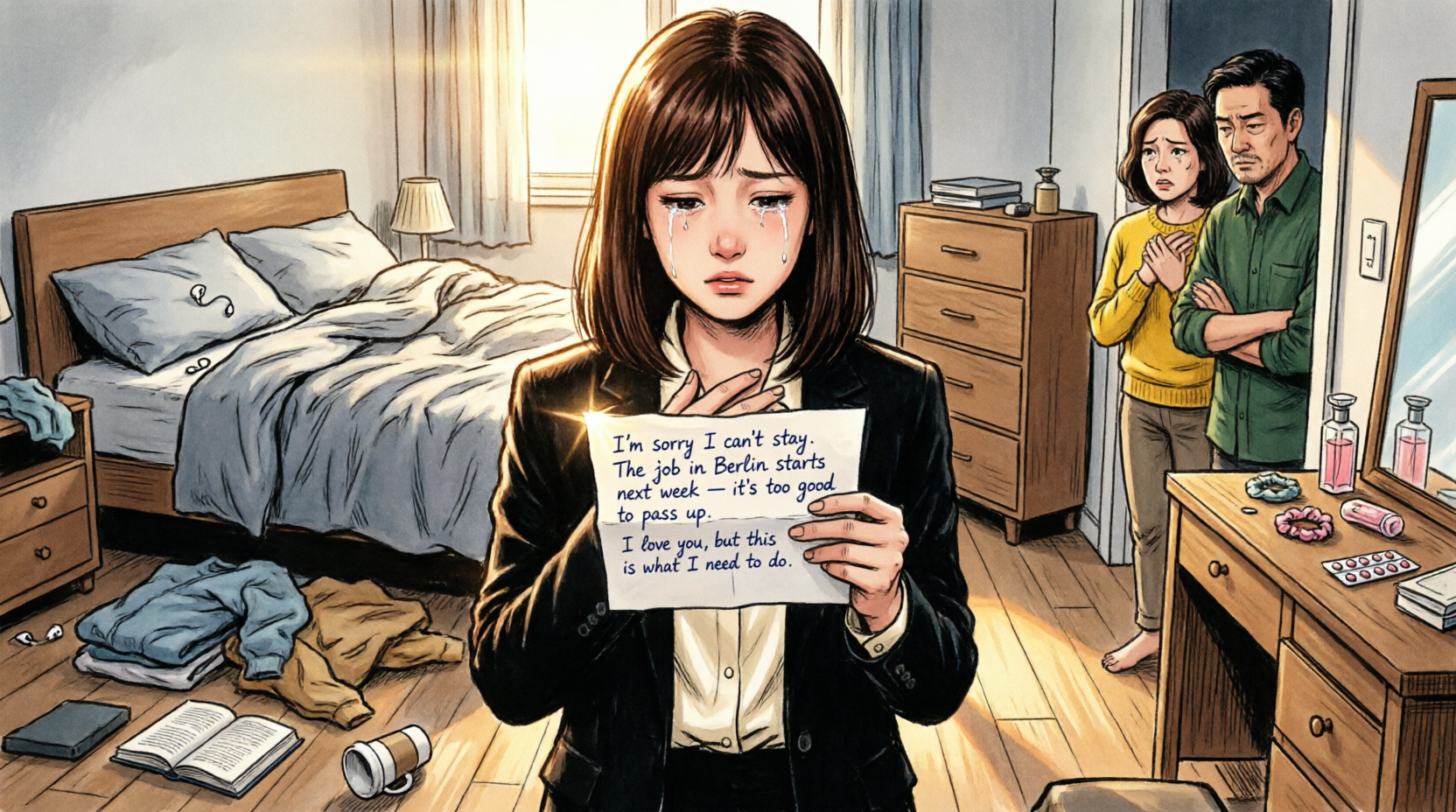
My 14-year-old daughter woke up to a note from my parents saying, “Pack your things and move out,” while I was abroad for work. We have to make room for your cousin. You’re not welcome. I gave this to them three hours later. My parents became pale. “What, wait? How…?
I was midway through a client presentation in Phoenix when my phone kept buzzing on the conference table.
I ignored the first call, then the second—but when Emma’s name flashed for the third time, a chill ran straight through me.
I excused myself, stepped into the hotel hallway, and answered.
At first, there was nothing but silence and soft, uneven breathing. Then Emma spoke in a voice so faint I almost didn’t recognize it.
“Mom… Grandpa and Grandma made me leave.”
I froze. “What do you mean?”
“They put my suitcase on the porch,” she whispered, fighting back tears. “And they left a note.”
I pressed my back against the wall so hard my shoulder banged into the framed fire escape map.
“Emma, where are you now?”
“I’m at Mrs. Donnelly’s next door. She saw me sitting out front.”
“Stay there. Don’t move,” I said. “Take a picture of the note and send it to me immediately.”
By the time the photo arrived, my hands were shaking. Written in my mother’s precise, blocky handwriting on one of her floral recipe cards were the words:
Pack your things and leave. We need the space for your cousin. You’re not welcome here.
For a long moment, my mind refused to accept what I was seeing.
Emma was fourteen. I had left her with my parents for only three nights while I attended a legal compliance conference out of state. Despite years of tension between us, I had never imagined they would actually hurt her.
I was wrong.
I called my mother immediately. She picked up on the fourth ring, annoyed.
“I’m busy, Claire.”
“Did you really throw my daughter out of the house?”
There was a pause.
“Don’t exaggerate,” she said. “Tyler needed the room.”
“My daughter is fourteen.”
“She can stay with a friend for one night,” my mother snapped. “Your sister’s in crisis, and Tyler has nowhere else. Family helps family.”
“Emma is family.”
Silence. Then my father took the phone.
“Don’t speak to your mother like that,” he said firmly. “We just made a temporary arrangement.”
“You left her on the porch with a note saying she wasn’t welcome.”
“It was just words,” he said. “You always overreact.”
Oddly, hearing that calmed me. The panic faded. The urge to argue vanished. What remained was clarity.
I hung up, called my attorney, and contacted Daniel Mercer, a former colleague now handling child welfare cases in Denver. By the time my flight was boarding, Emma was safely at Mrs. Donnelly’s, the note backed up in multiple places, and another message from my mother had arrived:
Don’t make a scene. Tyler needs stability. Emma can handle one night somewhere else.
One night somewhere else.
Three hours after landing, I walked into my parents’ living room with Emma at my side and a manila folder in my hands.
My mother looked irritated. My father confident. My nephew Tyler sat on the couch pretending not to notice.
I set the folder down.
They read the first page—and went pale.
My father looked up first.
“Wait… what? How is this possible?”
The first document was straightforward: an emergency guardianship petition I filed that afternoon because my daughter had been forced out while under their supervision. It included a formal incident report and a temporary no-contact request.
The second document was worse: a civil complaint drafted by my attorney citing negligence, emotional abuse, and unlawful interference with a minor’s care.
The third document shook my mother the most: the deed history of their house.
Technically, part of that house was mine.
Two years earlier, my grandmother had passed and left her estate in a trust my parents assumed would pass entirely to them. But the final amendment granted me a one-third ownership share—a detail they had overlooked or dismissed. She had added it after noticing how frequently my parents “temporarily” displaced relatives.
She had adored Emma.
She had never trusted my mother to make cruel choices seem reasonable.
I’d known about the clause for months.
I’d never planned to use it.
Until that day.
My father stared at the paper. “This can’t be right.”
“It is,” I said. “County records confirm it.”
My mother’s voice trembled with anger.
“You’re threatening your own parents over a misunderstanding?”
I almost laughed.
Emma stood quietly beside me, her backpack still slung over one shoulder, looking younger than fourteen. Seeing her like that made my anger flare hotter.
“You told my daughter to pack up and leave. You placed her suitcase on the porch and told her she wasn’t welcome. That wasn’t a misunderstanding—it was a decision.”
Tyler shifted uncomfortably.
“I didn’t tell them to do that,” he muttered.
“I know,” I said, keeping my gaze fixed on my parents.
My father dropped the documents on the table.
“What do you want?”
Not an apology. A negotiation.
“I want Emma’s things packed tonight,” I said. “Everything she brought. I want the spare key back. And I want written confirmation that neither of you will contact her directly without going through me.”
My mother sprang up, rattling the lamp beside her.
“You’d do this to your own parents?”
Emma spoke before I could.
“You did it to me first.”
Silence.
My father tried again.
“Claire, don’t make family disagreements into legal battles.”
“You made it legal when you expelled a minor while acting as her guardians.”
They said nothing. They didn’t know I’d already spoken to a family court clerk about minors forced out without parental consent. They didn’t know Mrs. Donnelly had written a statement. They didn’t know my mother’s text was already with my lawyer.
Eventually, my mother sank back into her chair.
“We were trying to help Tyler.”
“And you hurt Emma to do it,” I said.
That night, Emma and I left with her things.
In the car, she asked quietly, “They weren’t allowed to do that… right?”
I gripped the wheel.
“No,” I said softly. “They weren’t.”
For the first time all day, she exhaled and relaxed.
The months afterward were hard. My parents told relatives I had bullied them with lawyers over a misunderstanding. But the evidence told the truth: the note, the texts, Mrs. Donnelly’s statement, and Emma herself.
Eventually, a settlement was reached. My parents acknowledged their actions and agreed to no unsupervised contact with Emma for at least a year. They also bought out my one-third share of the house.
By spring, Emma had changed—more cautious, less trusting, but stronger.
That summer, we moved to a smaller apartment. Emma painted her room dark blue and hung a small sign on her bedroom door:
Still welcome here.
A year later, my mother mailed Emma a birthday card. Inside was one line:
We hope someday you understand we did our best.
Emma read it silently.
“What should I do with it?” she asked.
“Whatever gives you peace,” I said.
She thought a moment, fed it into the shredder, and returned to her homework.
The real ending wasn’t court papers or revenge.
It was Emma learning that being rejected by cruel people doesn’t make you unworthy of love—and my promise that no one would ever make her believe otherwise again.