The gravedigger beckoned me over to my mother’s burial and whispered, “Ma’am, your mom paid me to bury an empty coffin.” “Stop playing around,” I retorted. “Don’t go home,” he muttered as he quietly put a key in my hand. Proceed to Unit 16, correct?
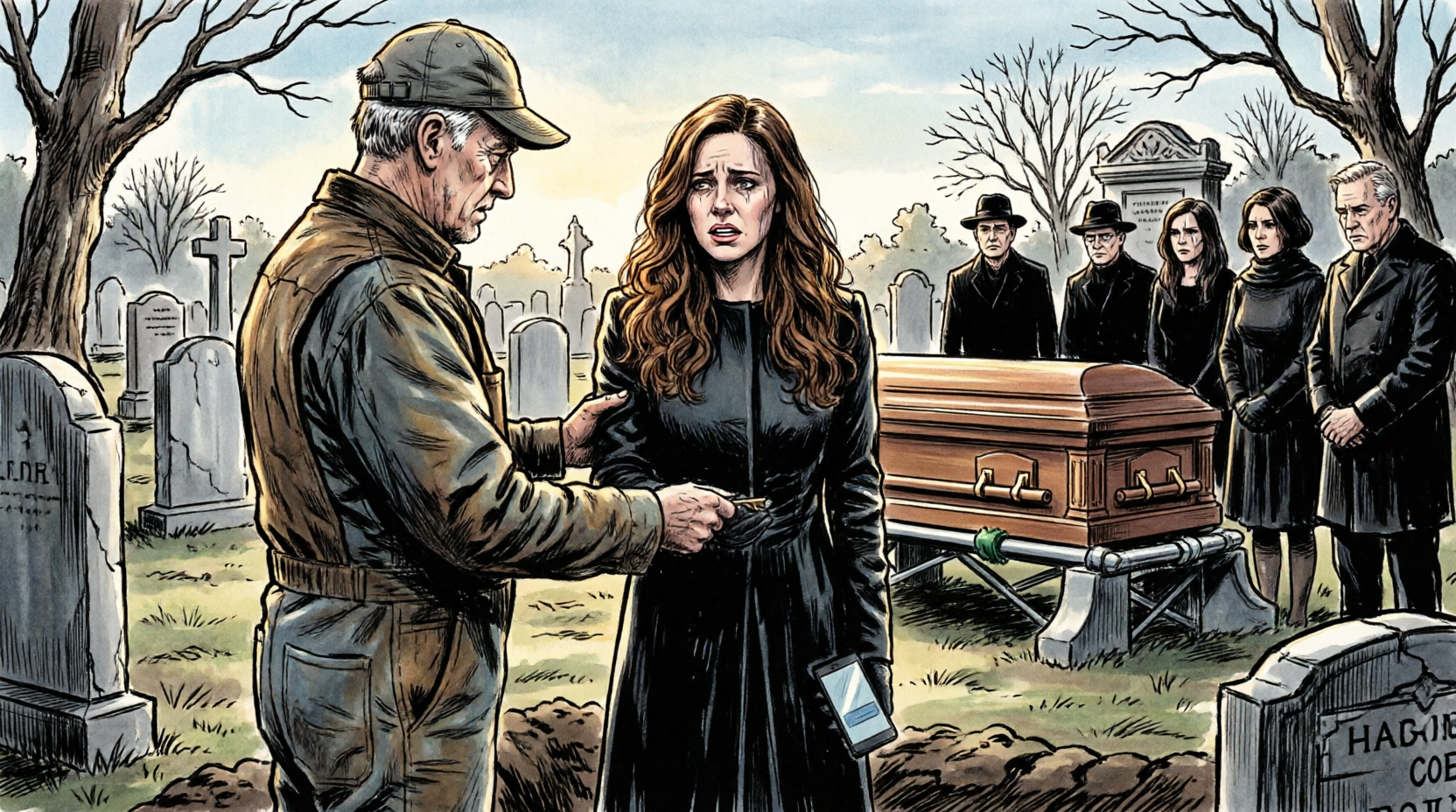
At my mother’s funeral, the last thing I expected was for the gravedigger to step quietly away from the crowd, remove his worn gloves, and gesture for me to come closer—as if we were about to discuss something deeply personal.
His name tag said Earl. His face looked weathered, older than the cemetery itself. When he spoke, his voice was low and careful.
“Ma’am,” he said, glancing toward the casket, “your mother paid me to bury an empty coffin.”
I blinked at him, certain grief had scrambled my hearing. “That’s not funny.”
Earl didn’t react. No smile, no hesitation. Instead, he pressed something cold into my palm.
A brass key.
A small metal tag dangled from it, stamped with the number: 16.
“Don’t go home,” he murmured. “Go to Unit 16. Now.”
Before I could ask anything else, my phone buzzed in my pocket.
I pulled it out—and felt my stomach drop.
A message from Mom lit up the screen.
Come home alone.
My mother had been dead for six days.
I had identified her body myself at St. Joseph’s. I had signed paperwork, answered questions, stood in front of relatives accepting condolences from people who told me she was “at peace now.” And yet her name was right there on my phone, as if nothing had happened.
When I looked up, Earl had already returned to the graveside. The pastor was speaking. My aunt Linda dabbed her eyes. No one seemed to notice anything unusual.
I should have said something.
Instead, I slipped the key into my purse, turned away from the service, and left before the first shovelful of dirt hit the coffin.
Unit 16 was in a storage facility on the edge of town—twenty minutes from the cemetery, quiet and nearly abandoned. A flickering sign read SAFELOCK STORAGE. Rows of identical metal doors stretched in both directions.
My hands trembled so badly I dropped the key twice before managing to unlock the unit.
The door creaked as I lifted it.
I froze halfway.
There were no boxes. No furniture. No forgotten belongings.
Inside sat a folding chair, a lantern, three large water containers, and a legal file box.
And on the chair—
My mother’s navy-blue handbag.
The same one she had supposedly been carrying the night she died.
An envelope was taped to it. My name was written across the front in her unmistakable handwriting.
For Emily. If you’re reading this, they lied to you first.
My fingers had just brushed the edge of the envelope when I heard it—
Tires crunching on gravel.
I spun around so fast my shoulder slammed into the metal door. A black SUV had pulled into the lane. It stopped a short distance away, engine still running, windows too dark to see inside.
For a second, I stood frozen—half inside the unit, half outside—holding the envelope like evidence I didn’t understand.
Then instinct took over.
I yanked the door down, slipped inside, and pulled it nearly shut, leaving only a thin strip of light at the bottom.
I waited.
A car door slammed.
Then another.
Footsteps approached slowly across the gravel.
I held my breath until it hurt. The steps paused outside the neighboring unit… then continued. A shadow crossed the thin line of light beneath my door—and stopped.
Whoever it was stood there long enough to make it clear this wasn’t chance.
Then a voice came, calm and controlled.
“Ms. Carter? We just want to talk.”
I stayed silent.
Another voice followed, sharper.
“Your mother involved you in something she shouldn’t have.”
The file box sat at my feet. My hands shook as I opened the envelope.
Inside was a short note.
Emily, if anyone followed you here, do not trust the police, Richard Hale, or anyone from Lawson Financial. Take the red folder and leave through the back fence. I’m sorry.
Richard Hale.
My mother’s boss. Or former boss. Nineteen years as his executive assistant. He had been at the funeral that morning, dressed in gray, holding my hands and offering condolences like a family friend.
Outside, metal scraped against my lock.
I dropped to my knees and opened the file box. Inside were neatly labeled folders, bank records, a flash drive taped under the lid—and one red folder.
Through its cover, I could already see copied IDs, transaction records, and a document bearing Richard Hale’s signature.
My pulse pounded.
The note mentioned a back exit.
I turned the lantern toward the rear wall and spotted a sheet of plywood. When I moved it aside, it revealed a section of chain-link fence that had been cut open—just wide enough to crawl through.
Outside, one of the men spoke again.
“Open the door, Emily. Your mother is dead because she stopped cooperating.”
Not died.
Was dead.
Not an accident.
Not the heart attack I had been told about.
Something else.
Something deliberate.
Cold realization spread through me.
I grabbed the red folder and the flash drive, then scrambled through the opening, tearing my blouse on the wire.
Behind me, a loud bang hit the storage door. Then another.
I ran.
I didn’t stop until I reached the service road behind the facility. My lungs burned. My hands wouldn’t stop shaking.
Then my phone buzzed again.
Another message from my mother’s number.
Go to Daniel Brooks. County Recorder’s Office. Trust no one else.
A second message appeared seconds later.
If Hale finds you first, burn everything.
Daniel Brooks didn’t look like someone at the center of anything important.
His sleeves were rolled up, his tie stained with coffee, his glasses sliding down his nose when I burst into his office just before closing.
“Emily Carter?” he asked, standing so fast his chair rolled backward. “Your mother said you might come.”
Might.
Not if.
Like this had been planned.
I locked the door behind me and dropped the red folder on his desk.
“Explain,” I said.
He swallowed, then handed me a sealed envelope.
My mother’s handwriting.
Inside was a letter dated three weeks earlier.
She explained everything—how Lawson Financial had been moving money through fake accounts, how estate funds were being redirected, how Richard Hale had used her access to hide it all. When she threatened to go to the FBI, he threatened me.
So she pretended to cooperate.
And secretly copied everything.
I arranged the coffin, she wrote, because if they believed I was buried, they would stop looking for me long enough for you to expose them.
I read that line again and again.
Not because I didn’t understand.
Because I did.
I looked up at Daniel.
“She’s alive?”
“She was four days ago,” he said. “She contacted me from a prepaid phone.”
Everything inside me shifted—grief, anger, relief, betrayal. She had let me believe she was dead. Let me stand over an empty grave.
Maybe to protect me.
Maybe because she had no choice.
I wasn’t ready to forgive her.
But I was ready to act.
Within hours, we contacted the federal agent she had trusted. By that evening, we were sitting in a secure office, handing over every document, every file, every piece of evidence.
Two days later, Richard Hale was arrested.
Along with two associates.
And a deputy coroner who had falsified records tied to my mother’s “death.”
The story made headlines for a week. Most people called it a financial scandal.
For me, it was the moment everything split into before and after.
Nine days later, my mother called.
She was in witness protection, somewhere in Arizona.
Her voice sounded older. Quieter. Real.
We didn’t cry. We didn’t say everything that first time.
But she was alive.
And for then, that was enough.
Sometimes I still think about that funeral—the flowers, the quiet music, the casket lowering into the ground while I stood there believing I had lost her.
Sometimes survival looks a lot like betrayal—until the truth finally catches up with you.
So tell me honestly—
If you were in my place, would you have gone to Unit 16?
Or straight to the police?
A lot of people say they’d trust the system first.
But after everything that happened to Emily Carter…
I’m not sure I would anymore.

