My kid looked me in the eye and said, “We can’t take care of you, Mom,” as I lay in that hospital bed, bruised and hardly able to move. We prioritize our vacation. I stopped sending them $6,000 a month, hired a private nurse, and grinned. My phone displayed 87 missed calls a few hours later. They knew then that I wasn’t the defenseless one after all.
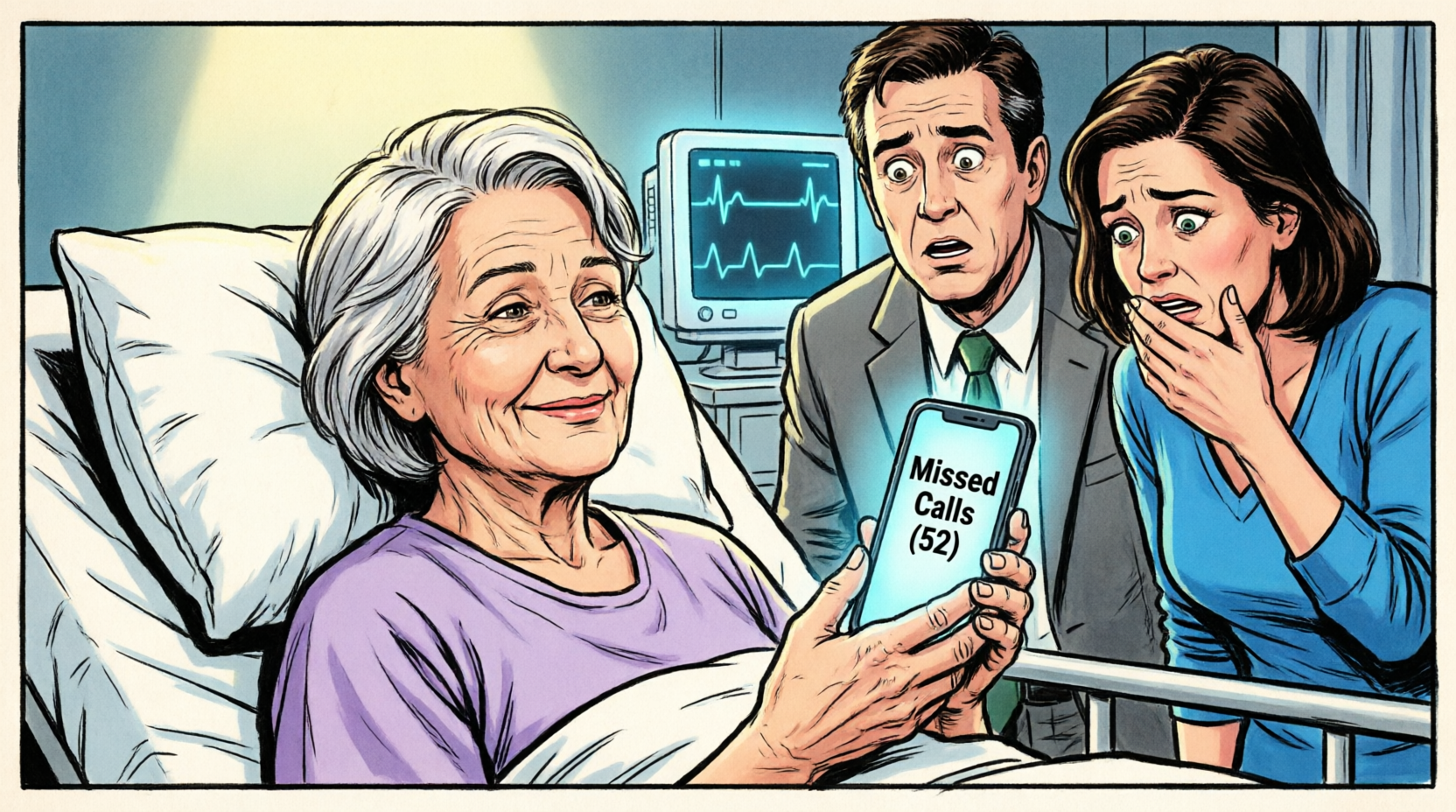
The night I was admitted to St. Vincent Medical Center, everything felt too bright, too sharp, too immediate. The fluorescent lights above me hummed faintly, and beneath them, pain stretched in a jagged line from my hip to my ribs—deep, insistent, impossible to ignore.
The second thing I remember was my son, Brian, standing at the foot of my bed. His wife, Melissa, stood beside him. Neither of them looked frightened. Neither of them looked relieved that I was alive.
They looked… inconvenienced.
Earlier that evening, I had slipped on a rain-slick grocery store entrance. At sixty-eight, a fall isn’t just a fall—it’s a turning point. The diagnosis came quickly: a fractured pelvis, a badly bruised shoulder, and weeks—possibly months—of recovery ahead. Walking without assistance was out of the question. Living alone, at least for now, wasn’t even a discussion.
The doctor explained everything carefully. Rest. Support. Supervision.
I nodded, but my attention had already shifted—to Brian.
For years, I had been his safety net. Quietly, consistently, without conditions. When his construction business slowed, I filled the gaps. When Melissa decided to stop working to “focus on the kids,” I absorbed the financial impact without protest.
Six thousand dollars a month. For nearly two years.
I told myself it was temporary. I told myself this was what family did. I told myself love didn’t need to be acknowledged to be real.
But that night, lying in that hospital bed, I finally heard the truth—not in what they said to me, but in how they said it.
“Mom, we can’t take care of you,” Brian said, already tense, already defensive. “We’ve got a trip booked.”
Melissa folded her arms, her tone sharper. “We need this vacation. We can’t just rearrange everything because of… this.”
Because of this.
Not because I was hurt. Not because I needed help. Just… an inconvenience that had appeared at the wrong time.
I watched them, waiting. Waiting for something human to break through the irritation. A flicker of guilt. A pause. A softening.
But Brian checked his watch. Melissa started talking about airline fees.
And in that moment, something inside me didn’t shatter—it settled.
Quietly. Completely.
I didn’t argue. I didn’t remind them of the years, the sacrifices, the quiet transfers that had funded their version of stability. I didn’t mention tuition, rent, emergencies, or the thousand small rescues they had already forgotten.
I simply smiled.
“That’s fine,” I said.
Brian looked surprised. Melissa looked relieved.
They thought the moment had passed.
It hadn’t. It had clarified.
As soon as they stepped out, I picked up my phone. My first call was to my attorney. The second was to a private care agency a neighbor had once recommended. By the time the nurse came to check my vitals, I had already arranged full-time in-home care for when I was discharged.
Then I opened my banking app.
The transfer was still there. Scheduled. Predictable. Unquestioned.
I canceled it.
They were still in the room when I did it.
They didn’t notice.
Not yet.
By the time they left for the airport, I was resting against my pillows, calm in a way I hadn’t felt in years. Not because I wasn’t in pain—but because, for the first time, I wasn’t ignoring reality.
Three hours later, my phone began to light up.
Again. And again. And again.
Brian.
Melissa.
Brian.
Melissa.
Eighty-seven missed calls.
I let it ring.
The first voicemail was almost polite. Confused. “Mom, call me back—there must be a mistake.”
The second had an edge. The third, sharper still. By the sixth, Melissa was crying. By the twelfth, Brian’s frustration had turned into anger. By the twenty-third, panic had taken over completely.
I listened to none of them.
Instead, I let the phone sit on the tray beside me while my nurse, Denise, adjusted my blanket and helped me sip water. She moved with quiet competence, her presence steady in a way that felt grounding.
She glanced at the phone, then at me. “Looks like you just became very important.”
I smiled—carefully, because even that hurt. “Funny how that works.”
The truth was, their life had been built on an assumption: that I would always be there, always paying, always smoothing things over. They hadn’t planned irresponsibly—they had planned around me. Around my consistency. Around my silence.
The SUV. The vacations. The expensive programs for the kids. The dinners out that I would have saved for special occasions.
Every time I suggested slowing down, Brian would say, “Just until things stabilize.”
But nothing stabilizes when there’s no reason for it to.
The next morning, he finally reached me through the hospital line.
“Mom,” he said, carefully now, “you canceled the transfer.”
“Yes.”
A pause. Expectant. Waiting for an apology that wasn’t coming.
“We have bills.”
“And I have a fractured pelvis.”
“That’s not the point.”
I almost laughed—not because it was funny, but because it was honest.
“It is exactly the point,” I said.
Melissa took the phone next, her tone tight. “We’re under pressure too.”
“Pressure?” I repeated. “You mean your vacation?”
“It was nonrefundable,” she said.
“So was raising you,” I replied softly. “But I did it anyway.”
Silence.
By noon, my attorney confirmed what I already knew: every dollar I had given them was a gift. Not a contract. Not an obligation. A choice.
And I was allowed to make a different one.
That afternoon, with Denise’s help, I reviewed everything—my recovery plan, my finances, my future. For the first time in years, my decisions were centered on my needs.
Not theirs.
When Brian called again that evening, his tone had softened further. “We can come back early.”
Not I’m sorry. Not How are you?
Just negotiation.
I closed my eyes. For years, I had mistaken proximity for care, dependence for connection.
“Don’t bother,” I said. “Enjoy your trip.”
And for once, I meant it.
—
Recovery wasn’t easy. Pain rarely is. But it was peaceful. Structured. Honest.
When I returned home, there was a medical bed waiting, a schedule for physical therapy, and someone there to help me without resentment or urgency. No one sighed when I needed assistance. No one checked the time while I spoke.
Brian and Melissa came back six days later.
Flowers in hand. Expressions carefully arranged.
I didn’t stand to greet them.
“Sit,” I said.
They did.
The conversation was brief—and revealing.
Excuses came first. Stress. Overwhelm. Travel complications.
Then reassurance. “You know we love you.”
And finally, the truth:
“When will the payments resume?”
There it was. Clear. Unfiltered.
I folded my hands over the blanket. “They won’t.”
Brian’s face hardened. “Don’t be ridiculous.”
“I’m being clear.”
“So you’re abandoning us?”
“No,” I said evenly. “I’m giving you the chance to stop abandoning yourselves.”
Melissa laughed bitterly. “The mortgage is due.”
“Then you should talk to your bank,” I replied. “And each other.”
Brian stood abruptly. “After everything we’ve been through?”
That question lingered—but it didn’t land the way it once would have.
“I did everything for this family,” I said. “That’s why this ends now.”
They left angry.
I stayed.
And for the first time in years, staying didn’t feel like being stuck—it felt like being grounded.
Denise brought me tea. “You okay?”
I took a slow breath. “Better than okay.”
And I was.
Not because it was easy—but because it was real.
Over time, things changed. Brian found work again. Melissa returned to a job. They downsized. Adjusted. Learned. Not quickly, not gracefully—but genuinely.
We still speak.
But now, there’s no confusion between love and money. No quiet transactions standing in for connection. No unspoken expectations.
Just honesty.
Losing the illusion hurt.
Keeping it would have cost far more.
So yes—the fall changed my life.
Not just because of the injury.
But because, for the first time, I truly saw who was standing at the foot of my bed…
—and why.
So tell me honestly—
Would you have answered after the first missed call…
or waited for all eighty-seven?