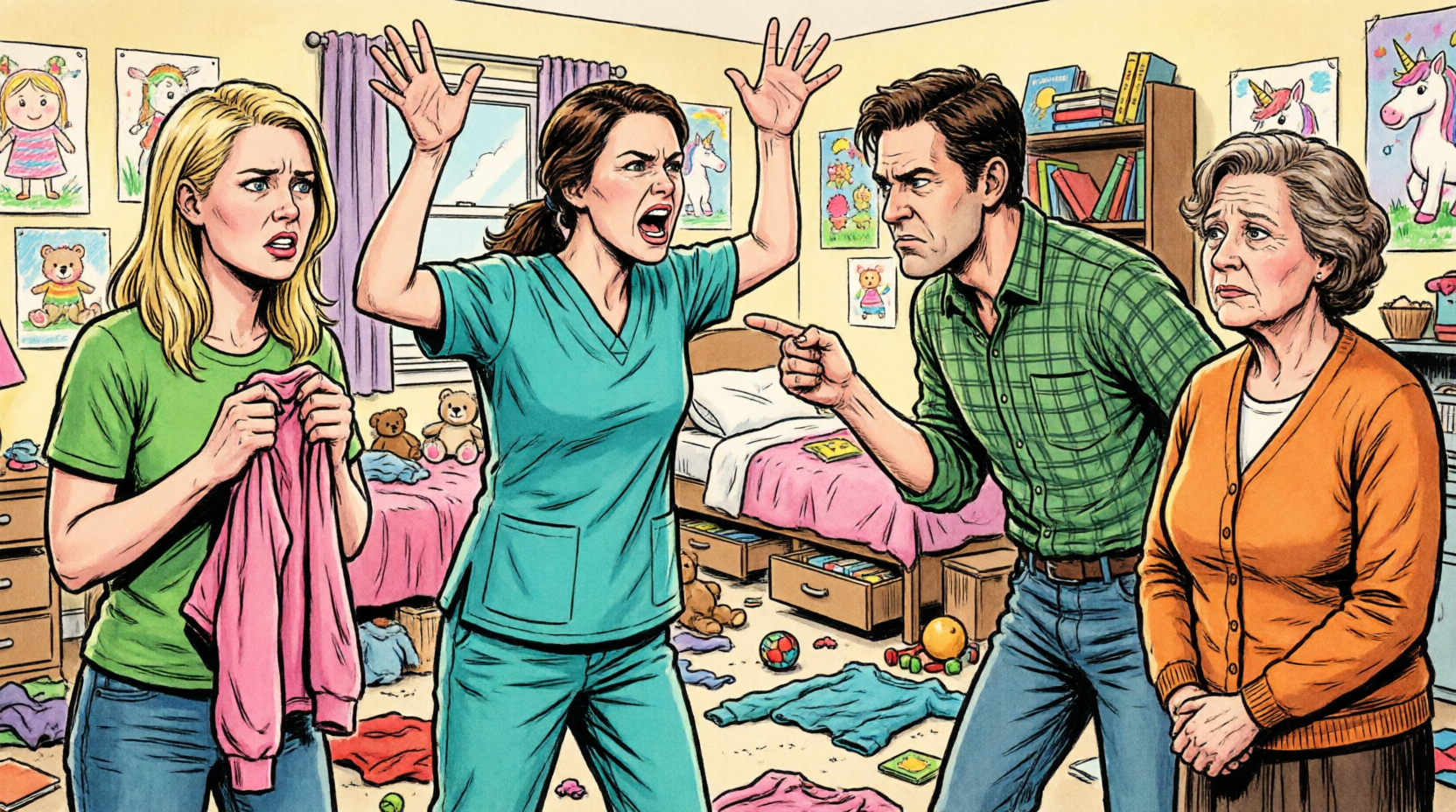
My 7-year-old daughter was gone when I arrived at the hospital after working a double shift. “We voted,” my mother remarked. “You don’t get a say,” my sister said as she frantically cleaned my child’s room. I refrained from screaming. They were scared of what I said next, but I remained composed.
By the time Emily Carter turned into the cracked driveway of her parents’ home in Dayton, Ohio, night had already settled in. The engine ticked as it cooled, a faint metallic rhythm that matched the exhaustion pulsing behind her eyes. Fourteen hours at Miami Valley Hospital had hollowed her out—fluorescent lights, relentless alarms, questions from families that hung in the air long after she left the room. She carried all of it with her, tucked somewhere between her ribs and spine.
All she wanted was simple: pick up Lily, drive home, sleep. Six uninterrupted hours felt like a fantasy she didn’t dare examine too closely.
But the porch light was on.
The front door stood open.
And Lily’s pink backpack lay on the top step, its zipper torn halfway down like it had been opened in a hurry—or not cared about at all.
Something in Emily shifted. Not panic. Not yet. Something sharper. A clean, immediate awareness that cut through fatigue like glass.
She stepped out of the car slowly, closing the door with deliberate quiet. The night air felt wrong—too still, too watchful. Her sneakers made soft, hollow sounds against the concrete as she approached the porch.
“Mom?” she called as she crossed the threshold.
Inside, the house smelled like lemon cleaner and tension.
Patricia stood in the living room, arms crossed so tightly it looked painful. Her jaw was locked, tendons in her neck pulled taut. Ronald hovered near the fireplace, posture rigid, face flushed with something that wasn’t quite anger and wasn’t quite shame.
From the hallway came the sound of drawers being yanked open. Closed. Open again.
Emily’s eyes flicked toward the hallway, then back. “Where’s Lily?”
No one answered.
The silence stretched just long enough to confirm what her instincts had already begun assembling.
Then Patricia spoke.
“She’s gone.”
The words didn’t land all at once. They arrived in pieces, like something translated poorly from another language.
Emily’s breath caught—just for a fraction of a second. “What does that mean?”
Patricia didn’t hesitate. “It means we voted. You don’t get a say.”
For a moment, Emily simply stared at her, as if repetition might change the sentence into something recognizable.
Behind Patricia, Vanessa stepped out of the hallway with an armful of Lily’s clothes—jeans, socks, school shirts, the soft yellow cardigan Lily wore when she felt anxious. The sight of it—folded, gathered, removed—made something cold settle in Emily’s chest.
Vanessa didn’t look guilty. She looked focused. Efficient. Like someone completing a task already decided.
Emily’s voice, when it came, was steady. “Where is my daughter?”
Patricia lifted her chin. “Somewhere stable.”
The word echoed in the room, heavy with judgment.
“You left her here every week,” Patricia continued, her voice sharpening. “And what does she get? A mother who’s never home. A child needs consistency, Emily. Not takeout dinners and midnight check-ins.”
“She is my daughter.”
Ronald exhaled slowly, stepping forward just enough to insert himself into the center of the moment. “You’re not in a position to decide that right now.”
Emily moved one step closer. Not fast. Not threatening. Controlled.
“Did you take her from this house?”
Vanessa shrugged, too casually. “She’s with people who can actually be present.”
The refrigerator hummed in the kitchen. A clock ticked somewhere out of sight. The house, so familiar, felt rearranged around her.
And then it clicked.
This wasn’t concern. It wasn’t spontaneous. This was a decision—discussed, agreed upon, executed. They had packed Lily’s things. Chosen a destination. Assigned roles.
They had held a meeting.
And decided Emily didn’t matter.
She set her keys down on the side table with careful precision. The soft clink sounded louder than it should have.
“I stayed calm,” she said quietly, “because I wanted to be absolutely sure you were all confessing before I called the police.”
That was when the room changed.
Not loudly. Not dramatically. But undeniably.
Vanessa’s posture faltered first. Ronald’s expression tightened. Patricia’s certainty flickered, just briefly.
Emily continued, her voice level, almost clinical. “If Lily is not back in this house in the next ten minutes, I will report this as custodial kidnapping. I will provide every camera recording outside, every message you’ve sent, including the one at 6:12 confirming she was here eating mac and cheese.”
She paused, just long enough for the weight of it to settle.
“If you crossed state lines,” she added, “this gets worse.”
No one spoke.
Emily didn’t raise her voice. That was what unsettled them. There was no emotion to argue against, no volume to overpower. Just clarity.
She took out her phone.
“Emily, don’t be dramatic,” Vanessa said, but the words lacked conviction.
Emily unlocked the screen. “Name the address.”
Patricia stepped forward, her composure cracking. “You would send police after your own family?”
Emily looked at her, and for the first time, there was something unyielding in her expression.
“You took my child.”
“We protected her.”
“No,” Emily said, her thumb already moving, “you concealed her location from her legal parent while removing her belongings. That’s not protection. That’s abduction.”
Ronald tried to regain control. “Now wait—no one abducted anyone. She’s with Denise. In Indiana. Just for a few days—”
He stopped.
Too late.
The silence that followed was almost surreal.
Emily met his gaze. “So she’s in Indiana.”
Ronald swore under his breath.
Emily pressed call.
Patricia lunged forward. “Stop this right now—”
Emily stepped back, lifting her hand—not aggressively, just enough.
“My name is Emily Carter,” she said into the phone, her voice calm and precise. “I need to report that my seven-year-old daughter was taken without my consent. The individuals involved just stated she was transported to Indiana.”
The moment the words left her mouth, the situation stopped belonging to the family.
Patricia began talking over her. Vanessa’s composure cracked into tears. Ronald insisted it was a misunderstanding.
Emily ignored all of it.
She gave names. Dates. Vehicle details. An address she knew by heart.
Because she had been there. Because she paid attention. Because being tired didn’t mean being careless.
Twelve minutes later, there were two officers in the living room.
Emily told the story again, the same way—clean, chronological, undeniable. She showed texts. Screenshots. The custody order.
Sole custody.
No ambiguity.
Officer Ramirez read it, then looked up. “Who authorized you to remove the child?”
Patricia tried to hold her ground. “We had a discussion as a family—”
“A discussion,” he repeated, “does not override custody law.”
The words landed harder than anything Emily had said.
Vanessa sank onto the couch, shaken now. “We didn’t think it would go this far.”
Emily almost laughed.
Instead, she said, “Can you contact Indiana State Police?”
They could.
So they did.
The waiting was the hardest part.
Time stretched thin and sharp. Emily sat at the dining table, phone in front of her, watching minutes crawl past like hours. Around her, the house felt smaller, quieter. Her family stayed in their places, as if movement might make things worse.
At 11:48 p.m., the call came.
Lily was safe.
Asleep on a pullout couch. Still in her strawberry-print pajamas.
Emily closed her eyes, just for a moment. Not relief exactly. Something steadier. Something deeper.
“Can they bring her tonight?” she asked.
“They’re arranging it,” Ramirez said. “She’s coming back.”
Coming back.
Patricia sat down slowly, her certainty gone. “Emily… we were trying to help.”
Emily turned to her fully.
“You don’t remove a child from her mother and call that help.”
At 2:17 a.m., headlights cut across the driveway.
Emily was already moving before the car stopped.
Lily stepped out wrapped in a blanket, clutching her stuffed rabbit. She looked small. Smaller than Emily remembered, as if distance had reduced her somehow.
“Mommy?”
Emily dropped to her knees and pulled her close, holding on like letting go wasn’t an option anymore.
“I’m here,” she whispered. “I’ve got you.”
Lily’s voice trembled. “Grandma said I was going on a trip because you were too busy.”
Something inside Emily settled into place—firm, permanent.
She stood, lifting Lily into her arms.
And without another word to anyone else, she walked out.
Home felt different when they got there.
Not bigger. Not brighter.
Safer.
Emily didn’t put Lily to bed right away. She sat on the couch instead, wrapped the blanket around both of them, and waited until Lily’s breathing slowed.
“Did I do something bad?” Lily murmured.
Emily brushed her hair back gently. “No. Never.”
“They said everyone agreed.”
Emily’s voice softened, but didn’t waver. “Nobody gets to vote on whether I’m your mom.”
Lily nodded, accepting it with the quiet certainty only children seem to have.
By morning, Emily had already started building something new.
Lawyer. School notifications. Updated records.
Boundaries, written in places that couldn’t be argued with or rewritten in a living room meeting.
At the hearing, the facts spoke clearly. No one could dress them up enough to make them acceptable.
A discussion wasn’t consent.
Concern wasn’t authority.
And love—real love—didn’t remove a child in secret.
The judge’s ruling was firm. Protective orders. Supervised contact. Consequences that didn’t bend for intention.
Outside the courthouse, sunlight felt sharp and clean.
Ronald tried one last time. “This has gone far enough.”
Emily adjusted her bag, steady as ever. “No. It went far enough when you decided I didn’t matter.”
Then she walked away.
That night, back in their small duplex, Lily drew a picture of their house.
Two stick figures inside.
“That’s us,” she said.
Emily studied it for a moment. No extras. No interference. Just home.
“Can we get better locks?” Lily asked.
Emily smiled—really smiled, for the first time in days.
“Yeah,” she said. “We can.”
And they did.
New locks. Cameras. Documents secured.
Not out of fear.
Out of clarity.
Some people think strength looks like noise—raised voices, visible anger, something undeniable.
But Emily had learned something different.
Panic would have made her easy to dismiss.
Calm had made her impossible to ignore.
She hadn’t needed to be louder.
She had only needed to be right.

