“You are not allowed to attend your sister’s wedding. The family will be embarrassed by your strange social anxieties. Before I packed one bag and bid farewell on the wedding day, my parents mentioned that.
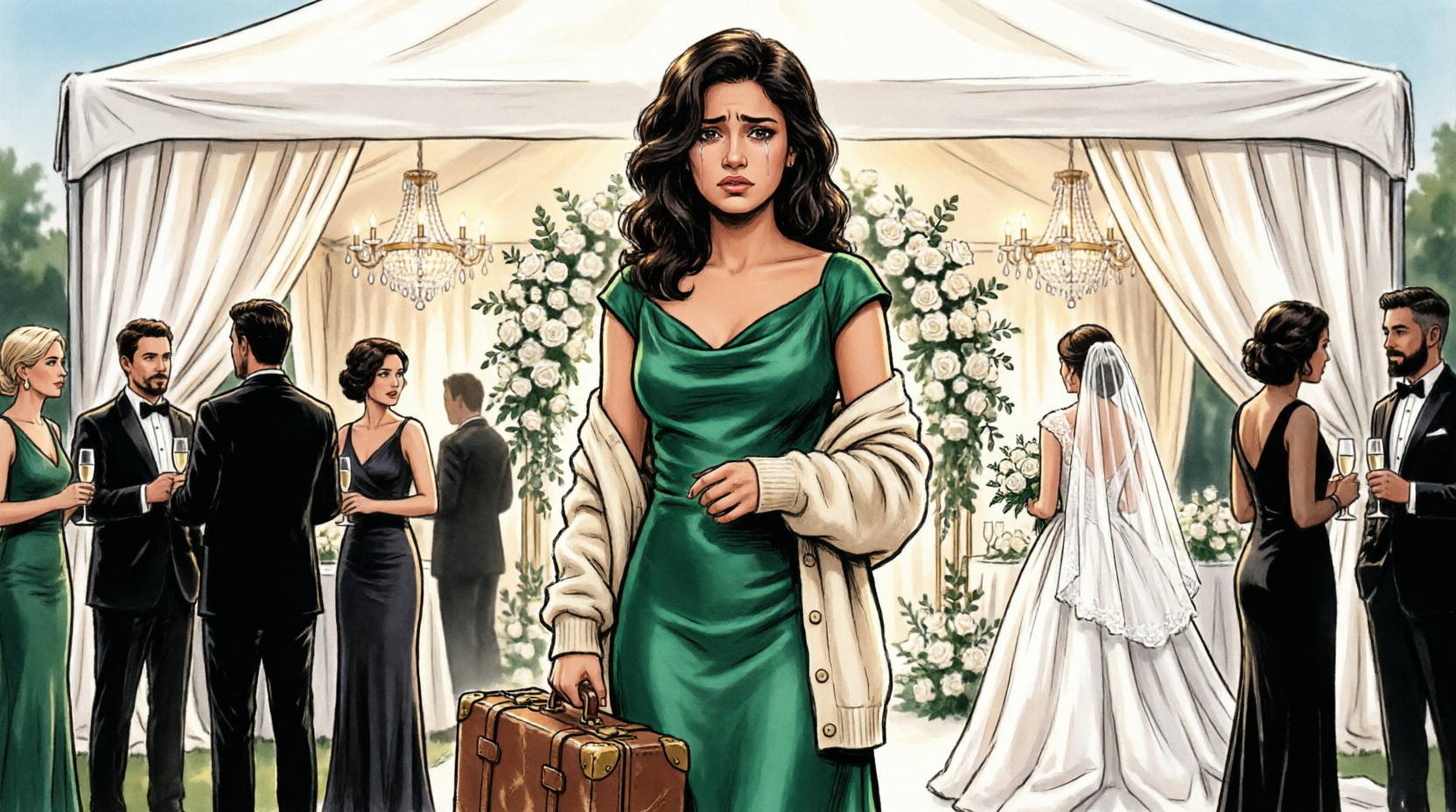
My name is Claire Bennett, and for most of my life, I existed in my family as something to be managed—like a stain you learn to cover instead of clean.
I lived with severe social anxiety and panic disorder. Not the kind people casually joke about, but the kind that closes your throat in a checkout line, that turns a simple “hello” into something that feels physically dangerous. My hands shook so badly some days I couldn’t hold a glass without spilling it. My chest would tighten until breathing itself felt like work.
My mother, Diane, called it my “performance issue,” as if I were failing at something optional.
My father, Robert, called it weakness, as if I were choosing it.
And my younger sister, Emily, learned early that love in our house came with conditions—so she adapted. She mirrored them. She stayed safe.
By the time Emily got engaged, I was barely holding my life together.
I worked remotely from my bedroom, quietly paying rent to live in a house where I wasn’t really allowed to exist. When guests came over, I was told to stay upstairs. If anyone asked about me, my mother would smile politely and say I was “going through something embarrassing,” like I was a phase she hoped would pass.
Once, at a restaurant, I had a panic attack so severe I knocked over a glass. The crash silenced the table. My father grabbed my arm hard enough to leave bruises and dragged me outside. He didn’t ask if I was okay. He just told me to get control of myself.
Still, when Emily announced her wedding, I tried.
I really tried.
I spent nearly all my savings on a pale blue dress I didn’t even know if I’d have the courage to wear. I booked an extra therapy session. I practiced breathing exercises every night, counting inhales like they were lifelines. I told myself this could be the day things changed—that maybe, just once, my family would choose me over appearances.
Three nights before the wedding, they called me into the dining room.
Emily sat there glowing, still wrapped in the aftershine of her bridal shower. My parents didn’t smile.
My father spoke first. “You’re not coming.”
It took a second for the words to land. “What?”
My mother didn’t hesitate. “Your sister’s wedding is off-limits. Your… condition will embarrass the family.”
Emily didn’t even look at me when she added, “Claire, don’t make this harder than it has to be.”
I cried.
Then I begged—and that part still burns when I think about it. I promised I would stay invisible. I promised I would leave the moment I felt anything coming on. I promised to take up as little space as possible.
My father stood so abruptly his chair scraped across the floor. “For once in your life,” he snapped, “stop making everything about you.”
That night, something in me didn’t just break.
It shifted.
I packed one suitcase.
What they didn’t know—what I had never told them—was that six months earlier, in one of the rare moments where hope felt stronger than fear, I had applied for a skilled worker visa to Canada. I had a remote accounting contract. A small emergency fund. And an approval letter hidden inside an old novel like something too fragile to exist out in the open.
On the morning of Emily’s wedding, the house buzzed with noise—hair dryers, laughter, perfume thick in the air.
I carried my suitcase downstairs.
My mother caught sight of it in the hallway mirror. She turned, looked at me, and laughed.
“You?” she said. “You won’t even make it past the Canadian border.”
My father barely glanced up. “Let her go. She’ll be back in a week.”
Emily didn’t come out to say goodbye.
So I left.
At the airport, I thought they might be right.
My hands shook so violently I could barely hold my passport. The line behind me stretched endlessly. My vision blurred at the edges. My chest locked tight.
But then—
A stamp.
A nod.
A wave forward.
That was it.
No collapse. No failure. No scene.
Just a door opening.
As I stepped toward security, my phone lit up one last time.
Don’t come back unless you’ve learned how to be normal.
I turned it off before I could read it twice.
And I got on the plane.
Canada didn’t fix me in a week.
It didn’t fix me in a month either.
My first weeks in Vancouver were raw and lonely. I rented a tiny basement suite that smelled faintly of damp carpet and unfamiliarity. I slept with my suitcase half-packed, just in case I needed to run—from what, I didn’t even know.
I had panic attacks everywhere.
In pharmacies.
In banks.
In government offices.
Once in a grocery store because a man sighed behind me when I took too long to move forward.
But something was different.
No one there knew me as “the embarrassment.”
I was just… a person.
Struggling, yes—but not hidden.
Not erased.
I kept working. Took on extra bookkeeping at night. Forced myself, slowly, painfully, into proper treatment instead of survival-mode coping.
And then I met Dr. Levin.
She didn’t treat me like I was broken.
She treated me like I was injured.
Recovering.
That difference rewired something in me.
Six months later, she suggested a support group.
I almost didn’t go.
The night I did, I sat closest to the door, mapping out my exit before I even sat down.
That’s where I met Daniel.
He was gripping a paper coffee cup so tightly the lid bent inward. When it was his turn to speak, he admitted he sometimes drove in circles for forty minutes before entering a building because saying hello felt impossible.
I laughed.
Not at him—but because I understood.
He looked at me, surprised.
Then he smiled.
And something quiet, something safe, began there.
With Daniel, everything was slower.
Softer.
We built something in small, careful steps—short walks, quiet cafés, long pauses that didn’t need filling. He never rushed me. Never mocked me. Never treated my anxiety like an inconvenience.
When I froze, he waited.
When I apologized, he said, “You don’t have to earn basic gentleness.”
No one had ever told me that before.
A year later, I learned who he really was.
Daniel Mercer.
Mercer Holdings.
Money. Expectations. Legacy.
He had hidden it—not out of shame, but out of caution. He wanted someone who saw him before his last name.
I understood that instantly.
Pain just wears different clothes in different families.
We married in a quiet civil ceremony.
Twelve people. No spectacle.
Two years later, we had Sophie.
And somehow, loving her taught me how to stay.
To speak.
To exist in rooms I once would have fled.
Not because I was suddenly fearless—but because she needed me to be present more than I needed to be safe.
On the fourth anniversary of the day I left home, I woke up in a house overlooking the water.
Daniel was making coffee. Sophie was asleep upstairs.
Peace had become something real.
So I recorded a video.
A simple one.
The house. The garden. Daniel smiling. Sophie laughing.
And then me.
“I made it past the border.”
I sent it.
The response was immediate.
Calls. Messages. Sudden concern.
We were worried about you.
Why did you disappear?
I always knew you’d succeed.
I stared at the screen, something cold settling in my chest.
Daniel glanced at the messages. “Do you want the truth,” he asked, “or do you want to watch them perform?”
“The truth.”
We got it.
Debt. Affairs. Cracks beneath their perfect image.
They didn’t miss me.
They needed me.
When I finally answered their call, nothing had changed.
No apology.
No acknowledgment.
No truth.
Just expectation.
So I asked one question.
“If I had nothing… would you still be calling?”
Silence answered for them.
That was enough.
I didn’t raise my voice when I ended the call.
I didn’t need to.
For the first time in my life, I wasn’t asking to be chosen.
I was choosing myself.
They kept trying for three days.
Different numbers. Emails. Even reaching through Daniel’s company.
It ended with legal action.
And one final message from me:
You didn’t lose me when I left.
You lost me when your love became conditional.
That night, Sophie fell asleep on my chest as the sun dipped below the water.
Daniel covered us with a blanket.
And for the first time in my life, silence didn’t feel like rejection.
It felt like peace.
I was never hard to love.
I was just raised by people who didn’t know how.