My son-in-law leaned down and whispered, “You have 24 hours to get out of my house,” during my daughter’s funeral. I met his eyes, grinned silently, packed one small bag that evening, and walked out without saying goodbye. His phone rang seven days later.
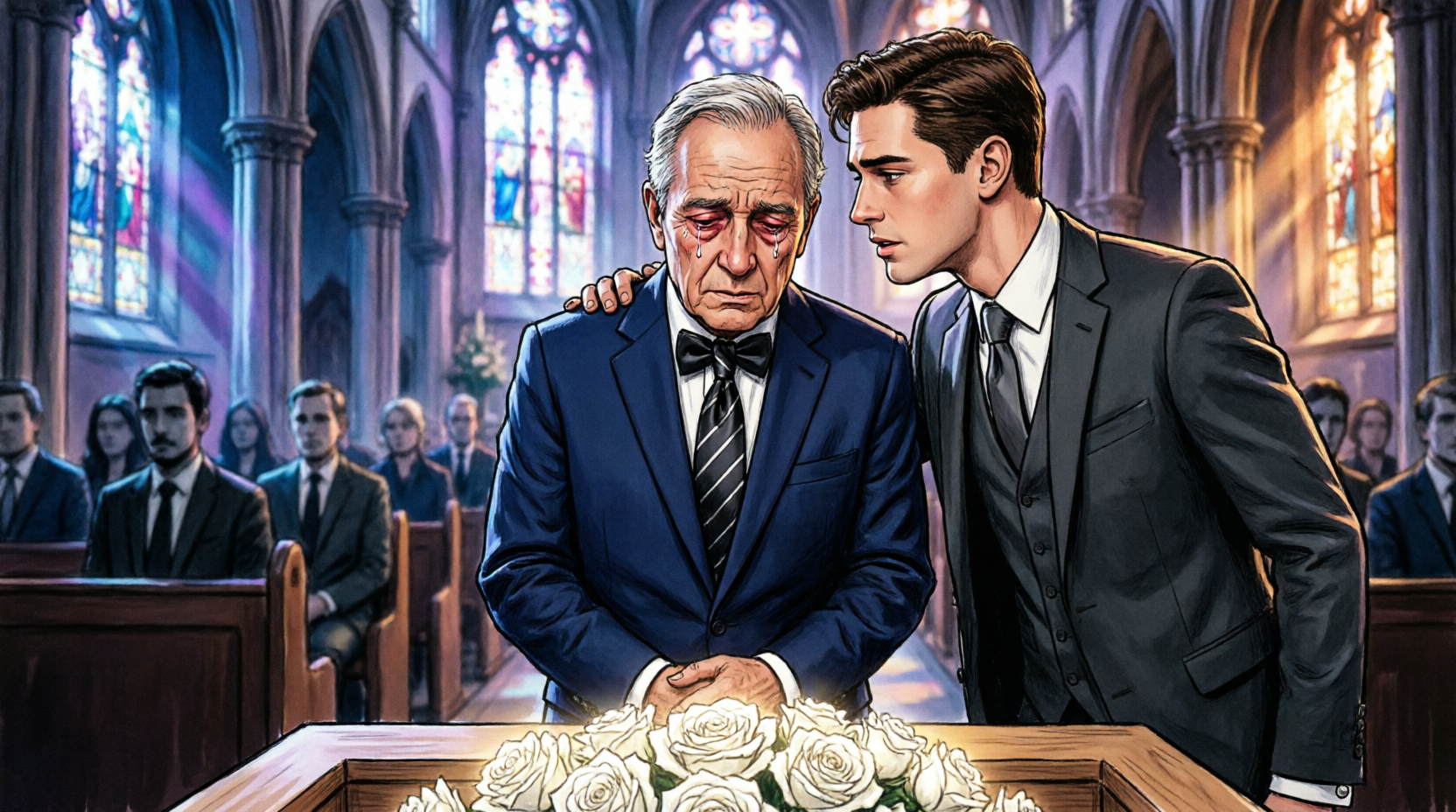
The day we buried my daughter Laura was the darkest day I’ve ever known.
The church was overflowing—friends, colleagues, distant relatives, even strangers who had only heard her name. The altar was crowded with white and pale pink flowers, their sweetness thick in the air. Candles flickered in tall holders, casting restless shadows along the stone walls, while the organ played a slow, aching hymn that seemed to press down on everything.
And yet, surrounded by all those people, I had never felt more alone.
I stood a few steps from the closed casket, my hands hanging uselessly at my sides. I kept staring at the polished wood, as if sheer will could make it open—just long enough to hear her voice again.
Just once.
But death doesn’t correct itself, and coffins don’t open for second chances.
Laura had been everything to me. After her mother died, she became the reason I kept going. The house had turned hollow overnight—too quiet, too wide, too empty. I still remember that first night, hearing her cry softly in her room, her small shoulders shaking beneath the blanket. I stood in the doorway and made a promise I never spoke out loud:
I would protect her, no matter what it cost.
And I did.
I raised her on my own—clumsily at first, then with a kind of fierce devotion that only grows out of loss. I worked long hours, took extra shifts, learned things I never expected to learn. I burned dinners, failed at braiding her hair, stayed up late helping with schoolwork I barely understood. But I was there.
Every birthday. Every school play. Every milestone.
I was there the day she brought Daniel home.
Even standing beside her coffin, thinking of him made something tighten in my chest. He stood near the front row in a perfectly tailored black suit, his expression carefully arranged into quiet grief. People gathered around him, offering condolences, touching his arm, speaking in soft, sympathetic tones—as if he were the one who had lost the most.
He played the part well.
Every so often, someone would glance at me, remembering I was her father, before drifting back toward him. I watched it all—the lowered voices, the rehearsed sympathy—and something inside me recoiled. Not because grief can be measured, but because I knew what lay beneath his polished composure.
Throughout the service, Daniel barely acknowledged me. When our eyes met, there was no warmth there. Only distance. Perhaps even irritation.
The priest spoke about peace, about faith, about Laura “going home.” I heard almost none of it. My mind wandered through memories—her first bike ride, the time she broke her arm climbing too high, the nights she crept into my room during storms because thunder terrified her.
When the holy water touched the casket, I felt as though what remained of my life was slipping away with it.
Eventually, the service ended. People began to leave, offering quiet words I barely processed. Then I saw Daniel near the doors, accepting one last round of sympathy.
And then he came toward me.
“Antonio,” he said.
It was the first time he had spoken to me all day.
“We need to talk.”
There was no shared grief in his voice. No connection. Just a calm, practical tone—as if he were handling business.
Still, I followed him.
We stepped aside into a quiet corner near an old confessional. Colored light from stained glass spilled across the floor. For a brief moment, I thought—perhaps foolishly—that he might say something about Laura.
Instead, he said:
“You have twenty-four hours to leave my house.”
The words were delivered evenly, without anger. Cold. Final.
Not a request. A decision.
Something tightened in my chest, but I didn’t react the way he might have expected. Daniel had never been openly cruel—his harshness was always controlled, deliberate. Still, even I hadn’t expected this, not here, not today.
“The house is mine,” he continued. “I need space. I can’t deal with complications right now. It’s better if you find somewhere else.”
No hesitation. No apology.
I studied him—the perfect suit, the measured expression, the careful performance of grief. I remembered dinners in that house, Laura’s nervous glances when tension rose, the way she tried to smooth things over.
And then, quietly, I smiled.
Not for him. For myself.
“I understand,” I said.
I didn’t argue. I didn’t remind him of what I had contributed, of the years I had been there, of everything he owed and chose to ignore.
I simply accepted it.
That evening, I returned to the house one last time.
Without Laura, it felt empty in a way I can’t fully describe—like the life had been pulled out of the walls. I paused at her bedroom door, half-open, and stood there for a long moment.
I could almost hear her voice.
“Dad, you don’t have to knock twice.”
Inside, everything was neat, untouched. Her scent lingered faintly in the air. On her desk sat a wedding photo—her smiling, him standing proudly beside her.
On the nightstand was another picture—Laura as a child, sitting on my shoulders at the beach, arms stretched wide.
I took that one with me.
I packed only what I needed. Clothes. Documents. A few essentials. The photograph went on top.
Everything else stayed behind. It was just things.
Before leaving, I made the bed out of habit. Then I set the keys on the kitchen table. The sound echoed in the quiet house.
At the door, I stopped and looked back one last time.
“Goodbye, hija,” I whispered.
Then I walked away.
That night, I stayed in a small hostel near the train station. The room was simple, the mattress thin, the window rattling whenever trains passed. I lay there staring at the ceiling, thinking about everything I had lost in a single day.
My daughter.
My home.
The illusion of family.
Daniel believed he had erased me.
What he didn’t know was that I had been part of his company from the very beginning.
The next morning, I sat in a café across the street, watching the world move as if nothing had changed. People hurried to work, buses passed, someone laughed into a phone. It all felt strangely distant.
I checked my messages. Condolences. Missed calls. I ignored them.
Instead, I called my lawyer.
This wasn’t sudden. Everything had been put in place years earlier—documents Daniel had signed without paying attention, agreements he never fully understood. I had stayed quiet because Laura wanted peace.
But Laura was gone.
And silence no longer served anyone.
A week later, Daniel received a call.
He likely expected something routine.
Instead, he learned the truth:
I owned eighty-four percent of the company.
The panic must have hit him all at once—the kind that starts deep and rises quickly. Contracts he ignored, signatures he dismissed—they were all real, all binding.
He had mistaken my silence for weakness.
He was wrong.
When he called me, his voice was different.
“Antonio… we need to talk.”
This time, I chose the place.
When he arrived, the confidence was gone. He looked tired, unsettled, unsure.
“I made mistakes,” he admitted.
“Yes,” I said. “You did.”
He tried to explain—stress, grief, control—but none of it changed what had happened.
“I’m not here to destroy you,” I told him.
He looked surprised.
“What do you want?”
I thought about it.
I wanted my daughter back. That was impossible.
So I chose something else.
“Respect,” I said. “For her. For everything that made your success possible.”
I restructured the company. Audits. Oversight. Accountability. He remained—but without unchecked power.
He had to answer to others now.
He accepted it.
Not because he wanted to—but because he had no choice.
Over time, things changed. The company improved. People felt safer. Daniel, slowly, became quieter, more careful.
Not better overnight—but different.
As for me, I used what I had to create something in Laura’s name.
Not something grand. Just meaningful.
A way to support people who had been overlooked—the ones who sacrificed quietly, the ones who never got credit.
Because I knew what it meant to stand in the background.
Sometimes I still visit her.
I bring flowers. Sit for a while. Talk to her, even if no one answers.
And sometimes, I think back to that moment in the church.
“You have twenty-four hours to leave my house.”
At the time, it felt like the end of everything.
But it wasn’t.
It was the moment everything changed.
Daniel thought he had removed me from his life.
What he failed to understand was simple:
I had never been a guest in his story.
I had been part of its foundation from the very beginning.
And foundations don’t disappear just because someone stops noticing them.
I still miss her. Every day.
But I carry her forward in the only way I can—through what I build, what I protect, and what I refuse to let be forgotten.
I sit with her photograph sometimes, coffee in hand, and whisper:
“I’m still here, hija.”
And in the quiet that follows, that feels like enough.