He (Michael Landon) Taught Me To Read. I Never Put the Book Down.
1974 — He opened it. 2026 — I came back still holding it.
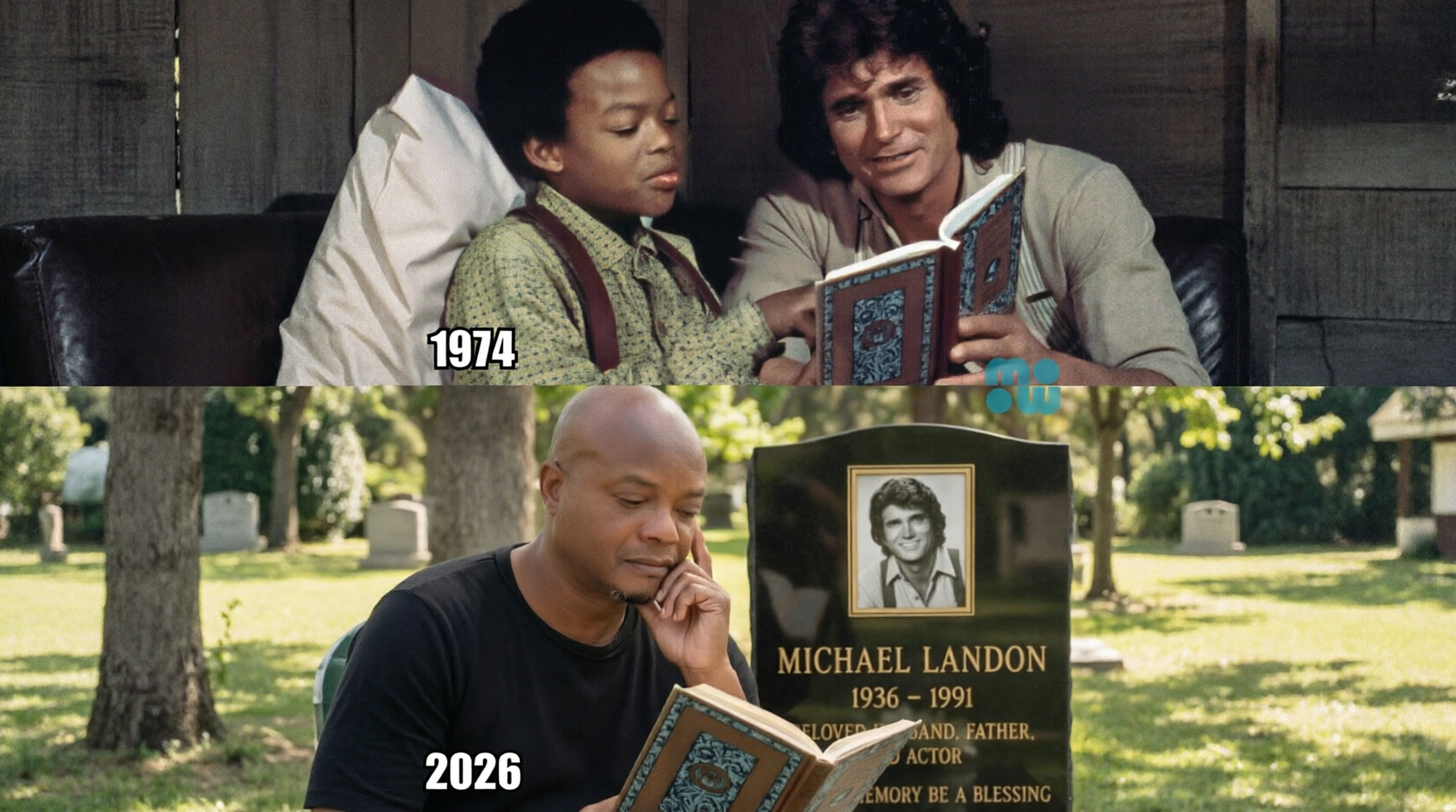
In 1974, a man sat beside a boy and opened a book.
Nothing about the moment announces itself as extraordinary. There is no grand speech, no swelling music you can hear outside the frame, no visible marker that says this will matter for the rest of your life. Just a man, a child, and a book held between them. Just the quiet exchange of attention—the rare, undivided kind—that turns symbols into meaning, turns ink into thought, turns learning into something that takes root.
But stay with the image a little longer.
Look at the way the man holds the book—not as an object to display, not as a prop in a lesson, but as something shared. He angles it toward the boy, not toward the camera. His body leans in, fully present, fully there. It’s the posture of someone who isn’t performing care, but practicing it. Someone who understands that the real lesson isn’t only in the words on the page, but in the act of sitting close enough for another person to see them clearly.
And look at the boy.
He is at that fragile, powerful threshold where reading stops being mechanical and becomes alive. Where letters stop being obstacles and start becoming doors. He doesn’t yet know what’s being handed to him. Not fully. Not in the way you only understand something after years have passed and life has tested you and taken things from you and left you with whatever cannot be taken.
But something is happening.
A man is teaching him that words matter. That stories matter. That attention matters. That if you follow a sentence far enough, it will lead you somewhere you’ve never been—and when you come back, you won’t be the same person who left.
A man is giving him a way to stay.
To stay curious.
To stay thinking.
To stay connected—to himself, to others, to the world beyond whatever moment he’s standing in.
The boy receives the book.
He doesn’t yet know he will carry it for the rest of his life.
Years pass.
Not the easy kind. Not the kind that move cleanly from one chapter to the next. The kind that fracture. That complicate. That test what holds and what doesn’t.
Fame arrives early, as it sometimes does, and with it comes the strange distortion of growing up in public. Applause that doesn’t translate into stability. Recognition that doesn’t guarantee direction. The long, uneven road of becoming someone again after the world has already decided who you are.
There are years that blur. Years that burn. Years that require rebuilding from the inside out.
And yet—
Somewhere beneath all of it, something remains intact.
Not loudly. Not always consciously. But steadily.
A memory of sitting beside someone who treated you like you mattered.
A memory of being shown—not told, but shown—that words are worth your time.
A memory of learning that attention is a form of respect, and that giving it fully can change a moment into something permanent.
The book, once opened, is never entirely closed.
A man sits before a grave.
Time has done what it always does. The boy is gone—not erased, but transformed. In his place is someone who has lived, who has lost, who has endured, who has made it through things that don’t leave you unchanged.
He is older now than the man who once sat beside him.
And he has brought a book.
He sits quietly. No audience. No performance. Just a private return to a place that holds meaning only because of who lies beneath it. His posture mirrors something from long ago—elbow resting, hand near his face, eyes lowered into the page. The same inward turn of attention. The same quiet immersion.
He is reading.
Not for anyone watching.
Not for memory alone.
But for connection.
Because sometimes the only way to speak to the past is to reenact it—not exactly, not perfectly, but faithfully enough that something of it lives again in the present.
The stone bears a name. Dates. A brief summary of a life that was anything but brief in its impact.
But the man sitting there isn’t reading the stone.
He’s reading the book.
What is he reading?
It almost doesn’t matter.
Because the act itself is the message.
To bring a book to the grave of someone who once opened one for you is to say something that words alone can’t quite hold. It is a gesture that reaches backward and forward at the same time. A quiet declaration that what was given was not temporary. That it endured. That it became part of you.
In that first moment, decades ago, the man held the book.
Now, the student does.
The exchange is complete—but also ongoing. Because what was given wasn’t just literacy. It was orientation. A way of moving through the world. A way of engaging with it, questioning it, entering it more deeply.
A way of staying open.
Think about what it means to be taught like that.
Not efficiently. Not impatiently. Not as a task to complete, but as a person to reach.
To be taught by someone who believes that your understanding matters. That your pace matters. That your presence in that moment is not incidental, but central.
That kind of teaching doesn’t end when the lesson does.
It embeds.
It becomes part of how you listen.
Part of how you read.
Part of how you return—to books, to people, to yourself.
And sometimes, if you’re fortunate, it becomes part of how you say thank you.
Because that’s what this is.
Not a performance of grief.
Not nostalgia for its own sake.
But gratitude, enacted.
A man returning with the very thing he was given, holding it not as an artifact, but as a living practice.
“I kept it,” the moment says without speaking.
“What you gave me—I kept it.”
Through everything that changed, everything that broke, everything that had to be rebuilt, this remained.
The book is still open.
A man leans in, sharing a page.
A man sits alone, still reading it.
Fifty-two years collapse into a single, continuous gesture.
The lesson did not end.
The gift did not fade.
The moment did not disappear.
It became a life.
And maybe that’s the quiet truth carried between these two images:
We don’t always know which moments will last.
We don’t always recognize when something small is becoming something permanent.
But sometimes, a man opens a book with a child,
and decades later, that child—grown, weathered, still here—
returns with that same book in his hands.
Not to close it.
But to show that he never did.
He taught me to read.
I never stopped.
I came back with the book still open.
And in the only language that ever truly mattered—
I showed up.