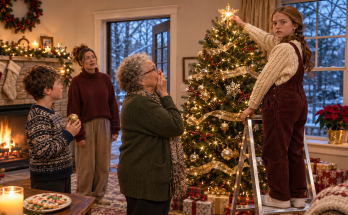
Three sharp knocks echoed through my house.
I stood in the hallway, seventy-two years old, holding a phone in one hand and a forged power of attorney in the other.
Outside my front door stood two strangers who had apparently been sent to question my ability to care for myself.
And behind them, sitting comfortably in his SUV, was my son-in-law Greg.
He was smiling.
That smile told me everything.
He thought he’d won.
“Mrs. Harper?” the man called again. “We’re here because someone expressed serious concerns about your welfare.”
I looked at my phone.
“Daniel, are you still there?”
“I’m here, Evelyn. Put me on speakerphone, ask for their identification, and don’t sign anything.”
I took a deep breath and opened the door, leaving the storm door locked.
A middle-aged woman introduced herself as a county adult protective services worker. The man beside her was a local police officer.
“We received a report that you may be confused, living without adequate support, and refusing assistance from concerned family members,” the woman explained.
I almost laughed.
Confused?
I’d spent Christmas morning discovering that my daughter had helped forge legal documents, my oldest friend had betrayed me for money, and my son-in-law was trying to take my home.
If anything, I’d never been more clearheaded.
“May I ask who made the report?” I said.
“We can’t disclose every detail of the referral,” she replied gently. “But we’d like to make sure you’re safe.”
I nodded.
“Of course. And I’d like you to speak with my attorney before we go any further.”
Daniel introduced himself through the speakerphone.
Then he calmly explained that he was reviewing evidence of a potentially forged power of attorney and an unauthorized property transaction.
The officer’s expression immediately changed.
“Forged documents?” he asked.
“Yes,” Daniel replied. “My client believes someone has falsely represented her consent to transfer authority over her financial affairs.”
I held up the paperwork.
“And I can tell you something else,” I said. “The man who reported me may be the same man trying to sell my house.”
The social worker glanced toward Greg’s SUV.
Greg must have noticed.
Because suddenly, he climbed out.
“Evelyn!” he shouted. “What’s going on?”
I turned toward him.
“Come closer, Greg. I believe these people would like to hear your explanation.”
He stopped walking.
For the first time all morning, the confidence disappeared from his face.
“I was only trying to help,” he said.
The officer looked at him.
“Sir, are you the person who requested this welfare check?”
Greg hesitated.
Then he nodded.
“My mother-in-law isn’t thinking clearly. She’s been making accusations against everyone.”
I smiled.
“Then perhaps you’d like to explain why my signature appears on documents I’ve never signed.”
His face tightened.
“That’s a misunderstanding.”
“And why you’ve been discussing my house with a real estate broker?”
“Evelyn, don’t do this.”
“And why you told someone you planned to have me declared incompetent?”
The officer stepped forward.
“Sir, I think everyone needs to remain calm.”
I looked at Greg.
“I’m perfectly calm.”
Then I held up Caleb’s phone.
“And I have a recording.”
Greg’s eyes widened.
Behind me, Melissa appeared in the hallway.
“Mom,” she whispered, “please.”
I turned toward her.
For one painful second, I saw my little girl again.
The child who used to fall asleep against my shoulder during Christmas movies.
The daughter I’d taught to bake cookies.
The mother of three grandchildren I adored.
But love couldn’t erase the truth.
“Melissa,” I said softly, “you have one chance to stop hiding.”
She looked at Greg.
He shook his head sharply.
“Don’t say another word.”
And that was when something extraordinary happened.
My daughter straightened her shoulders.
“No, Greg.”
He froze.
“What?”
“I said no.”
Her voice shook, but she continued.
“I helped you lie to my mother. I let you convince me she would be better off somewhere else. I signed a false statement because you said we’d lose everything if I didn’t.”
Tears streamed down her cheeks.
“But I won’t let you take her house.”
Greg stared at her.
“You have no idea what you’re doing.”
Melissa stepped beside me.
“For the first time in months, I think I do.”
The officer asked her to explain.
And she did.
Not perfectly.
Not without crying.
But honestly.
She told them about the debt.
The proposed sale.
Margaret Collins.
The forged signature.
And the agreement she had signed falsely claiming to witness my consent.
The officer took notes and explained that the allegations would need to be investigated.
Nobody was arrested on my doorstep that Christmas afternoon.
Nobody magically canceled a legal document with a single phone call.
But something much more important happened.
Greg’s story finally stopped being the only story anyone heard.
And I was no longer facing him alone.
By the following Monday, Daniel had obtained copies of the disputed filings and begun the formal process of challenging them.
He also helped me make a police report and notify the relevant financial institutions that I had not authorized anyone to act on my behalf.
Margaret was contacted about her involvement.
When she called me three days later, I answered.
“Evelyn,” she began, “there’s been a terrible misunderstanding.”
“No, Margaret. A misunderstanding is forgetting someone’s birthday. This was a plan to take my home.”
She began crying.
“Greg told me you wanted to downsize.”
“Then why did you help arrange paperwork I never signed?”
Silence.
I waited.
Finally, she whispered, “He promised me twenty-five thousand dollars.”
Thirty years of friendship.
Twenty-five thousand dollars.
I closed my eyes.
“Margaret, I would have given you twenty-five thousand dollars if you were desperate and had asked me for help.”
She began sobbing harder.
“But you’ve taken something I can’t give you back.”
“What?”
“My trust.”
Then I ended the call.
I never answered another call from her.
Over the next several weeks, the investigation uncovered more.
Greg had been hiding his business debts for nearly two years.
He’d borrowed from multiple lenders, missed payments, and used family money to keep up appearances.
And the old loan agreement Robert had insisted on keeping?
Daniel verified the records and sent Greg a formal demand for the outstanding amount supported by the loan documents.
Greg’s attorney initially disputed it.
But when confronted with years of signed agreements and payment records, his position became much harder to defend.
The forged power of attorney was challenged, and the attempted property transaction was stopped before any sale could be completed.
My house remained mine.
Every brick.
Every floorboard.
Every Christmas ornament Robert and I had collected.
But the most painful consequence wasn’t financial.
It was watching my daughter finally recognize the man she’d married.
In January, Melissa moved out with the children.
She rented a small townhouse fifteen minutes from me.
I didn’t pay her rent.
I didn’t rescue her from every problem.
For the first time, I let my daughter work through the consequences of her choices.
But I helped with the children when she asked.
Because my grandchildren had done nothing wrong.
One afternoon, Melissa came over alone.
She stood in my kitchen watching me roll cinnamon dough.
“Mom,” she said, “I don’t know how you’ll ever forgive me.”
I kept working.
“Neither do I.”
She nodded, wiping her eyes.
“I understand.”
I stopped rolling.
“Melissa, forgiveness isn’t something you demand because you’re sorry. It’s something you rebuild through your actions.”
She began crying.
“I know.”
I looked at her.
“You let your husband convince you that my age made me less important. You let him use your children to hurt me. And you signed a lie that could have cost me everything your father and I worked for.”
“I know, Mom.”
“But you’re still my daughter.”
She covered her mouth.
“And I still love you.”
She stepped forward, but I gently raised my hand.
“Love doesn’t mean everything goes back to the way it was.”
She stopped.
“I understand.”
And for the first time, I believed she truly did.
Three months later, on a quiet Saturday morning, I received a letter from Daniel.
Greg had agreed to a negotiated repayment arrangement concerning the family loans while the separate investigation into the documents continued.
There would be no sudden windfall.
No magical check for hundreds of thousands of dollars.
But the agreement finally made him responsible for a debt he’d spent years pretending didn’t exist.
And I had taken every appropriate step to protect my property.
The relief was almost overwhelming.
I placed the letter inside Robert’s blue folder.
Then I looked at his photograph.
“You were right about keeping records,” I whispered.
I could almost hear him laughing.
But the moment that mattered most came the following Christmas.
December twenty-fifth.
One year after that terrible morning.
I woke at six.
Just as I always had.
I rolled out the cinnamon dough.
I brewed coffee.
I turned on the Christmas tree lights.
And I placed the little wooden angel inside its velvet-lined box on the mantel.
At 8:47 a.m., someone knocked.
I opened the door.
Caleb stood there, taller than the year before, carrying a grocery bag.
Hannah held a plate of homemade cookies.
Leo wore a ridiculous red sweater with flashing Christmas lights.
And behind them stood Melissa.
She was holding a small wrapped package.
“Mom,” she said nervously, “would it be all right if we celebrated Christmas with you?”
I looked at my grandchildren.
Then at my daughter.
“Come inside before you freeze.”
Leo rushed past me.
“It smells right!”
I laughed.
Hannah ran toward the fireplace.
“Grandma, can I put the angel on the tree?”
“Of course, sweetheart.”
Caleb followed me into the kitchen.
“Grandma, can you finally teach me Grandpa’s entire cinnamon roll recipe?”
I handed him Robert’s old apron.
“I think it’s time.”
For the next hour, my kitchen filled with laughter.
Flour dusted the countertops.
Leo ate far too much icing.
Hannah climbed the wooden step stool and placed the angel on the highest branch.
And Melissa quietly washed dishes beside me, asking where everything belonged instead of assuming she knew.
It wasn’t the Christmas we’d once had.
It was something new.
Something more honest.
After breakfast, Melissa handed me her wrapped package.
Inside was a small wooden frame.
It contained a photograph from Christmas morning the year before.
Hannah standing on the step stool.
Leo holding a cinnamon roll.
Caleb beside the tree.
And me, standing behind them with tears in my eyes.
On the back, Melissa had written:
“Family isn’t decided by who gets invited to the table. It’s decided by who makes sure nobody is forgotten.”
I read those words twice.
Then I looked at her.
“Your father would have liked that.”
She began to cry.
And this time, I reached for her hand.
Not because everything had been forgotten.
But because healing sometimes begins when people finally stop pretending nothing happened.
That afternoon, after everyone had gone home, I sat beside the fireplace with a cup of tea.
My house was quiet again.
But it wasn’t lonely.
I looked around at the walls that had witnessed forty-two Christmases.
The walls that had held my children’s laughter.
My husband’s final years.
My grandchildren’s first steps.
And the most frightening betrayal of my life.
I thought about the text Melissa had sent the previous December.
“Mom, we decided Christmas is immediate family only this year. Hope you understand.”
For so long, I’d wondered whether answering with one word had been enough.
Now I knew.
Because I’d learned something at seventy-two that I wished I’d understood at forty.
You can love your family without surrendering your dignity.
You can forgive someone without handing them the keys to hurt you again.
And you can be kind without allowing people to mistake your kindness for weakness.
Before going to bed, I walked to the fireplace mantel.
Beside Robert’s photograph sat the three letters I’d written to my grandchildren.
The letters that had started everything.
I picked them up and held them against my heart.
They hadn’t contained accusations.
They hadn’t demanded loyalty.
They hadn’t asked anyone to choose sides.
They’d simply reminded three children that they were loved.
And somehow, that love had brought the truth into the light.
I smiled at Robert’s photograph.
“They thought I was too old to fight,” I whispered.
Then I switched off the Christmas tree lights.
“But they forgot something, darling.”
I looked once more around the home we’d built together.
“I wasn’t fighting for a house. I was fighting for the right to decide how the rest of my life would be lived.”
And when I locked my front door that night, I knew no one else held a key without my permission.
Because growing old had not made me powerless. It had simply taught me that the strongest word a woman can say, after a lifetime of giving everything to everyone else, is NO.
THE END.