I stared at Martin as his words settled over me.
My Uncle Raymond had supposedly been appointed trustee of the fortune my grandfather left behind.
The same uncle who hugged me at every Christmas dinner.
The same man who told me my farm would never amount to anything.
And the same man who had handled my grandfather’s financial affairs before his death.
“Martin,” I whispered, “are you telling me Raymond helped Ranata steal my inheritance?”
“I’m telling you the documents raise serious questions. We need to establish who signed them and whether they were legally valid.”
I looked down at Grandpa’s letter.
For fifteen years, I had believed my sister’s cruelty was nothing more than jealousy.
Now I understood something terrifying.
She hadn’t been working alone.
And the people involved had counted on one thing.
That I would remain the poor, struggling farmer nobody bothered to question.
Martin carefully unfolded the second page of Grandpa’s letter.
There, written in his familiar handwriting, were words that made my chest tighten.
Fay, your uncle has asked me more than once to change the arrangements for your inheritance. He believes Ranata deserves control because she understands money better than you. I disagree. I have made separate arrangements to protect what belongs to you. If anyone challenges those arrangements, show this letter and the original documents to an independent attorney.
My eyes filled with tears.
Grandpa had known.
Maybe not everything.
But enough to worry about what would happen after he was gone.
“What do we do now?” I asked.
Martin closed the folder.
“We establish the trust’s legitimate terms, challenge the disputed documents, and preserve every financial record. If the evidence supports fraud, the authorities will need to investigate.”
I nodded.
“Then that’s what we’re going to do.”
Three days later, everything changed.
Martin arranged a meeting with the attorney who had originally prepared my grandfather’s trust.
His name was Walter Hayes, an elderly man who had retired seven years earlier but still remembered my grandfather clearly.
When Walter saw the documents from the safe-deposit box, he removed his glasses.
“My goodness,” he whispered. “I’ve wondered for years what happened to these.”
I leaned forward.
“You knew about them?”
“Of course. Your grandfather instructed me to create the trust specifically for you. Raymond was never intended to have unrestricted control over it.”
Martin placed the document Ranata had recently submitted beside the original.
Walter examined both.
Then his expression hardened.
“This isn’t the version I prepared.”
My heart began racing.
“What does that mean?”
“It means someone appears to have altered the trustee provisions. My original records should help establish the differences.”
For the first time since this nightmare began, I felt something stronger than fear.
Hope.
Walter helped Martin obtain certified copies of the original documents from the appropriate records and custodians.
Within weeks, the inconsistencies became impossible to ignore.
The signatures.
The dates.
The questionable transfers.
The account opened in my name.
The forged partnership agreement claiming half my farm.
Piece by piece, the truth emerged.
Ranata and Raymond had allegedly worked together to divert money intended for me while convincing our parents that I was secretly drowning in debt.
Raymond had used his financial experience to make the transactions look ordinary.
Ranata had handled the family lies.
And for fifteen years, their arrangement had survived because nobody ever compared the stories.
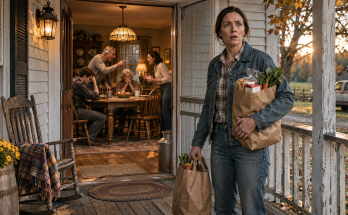
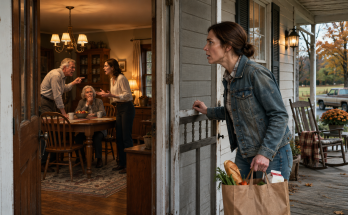
Until the day I arrived carrying two bags of groceries.
But the biggest revelation was still waiting.
Evelyn called me one afternoon and asked me to come to Martin’s office.
When I arrived, she had a fresh valuation report.
“The holding company associated with your grandfather’s trust has undergone significant expansion,” she explained.
I sat down slowly.
“What does that mean for me?”
“The trust’s beneficial interest appears substantially more valuable than it was fifteen years ago.”
She turned the report toward me.
The preliminary estimate was staggering.
$12.4 million.
I stared at the figure.
“That’s mine?”
“Potentially the value attributable to your beneficial interest,” Martin clarified. “The final amount depends on the trust’s verified ownership, liabilities, and other legal issues.”
I leaned back and covered my face.
Thirty-nine million from my farm.
And now a possible twelve million more from the grandfather who had believed in me before anyone else.
But I didn’t feel victorious.
I felt heartbroken.
Because I would’ve traded every dollar of that inheritance for one more afternoon sitting in Grandpa’s workshop, listening to him explain why a broken watch was worth repairing.
Then came the call that changed my family’s future.
Investigators had obtained records linking Raymond to the disputed account activity.
Additional evidence supported allegations of forged documents and misappropriated funds.
Formal investigations began.
Financial institutions were notified.
And the civil disputes moved forward.
Ranata called me seventeen times that week.
I didn’t answer.
Then she appeared at my farmhouse.
I watched through the window as she climbed out of her expensive SUV.
She wasn’t wearing designer sunglasses.
She wasn’t smiling.
For the first time I could remember, my older sister looked frightened.
I opened the door but stayed on the porch.
“Fay,” she whispered. “Please.”
“What do you want, Ranata?”
Her eyes filled with tears.
“They’re investigating everything. Raymond says he’s not taking responsibility for what happened.”
I said nothing.
“He’s blaming me.”
“And are you innocent?”
She looked away.
That was my answer.
Then she began crying.
“I didn’t think it would become this big.”
I stared at her.
“Nearly two million dollars passed through an account using my name. You let Mom and Dad refinance their house. You intercepted Grandpa’s inheritance. And you demanded half the money from a farm you never helped me build.”
She wiped her cheeks.
“I was jealous.”
The simplicity of her answer stunned me.
“Jealous of what?”
“Of you!” she shouted.
“Grandpa admired you. Dad bragged about your determination. Everyone thought you were brave for buying that stupid farm. I had the perfect house, the perfect clothes, the perfect marriage, and somehow you still made me feel invisible!”
I looked at her for a long moment.
“Ranata, I never competed with you.”
She began sobbing harder.
“I know.”
I took a breath.
“You could have told me you were hurting. Instead, you spent fifteen years trying to make me look like a failure.”
She reached for my arm.
“Please tell them we worked everything out. Please make this stop.”
I gently stepped back.
“I can’t do that.”
“Fay, we’re sisters!”
“Yes,” I replied. “And that’s what makes this so much worse.”
Her face crumpled.
“You’re going to let them destroy my life?”
I looked directly into her eyes.
“No, Ranata. Your decisions brought us here. I won’t lie to protect them.”
She stood on my porch for another minute.
Then she turned and walked away.
I watched her leave.
And strangely, I didn’t feel satisfaction.
I felt free.
Over the following months, the financial investigations continued while Martin pursued the civil cases.
The original trust records helped defeat Raymond’s attempt to establish control over my grandfather’s assets.
Ranata’s claim to half my farm proceeds also collapsed after her supposed investment documents failed to withstand scrutiny.
The $39 million sale remained mine.
My parents’ disputed property transfer was challenged, and their ownership was ultimately restored.
Some money was recovered through frozen accounts and settlements.
Other losses remained difficult to trace.
The criminal proceedings took longer.
Eventually, Ranata and Raymond faced consequences for their roles in the fraudulent transactions, including court-ordered restitution.
But no legal victory could give my parents back the fifteen years they had spent worrying about a daughter who had never needed rescuing.
One evening, Dad called me.
“Fay, could you come over for dinner?”
I hesitated.
Then he added, “Just your mother and me.”
I agreed.
When I arrived, the porch light was glowing.
Mom opened the door before I could knock.
She hugged me so tightly I nearly dropped the flowers I’d brought.
“I’m sorry,” she whispered.
I held her.
“I know, Mom.”
Dad was waiting at the kitchen table.
There were three plates.
Three glasses.
And a framed photograph sitting in the center.
It was the picture he’d taken when I bought my farm fifteen years earlier.
Me, standing proudly in front of that little farmhouse.
Dirty boots.
Faded jeans.
The biggest smile on my face.
Dad picked up the photograph.
“Do you remember what I said that day?”
I shook my head.
He swallowed.
“I told you eighty acres were too much responsibility for a young woman on her own.”
I smiled sadly.
“I remember that part.”
He nodded.
“But I also remember what you told me.”
“What?”
He looked straight at me.
“You said, ‘Dad, I don’t need everyone to believe I can do it. I just need the chance to prove it to myself.’”
Tears filled my eyes.
Dad reached across the table and took my hand.
“Fay, I spent fifteen years believing somebody else’s story about you. And I never bothered asking you to tell me your own.”
His voice broke.
“That’s what I regret most.”
I squeezed his hand.
“Then ask me now.”
He smiled through his tears.
“Tell me about your farm.”
And I did.
For the next two hours, I told my parents everything.
The freezing mornings.
The broken tractors.
The seasons when rain threatened my crops.
The first profitable harvest.
The survey that changed everything.
The meetings with developers.
The years of saving and reinvesting.
And the day I finally signed the papers for $39 million.
Mom listened without interrupting.
Dad asked questions.
Real questions.
Questions nobody in my family had thought to ask for fifteen years.
When I finished, Mom wiped her eyes.
“I’m so proud of you.”
For some reason, those five words meant more than the balance in my bank account.
But there was one final thing I needed to do.
The following spring, I invited my parents to the five acres I’d kept around my farmhouse.
A new wooden building stood near Grandpa’s favorite old oak tree.
Dad stared at it.
“What’s that?”
I handed him a small envelope.
Inside was a photograph of the building and a printed description.
THE BENNETT FAMILY LEARNING CENTER
Established in loving memory of Arthur Bennett
Mom covered her mouth.
I explained that I’d used part of my farm sale proceeds to establish a charitable foundation.
The center would offer agricultural training, scholarships, and practical business education to young people from families who couldn’t afford those opportunities.
I’d also arranged for free financial literacy workshops.
Because after everything that happened, I’d learned how dangerous it could be when people were taught to trust blindly instead of understanding their own finances.
Dad looked toward the building.
“Your grandfather would have loved this.”
I smiled.
“I think so too.”
Then I handed Mom another envelope.
Inside were documents confirming that I’d paid off the remaining legitimate mortgage debt on their house, with everything properly reviewed by my attorney.
She stared at me.
“Fay, we can’t accept this.”
“Yes, you can.”
“But after everything…”
I gently interrupted.
“Mom, I’m not doing this because you believed Ranata. I’m doing it because I love you. And because I don’t want the rest of your retirement stolen by someone else’s choices.”
Dad began crying.
I hugged him.
And for the first time in years, our family felt like something worth rebuilding.
Not perfect.
Not untouched by betrayal.
But honest.
Later that afternoon, I walked alone to the old oak tree.
I carried Grandpa’s letter in my pocket.
The wind moved gently through the branches as I sat on the wooden bench beneath it.
For a while, I simply listened to the birds.
Then I unfolded the letter one last time.
Trust your work. Trust your heart. And never let anyone tell you what you’re worth.
I smiled through my tears.
“Grandpa,” I whispered, “I finally understand.”
Fifteen years earlier, I’d bought eighty acres with everything I had.
My family thought I was foolish.
My sister called me a failure.
People laughed at my old truck and worn clothes.
But I kept working.
Not because I wanted to prove them wrong.
Because I believed I was building something meaningful.
And in the end, the land became worth $39 million.
My grandfather’s trust was returned to its rightful protection.
My parents got their home back.
And the people who had spent years stealing from me finally had to face the truth.
But the greatest thing I recovered wasn’t money.
It was my voice.
For fifteen years, my sister had told my story for me.
She’d decided who I was, what I deserved, and how the people I loved should see me.
And I had let the lies pass because I thought silence was the same as peace.
I know better now.
Sometimes keeping the peace means allowing someone else to keep hurting you.
And sometimes the bravest thing you can do is finally tell the truth.
Six months later, I still drove my old pickup.
It had nearly 240,000 miles on it.
The driver’s seat was cracked.
The radio only worked when it felt like it.
And the passenger door needed an extra shove to close.
One afternoon, Dad stood beside it and laughed.
“Fay, you’ve got enough money to buy a hundred trucks. Why are you still driving this old thing?”
I smiled.
“Because it still runs.”
He laughed harder.
Then he said something that stayed with me.
“You know, sweetheart, I used to look at this truck and think it meant you hadn’t succeeded.”
He placed one hand on the faded hood.
“Now I look at it and realize I was judging the wrong things.”
I hugged him.
And as the sun began setting over the farmhouse, I thought about the afternoon that started everything.
Two bags of groceries.
A closed set of blinds.
A sister telling lies.
And a father asking how much money he’d already given me.
I had walked away from that porch believing I’d discovered the worst thing my family could do.
Instead, I’d begun a journey that uncovered fifteen years of deception and brought me back to the people who were willing to make things right.
I never got those fifteen years back.
But I stopped letting them steal another day.
And if there’s one lesson I hope my story leaves behind, it’s this:
Never judge someone’s success by the car they drive, the clothes they wear, or the money they choose not to show.
Some people spend their lives looking wealthy while secretly taking from others.
And some people spend their lives looking ordinary while quietly building something extraordinary.
My sister spent fifteen years trying to convince the world I was worthless.
But the moment the truth finally came out, I learned something no amount of money could ever teach me.
My worth was never hidden in that $39 million bank account.
It was in the woman who built a life with her own two hands, survived betrayal without becoming cruel, and chose to use her success to give other people a chance.
Because the greatest revenge isn’t becoming richer than the people who looked down on you.
It’s becoming someone their cruelty could never destroy.
THE END.