PART 2 (FINAL PART): THE PRICE OF A MOTHER’S LOVE
Rena set that black folder down in front of my son, and for the first time in his forty-three years, Porter looked at a restaurant bill like it might reach up and slap him.
I could see him through the window, leaning forward, squinting at the numbers.
Kenna stopped pouring her wine.
Then she grabbed the folder, flipped it open, and her mouth fell wide enough to catch flies.
I didn’t need to hear what she said.
I knew that expression.
It was the same one she’d worn when I told her I wasn’t giving them five thousand dollars for a bass boat.
My phone started ringing.
Porter.
I let it ring three times before answering.
“Mama, where are you?”
“Outside, honey. Getting some fresh air.”
“Well, you need to come back in. There’s been a misunderstanding.”
“A misunderstanding?”
“The waitress brought us the bill.”
“Well, that sounds about right. You did eat supper, didn’t you?”
There was a silence.
Then Kenna’s voice came through, sharp enough to cut barbed wire.
“Tell her this isn’t funny, Porter!”
I looked through the window.
Rena was standing beside their booth with her hands folded in front of her apron.
Poor thing had probably heard worse at the hospital switchboard.
“Mama,” Porter said, lowering his voice, “you invited us. You said to order whatever we wanted.”
“That’s right.”
“So naturally, we assumed you were paying.”
I took a slow breath.
“Funny thing about assumptions, son. I assumed you were paying when you invited me out for my birthday.”
Another silence.
This one lasted longer.
Then Porter said something that nearly broke what was left of my heart.
“You’re still upset about that?”
Still upset.
As though leaving your widowed mother stranded at a restaurant with a $486 bill was something she ought to forget between Sunday church and Monday laundry.
“Yes, Porter,” I said. “I’m still upset.”
Kenna snatched the phone from him.
“LaVerne, this is childish. You’re embarrassing us in public over money you don’t even need!”
I looked down at my hands.
Thirty-four years of hospital switchboard work had left my fingers crooked and stiff.
Those hands had packed Porter’s school lunches, washed his baseball uniforms, held his daddy’s hand while the cancer took him, and signed every paycheck that kept our little family afloat.
And now my daughter-in-law was telling me what I needed.
“Kenna,” I said quietly, “how much is your supper?”
“That’s not the point!”
“How much?”
She hesitated.
“Six hundred and twelve dollars.”
I almost smiled.
“Well, isn’t that something? That’s a hundred and twenty-six dollars more than my birthday.”
“You set us up!”
“No, honey. I gave you the same invitation you gave me.”
She made a sound like a kettle boiling over.
Then the phone went dead.
I watched Porter rub his forehead.
Kenna started digging through her purse.
A minute later, Rena walked toward the front door.
She came outside and leaned against my car.
“Well?” I asked.
“Your boy says he only brought forty dollars cash, and his wife says her credit card’s nearly maxed out.”
I shook my head.
“That bass boat must be getting expensive.”
Rena chuckled, then grew serious.
“LaVerne, you sure you want to do this?”
I looked through the window again.
Porter was staring at his phone.
Kenna was pointing at something on the bill.
For a moment, I saw my little boy instead of the grown man.
The boy who used to run down the sidewalk with his backpack bouncing, shouting, “Mama, look what I made!”
The boy who climbed into my lap after his daddy died and promised he’d never leave me alone.
That memory nearly sent me back inside with my debit card.
Nearly.
“Rena,” I said, “you remember the night my husband died?”
She nodded.
“You were working beside me when the doctor called.”
“I remember.”
“After I hung up, I finished my shift. Six hours. Because somebody had to keep the lights on.”
Rena’s eyes softened.
“I remember that too.”
“I’ve spent my whole life making sure everybody else was comfortable. Tonight, I want my son to know what uncomfortable feels like.”
Rena reached through the window and squeezed my hand.
“Then stay right here.”
She went back inside.
Ten minutes later, Porter came out alone.
He walked toward my car with his shoulders hunched, looking older than he had when we’d arrived.
I rolled down the window.
“Mama, please. Kenna’s crying.”
“Is she crying because she hurt somebody or because she got a bill?”
He looked away.
“That’s not fair.”
“Neither was making your mother sit alone on her birthday wondering how she was getting home.”
He shifted his weight.
“I thought you could afford it.”
There it was.
Not an apology.
Not even a little shame.
Just a calculation.
“You know what I can afford, Porter?”
He didn’t answer.
“I can afford my electricity. My groceries. My medicine. And if I’m careful, I can afford a little trip to see your children on their birthdays.”
I reached into my purse and took out the old receipt.
The paper had softened along the folds.
I held it up.
“Four hundred and eighty-six dollars. I saved this because I wanted to remember the exact price of the night my son decided my feelings were cheaper than his dinner.”
Porter’s face changed.
“Mama…”
“And that text your wife sent? I saved that too.”
He swallowed.
“Kenna was joking.”
“Then why wasn’t I laughing?”
He had no answer.
For the first time that evening, he looked at me without asking for anything.
I pulled another envelope from my purse.
“This is what I actually invited you here to talk about.”
He glanced at it.
“The will?”
“Yes.”
His eyes moved toward the restaurant.
“Can we discuss it inside?”
“No. We can discuss it right here.”
I handed him the envelope.
Inside was a copy of a letter from my attorney, Mr. Whitcomb.
I’d visited him two weeks after my birthday.
He’d handled my husband’s estate, so he knew exactly what I had.
The house was paid off.
There was a small investment account, my savings, and the life insurance money I’d never touched unless I absolutely had to.
I wasn’t rich.
But I had enough.
Enough to make people suddenly interested in my health.
Enough to make a daughter-in-law smile when she wanted something.
Enough to make my son forget that I was a person and start seeing me as a bank account with gray hair.
Porter unfolded the paper.
I watched his eyes move down the page.
Then he looked up.
“You changed it?”
“I did.”
“But Mama, you promised the house would stay in the family!”
“It will.”
He blinked.
“What does that mean?”
“It means the house is going into a trust for your children. When they’re grown, they’ll have something solid to stand on.”
He stared at me.
“And what about me?”
I felt something heavy settle in my chest.
He hadn’t asked whether I was happy.
He hadn’t asked whether I was lonely.
He hadn’t asked whether I was scared of growing old alone.
He’d asked about himself.
“I’ve made arrangements for my remaining estate to be distributed according to the new will,” I said. “Most of it will help your children with their education and their futures. Some will go to the hospital assistance fund.”
“The hospital?”
“Yes. The same hospital where I worked for thirty-four years. Some families can’t afford their medical bills. I’d rather help them than buy somebody a boat.”
Porter stepped backward.
“You’re cutting me out?”
“I’m changing what happens to my money after I’m gone. I’m also making sure nobody can pressure me into handing it over while I’m alive.”
His eyes filled.
For one hopeful second, I thought he finally understood.
Then he said, “Kenna’s going to be furious.”
And just like that, the hope disappeared.
I laughed.
Not because it was funny.
Because sometimes, when something hurts badly enough, laughter is the only sound that comes out.
“Well, son, Kenna’s feelings seem to get plenty of attention in your house. Maybe tonight you can spare a thought for mine.”
He stared at the letter.
“What am I supposed to tell her?”
“The truth.”
“And the bill?”
I looked through the window.
Kenna had stopped crying.
She was sitting perfectly still, watching us.
I recognized that look.
She was waiting for Porter to fix things.
He always did.
And before him, I always had.
“You have a checking account, Porter.”
“Not enough in it.”
“Then use your credit card.”
“Kenna said…”
“Porter.”
He stopped.
“You’re a grown man. You ordered the lobster. You ordered the wine. You can figure out how to pay for it.”
He lowered his head.
I could see the little boy again.
The one who fell off his bicycle and came running for a kiss on his scraped knee.
Every mother knows that terrible feeling.
The instinct to fix everything.
To reach into her purse.
To make the hurt go away.
But I’d spent forty-three years fixing things for Porter.
And somehow, he’d never learned how to fix himself.
“I love you, son,” I said.
He looked up.
“Then why are you doing this?”
“Because loving you doesn’t mean letting you hurt me.”
He stood there for a long moment.
Then he turned and walked back inside.
I watched him go.
And I cried.
Not the loud kind of crying.
Just tears sliding down my cheeks while I sat in a cold parking lot with my hands on the steering wheel.
Five minutes later, Rena came outside again.
“Well, sugar,” she said, “your boy paid.”
“How?”
“He used his credit card. Had to call the bank to approve the charge.”
I nodded.
“And Kenna?”
“She asked whether the restaurant could split the bill into monthly payments.”
I almost choked laughing.
Rena laughed with me.
Then she reached into her apron and handed me a little white envelope.
“What’s this?”
“Your birthday present.”
Inside was a gift card to the steakhouse.
Fifty dollars.
And underneath it, a handwritten note.
Next time, come eat with somebody who’s happy you’re here.
That did it.
I cried so hard Rena had to open my car door and hug me.
“Lord, LaVerne,” she whispered, “you’ve got to stop apologizing for taking up space.”
I drove home slowly.
When I got inside, the house was quiet.
My husband’s photograph sat on the mantel.
I looked at him and said, “Well, Earl, I finally did something you always told me to do.”
I could almost hear his voice.
Stand up for yourself, woman.
The next morning, Kenna called.
I didn’t answer.
She left a voicemail saying I’d humiliated her, damaged the family, and ruined Porter’s relationship with his mother.
She said the children would be confused.
She said I should reconsider my will before I did something I’d regret.
I saved the voicemail.
Then I made myself scrambled eggs and sat on the porch with my coffee.
An hour later, Porter called.
This time, I answered.
“Mama,” he said, “Kenna says you’re not welcome at the house until you apologize.”
My heart dropped.
There it was.
The thing Rena had warned me about.
My grandbabies.
The two little faces on my refrigerator.
For a moment, I couldn’t speak.
Then I asked, “And what do you say, Porter?”
He was quiet.
I could hear a television in the background.
Finally, he whispered, “I don’t know.”
That hurt more than Kenna’s threats.
“Well,” I said, “when you figure it out, you know my number.”
I hung up before my voice broke.
The next six weeks were the loneliest of my life.
No Sunday dinners.
No little sneakers by my front door.
No drawings taped to my refrigerator.
Kenna posted pictures of family outings.
I saw them, but I didn’t comment.
Twice I picked up the phone to apologize.
Twice I put it down.
Because I hadn’t done anything wrong.
And I wasn’t going to teach my grandchildren that love meant accepting cruelty just to keep the peace.
Then, one Thursday afternoon, my doorbell rang.
It was Porter.
Alone.
He stood on my porch holding a brown paper grocery bag.
His eyes were red.
“Mama,” he said, “can I come in?”
I stepped aside.
He walked into the kitchen and set the bag on the table.
Inside were groceries.
Milk.
Bread.
Eggs.
A jar of peach preserves, the kind I like.
I stared at them.
“What’s all this?”
He swallowed.
“I didn’t know what to bring.”
I pulled out a chair.
“Sit down, son.”
He sat.
For a long time, neither of us spoke.
Then he reached into his pocket.
And placed a folded check on the table.
Four hundred and eighty-six dollars.
The exact amount of my birthday dinner.
“I should’ve brought this a long time ago,” he whispered.
I looked at the check.
Then at my son.
His chin was trembling.
“I’ve been thinking about that night,” he said. “About leaving you there. About how Dad would’ve felt if he’d known.”
His voice broke.
“I kept telling myself it was just money. But it wasn’t, was it?”
“No, baby,” I said softly. “It wasn’t.”
He wiped his eyes.
“Kenna and I have been fighting. She says you manipulated us. But every time I look at those kids, I keep thinking about what I’d feel if one of them treated me the way I treated you.”
He looked down at his hands.
“And I realized something worse.”
“What?”
“I’ve been letting Kenna talk to you like that for years. Because it was easier to stay quiet than stand up for you.”
I didn’t say anything.
He deserved the silence.
“I told her the kids aren’t bargaining chips,” he continued. “That she can be angry with you, but she can’t use them to punish you.”
I felt my throat tighten.
“And what did she say?”
“She said I had to choose.”
My heart stopped for a second.
“Porter…”
He shook his head.
“I told her I wasn’t choosing between my wife and my mother. I was choosing what kind of man I wanted to be.”
Then he started crying.
Not little polite tears.
He cried like the boy I’d once held through thunderstorms.
“I’m sorry, Mama.”
Those three words.
I’d waited seven weeks to hear them.
And now that they were here, I didn’t know what to do with them.
So I did what mothers do.
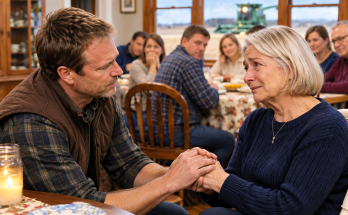
I reached across the table and took his hand.
“I forgive you,” I said. “But I need you to understand something.”
He nodded.
“Forgiveness doesn’t mean things go back to the way they were. You have to earn back my trust.”
“I know.”
“And I won’t be buying that boat.”
He laughed through his tears.
“No, ma’am.”
“And I’m not changing my will just because you’re sorry.”
He nodded again.
“I understand.”
I studied his face.
For once, I believed him.
Not because he brought groceries.
Not because he wrote a check.
But because he hadn’t asked me for a single thing.
Three days later, my grandchildren came over.
Porter brought them himself.
My granddaughter ran through the front door screaming, “GRANDMA!”
My grandson followed with a drawing of a purple dinosaur wearing cowboy boots.
I hugged them so tightly they both complained I was squishing them.
We made pancakes for supper.
We watched cartoons.
And when Porter came to pick them up, he stood in my doorway and said, “Same time next Sunday?”
I smiled.
“Same time next Sunday.”
Kenna didn’t come.
Not that week.
Not the next.
And I didn’t chase her.
I hoped someday she’d understand.
But I wasn’t going to buy her approval.
Then, three months after that awful birthday, something happened I never expected.
Rena called me on a Saturday morning.
“LaVerne, honey, you’ve got to come down to the steakhouse.”
“Why?”
“Just trust me.”
I drove over wearing my old blue cardigan.
When I walked through those doors, I stopped dead.
Porter was standing beside a table.
My grandchildren were there.
There were balloons tied to the chairs.
And in the middle of the table sat a chocolate cake.
On top, written in pink frosting, were the words:
HAPPY BIRTHDAY, MAMA. THIS TIME, IT’S ON ME.
I covered my mouth.
“Porter, my birthday was three months ago.”
He smiled.
“I know. But I figured we owed you a proper one.”
Rena came over carrying a pitcher of sweet tea.
“Don’t worry, sugar,” she said. “I checked his credit card before I let him decorate.”
Everybody laughed.
Then Porter pulled out my chair.
Not because I was old.
Not because I needed help.
But because he wanted to.
And for the first time in a long time, I felt like his mother again.
Not his emergency fund.
Not his retirement plan.
Not an inconvenience with a savings account.
His mother.
We ate steak.
We told stories.
The children got frosting on their noses.
And when the bill came, Porter picked it up before I even saw the total.
I didn’t offer to pay.
Not once.
Later, as we walked toward the parking lot, my grandson slipped his little hand into mine.
“Grandma?”
“Yes, sweetheart?”
“Daddy said you taught him something important.”
I looked at Porter.
He was buckling my granddaughter into her car seat.
“Oh, did he?”
My grandson nodded seriously.
“He said sometimes people have to learn how to be nice all over again.”
I squeezed his hand.
“That’s right, baby.”
Then he looked up at me with those big brown eyes.
“Grandma, are you still teaching Daddy?”
I smiled.
“Every day, sweetheart. Every day.”
That night, I went home and put the new birthday photograph on my refrigerator.
Right beside the picture of my grandbabies.
I took the old restaurant receipt out of my purse one last time.
Four hundred and eighty-six dollars.
A ridiculous amount of money for one supper.
But I didn’t throw it away.
I put it in a little wooden box beside my husband’s wedding ring.
Because sometimes a receipt isn’t just proof of what you paid.
Sometimes it’s proof of what you finally stopped allowing.
And the check Porter had written?
I never cashed it.
Instead, I framed it and placed it in the drawer of my bedside table.
Not because I wanted to shame him.
But because for the first time, my son had understood that an apology wasn’t something you said to get your way.
It was something you gave because you finally understood the hurt you’d caused.
A few weeks later, Porter asked me whether I was still leaving the house to the children.
I told him yes.
Then he smiled and said, “Good. They’ll take better care of it than I ever would.”
That was the moment I knew something had truly changed.
He could finally talk about my money without seeing it as his.
And as for Kenna?
She eventually sent a short apology.
I accepted it politely.
But I kept my boundaries, my bank account, and my house keys exactly where they belonged.
With me.
I’m seventy-two years old now.
I’ve buried a husband, raised a son, worked through more night shifts than I care to count, and learned that the people who love you can still hurt you terribly.
But I’ve also learned something I wish somebody had told me when I was thirty.
You can love your children with your whole heart without handing them your whole life.
You can forgive somebody without giving them permission to hurt you again.
And you can be a good mother without being everybody’s fool.
That first birthday dinner cost me $486.
The second cost my son $612.
But the lesson we both learned?
That was worth more than everything I owned.
Because the greatest gift my son finally gave me wasn’t a steak dinner, a birthday cake, or even an apology.
It was the day he stopped looking at me as the woman who would always pay the price and started seeing me as the woman who deserved to be loved.
And if Earl were still here, I believe he’d look at that little wooden box, smile his crooked smile, and say, “Well, LaVerne, looks like you finally got your money’s worth.”
THE END.