PART 2: THE LAST PROMISE MAMA MADE
Daddy unfolded the yellowed letter with trembling fingers, and for the first time in thirty-two years, I saw something in his eyes I hadn’t seen since Mama’s funeral.
Courage.
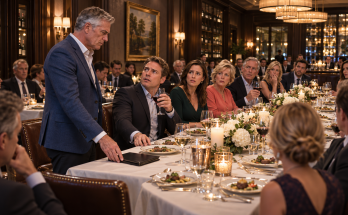
Dane stood at the head of the Thanksgiving table, still holding his wineglass, but the smile had disappeared from his face.
“Dad, what’s going on?” he demanded.
Daddy didn’t answer right away.
Instead, he smoothed Mama’s letter against the tablecloth and looked at the family gathered around him.
“Your mother wrote this three days before she died,” he said quietly. “She told me to keep it until the day somebody tried to take this farm away from Olive.”
Charla crossed her arms.
“That’s ridiculous. We have signed paperwork.”
Daddy looked at her.
“Then somebody sold you something they didn’t own.”
The room went completely silent.
Dane lowered his glass.
“What are you talking about?”
Daddy took a slow breath and began reading.
“To my children, if you’re hearing this, then I’m afraid the thing I worried about most has finally happened.”
My throat tightened.
I remembered Mama sitting at the kitchen table during her final weeks, writing letters between her treatments. She had always been careful with her words, but I never knew she’d written one specifically for this moment.
Daddy continued.
“This farm was built with the hands of people who loved it. My parents sacrificed to keep it, and I worked alongside your father for forty years to make sure neither of our children would ever go hungry.”
Dane shifted impatiently.
“Dad, we don’t need a history lesson.”
Daddy raised one hand.
For a ninety-three-year-old man who needed help getting out of his chair, that small gesture carried surprising authority.
“You’ll listen to your mother,” he said.
And Dane sat down.
Daddy continued reading.
“When I became sick, I watched my daughter leave her own troubles at the door every morning to help us. I watched her work through nights, storms, broken equipment, and years of exhaustion without asking for anything in return.”
Tears blurred my vision.
Mama had noticed.
All those years, I’d thought she was too sick to understand how hard things had become.
“I also watched my son build a life elsewhere,” Daddy read. “I never resented him for leaving. A child deserves to choose his own road. But choosing a different road does not give him the right to claim the one his sister spent her life maintaining.”
Dane’s jaw tightened.
“That’s not fair.”
Daddy kept reading.
“I have left the farm to Olive, subject to her father’s lifetime right to live in the farmhouse. This is not punishment for Dane. It is recognition of what Olive has already given.”
Then Daddy stopped.
His eyes filled with tears.
There was one final paragraph.
“If my son ever stands in this house and tells my daughter she no longer belongs here, I want him to understand something. He may share our blood, but love is not measured by a family name. It is measured by who stays when staying becomes difficult.”
Daddy folded the letter.
Nobody moved.
Even Charla had stopped checking her phone.
Finally, Dane let out a bitter laugh.
“Fine. Mom wrote a sentimental letter. That doesn’t change a legal document.”
“No,” I said quietly. “It doesn’t.”
I stood up and walked to the old oak cabinet beside the kitchen doorway.
Inside the bottom drawer, beneath Mama’s church cookbooks, was a metal document box.
I had kept it there for more than three decades.
When I returned to the table, I placed the box in front of Dane.
“Open it.”
He stared at me.
“What’s this supposed to be?”
“The documents you should’ve asked to see before selling somebody else’s property.”
Inside were Mama’s will, the probate records, and the recorded deed showing that the farm belonged to me, subject to Daddy’s lifetime right to live there.
Dane picked up the first document.
His eyes moved across the page.
Then he read it again.
His face changed.
“1994?” he whispered.
“That’s when Mama died,” I said.
“But Dad…”
“Daddy has the right to live here until his last day. He doesn’t have the right to sell it.”
Dane turned toward him.
“You told me it was yours!”
Daddy lowered his head.
“I let you believe it was.”
“For thirty-two years?”
“Yes.”
“Why?”
Daddy looked at me before answering.
“Because I was afraid you’d stop coming home if you knew.”
That sentence hurt more than anything Dane had said all afternoon.
My father had spent thirty-two years protecting a son’s feelings while asking his daughter to carry the burden of his silence.
And I had agreed.
Because sometimes the people who stay become so accustomed to keeping peace that they forget what peace actually costs them.
Charla suddenly reached for the manila envelope she’d brought from the car.
“Wait,” she said sharply. “We already signed an agreement with the developer. There’s a deposit involved.”
I looked at her.
“How much?”
She hesitated.
Dane answered.
“Seventy-five thousand.”
Laurel sat up straight.
“Seventy-five thousand dollars?”
“We were going to use it toward a condo,” Charla snapped. “The developer was supposed to finish everything after the holidays.”
I felt the room tilt.
They hadn’t just promised to sell my farm.
They had already taken money for it.
“Did you spend it?” I asked.
Dane wouldn’t meet my eyes.
Charla’s expression told me everything.
I sat down slowly.
“Tell me exactly what you signed.”
Dane pushed the envelope across the table.
Inside was a purchase agreement naming him as the seller and Daddy as the property owner.
There was also a paper with Daddy’s signature.
Or something that looked like it.
I examined it carefully.
“Daddy, did you sign this?”
He put on his glasses and leaned forward.
“I signed something Dane brought me last Tuesday. He said it was about updating my insurance.”
My stomach dropped.
Dane stared at the floor.
“You told him it was insurance?” I asked.
He didn’t answer.
“Look at me, Dane.”
He finally raised his eyes.
I had known my brother for seventy years.
I knew his childhood grin, his stubborn temper, and the little twitch in his cheek that appeared whenever he lied.
That twitch was there now.
“I didn’t think it mattered,” he muttered. “Dad always said the farm would come to me.”
“But you knew you were asking him to sign something he didn’t understand.”
Charla grabbed Dane’s arm.
“We need to leave.”
“No,” Daddy said.
His voice was so firm that everyone froze.
“You sit right there.”
And then he said something I never expected to hear.
“Olive, I’m sorry.”
I looked at him.
His eyes were wet.
“I should’ve told your brother the truth when your mother died. I made you carry a secret that wasn’t yours to carry. And because I was too afraid to disappoint him, I let him believe he could push you out of your own home.”
“Daddy…”
“No, girl. Let me finish.”
He reached across the table and took my hand.
“You’ve fed me, cared for me, kept this farm alive, and never once asked me to choose between my children. But today I should’ve chosen the truth before you had to ask.”
I started crying.
Not because of the farm.
Not because of the money.
But because after thirty-two years, somebody had finally said aloud what it had cost me to stay.
Dane pushed back his chair.
“So that’s it? Olive gets everything, and I’m the villain?”
I wiped my cheeks.
“No, Dane. You became the villain in your own story the moment you told me to leave a home that was never yours.”
He looked wounded.
For a moment, I almost apologized.
That old habit rose inside me, the same one that had made me swallow every insult at Christmas and every complaint about how I ran the farm.
But then I remembered Charla calling Mama’s sewing machine junk.
And I remembered my brother raising his glass while telling me I had until spring to disappear.
So I said nothing.
Laurel quietly gathered the documents.
“Mom, I’m calling Mr. Whitaker tomorrow.”
Mr. Whitaker was the attorney who had helped Mama settle her affairs. His daughter now ran the practice.
“Good,” I said.
Charla stood up.
“You can’t seriously expect us to repay that deposit.”
I looked her straight in the eye.
“I expect you to deal with whatever you promised. I never authorized a sale, and neither did my mother.”
“You could help us,” Dane said.
There it was.
The request I had somehow known was coming.
He had tried to sell my property.
He had humiliated me in front of my children and grandchildren.
And now, with the scheme collapsing around him, he wanted me to rescue him.
“How?” I asked.
“Sell a few acres. Just enough to cover what we owe.”
I looked toward the kitchen window.
Beyond the glass, the old red barn stood against the gray November sky.
Mama had painted that barn herself one summer when Dane and I were children.
I could still remember her standing on the ladder, calling down for us to stop fighting over the paintbrush.
“No,” I said.
Dane blinked.
“What?”
“No. I’m not selling one foot of Mama’s land to cover a deal you made behind my back.”
His face hardened.
“After everything I’ve done for this family?”
Daddy gave a tired, humorless laugh.
“Son, name one fence you’ve fixed.”
Dane opened his mouth.
Nothing came out.
“Name one winter you’ve hauled feed through the snow,” Daddy continued. “One property tax bill you’ve paid. One night you’ve stayed up because the roof was leaking or the cows were sick.”
“Dad, I have a career!”
“And Olive had a life,” Daddy replied. “She gave most of it to this place and to us.”
That was the moment Dane finally stopped arguing.
He looked around the table.
At Laurel.
At her boys.
At the faded wallpaper Mama had chosen.
At the family he’d expected to applaud when he announced his victory.
And he realized nobody was on his side.
Charla took her purse.
“We’re leaving.”
Dane stood up, but Daddy spoke again.
“Before you go, there’s one more thing.”
He reached into the same shirt pocket and pulled out a small brass key.
I recognized it immediately.
It belonged to Mama’s cedar chest upstairs.
“Your mother left something else,” he said.
Dane’s eyes widened.
“What?”
Daddy placed the key in front of him.
“Go upstairs and look.”
For the first time that afternoon, my brother looked hopeful.
He hurried toward the stairs.
Charla followed him.
A few minutes later, we heard the old chest creak open.
Then silence.
When Dane returned, he was carrying a small wooden box.
Inside were photographs, a child’s baseball glove, and a handwritten note.
Mama had saved every photograph of Dane playing baseball.
Every report card.
Every birthday card he’d made.
Even the crooked little wooden birdhouse he’d built for her when he was nine.
There was no money.
No jewelry.
No secret inheritance.
Just a lifetime of love packed into a cedar chest.
Dane unfolded the note.
I watched his expression change as he read.
Then his shoulders began to shake.
He sat down heavily.
“What does it say?” Charla demanded.
Dane didn’t answer.
Instead, he handed the note to me.
Mama’s words were short.
“My dear boy, if you ever think I loved your sister more because I left her the farm, I want you to open this box. She was the one who stayed to protect the land. But you were never loved any less. I saved these things because they remind me of the little boy who used to run through the fields and bring me wildflowers. I hope you never become so busy chasing what you think you deserve that you forget what you already have.”
I couldn’t finish reading aloud.
Dane was crying now.
Not loudly.
Just quietly, with his face in his hands.
And for the first time all day, I saw my little brother instead of the angry man who had threatened to throw me out.
But love didn’t erase what he’d done.
And I knew it couldn’t.
The following Monday, Laurel and I met with the attorney.
She reviewed Mama’s will, the probate records, and the deed.
Then she examined the papers Dane had signed with the developer.
Her conclusion was clear: Dane could not convey ownership of my farm, and Daddy’s lifetime interest did not give him the power to transfer my title. The purchase agreement still needed to be formally addressed, and the signature obtained from Daddy required careful examination.
She sent written notice disputing the proposed sale and warning the developer that neither Dane nor Daddy owned the full property.
The developer’s lawyer contacted us two days later.
After reviewing the records, the developer stopped the transaction and demanded that Dane resolve the deposit and his representations under their agreement.
That was Dane’s problem.
Not mine.
For the first time in my life, I allowed a problem to remain where it belonged.
December came.
Then Christmas.
Dane didn’t call.
Daddy sat beside the living room window on Christmas morning, watching the lane.
“He’ll come around,” I told him.
Daddy shook his head.
“Maybe. But I won’t ask you to give up your peace to make it happen.”
I kissed his forehead.
That was the best Christmas gift he’d ever given me.
In January, Dane called.
His voice sounded different.
Tired.
Smaller.
“Olive, I’ve been wanting to talk.”
I listened.
He told me he and Charla had entered into an agreement to repay the developer’s deposit over time, with the details handled by their attorneys.
He said they’d sold their second car and canceled a vacation they’d planned for spring.
Then he fell silent.
I waited.
Finally, he whispered, “I’m sorry.”
I closed my eyes.
Those two words had taken him thirty-two years to say.
“I’m sorry I tried to take the farm,” he continued. “I’m sorry I embarrassed you. And I’m sorry I let myself believe being the son meant I deserved more than you.”
I looked out at the snow-covered pasture.
“Thank you for saying that.”
“Do you think you can forgive me?”
I took a long breath.
“I think I can, Dane. But forgiveness doesn’t mean we go back to pretending nothing happened.”
“I know.”
“And you will never make decisions about this farm again.”
“I understand.”
There was another pause.
Then he asked something that surprised me.
“Would you let me come help with the spring fencing?”
I almost laughed.
Dane hadn’t held a fence stretcher in nearly fifty years.
“You’ll get muddy,” I warned.
“I probably deserve to.”
For the first time since Thanksgiving, we both laughed.
And when April arrived, my brother came back to the farm.
Not wearing a suit.
Not carrying a manila envelope.
Not bringing a buyer.
He arrived in an old flannel shirt and work boots.
He helped Laurel’s boys replace broken fence posts along the back pasture.
He worked slowly.
He complained about his knees.
And by lunchtime, he had blisters on both hands.
Daddy watched him from the porch.
“Your brother finally remembers which end of a shovel goes in the ground,” he told me.
I smiled.
“Only took him about fifty years.”
That afternoon, Dane walked with me to Mama’s grave beneath the maple tree at the edge of the property.
He stood there for a long time.
Then he knelt and placed a handful of wildflowers beside the stone.
“She really did love me,” he whispered.
“Of course she did.”
“I thought the farm was proof she didn’t.”
I looked across the rolling fields.
“No, Dane. The farm was never a prize. It was a responsibility.”
He nodded slowly.
“I think I’m starting to understand.”
We stood together until the wind grew cold.
Then he reached into his coat pocket.
My stomach tightened when I saw another envelope.
But this one wasn’t filled with contracts.
It held a photograph.
Mama standing in front of the barn, smiling with both her children beside her.
Dane on one side.
Me on the other.
He handed it to me.
“I found another copy in that box. I thought you should have it.”
I stared at Mama’s face.
She looked so young.
So happy.
And for a moment, I could almost hear her calling us inside for supper.
That evening, Daddy sat at the kitchen table while I made coffee.
Dane was outside helping Laurel’s boys put away the tools.
Daddy watched them through the window.
“Your mother would be happy,” he said.
“Would she?”
He nodded.
“She didn’t leave you the farm because she wanted you and your brother to stop loving each other. She left it to you because she trusted you to protect it.”
I took his hand.
“And I will.”
Daddy smiled.
“I know, Olive. I know.”
That summer, I had a new sign made for the entrance to the property.
Not a FOR SALE sign.
Not a sign announcing a housing development.
A simple wooden sign, painted green and white, with Mama’s favorite flowers carved along the edges.
It read:
MARGARET’S FARM
EST. 1948
ROOTED IN LOVE. KEPT BY THE HANDS THAT CARE.
When Dane saw it, he stood in front of it for a long time.
Then he said, “That’s exactly what she would’ve wanted.”
I smiled.
“I think so, too.”
The next Thanksgiving, we gathered around the same table.
Daddy was ninety-four.
Laurel made the sweet potatoes.
Her boys helped bring in the chairs.
And Dane arrived two days early to help me prepare.
Charla came with him, quieter than before. She apologized to me privately for what she’d said about my belongings, and I accepted her apology without pretending we were suddenly close.
Some wounds heal slowly.
Some trust has to be earned back one ordinary day at a time.
Before dinner, Dane stood and raised his glass.
For one brief second, my heart jumped.
I remembered the previous Thanksgiving.
The humiliation.
The threat.
The silence.
But this time, my brother wasn’t smiling with arrogance.
He was looking at me.
“Last year,” he said, “I stood at this table and told my sister she had until spring to leave.”
Nobody moved.
“I was wrong. I tried to sell something that didn’t belong to me, and I treated the person who kept this family together like she was standing in my way.”
His voice cracked.
“Olive, I can’t give you back the years I spent taking you for granted. But I can spend the years I have left showing you that I understand what you’ve done.”
He raised his glass a little higher.
“To my sister. The rightful owner of this farm. And the strongest person I’ve ever known.”
Laurel started crying.
Daddy covered his face with his hand.
And I stood up.
Not because I needed to make a speech.
But because there was something I wanted my family to hear.
“Mama once told me that land remembers the people who care for it,” I said. “Every fence post, every tree, every stone carries a little piece of somebody’s life.”
I looked at Dane.
“I don’t need you to repay me for the years I stayed. I just need you to remember that those years mattered.”
He nodded through his tears.
“They did, Olive. They always did.”
Then Daddy reached for my hand.
“Your mama would be proud of you,” he whispered.
And I finally believed him.
That night, after everyone had gone home and the dishes were washed, I walked across the lane to my little house.
My husband’s old barn coat was still hanging by the door.
Mama’s sewing machine still sat beneath the window.
And beyond the glass, the farmhouse glowed softly against the dark Pennsylvania hills.
Nothing had been sold.
Nothing had been taken.
And nobody was going to tell me to leave.
I sat in Mama’s old rocking chair and looked at the photograph Dane had given me.
For thirty-two years, I had protected my brother from the truth because Daddy was afraid the truth would break his heart.
But keeping that secret had almost broken mine.
Now I understood something Mama had known all along.
You can love your family without surrendering what belongs to you. You can forgive someone without giving them permission to hurt you again. And you can keep the door open without handing over the keys.
My brother came to Thanksgiving with a contract worth $900,000 and thought he was about to become rich.
But he walked away learning something money could never buy.
And I learned something just as important.
I wasn’t selfish for protecting the home I’d spent my life caring for. I wasn’t cruel for saying no. And I wasn’t less of a daughter because I finally stopped sacrificing myself to keep everyone else happy.
Mama left me a farm.
But the greatest inheritance she gave me wasn’t the land, the barn, or the house.
It was the courage to stand at my own family’s table and say:
“I belong here. I always have. And I am not leaving.”
THE END.