PART 5: THE SECOND BABY, THE STOLEN IDENTITY, AND MY MOTHER’S FINAL LIE
The words my mother had spoken outside my window kept repeating in my head.
“Get rid of the hospital records from the night Emily was born. Nobody can find out there were two babies.”
Two babies.
For thirty-four years, I had believed I knew who I was. I knew my birthday, my childhood, my family, and the story of how I came into this world.
But standing in my living room, watching the police question my mother beside her car, I realized something terrifying.
I didn’t even know whether I had been born alone.
I called Richard immediately.
“There’s something you need to hear,” I whispered.
I sent him the security recording.
Twenty minutes later, he called back.
“Emily, don’t confront anyone about this yet. I’m going to help you request the hospital records, but I need you to understand something. Whatever we find, your life is about to change.”
I looked toward Norah’s bedroom.
“My life already changed the moment my mother tried to steal my daughter’s home.”
Richard was silent for a moment.
Then he said, “Your grandmother may have left us one final clue.”
The following morning, I met Daniel at Richard’s office.
He looked exhausted.
When I played him the recording, he covered his mouth with one trembling hand.
“Two babies,” he whispered.
I stared at him.
“You knew?”
He shook his head.
“No, sweetheart. But I remember something about the night you were born.”
My heart pounded.
“Tell me.”
“Your mother went into labor early. I was working out of town, and by the time I reached the hospital, she’d already delivered. A nurse told me there had been complications and that one baby needed special care.”
I gripped the edge of my chair.
“One baby?”
Daniel nodded slowly.
“I thought she meant you. Margaret told me you were the only child. I never questioned it.”
Richard opened a folder on his desk.
“Your grandmother kept copies of nearly everything. Among her records, I found an old hospital invoice.”
He slid a yellowed paper toward me.
There were two newborn identification numbers.
Two separate charges for neonatal care.
And beside them, two handwritten names.
Baby Girl Whitmore A.
Baby Girl Whitmore B.
My stomach dropped.
“Girls?”
Richard nodded.
“Emily, the records suggest you may have had a twin sister.”
I couldn’t breathe.
A twin sister.
Someone who might have my eyes.
My smile.
My childhood memories that should have belonged to both of us.
“Where is she?” I whispered.
Richard hesitated.
“We don’t know yet.”
Daniel reached for my hand.
“But we’re going to find her.”
For the first time, I believed him.
Because unlike the people who had raised me, Daniel didn’t make promises to control me.
He made them because he intended to keep them.
Over the next several weeks, the truth began emerging from records my mother had spent decades believing nobody would examine.
The hospital confirmed that two girls had been born that night.
One had gone home with Margaret.
The other had been placed with a family through an adoption arrangement that raised serious questions about consent and documentation.
Daniel’s signature appeared on forms he insisted he’d never seen.
An independent document examination later supported his claim that those signatures had been forged.
And then came the discovery that left even Richard speechless.
The adoption paperwork contained the name of the receiving family.
Harrison.
I knew that name.
I had seen it on the back of one of Grandma’s photographs.
A picture of two newborn girls, lying side by side beneath pale pink blankets.
On the reverse, Grandma had written:
Emily and Grace. Together for their first seven days. God willing, together again someday.
I cried so hard I could barely hold the photograph.
Grace.
My sister had a name.
And for the first time in my life, I knew what had been missing.
Richard helped arrange a lawful search through the adoption records.
Three weeks later, we found her.
Grace Harrison was thirty-four years old.
She lived two hours away.
She was married, had a little boy, and worked as an elementary school teacher.
When Richard contacted her, she thought there had been a mistake.
Then she saw the photograph.
And she started crying.
Our first meeting happened in a quiet café.
I arrived early, my hands trembling around a cup of untouched coffee.
Then the door opened.
A woman stepped inside wearing a blue sweater and carrying a small handbag.
She looked around nervously.
And I saw my own face looking back at me.
Not exactly.
Her hair was shorter. Her smile was softer.
But the resemblance was unmistakable.
“Emily?” she whispered.
I stood up.
“Grace?”
She covered her mouth.
Then she ran toward me.
We held each other in the middle of that café while strangers quietly looked away.
“I always felt like someone was missing,” she sobbed against my shoulder.
“So did I.”
For thirty-four years, we had lived separate lives.
Two little girls divided by decisions neither of us had made.
But the moment I held her, something inside me finally felt whole.
And yet, the most difficult truth was still waiting.
The investigation into Grandma’s death uncovered something nobody expected.
The original emergency call had been made nearly forty minutes after the time my mother claimed to have found her.
Medical records confirmed Grandma had suffered a serious head injury, but investigators could not establish that someone had deliberately caused her fall.
What they did uncover was evidence that my mother had taken financial documents from Grandma’s house that night.
My father eventually admitted that Margaret had returned home carrying a box of papers and had ordered him never to mention it.
He also admitted helping conceal several financial transactions.
For the first time in his life, he stopped protecting her.
“I can’t undo what I did,” he told investigators. “But I’m done lying.”
The financial investigation revealed years of forged signatures, unauthorized transfers, and money diverted from accounts intended for me.
Some had been used to support my parents’ lifestyle.
Some had funded Ava’s business.
And some had simply disappeared into accounts my mother controlled.
The evidence was overwhelming.
My mother faced criminal charges related to the forged documents, financial misconduct, and concealment of records.
The investigation into Grandma’s death remained separate, and no one claimed to have proved a murder.
But one thing became painfully clear.
My mother had lied about nearly everything surrounding Grandma’s final days.
When I learned she had been arrested on the financial charges, I felt no satisfaction.
Only exhaustion.
I had spent my entire childhood begging for her approval.
Now I finally understood that no amount of obedience could have made her love me the way I deserved.
Months later, the civil court confirmed that Grandma’s trust protected my interest in the family property.
The fraudulent agreement my parents had used to evict me was rejected.
The court also ordered restitution for the misappropriated funds, although recovering everything would take time.
For the first time, nobody could simply decide that Norah and I didn’t belong in our own home.
And then came the day I had dreaded.
My mother asked to see me.
I almost refused.
But there was one question I needed answered.
So I went.
She sat across from me in the visitation room, looking smaller than I remembered.
Her perfectly styled hair was gone.
So was the commanding voice that had ruled our family.
For a long moment, neither of us spoke.
Then she whispered, “Emily, I never meant for things to go this far.”
I looked at her.
“You gave away my twin sister.”
Her eyes filled with tears.
“You don’t understand. We couldn’t afford two babies. I was young, and I was scared.”
“Daniel wanted us both.”
She looked away.
“Your grandmother would have helped you.”
Silence.
“And you stole the money she left me.”
My mother began crying.
“I made mistakes.”
I shook my head.
“A mistake is forgetting a birthday. A mistake is saying something cruel and regretting it. You forged my name, hid my father, separated me from my sister, and tried to take the only home my sick daughter had.”
She lowered her head.
“I was your mother.”
I felt tears burn behind my eyes.
“Yes,” I whispered. “That’s what made it hurt so much.”
She reached toward the glass.
“Can you forgive me?”
I studied her face.
For years, I had imagined this moment.
I thought forgiveness would feel like victory.
But sitting there, I finally understood something.
Forgiving someone doesn’t mean inviting them back into the life they nearly destroyed.
“I hope one day I can forgive you,” I said quietly. “But you don’t get to hurt my daughter just because you gave birth to me.”
My mother started crying harder.
I stood up.
“Goodbye, Mom.”
And for the first time, I walked away without feeling guilty.
Ava eventually admitted her role in the forged eviction agreement and cooperated with the investigation.
She lost her business, moved into a small apartment, and began rebuilding her life.
One afternoon, she came to the carriage house carrying a handwritten apology.
I listened.
I accepted the apology.
But I didn’t give her a key.
Some relationships can heal.
Others need distance before healing is even possible.
My father began counseling and took responsibility for his part in the deception.
I didn’t immediately welcome him back into my life.
Trust, I told him, wasn’t something he could ask for.
It was something he would have to earn.
Daniel, however, became part of our everyday world.
He taught Norah how to build birdhouses in the backyard.
He helped repair the old porch.
And every Sunday, he came over for dinner with Grace and her family.
Sometimes I watched him with my daughter and wondered how different my childhood might have been if we’d found each other sooner.
But I refused to spend the rest of my life mourning years I couldn’t get back.
Instead, I chose to treasure the ones we still had.
One beautiful spring morning, almost a year after that terrible courtroom hearing, we gathered in the backyard.
Grace brought her husband and little boy.
Daniel brought a wooden swing he’d made himself.
Norah ran barefoot through the grass, laughing with her cousin.
Her health had improved, and her doctors were hopeful about her recovery.
The sun shone through the trees Grandma had planted decades earlier.
And for the first time in years, the property didn’t feel like a battlefield.
It felt like home.
Richard arrived carrying one final envelope.
“I thought you should have this,” he said.
Inside was a letter Grandma had written shortly before she died.
It had been stored with her attorney’s sealed records.
I unfolded it carefully.
My darling Emily,
If there is one thing I hope you remember, it’s that love should never require you to make yourself smaller.
You have spent too much of your life trying to earn what should have been given freely.
One day, you may discover things about our family that hurt you deeply. When that happens, please remember that the cruelty of others does not determine your worth.
This little house was always meant to be your safe place.
Not because you are weak.
But because even the strongest people deserve somewhere they can rest.
And if you ever have a daughter of your own, teach her something I wish I had taught your mother.
Family is not measured by blood, obedience, or sacrifice.
Family is measured by the people who make you feel safe enough to be yourself.
With all my love, Grandma.
By the time I finished reading, tears were falling onto the paper.
Norah climbed onto my lap.
“Mommy, why are you crying?”
I smiled through my tears.
“Because Grandma loved us very much.”
She looked around the yard.
At Daniel.
At Grace.
At the little boy laughing beneath the trees.
Then she wrapped her arms around my neck.
“Mommy, do you remember when Grandma tried to take our house?”
I nodded.
“How could I forget?”
Norah thought for a moment.
“I’m glad I showed the judge my video.”
I kissed her forehead.
“So am I, sweetheart.”
She smiled proudly.
“I was scared, but I did it anyway.”
I held her close.
“You were braver than all the grown-ups in that courtroom.”
Then she asked a question that made me laugh and cry at the same time.
“Does that mean I saved our family?”
I looked around at the people who had chosen to love us.
The father who had waited decades to hold me again.
The sister I had never known existed.
The daughter who had given me a reason to fight when I had almost given up.
And I finally knew the answer.
“No, sweetheart,” I whispered. “You didn’t save the family we had.”
I kissed her cheek.
“You helped us find the family we deserved.”
That evening, as the sun disappeared behind Grandma’s trees, I stood on the porch of the little carriage house I had rebuilt with my own hands.
A year earlier, my parents had dragged me into court because they believed I was the easiest person in the family to sacrifice.
They thought I would lower my head.
Pack my belongings.
Take my daughter by the hand.
And disappear quietly so Ava could have the life she wanted.
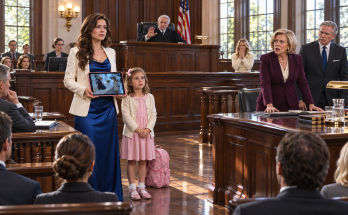
Instead, one frightened seven-year-old girl had pressed play on a tablet.
And that tiny act of courage uncovered thirty-four years of lies.
My mother lost the power she had used to control us.
My father was finally forced to face his choices.
My stolen inheritance began finding its way home.
And the sister I never knew I had was now sitting at my kitchen table, laughing with the daughter who had started it all.
I looked up at the stars and whispered, “We made it, Grandma.”
Then I closed the door.
Not to shut the world out.
But because, at last, everyone inside belonged there.
My parents took me to court to steal my home. They never imagined that the little girl standing beside me would uncover the truth, return my family to me, and teach us all that the most powerful voice in the room sometimes belongs to the smallest person.
THE END.