At a packed restaurant, my son-in-law grabbed my daughter by the hair and humiliated her in front of everyone. Then his mother smiled and cheered, “That’s how it’s done! She needs to learn her place.” My daughter fell apart in tears, and I rose from my seat trembling with rage. The restaurant was called Marigold & Ash, the kind of Boston place where the lighting was gentle, the wineglasses were delicate, and people spoke as though good manners had been printed right onto the menu. My daughter, Emily Whitaker, sat across from me with her hands wrapped around a glass of water she had not touched. She was twenty-eight, beautiful in an exhausted way, with brown hair falling over one shoulder and a smile she had been forcing since we arrived. Beside her sat her husband, Brent Callahan, a broad-shouldered man wearing an expensive watch and a small cruel smirk that appeared whenever anyone else spoke too long. His mother, Diane Callahan, sat beside him like a queen claiming her throne. Pearls at her throat, red lipstick sharp as a blade, eyes constantly weighing my daughter. I had come to dinner because Emily asked me to. “Please, Mom,” she had whispered over the phone. “Just be calm tonight. Brent wants both families to try again.” Try again. The phrase tasted bitter as I watched Brent interrupt her for the sixth time. “She forgets things,” he told the table, laughing. “Bills, appointments, basic instructions. I swear, living with Emily is like managing a teenager.” Emily’s face flushed. “That’s not true,” she said softly. Brent turned his head slowly. “Excuse me?” The silence around the table pulled tight. Emily swallowed. “I said that’s not true. I handle the rent, the groceries, your dry cleaning, the insurance—” Before she could finish, Brent’s hand shot out. He seized a fistful of her hair near the back of her head and yanked. Emily cried out, sharp and broken. Her chair scraped against the floor. Several diners turned. A waiter froze beside a nearby table, balancing a tray of plates in both hands. Brent leaned close to her ear, still gripping her hair. “Don’t embarrass me in public.” For one second, the entire world went perfectly still. Then Diane clapped. She actually clapped. “That’s how it’s done!” she said, smiling with pride. “She needs to learn her place.” Tears filled Emily’s eyes. She looked at me, not like a grown woman asking for help, but like the little girl who used to run into my arms after nightmares. Something inside me turned cold. I stood up slowly. Brent looked at me with lazy amusement. “Sit down, Linda.” I reached into my purse, took out my phone, and set it on the table. Then I said, loud enough for every person in that restaurant to hear, “Let go of my daughter, or the next voice you hear will be the police dispatcher listening to me report an assault in progress.” Brent laughed. “You wouldn’t dare.” I tapped the screen. “911, what is your emergency?” The color drained from his face. I looked straight into his eyes and said, “My son-in-law has just assaulted my daughter in a public restaurant. He is still touching her. We need police at Marigold & Ash on Hanover Street.”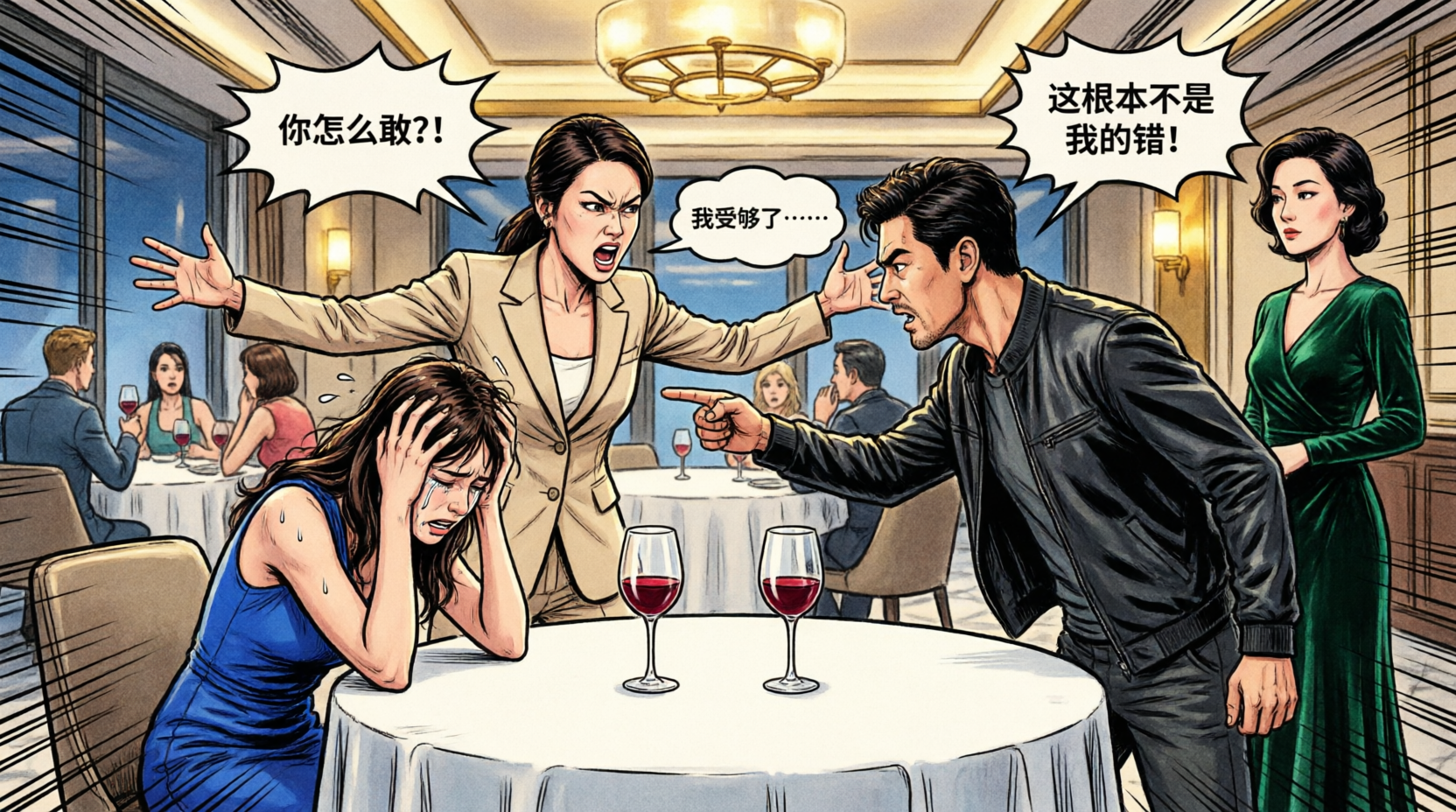
PART 2: Brent let go of Emily’s hair so abruptly that she almost tipped sideways. I moved around the table and caught her shoulders before she could strike the edge of the chair. Her entire body shook beneath my hands. “Mom,” she whispered, panic spreading over her face. “Please—” “No,” I said, not loudly, but firmly enough that she stopped. Brent pushed up from his chair, his mouth twisting. “This is insane. You’re making a scene.” I kept the phone against my ear. “He has released her now,” I told the dispatcher. “But he is standing. He is angry. My daughter is crying. There are witnesses.” Around us, the restaurant had fallen silent except for the dull hum of the kitchen behind the swinging doors. A young couple near the window stared openly. An older man slowly put down his fork. The waiter holding the tray backed away and set the plates on an empty table. Diane rose too, her pearls shifting at her throat. “You bitter old woman,” she hissed. “You have no idea what marriage takes. A wife must respect her husband.” I turned toward her. “No, Diane,” I said. “A wife is not property.” Her nostrils flared. “You poisoned her against him.” Brent jabbed a finger toward me. “Emily, tell her to hang up.” Emily’s lips parted. No sound came out. He leaned toward her. “Tell her.” That was when I finally saw it clearly. Not only the fear. The training. The way my daughter’s shoulders folded inward before he even raised his voice. The way she looked at his hands before she looked at his face. The way she had been shrinking for years while I told myself not to interfere too much, not to push her away, not to make things worse. I had been careful. He had mistaken careful for weak. The manager, a silver-haired man in a navy suit, approached the table. “Ma’am, is everything all right?” “No,” I said. “Your security cameras saw him assault my daughter. Please preserve the footage for the police.” Brent’s expression changed. For the first time all night, he looked afraid. “Cameras?” he said. The manager glanced toward the ceiling near the bar. “Yes, sir.” Diane grabbed her purse. “We’re leaving.” “No one is stopping you,” I said. “But the police already have your names.” Brent took one step toward Emily. I moved between them. He towered over me, but height had never impressed me. I had buried a husband, raised a child alone, worked double shifts in an emergency room, and held the hands of dying strangers when their own families could not arrive in time. Men like Brent believed rage made them powerful. They never understood what endurance looked like when it finally stood up. “You’re going to regret this,” he said. I smiled once. “No, Brent. I regret waiting this long.” The police arrived seven minutes later. By then, three witnesses had given their names to the manager. Emily sat wrapped in my coat, eyes red, mascara streaking down her cheeks. Diane kept muttering about family business. Brent kept insisting it had been “a private marital misunderstanding.” But the officer looked at Emily’s scalp, where the skin had reddened beneath the torn strands of hair. Then he looked at Brent. “Sir,” the officer said, “please step away from her.” And for the first time since my daughter had married him, Brent Callahan obeyed someone without arguing.
PART 3: Officer Rachel Morales took Emily’s statement in a quiet corner near the front windows. Her partner, Officer Devin Shaw, spoke with the manager and gathered the witnesses’ names. Brent stood near the bar with his arms crossed, trying to look insulted instead of terrified. Diane sat beside him, whispering sharply into his ear. I stayed close enough for Emily to see me, but far enough away that I would not speak over her. That mattered. I had spent too many years trying to save her with advice, questions, and careful suggestions that she leave him when she was ready. Tonight, I understood something painful. She did not need me to tell her what to do. She needed me to stand somewhere she could see I would not move. Officer Morales crouched slightly beside Emily’s chair, speaking gently. “Has this happened before?” Emily stared down at her hands. Brent’s head snapped toward them. “Don’t answer that.” Officer Shaw immediately stepped in front of him. “Sir, you need to stay quiet.” “This is my wife.” “That does not give you the right to interfere with her statement.” Diane rose. “My son is being treated like a criminal because that girl can’t control her emotions.” The older man from the nearby table turned in his chair. Restaurant table booking “I saw him pull her hair,” he said clearly. “She didn’t do anything to deserve it.” A woman by the window raised her hand. “I saw it too.” The waiter added quietly, “So did I.” Diane’s face hardened as the room turned against her. Her pride could not survive witnesses. People like her thrived in private rooms, behind closed doors, inside houses where victims learned to lower their voices. Public truth offended her more than violence ever could. Emily took a breath that trembled from start to finish. “Yes,” she said at last. Officer Morales waited. Emily looked up, tears gathering again. “Yes, it’s happened before.” Brent cursed under his breath. My knees weakened, but I did not sit down. Doors & Windows “When?” the officer asked gently. Emily wiped her cheek. “At home. Mostly when he drinks. Sometimes when he doesn’t. He grabs my arm. He blocks doors. He throws things near me, not always at me. He says if I call anyone, he’ll ruin me. He says my mother will get tired of helping me.” My throat tightened. Emily glanced toward me. “I believed him.” I stepped closer then, unable to stop myself. “I will never get tired of helping you,” I said. Her face crumpled. Officer Morales gave us a moment, then continued. “Do you feel safe going home with him tonight?” “No,” Emily said. It was the first answer she gave without hesitating. Brent was arrested at the restaurant. Family communication workshop. Not dramatically, not like in a movie. There was no grand speech, no shouting match that fixed everything. Officer Shaw told him to turn around. Brent demanded a lawyer. Diane called me trash. The handcuffs clicked closed. Diners pretended not to watch while watching every second.
As he was led past us, Brent looked at Emily. “You’re destroying my life,” he said. Emily flinched. I held her hand. “No,” she said, barely audible at first. Then louder. “No. You did that.” He stared as though she had slapped him. That moment stayed with me more than the arrest. Not because it was loud, but because it belonged to her. The manager returned with a sealed copy of the security footage saved for the police. He apologized to Emily twice. She nodded, unable to speak. A woman from another table came over and set a small paper napkin in front of her. On it, she had written her name and phone number. Restaurant table booking “I’m a family law attorney,” the woman said. “No pressure. Just keep it.” Emily looked at the napkin as if it weighed ten pounds. Outside, the Boston air felt cold and damp. Blue lights flashed against the restaurant windows. Diane stood near the curb, furious, speaking on the phone to someone about “false accusations” and “that unstable wife.” She did not look at Emily once. I helped my daughter into my car. For several minutes, neither of us spoke. Then Emily said, “I’m sorry.” I almost pulled over. “For what?” I asked. “For making a mess.” I gripped the steering wheel until my fingers hurt. Communications Equipment “Sweetheart, you didn’t make the mess. You survived it.” She turned toward the window, crying silently. I drove her to my house in Brookline, the same house where she had learned to ride a bike, where her father had planted maple trees before cancer took him, where her old bedroom still had the pale blue wall she had once begged me not to repaint. I made tea she never drank. I found clean pajamas. I placed towels in the bathroom and pretended not to hear her sobbing under the shower. While she washed, my phone rang. Unknown number. I answered. Diane’s voice came through like broken glass. “You have no idea what you’ve done.” “I know exactly what I’ve done.” “You turned a private disagreement into a police matter.” Family conflict resolution “Your son assaulted my daughter.” “She provoked him.” There it was again. The old language of control. Provoked. Disrespected. Embarrassed. Failed. Words arranged like furniture around the truth so no one had to look at it directly.
I said, “Do not call this number again.” “You think Emily can survive without him? She has no backbone.” I looked down the hallway toward the bathroom door, where the water was still running. “She found it tonight.” Then I hung up and blocked the number. The next morning, Emily came downstairs wearing one of my old sweaters. Without makeup, she looked younger and more fragile, but there was something different in her eyes. Exhaustion, yes. Fear, yes. But also a thin line of clarity. “I need to go back to the apartment,” she said. Doors & Windows. My first instinct was to say absolutely not. Instead, I asked, “For what?” “My documents. Laptop. Some clothes. Dad’s watch. I don’t want Brent touching it.” We called Officer Morales, who had given Emily her card. She explained how to request a civil standby while Emily collected essentials. By noon, two officers met us outside the apartment building in Cambridge. Brent was still in custody awaiting arraignment. Diane was there instead. She opened the apartment door before we even knocked, as though the place belonged to her. Behind her, I saw two suitcases open on the living room floor. Emily stiffened. Diane smiled coldly. “I was packing my son’s belongings before you steal anything else.” Officer Morales stepped forward. “Ma’am, we’re here so Emily can collect her personal property.” Chicago house rental. Diane ignored her and looked at Emily. “You ungrateful little actress. Do you know how many women would be thankful for a husband who provides?” Emily’s voice shook, but she answered. “I provided too.” Diane laughed. “With your little marketing job?” Emily walked past her into the apartment. I followed. The apartment told a story I had not wanted to read before. A broken picture frame behind the sofa. A dent in the drywall near the hallway. A kitchen cabinet hanging slightly crooked. Emily moved quickly through the rooms, gathering files, passport, Social Security card, medications, laptop charger, and a velvet box that held her father’s watch. In the bedroom, I saw a scarf tied around the handle of a closet door. Emily saw me looking. Communications Equipment. “He used that once,” she said flatly, “to keep the door shut when I was inside.”
The room seemed to tilt.
I had no words.
She placed the scarf into a plastic bag.
“For evidence,” she said.
That was when I knew my daughter was not simply leaving. She was building a record.
Over the next several weeks, Brent’s public confidence began to decay. The restaurant footage was clear. The witness statements matched. Emily’s photos of bruises, which she had secretly kept in a hidden folder, matched dates when Brent had claimed she was “clumsy.” Text messages showed threats. Voicemails caught his low, vicious voice telling her no one would believe her because she was “too emotional.”
He was charged. He pleaded not guilty. Diane posted online about false accusations and family betrayal. For three days, people liked and commented with sympathy.
Then one of the restaurant witnesses posted only this: “I was there. I saw him do it.” Holiday surprise gifts
After that, silence spread faster than gossip.
Emily filed for a protective order. She filed for divorce. She changed her phone number. She moved into my guest room first, then into a small apartment six months later with yellow curtains and secondhand furniture she chose herself.
Healing did not look like victory at first.
It looked like nightmares. Like checking the locks three times. Like crying because a man in the grocery store raised his voice at someone else. Like apologizing for using too much milk, then realizing she did not need to apologize for milk.
Some days she was angry with Brent. Some days she was angry with herself. Some days she was angry with me for not forcing her to leave sooner, then cried because she knew I had tried in every way she would allow.
I accepted all of it.
Anger was better than silence.
At the final hearing, Brent wore a gray suit and the expression of a man insulted by consequences. Diane sat behind him, stiff and pale. Emily sat beside her attorney, the woman from the restaurant, whose name was Nora Feldman. Doors & Windows
I sat in the row behind Emily.
When the judge reviewed the evidence, Brent’s lawyer tried to describe the restaurant incident as “an isolated emotional reaction during marital tension.”
Nora stood.
“Your Honor, isolated incidents do not come with hidden photo folders, threatening voicemails, damaged property, and witnesses describing a pattern of intimidation.”
Emily testified for forty-two minutes.
Her voice shook at first. Then it steadied.
She described the first time Brent squeezed her wrist hard enough to leave a bruise. The apology flowers. The second time. The way Diane told her, “Men have tempers. Smart wives don’t trigger them.” The way Brent controlled money while mocking her income. The way he turned charm on in public and cruelty on at home.
Brent stared at the table.
Diane stared at Emily with hatred. Packaging
But Emily did not look at either of them. She looked at the judge.
When it was over, the protective order was extended. The divorce moved forward. Brent’s plea deal came later, with probation, mandatory counseling, fines, and a criminal record that followed him into every job interview he once believed his charm could win.
It was not perfect justice.
Real life rarely gives perfect justice.
But it was a door closing.
One year after that night at Marigold & Ash, Emily asked me to meet her for dinner.
I hesitated when she gave me the address.
Same restaurant.
“You’re sure?” I asked.
“Yes,” she said. “I don’t want that place to belong to him.” Family conflict resolution
So we went.
The manager recognized us. He said nothing dramatic, only led us to a quiet table by the window and sent over dessert we had not ordered.
Emily wore her hair loose that night.
Not hidden. Not pinned tightly. Not guarded.
Loose over her shoulders, shining beneath the soft lights.
She laughed when I spilled a little wine. She told me about a promotion at work. She talked about maybe adopting a cat. Small things. Ordinary things. Beautiful things.
Near the end of dinner, she reached across the table and squeezed my hand.
“I thought you were going to hit him that night,” she said.
I smiled. “So did I.”
“What stopped you?” Communications Equipment
I looked around the restaurant, remembering the silence, the shock, Brent’s hand in her hair, Diane’s applause.
“Because he wanted chaos,” I said. “Men like Brent know what to do with chaos. They twist it. They use it. I wanted witnesses, cameras, police reports, consequences. I wanted you safe more than I wanted him hurt.”
Emily’s eyes glistened.
“You saved me.”
I shook my head.
“No, sweetheart. I opened a door. You walked through it.”
Outside, snow began to fall lightly over Hanover Street. People hurried past in coats and scarves, carrying their own private stories. Emily stepped out of the restaurant beside me, breathing in the cold night air.
For the first time in years, she did not look over her shoulder.
And that was the thing they would never forget. Money management guide
Not my rage.
Not the phone call.
Not the police lights outside the window.
They would never forget that the woman they tried to break stood up in a room full of strangers and told the truth.
And once she did, everyone heard it.
PART 4
The snow outside Marigold & Ash should have made the night feel peaceful.
But peace, I learned, is not something that arrives just because danger leaves the room.
Peace has to be rebuilt.
Piece by piece.
Morning by morning.
Door by door.
And for Emily, the first real door was not the restaurant door she walked out of.
It was the apartment door she refused to ever open for Brent again.
For two weeks after the final hearing, she slept with a chair wedged under the bedroom doorknob.
She knew my house was safe.
She knew Brent could not come near her.
She knew the locks had been changed, the security camera installed, and the protective order signed.
But fear does not read court orders.
Fear remembers footsteps.
Fear remembers keys turning.
Fear remembers a man’s voice changing from charming to cold in the middle of a sentence.
One night, at 2:13 a.m., I heard a sound from the hallway.
Not a scream.
Not crying.
Just a small thud.
I got out of bed and found Emily sitting on the floor outside the guest room with her back against the wall.
Her knees were pulled to her chest.
Her hair covered half her face.
The hallway night-light painted her in a soft yellow glow.
“Sweetheart,” I whispered.
She startled so hard her hand flew to her throat.
“It’s me,” I said quickly.
Her eyes focused.
Then filled.
“I heard him,” she whispered.
I looked toward the stairs.
The house was silent.
Only the old pipes settling.
Only the wind touching the windows.
“He’s not here,” I said.
“I know.”
She swallowed.
“I know he’s not here.”
But her body did not know.
I sat beside her on the floor.
Neither of us spoke for a long time.
Then she said, “I hate that he still gets to scare me when he isn’t even in the room.”
I took her hand.
“That won’t last forever.”
She gave a broken little laugh.
“You don’t know that.”
“No,” I said.
“I don’t.”
She looked at me.
I squeezed her fingers.
“But I know you.”
That made her cry harder than comfort would have.
So I stayed there on the floor with her until sunrise began turning the hallway gray.
PART 5
The call from Nora Feldman came on a Thursday afternoon.
Emily was at my kitchen table with a mug of coffee, a legal pad, and a list titled Things I Own Now.
The list had started as practical paperwork.
Clothes.
Books.
Laptop.
Passport.
Dad’s watch.
Then, slowly, it had changed.
My mornings.
My paycheck.
My decisions.
My hair.
My voice.
My future.
When Nora called, Emily put her on speaker.
“Emily,” Nora said carefully.
“I need you to sit down.”
Emily glanced at me.
“I am sitting.”
“There is something new.”
My stomach tightened.
“What?” Emily asked.
“Brent’s attorney contacted me.”
Emily’s hand closed around the pen.
Nora continued.
“They are asking whether you would consider a private settlement in exchange for modifying your statement in the divorce filings.”
The kitchen went still.
Emily blinked.
“Modify how?”
“They want certain language removed.”
“What language?”
“The words pattern of abuse.”
Emily laughed once.
It was not a happy sound.
“They want the truth edited.”
“Yes,” Nora said.
“That is exactly what they want.”
I felt heat rise up my neck.
“And what are they offering?”
Emily asked it calmly.
Too calmly.
Nora exhaled.
“Money.”
“How much?”
“Two hundred thousand dollars.”
The pen snapped in Emily’s hand.
Ink leaked across her fingers.
For a moment, she only stared at the stain spreading over her skin.
Then she whispered, “He thinks he can buy the story back.”
Nora’s voice softened.
“He thinks your silence is still for sale.”
Emily looked at me.
I did not answer for her.
I had learned.
This had to be hers.
Emily turned back to the phone.
“No.”
Nora said nothing.
Emily sat straighter.
“No settlement.”
“No edited language.”
“No private lie.”
Then she looked down at the ink on her fingers.
“And tell his lawyer that if Brent wants to negotiate, he can start by admitting what he did.”
Nora’s voice changed.
There was pride in it now.
“I’ll tell them.”
After the call ended, Emily went to the sink and washed her hands.
The ink came off slowly.
Not all at once.
That felt about right.
PART 6
Diane Callahan did not disappear.
People like Diane rarely do.
They simply change costumes.
When she could no longer play proud mother in public, she played wounded victim online.
She wrote long posts about betrayal.
She quoted scripture without understanding mercy.
She shared articles about false accusations.
She told anyone who would listen that her son had been “destroyed by one dramatic dinner.”
But Boston is smaller than people think.
And truth has a way of walking into rooms before liars do.
The first crack came from Brent’s company.
He worked as a senior project manager at a luxury development firm.
For years, he had sold himself as disciplined, polished, controlled.
The restaurant footage ruined that image.
Not because the company suddenly cared about Emily.
Companies often care only when witnesses become headlines.
But a client had been dining at Marigold & Ash that night.
A client with a daughter.
A client who had watched Brent grip Emily’s hair while Diane clapped.
Three days later, Brent was placed on leave.
Two weeks later, he was gone.
Diane blamed Emily.
Brent blamed me.
Emily blamed neither of them out loud.
But one evening, while folding towels in my laundry room, she said, “I’m afraid he’ll come after me now that he lost his job.”
I set down the towel in my hands.
“That fear makes sense.”
“I don’t want it to make sense.”
“I know.”
She leaned against the dryer.
“What if he has nothing left to lose?”
I walked to the cupboard above the washing machine and took down a small box.
Inside were copies.
Protective order.
Police report.
Emergency contacts.
Photos.
Nora’s card.
Officer Morales’s card.
A printed safety plan.
Emily stared at it.
“You made a box?”
“I made three.”
“Three?”
“One here.”
“One in my car.”
“One with Nora.”
Her mouth trembled.
“I thought I was supposed to be the organized one.”
“You are.”
I closed the box.
“I’m just your mother.”
She smiled through tears.
That was the first real smile I had seen in days.
PART 7
The twist came from someone none of us expected.
Brent’s sister.
Her name was Allison Callahan.
I had met her only twice.
Quiet woman.
Early thirties.
Always standing half a step behind Diane.
Always watching the room before choosing where to sit.
She called Emily one evening from a blocked number.
Emily almost did not answer.
Then something made her swipe the screen.
“Emily?”
The voice was thin.
“It’s Allison.”
Emily froze.
I was beside her on the sofa, sorting mail.
She put the phone on speaker.
“What do you want?” Emily asked.
Allison was silent for three seconds.
Then she said, “I want to apologize.”
Emily’s face closed.
“For what?”
“For knowing.”
The words landed heavily.
Allison breathed shakily.
“I knew Brent had a temper.”
“That’s what your family calls it?”
“No.”
Allison’s voice broke.
“That’s what I was taught to call it.”
Emily did not speak.
Allison continued.
“When we were kids, our father was the same way.”
I looked at Emily.
Her eyes had widened.
“Diane told us men were under pressure.”
Allison gave a bitter laugh.
“She told us boys needed respect and women needed patience.”
Emily whispered, “Did he hurt you?”
“Not like Brent hurt you.”
Allison paused.
“Diane did most of that herself.”
The room seemed to shrink around us.
Allison said, “I have things.”
“What things?” Emily asked.
“Emails.”
“Texts.”
“Old messages from Brent bragging about keeping you in line.”
Emily shut her eyes.
Allison’s voice became smaller.
“I should have helped sooner.”
Emily opened her eyes.
“Yes.”
Allison inhaled sharply.
Emily’s voice shook.
“But helping now still matters.”
Allison began to cry.
Not loudly.
Just enough that the phone filled with her breathing.
“I can send them to your lawyer,” she said.
Emily looked at me.
This time, I nodded.
“Send them,” Emily said.
PART 8
The messages changed everything.
Not legally in the way people imagine.
There was no sudden dramatic court scene where a judge slammed a gavel and shouted justice.
Real justice is slower.
It arrives with attachments.
Timestamps.
Screenshots.
Forwarded emails.
Patterns no one can deny anymore.
Brent had written to his sister two months after marrying Emily.
She talks back more now.
Diane says pregnancy will settle her when it happens.
Another message.
Linda is a problem.
Emily listens to her too much.
Another.
If she ever leaves, I’ll make sure she has nothing.
Another.
She cries, then apologizes.
Works every time.
Emily read the messages at Nora’s office.
She did not cry.
That frightened me more.
She sat completely still while Nora printed each page.
When the last one came out, Emily said, “He studied me.”
Nora looked up.
Emily tapped the paper.
“He wasn’t losing control.”
Her voice was flat.
“He was controlling me on purpose.”
No one answered.
Because she was right.
That day, something inside Emily shifted again.
The fear did not vanish.
But it gained a companion.
Anger.
Clean anger.
Useful anger.
The kind that does not burn the house down.
The kind that turns on every light.
PART 9
Brent violated the protective order on a rainy Sunday morning.
Not by showing up at my door.
He was too cowardly for that at first.
He sent flowers.
White lilies.
Emily hated lilies.
They reminded her of funerals.
The card had no signature.
Only one sentence.
You know what happens when people embarrass me.
Emily stood in my doorway holding the card between two fingers.
Her face was pale.
I took one look and reached for my phone.
Officer Morales arrived within forty minutes.
She photographed the flowers.
She photographed the card.
She asked Emily questions gently, but directly.
“Do you believe these came from Brent?”
“Yes.”
“Why?”
“He sent lilies after the first time he hurt me.”
The officer’s pen paused.
Emily continued.
“He said they were apology flowers.”
Her mouth twisted.
“Then he said they were a reminder that I looked pretty when I was quiet.”
Officer Morales’s jaw tightened.
She wrote it down.
By evening, Brent was back in trouble.
By Monday, Nora had filed an emergency motion.
By Tuesday, Diane called from another number.
I answered before Emily could.
Diane did not bother with politeness.
“You stupid woman.”
I said nothing.
“My son is suffering because of your daughter’s lies.”
I walked into the pantry and closed the door so Emily would not hear.
“Diane,” I said.
“If you contact Emily again, I will report it.”
“She belongs with her husband.”
“No.”
“She made vows.”
“So did he.”
Diane scoffed.
“You think a few bruises break a marriage?”
And there it was.
The sentence that exposed her whole soul.
Not denial.
Not confusion.
Not shock.
A few bruises.
As if pain was a household expense.
As if fear was part of a wife’s duty.
As if love meant staying quiet while someone took pieces of you.
I said, “Thank you.”
She paused.
“For what?”
“For saying that clearly.”
Then I hung up.
This time, I did not block the number immediately.
I saved the voicemail.
PART 10
The final confrontation did not happen in a restaurant.
It happened in a courtroom hallway.
Brent had been ordered to appear for the protective order violation.
Diane came with him.
Allison came with us.
That was the first time Diane saw her daughter standing on Emily’s side.
The look on Diane’s face was almost worth every sleepless night.
Almost.
“Allison,” Diane said sharply.
“What are you doing?”
Allison’s hands trembled, but she did not step back.
“I’m telling the truth.”
Diane laughed.
It was an ugly sound.
“You always were weak.”
Allison flinched.
Emily reached for her hand.
Diane saw it and sneered.
“How touching.”
Brent stood beside his lawyer, eyes fixed on Emily.
He looked thinner.
Harder.
Less polished.
But the cruelty was still there.
Consequences had not made him sorry.
Only inconvenienced.
“You look proud of yourself,” he said.
Nora stepped forward.
“Do not speak to my client.”
Brent ignored her.
“You think this ends well for you?”
Emily looked at him.
For the first time, she did not look away.
“It already has.”
His expression flickered.
She continued.
“I woke up today without asking your permission.”
Brent’s jaw tightened.
“I ate breakfast without being mocked.”
I felt my throat close.
“I wore my hair down because I wanted to.”
Diane’s face darkened.
Emily’s voice grew stronger.
“And tonight, I will go home to a place where no one blocks the door.”
Brent took half a step forward.
Officer Shaw, who was standing near the courtroom entrance, moved immediately.
“Back up,” he said.
Brent stopped.
Everyone saw it.
The instinct.
The threat.
The way his body answered before his lawyer could stop him.
The hallway went silent.
And Emily smiled.
Not because she enjoyed his anger.
Because she no longer confused it with power……….👇