“You’re banned from the family beach house forever,” my stepmother informed me over the phone. I’ve replaced every lock! She chuckled. “Thanks for letting me know,” I said coolly. She was unaware that my mother had previously left me the house in a hidden trust.
The first thing I noticed was the way the fading sun caught on the glass of my apartment window.
It had been one of those utterly draining days when the city felt like a machine designed to chew you up and spit you out. My laptop sat open on the kitchen counter, an unfinished email glowing faintly on the screen, while I leaned against the window, phone pressed to my ear. Outside, the Boston skyline carved sharp angles against a sky streaked with orange and pink. Then, cutting through the quiet, came the voice I least wanted to hear, dripping with satisfaction.
“You are banned from the family beach house, forever.”
It was Diana Crawford, my stepmother, her tone sharp and almost gleeful. I gripped the phone tighter, staring at my reflection in the glass: dark hair in a messy bun, sweater slipping off one shoulder, city lights twinkling below.
“What?” I said slowly.
“I changed all the locks,” she continued, each word drawn out like a knife. “Do not think for a second about stepping inside. This is what you get for ruining your sister’s graduation party.”
A bitter laugh nearly escaped me. “You mean the party I was never invited to?” I asked evenly.
She scoffed. “Oh, spare me the victim act.”
“The same party where you told everyone I was too busy to come?” I replied, calm and measured. I had learned long ago that showing anger only fueled Diana’s cruelty.
Her laughter crackled through the line. “Everyone knows you’re jealous of Madeline’s success,” she said smugly. “You will never enter that house again. I made sure of it.”
Jealousy had always been her weapon. From the day she married my father, it was her go-to accusation, a tool she wielded to twist reality in her favor.
Through the window, the beach house seemed to float over the city skyline in my reflection: the broad porch, pale railings polished smooth by generations of hands, and the endless Atlantic stretching beyond the dunes.
I could almost hear my mother’s laughter on the wind:
“Look at that wave, Rebecca. I swear it’s bigger than you were at five.”
I blinked and returned to the present.
“The house isn’t yours to ban me from,” I said softly.
“Oh, but it is,” Diana snapped. “Your father signed it over last month. It belongs to me, and I will not have you anywhere near it.”
A faint smile crept onto my lips.
“Thanks for letting me know about the locks,” I said.
There was a pause. “What do you mean?”
But I had already hung up.
The quiet that followed was almost peaceful. The city hummed outside, but inside, the apartment felt still as I walked down the hall to my small office.
I knelt by an old metal filing cabinet and pulled open the bottom drawer. Inside lay a thick manila envelope, sealed years ago, the tape yellowed with age. My mother’s familiar handwriting stretched across the front:
REBECCA. BEACH HOUSE DOCUMENTS. IMPORTANT.
The word important had been underlined three times.
I carried the envelope to my desk and opened it carefully. Inside were neatly arranged papers: the trust my mother had established shortly before her death, and the official deed to the beach house in Cape Ann, Massachusetts.
My chest tightened as I traced her signature with my finger.
She had anticipated everything.
Years earlier, I had sat beside her hospital bed as she struggled to speak, illness weighing her down. The room smelled faintly of antiseptic, yet she insisted on leaving the window slightly open to imagine the ocean breeze.
“Rebecca,” she whispered, squeezing my hand. “The beach house is our family legacy. My parents built it, and we spent every summer raising you there.”
I urged her to focus on treatment rather than property, but she shook her head with quiet resolve.
“Diana has wanted that house from the moment she set foot inside,” my mother said softly. “She sees it as a prize, not a home. I won’t let her take it.”
Her longtime attorney, Evelyn Porter, stood nearby, explaining the trust as my mother signed the final documents. At the time, the legal details were almost incomprehensible to me, but one thing was clear: the house would always be mine.
My phone buzzed, pulling me back to reality.
It was a message from Diana: “I already told the local police you’re not allowed on the property. Don’t embarrass yourself by trying to enter.”
I stared at the screen, then forwarded it to Evelyn with a brief note. Her reply came almost instantly: “It’s time to handle this properly.”
Another message followed, this one from Madeline: “Mom said you tried to ruin my party. You were never really part of this family anyway.”
I set the phone down and exhaled.
Madeline had been ten when her mother married my father. Initially shy, she had gradually been molded by Diana into a reflection of herself. Every accomplishment of mine was overshadowed by something designed to highlight her.
After my mother died, that imbalance only worsened.
My phone rang again. This time, it was my father.
“Rebecca,” he said tiredly, “please don’t make this more difficult.”
He didn’t question Diana’s claims—he went straight to asking me to stay quiet.
“Diana is just trying to keep the family peace,” he said. “Maybe banning you was extreme, but maybe some space will help.”
I looked down at the trust documents spread across my desk.
“The beach house belongs to me,” I said firmly. “Mom placed it in a trust before she passed.”
He hesitated, the faint clink of a glass audible.
“Diana said you didn’t care about the property,” he murmured. “You never visited, didn’t want the responsibility.”
I exhaled quietly.
“I’ll handle this,” I told him, then ended the call.
An hour later, I booked a flight to Logan Airport for the next morning.
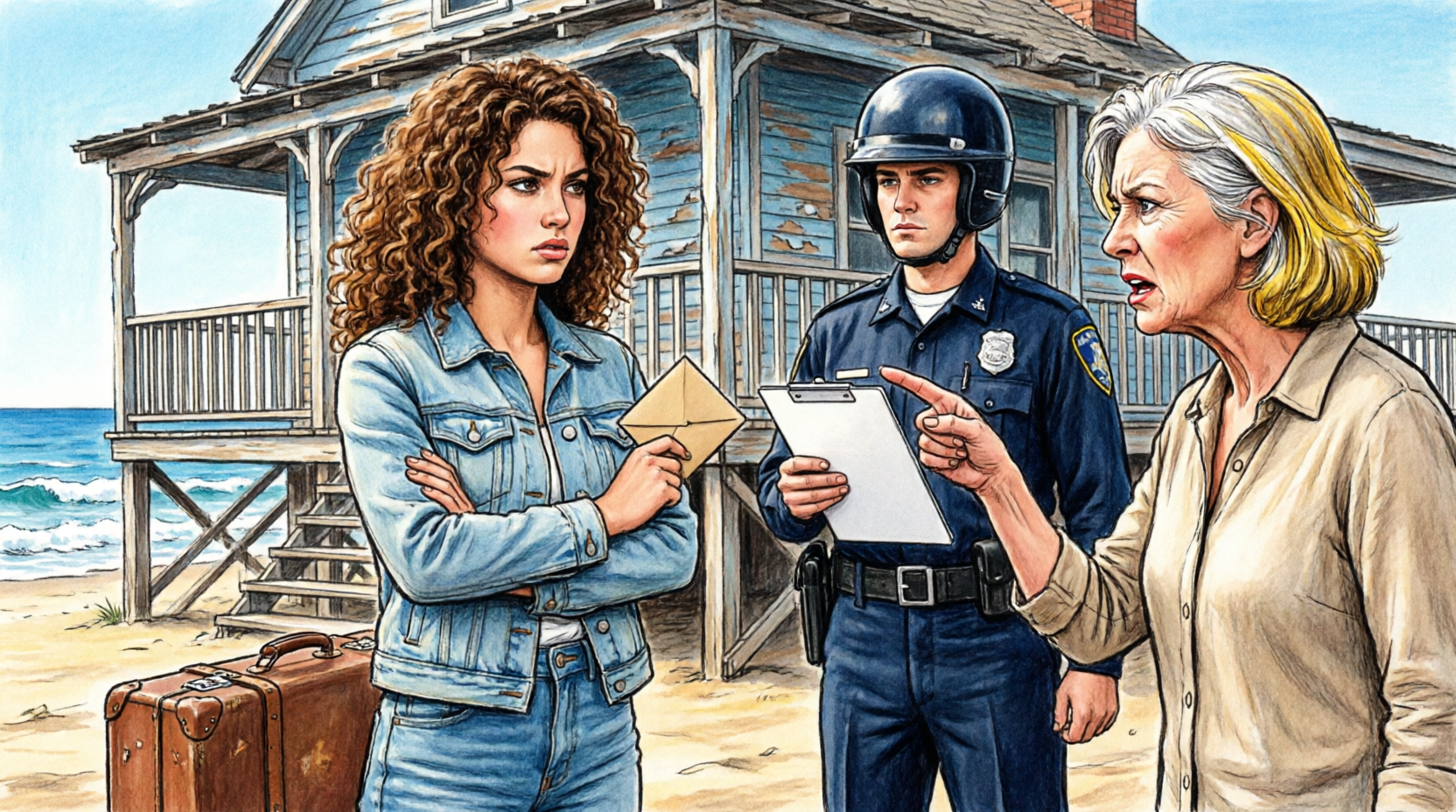
A dense fog hung along the Massachusetts coast as my car approached the narrow road to the house. Through the mist, I saw its familiar outline.
But something was wrong.
The railings had been replaced with sleek modern panels. Security cameras lined every corner. A bright red luxury sedan occupied the driveway where my mother had kept a small wooden shed.
Before I could step out, the front door swung open.
Diana stormed out in expensive activewear, Madeline close behind recording on her phone.
“I told you not to come here!” Diana yelled.
“Go ahead and call the police,” I said calmly, pulling my suitcase from the trunk. “I already did.”
Two patrol cars pulled into the driveway. An officer approached with professional composure.
“Mrs. Crawford,” he said, “we received your complaint regarding trespassing.”
“Yes,” she snapped, pointing at me. “She has no right to be here.”
The officer opened a folder.
“There seems to be a misunderstanding,” he said. “According to documents from attorney Evelyn Porter, this property legally belongs to Miss Rebecca Hale.”
Diana froze.
“That’s impossible,” she hissed. “My husband signed the deed over to me.”
“The property was placed in an irrevocable trust by the previous owner,” the officer explained. “Your husband could not transfer what he didn’t legally own.”
Madeline lowered her phone slowly.
I stepped forward and handed over the originals.
“My mother set up the trust before she passed,” I said.
At that moment, my father appeared on the porch, pale and confused.
“You knew?” I asked.
He shook his head. “Your mother never explained the details.”
Diana’s anger surged.
“You manipulated him!” she accused.
The officer’s tone was firm.
“Miss Hale has full legal ownership. Blocking her access could have legal consequences.”
Diana’s face drained of color.
Minutes later, her lawyer arrived, read the documents, and left. The trust was airtight.
Diana stormed off with Madeline following hesitantly.
The house fell silent again, the only sound the steady crash of waves.
Over the following weeks, I restored the house piece by piece—repainting the porch, rehanging hidden family photos. My father visited occasionally, slowly realizing how many lies he had accepted.
One afternoon, Madeline returned with a bundle of letters she had found in her mother’s desk.
“They’re from your mom,” she said. “She wrote them before she died.”
Inside, my mother spoke of the life she hoped I would build and the strength she believed I had, even when I doubted myself.
Months later, I discovered one last envelope beneath the porch swing. Inside was a single note:
The house is just a symbol. The real legacy is the courage to protect what matters.
As the sun sank over the Atlantic and waves rolled in, I finally understood. The beach house had never been just property—it was our family’s story. And now, it was finally safe.
THE END.