I was instructed to safeguard my grandmother’s $450,000 lakehouse. My parents covertly sold it to pay for a world tour while I was away on business, and they emailed me, saying, “Thanks for making our dream come true.”
I used to think a “family legacy” meant warmth—the soft crackle of photo albums, Sunday dinners, and the scent of Nana’s cinnamon rolls drifting through the kitchen.
Then Nana Maggie Carter passed, leaving me her Lake Tahoe cabin—a cedar lakehouse nestled among towering pines, its dock creaking like it held a thousand whispered secrets.
Her will was explicit. The cabin, valued at roughly $450,000, was mine. Alongside it was a handwritten note in her elegant looping script: Protect it at all costs.
That cabin had been my sanctuary every summer. While my parents chased their careers, Nana kept me there. I learned to swim off that dock, row her old fishing skiff, and sit quietly in the kind of silence that feels like safety instead of solitude. She called the cabin our anchor. I vowed I’d never let anyone sever that line.
I took my responsibility seriously. Paid the property taxes promptly. Hired a caretaker, Luis, to check in weekly. Installed a modest smart security system. And following Nana’s attorney’s guidance, I created the Maggie Carter Family Trust, named myself sole trustee, and filed the appropriate notice with the county recorder.
Two months later, work whisked me away to Chicago for a conference. Tahoe was blanketed in fresh snow when I left, the cabin quiet, secure, and untouched.
On the second evening, my phone buzzed with a text from my mother:
Thanks for making our dream come true.
Then another—my father, grinning in front of stacked suitcases at a bright, bustling airport terminal.
Round-the-world trip. Finally!
My stomach sank. I called. Voicemail. Checked accounts. No transfers, no alerts.
Then I logged into the county’s property monitoring system Nana’s lawyer had insisted I set up.
There it was:
DOCUMENT RECORDED: GRANT DEED — TRANSFER OF OWNERSHIP.
My hands trembled. My cabin. Sold.
I called Luis. “Emily,” he panted, “there are strangers inside. A realtor put up a lockbox. They said your parents approved it.”
Chicago’s skyline blurred outside my hotel window as I pictured my parents grinning at their gate, convinced they’d pulled off a coup.
Then another email arrived—from the title company:
URGENT: Verification required for trustee signature.
I read the fine print. Buried in legal language, Nana’s attorney had included a critical clause years ago after my parents once tried to “borrow against” the property:
Trustee must appear in person with government-issued ID. No remote notarization. No third-party authorization.
Any legitimate sale required my physical presence at closing.
My parents hadn’t just overstepped—they’d attempted fraud.
I called the title company. “This is Emily Carter, trustee of the Maggie Carter Family Trust. I did not authorize any sale.”
A moment later, the representative replied, “We flagged the signature. It doesn’t match our records. Notary commission cannot be verified. Funds are still in escrow.”
“Freeze everything,” I said.
“It’s already on hold. You’ll need a formal fraud report and your attorney.”
Denise Holloway, Nana’s lawyer, answered immediately. Her voice was sharp. “Send me everything. I’m filing a temporary restraining order and recording a lis pendens. That will cloud the title immediately.”
I didn’t fully understand the legal term, but I understood the effect: stop them.
The scanned deed showed my forged signature. The notary stamp listed Clark County, Nevada—while the cabin stood in California.
A careless, greedy oversight.
I contacted the county recorder’s fraud department and the sheriff’s office. The deputy was calm. “Family fraud happens more often than you’d think,” he said. “Send over all documentation.”
I forwarded my father’s airport selfie—flight information visible behind him.
At 3:17 a.m., the title company emailed:
Attempted wire transfer declined. Escrow hold in effect.
Minutes later, my father called. “Why is the wire delayed?” he asked smoothly.
I didn’t answer. Instead, one text:
You sold a house you don’t own.
By morning, Denise confirmed: Temporary restraining order granted. Lis pendens filed. Authorities notified.
I booked the first flight back to Reno—not to intervene, but to witness what came next.
At the airport, the departure board flipped to BOARDING. Then I saw them—my mother, smiling in a white scarf, my father rolling two matching suitcases.
At the gate, his credit card declined.
Two officers approached calmly.
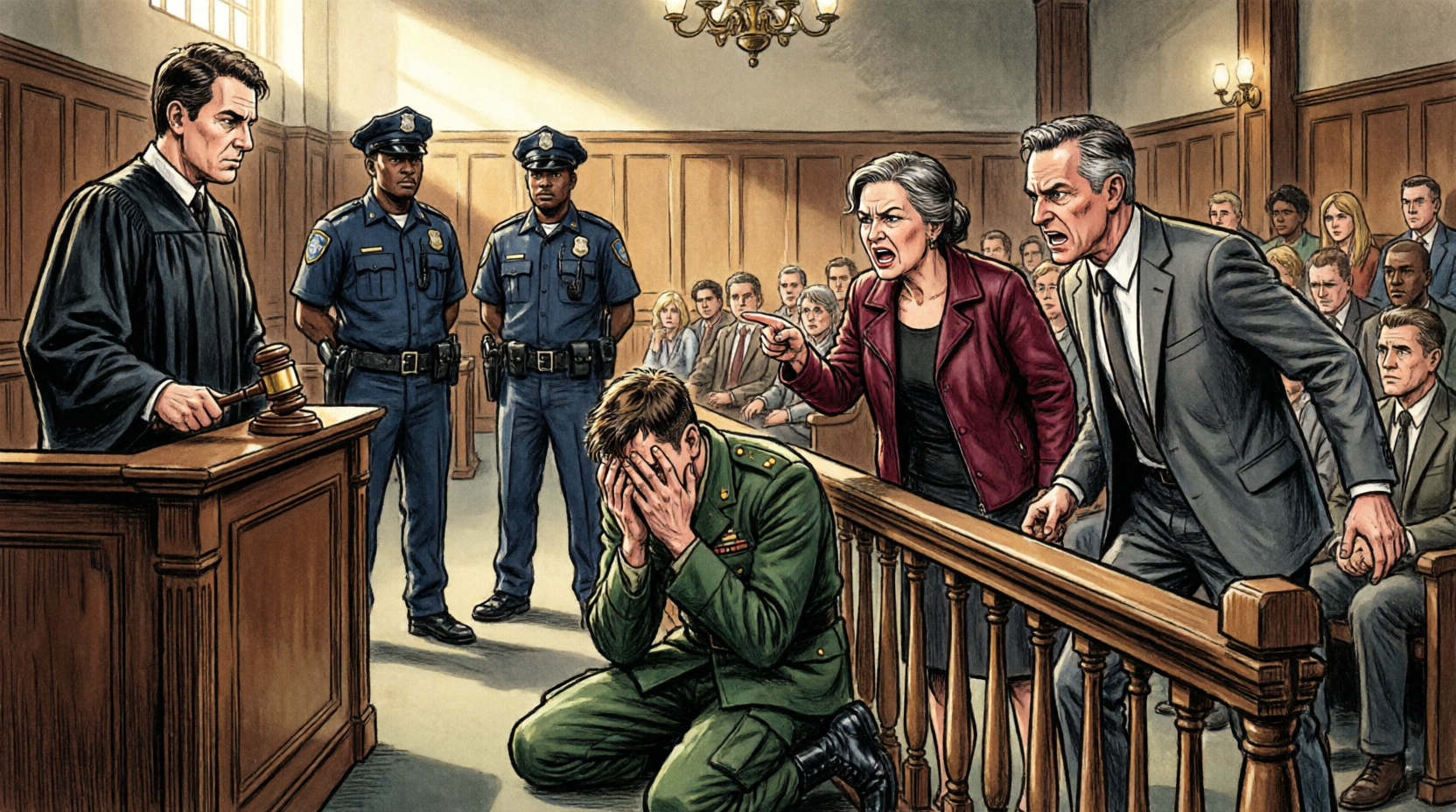
“Mr. and Mrs. Carter? We need to speak with you regarding a report of real estate fraud and forgery.”
Their expressions froze when they spotted me.
“Emily, what did you do?” my mother demanded.
“I protected it,” I said softly. “Like Nana asked.”
The officers explained the forged signature, invalid notary, frozen escrow, and restraining order.
My father’s confidence evaporated. “This is a misunderstanding,” he mumbled.
“It isn’t,” the officer replied.
As they were escorted away, one of their suitcases toppled. Travel brochures—Paris, Kyoto, Sydney—spilled across the floor.
My phone buzzed.
Escrow cancelled. Title remains with trust. No funds disbursed.
That afternoon, I drove back to Tahoe. The cabin stood unchanged. Luis greeted me with relief.
Inside, on the kitchen counter, sat Nana’s old tin recipe box. Beneath the cards was a note, dated the week she died:
If you’re reading this, they tried. Remember—love doesn’t require surrender.
I pressed it to my chest.
Then I changed every lock, reset every password, and worked with Denise to fortify the trust so no one could ever threaten Nana’s anchor again.