I informed my family over the phone that I had breast cancer. “We are in the middle of your cousin’s bridal shower,” Mom replied. I underwent chemotherapy by myself. They asked whether I could still co-sign my sister’s auto loan a few days later. My six-year-old son arrived
When I phoned my mother to tell her I had breast cancer, she answered on the third ring and immediately hushed her voice, as if I’d interrupted something far more important.
“Claire, we’re at your cousin Jenna’s bridal shower,” she said. I could hear laughter, glasses clinking, someone calling out for ribbon scissors in the background. “Can this wait?”
I stood in the hospital parking lot gripping a folder so tightly my fingers hurt—the biopsy results that had just divided my life into a before and an after. My knees trembled, and I leaned against my car to stay upright.
“No,” I said. “It can’t. I have cancer.”
There was a pause—but not the kind I had imagined. No shock. No heartbreak. Just irritation, like I’d brought up a minor inconvenience at the worst possible time.
“Oh my God,” she muttered. “You’re serious?”
“Yes.”
More laughter filtered through the phone. Then she sighed. “What do you expect me to do right now? We have guests.”
I stared down at the pavement, feeling something inside me turn cold and still. “I thought you might say you were coming.”
“Tonight isn’t possible,” she replied quickly. “Call your sister if you need someone.”
My sister, Megan, didn’t answer. Twenty minutes later, she texted: Mom said you’re upset. I’m at the shower. We’ll talk tomorrow.
Tomorrow became next week. Next week became the start of chemotherapy.
I drove myself to nearly every appointment. The only exception was my first infusion—my neighbor Denise took off work because, as she put it, no one should face that alone. She held my coat while I got sick in a parking garage. She shaved my head in her kitchen when my hair started falling out in clumps. My mother sent flowers once, but the card read: Stay strong! Sorry we missed your call. Love, the family.
The family—like it was a group, not people who were supposed to know me.
Then, four days after my second chemo session, they showed up.
My mom. Megan. My stepfather, Ron. Smiling. Carrying a grocery store fruit tray like it proved something.
I was curled up on the couch under a blanket, exhausted and aching, when Megan sat on the armrest and said, “You actually look better than I expected.”
I almost laughed.
My mother folded her hands carefully, the way people do when they’re about to ask for something they shouldn’t.
“So,” she began, “we need a small favor.”
Ron explained that Megan had found a car she loved, but the bank wanted a stronger co-signer. Her credit wasn’t great. His finances were tied up. Mine, apparently, had always been “reliable.”
I looked at all three of them, wondering if the medication was making me imagine things.
“You came here,” I said slowly, “while I’m going through chemo… to ask me to co-sign a car loan?”
Megan shrugged. “It’s not like we’re asking for money.”
Before I could respond, small footsteps echoed from the hallway.
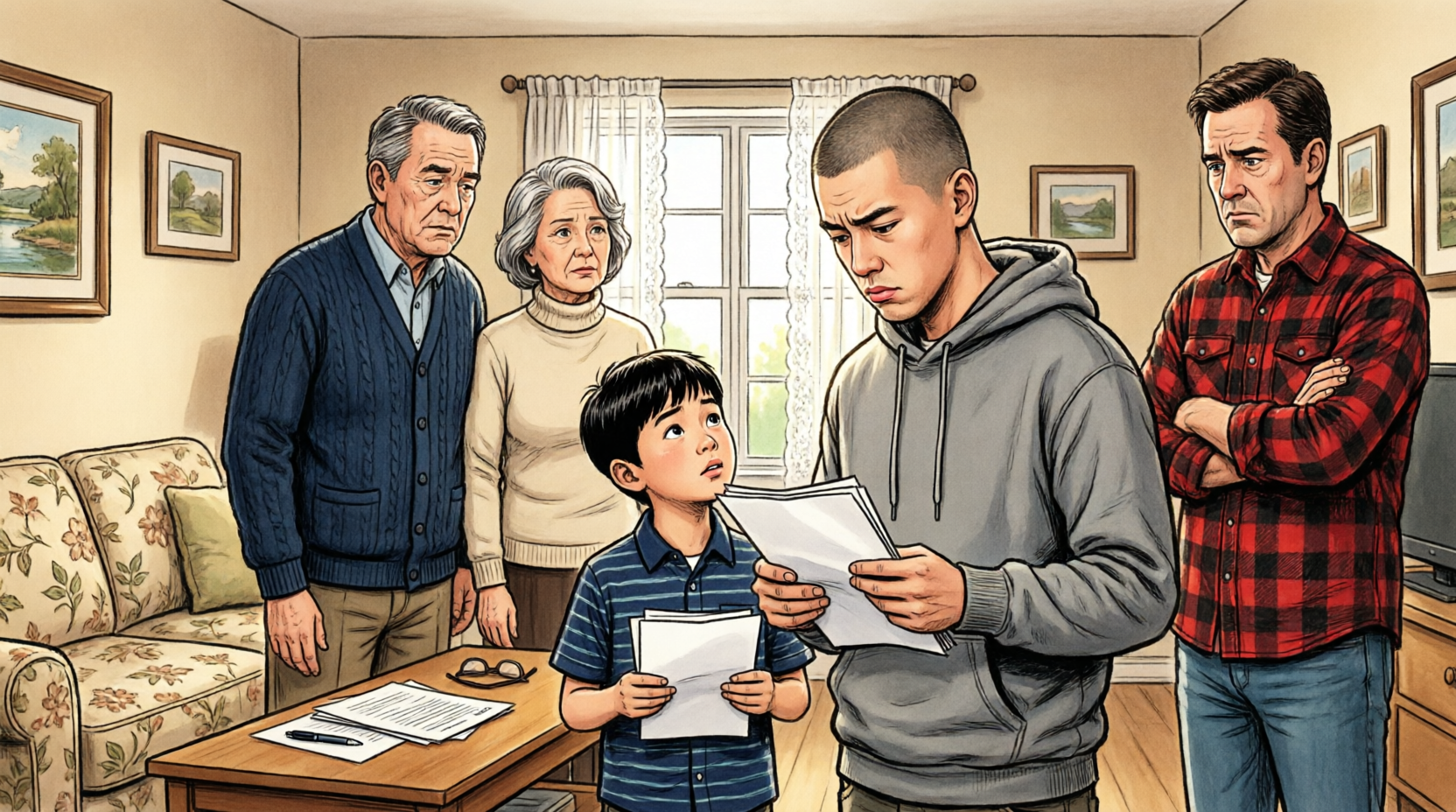
My six-year-old son, Ethan, walked in holding a folded piece of paper. He looked at me, then at them, and said softly, “Mom said to give you this if you ever asked for money.”
Their smiles faded before he even handed it over.
My mother opened the note, and as she read, the color drained from her face.
The paper wasn’t casual—it was printed on oncology letterhead, signed by my care provider. It confirmed I was actively undergoing chemotherapy and advised against taking on any financial or legal obligations. At the bottom, in my own handwriting, I had added:
If you’re reading this, it means I was too exhausted to argue. The answer is no.
Megan’s expression hardened instantly. “Wow.”
“Wow?” I repeated.
She stood. “You seriously involved your kid in this? That’s manipulative.”
I pushed myself upright, the room tilting slightly. “You walked into my house and asked a woman in treatment to risk her financial stability for a car you don’t need.”
“I do need a car.”
“You want that car,” I said. “A brand-new SUV.”
My mother folded the paper sharply. “No one is trying to hurt you. Families help each other.”
That hit harder than anything else, and I let out a bitter laugh. “Families? Which part felt like family? When I called from the hospital and you said you were busy? When Megan sent a text instead of showing up? Or the silence through every appointment since?”
“We sent flowers,” Megan snapped.
At that moment, Denise stepped in through the side door carrying a casserole. She paused, taking in everything—the tension, the fruit tray, my son—and quietly set the dish down.
“Should I leave?” she asked.
“No,” I said.
My mother turned, forcing a polite smile. “And you are?”
“Someone who showed up,” Denise replied.
The silence that followed cracked something open.
Ron cleared his throat. “Maybe this wasn’t the right time.”
“That’s one way to say it,” Denise answered.
My mother ignored her and looked back at me, shifting into a wounded tone. “I can’t believe you’d embarrass us like this in front of a stranger.”
“You did that yourselves,” I said.
Ethan pressed closer to me, and I rested a hand on his shoulder. In that moment, everything inside me settled—not anger anymore, but something clearer.
“Megan,” I said quietly, “I’m not signing anything.”
She crossed her arms. “Fine.”
“And I’m done being the person you turn to only when you need something.”
“You’re overreacting because you’re sick,” my mother said.
“No,” I replied. “I’ve been underreacting for years because I wanted a family.”
That landed.
Megan grabbed her bag. “Let’s go. She wants to play victim.”
“She has cancer,” Denise said sharply.
“You don’t know our family,” Megan shot back.
“I know enough,” Denise replied.
Ron urged them toward the door. My mother lingered, still holding the note, waiting—like she always had—for me to soften, to fix things.
I didn’t.
“You need to leave,” I said.
She looked stunned. “You’re kicking us out?”
“Yes.”
“One day you’ll regret this,” she said.
“Maybe,” I answered. “But not as much as I’d regret begging people to care when they don’t.”
She flinched, then left without another word.
The house felt lighter the moment the door closed.
Ethan looked up at me. “Did I do it right?”
I knelt and hugged him gently. “Perfect,” I whispered. “You did it perfectly.”
That night, after he fell asleep and Denise made sure we were okay, I opened my laptop and finally did what I should have done long ago.
I removed my mother as my emergency contact. Updated my will. Locked my credit. Changed every account and document that still tied me to them.
At 11:43 p.m., Megan texted: You didn’t have to make this so dramatic.
I stared at the screen, then replied:
I didn’t. The cancer already did. You just made it clear.
She never answered.
A few days later, I discovered something worse.
They hadn’t just come for my signature.
They had been quietly preparing for what would happen if I didn’t survive.
That was the moment everything finally became undeniable.
And it was also the moment I stopped confusing obligation with love—and started choosing, very carefully, who deserved a place in my life.