Forever in Our Hearts
Caroline, Laura, and Mary Come Home One Last Time
The plaque is simple. Elegantly simple. It reads:
MICHAEL LANDON — Pa — FOREVER IN OUR HEARTS
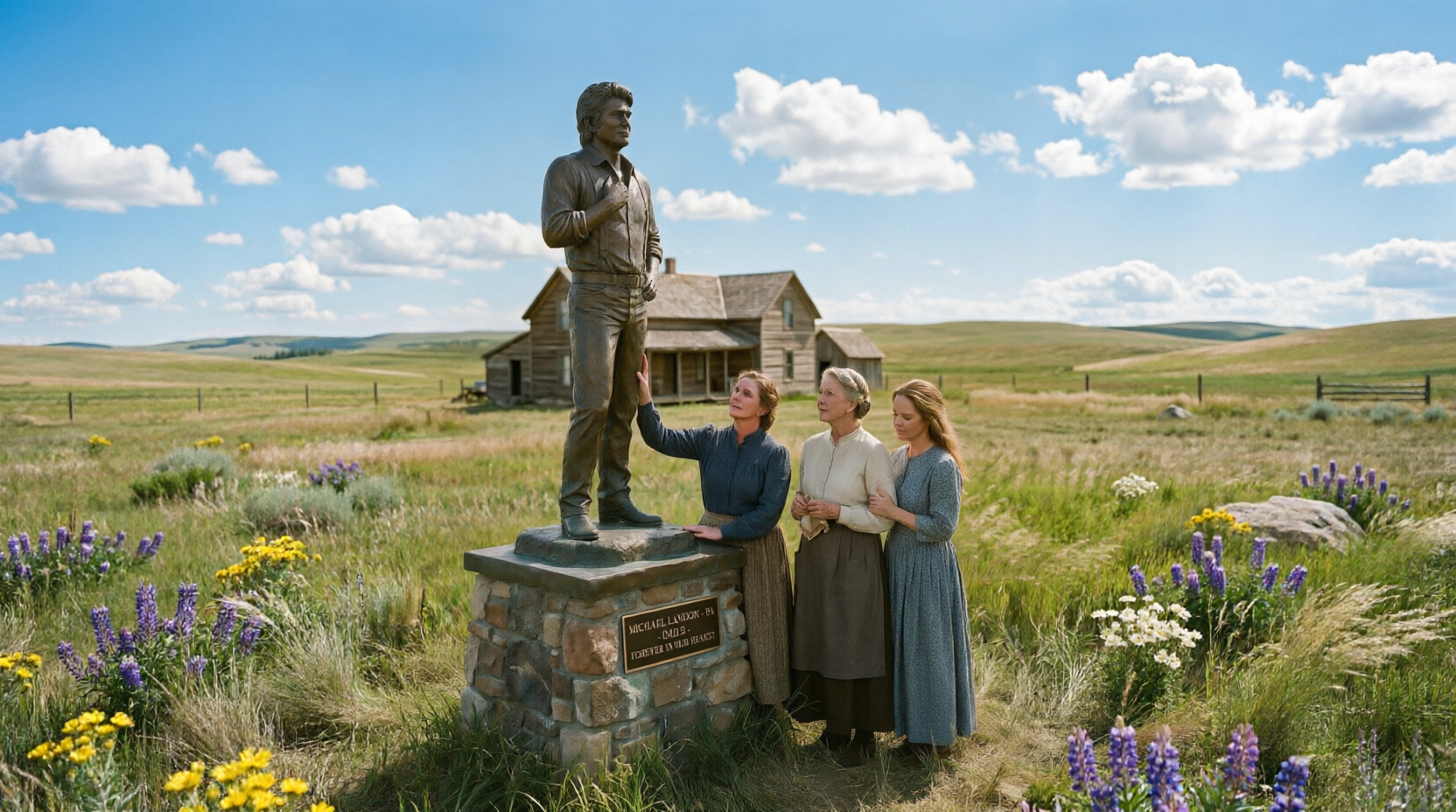
And somehow, that is enough. That says everything. Everything that needs saying.
Behind the statue, the little house endures. Its once-bright wood now silvered and worn by decades of prairie sun, wind, and rain. Its windows dark, its porch empty of the boots and laughter that once filled it. It stands not abandoned, not forsaken, but preserved — a shrine in amber, too sacred to dismantle, too honest to pretend it still pulses with life. The house bears the weight of memory, of love so enormous it cannot vanish.
Before that house. Beneath that bronze figure. Three women stand.
Caroline. Laura. Mary.
Karen Grassle. Melissa Gilbert. Melissa Sue Anderson.
A mother and her daughters, come home at last to Pa.
Karen reaches up. Her fingers rest on the bronze shoulder of the man she portrayed as her husband for nine seasons — not in reality, but in the deep, particular truth of fiction made real through repetition, devotion, and shared work. Caroline Ingalls was the anchor behind Charles, the quiet force steadying the family while Pa dreamed and dared, stumbled and soared. She was the hearth; he was the horizon.
And now Karen stands there, silver-haired and unhurried, her hand on his shoulder the way Caroline always stood beside Charles — not behind him, not in shadow, but beside him, equal in love, different in expression. Her touch is tender and deliberate, a silent conversation spanning decades. One hand rests on the statue, the other on the stone base, grounding herself, holding onto permanence in a world of impermanence.
Melissa Gilbert leans in. Her arm loops through Karen’s, her head tilting to that familiar shoulder. She is Laura Ingalls once more — she cannot help it, and she does not try. Some roles do not end when the cameras stop. Some characters, sown into your bones in youth, remain inseparable from who you are. Laura shaped Melissa like rivers shape stone — slowly, inevitably, indelibly.
And Michael Landon — Pa — shaped her too. He was more than a fictional father; he was a guide, a teacher, a presence in those formative years when she was learning what it meant to be brave, curious, and worthy of love. The gift is rare, complex, impossible to replicate: a man who fathers you through performance, love, and unwavering care.
Her gaze holds decades of feeling. Grief is there — undeniably, impossibly, because he has been gone more than thirty years, and some absences only grow heavier with time. Yet beneath grief lies something more: warmth, gratitude, a love that transcends presence. This is a love that does not require a hand to hold or a voice to speak. It lives quietly, insistently, like the prairie itself.
Melissa Sue Anderson stands slightly apart. Arms folded gently, eyes steady, bearing the quiet dignity Mary Ingalls embodied. Mary endured the deepest losses — blindness, bereavement, reinvention — and found grace in each. So too does Melissa Sue, standing here today. Her connection to Landon, to this place, to this chapter, is wordless. It lives beneath gesture, vast as the prairie, patient and enduring.
The little house behind them is both witness and participant. It was never just a set. It was, and is, a vessel for truth hidden inside fiction. A creation of wood and paint became a crucible for genuine emotion, the alchemy of human hearts working together. Something true grew here — the love between the characters, the devotion Michael Landon poured into every frame, the warmth that cannot be scripted.
The house remembers. The prairie remembers. Bronze does not forget. You can feel it all. The echo of boots on the wooden floor. The crackle of fire. The voices calling: Pa! Pa’s home! The screen door swinging open. A man stepping into sunlight, tired and yet radiant, someone who knows what matters and gives it freely.
And then there is the clothing — period skirts, aprons, bonnets loosely draped — a signal that these women have returned not only as themselves but as the characters who shaped them, and as the young girls who first inhabited this story. They are all of these things at once. The story is not over. Walnut Grove is not gone. It exists permanently, indelibly, in imagination and memory.
Pa stands on his pedestal, towering yet tender, over prairie and tall grass, over the house and the stories it holds. His eyes, bronze and still, carry the same capacity for love that filled the world around him — more than the world knew what to do with, and yet offered freely to those who would receive it.
The plaque says: Forever in Our Hearts.
Look at the three women. Look at Karen’s hand on his shoulder. Look at Melissa’s head tilting softly. Look at the quiet, profound stillness in Melissa Sue’s eyes.
The plaque is not a sentiment, not a decorative phrase, not nostalgia dressed as homage.
It is truth.
Michael Landon built them a home out of stories. And in that home, they have never stopped living.