“Coming Home to Pa”
The little house family never truly left — they just waited until the world was quiet enough to say what words never could
There are pilgrimages that have nothing to do with religion and everything to do with love.
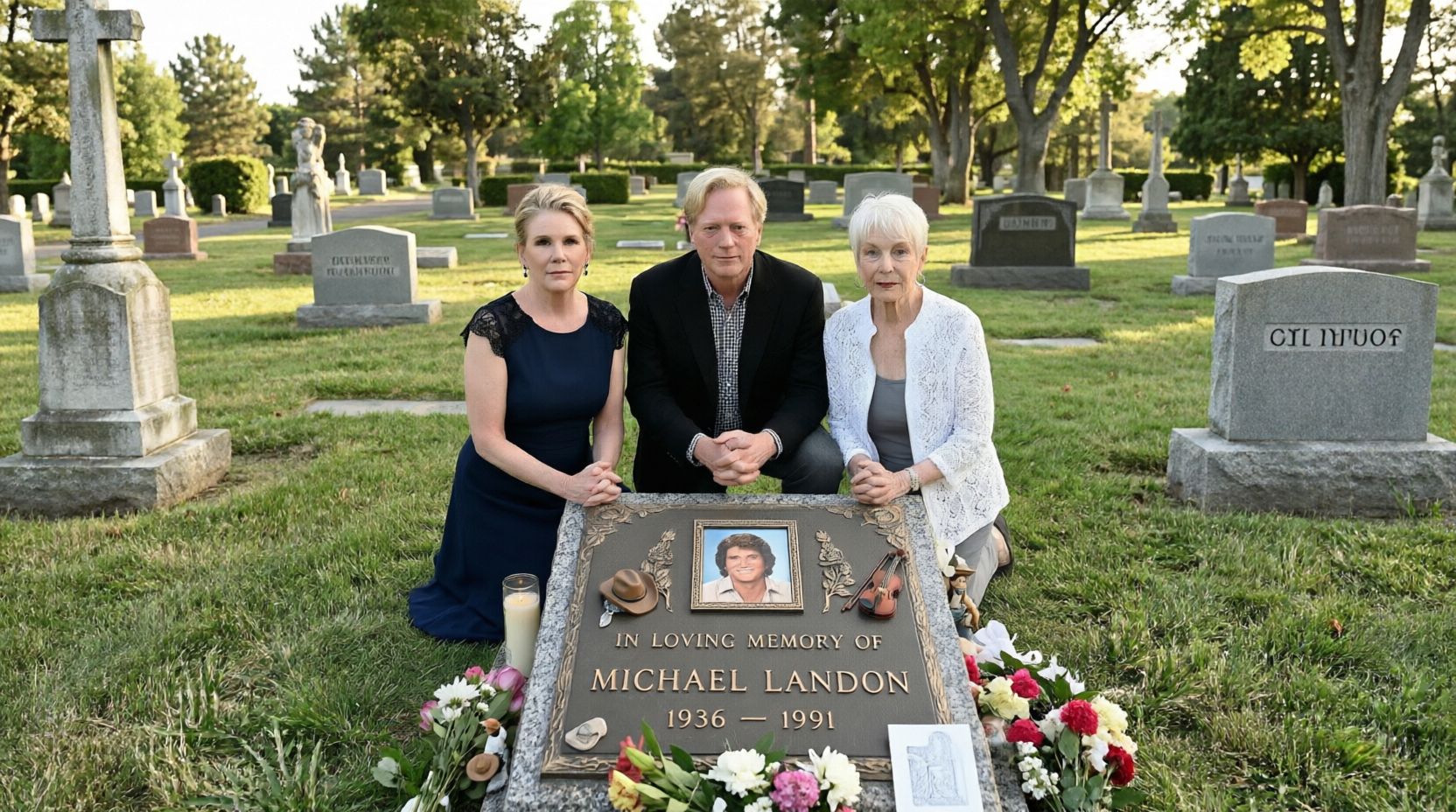
This was one of them.
Three people knelt in the soft grass of a California cemetery as the late afternoon light filtered through the trees in long, golden ribbons — the kind of light that feels almost deliberate, as if the sky itself understood the weight of the moment and chose, gently, to be kind.
On the grave marker before them, a photograph. A young man with dark, tumbling hair and eyes that carried warmth like a furnace carries heat — steady, constant, capable of filling any room it touched. A cowboy hat. A tiny violin. Flowers placed by hands that remembered.
And carved into the stone, the words that time cannot argue with:
In Loving Memory of Michael Landon. 1936 — 1991.
Melissa Gilbert. Dean Butler. Karen Grassle.
Laura Ingalls. Almanzo Wilder. Caroline Ingalls.
They had come home to Pa.
If you grew up in the 1970s or 1980s — if you spent your Sunday evenings gathered around a television set with your family, if you ever felt the specific, aching sweetness of a story that made the world seem worth believing in — then Michael Landon was not just an actor to you.
He was a feeling.
He was the warm certainty that goodness could survive hardship. That a father’s love was the most powerful force in any universe. That a family gathered around a table at the end of a hard day was not a small thing — it was everything.
As Charles Ingalls — Pa — Michael Landon spent nine years building something that television had never quite seen before and has never quite replicated since: a portrait of family life so honest, so tender, so unflinchingly committed to the belief that ordinary people living ordinary lives were worthy of extraordinary storytelling.
He did not play a superhero. He did not solve crimes or fight wars. He plowed fields. He held his daughters when they cried. He made mistakes and then stood in the doorway of a little house on a prairie and figured out how to be better.
And a generation of children watched him and learned, without anyone ever saying it directly, what a good man looked like.
Melissa Gilbert was nine years old when she first looked up at Michael Landon and called him Pa.
Let that sit for a moment.
Nine years old. She grew up on that set. She grew up under his watch, in the warmth of his attention, shaped in ways that don’t fully reveal themselves until you’re standing at a gravestone decades later with your hands folded and your eyes wet and the words simply won’t come.
Because what do you say to the man who was your father before you were old enough to understand what fathers truly mean? What do you say to the presence that shaped your sense of safety, your sense of what love looks like in practice, your very understanding of what it means to be seen?
You say nothing. You kneel. You stay.
Melissa Gilbert has spent her adult life carrying the gift and the weight of having been Laura Ingalls. Of having been Pa’s little girl in front of the entire world. She has spoken about Michael Landon with a tenderness that never dims — not after thirty years, not after everything life has thrown at her. Because some bonds don’t follow the ordinary rules of time. Some people become so embedded in the architecture of who you are that losing them is less like losing a person and more like losing a room inside yourself.
She knelt at his grave the way Laura Ingalls once knelt to pick wildflowers on the prairie. With complete, unguarded love.
Karen Grassle was Caroline Ingalls. Ma.
There is a particular grace required to play a mother — to inhabit that role week after week, season after season, and make it feel not like a performance but like a truth. Karen Grassle brought to Caroline Ingalls a quiet dignity, a bone-deep resilience, a warmth that never felt performed because it was rooted in something real.
She and Michael Landon built a television marriage that millions of families took into their own homes as a kind of template — a reminder of what partnership could look like when it was built on respect and shared purpose and the willingness to face whatever the prairie threw at you without letting go of each other’s hand.
To sit beside his grave now, as the woman who was his wife on screen for nearly a decade — there are no adequate words for what that must feel like. It is grief layered over memory layered over gratitude, all compressed into a moment of absolute stillness on a quiet afternoon in a California cemetery.
She placed her hands near the stone. She stayed.
Because Ma always stayed.
Dean Butler was Almanzo Wilder. The man who loved Laura. The man who drove his horses through blizzards to bring her safely home, who courted her with a patience and a steadiness that made every young girl watching believe that being truly loved was not only possible but worth waiting for.
Dean Butler came to Little House on the Prairie as a young man and left it with something he could never have anticipated: a second family. Because that is what Michael Landon built on that set. Not a production. Not a cast. A family — with all the complexity and loyalty and fierce affection that word implies.
Michael Landon was not always easy. He was demanding and brilliant and funny and occasionally impossible, the way all great forces of nature tend to be. But he was present. He was invested. He cared about the people around him with an intensity that made everyone feel like they mattered.
Dean Butler knew that. And on this afternoon, kneeling at the grave of the man who had been the patriarch of his professional family, he brought the quiet fidelity of Almanzo Wilder to a real and tender moment.
He had driven through the blizzard. He had shown up.
Michael Landon died on July 1, 1991. Pancreatic cancer. He was fifty-four years old.
Fifty-four.
The cruelty of that number is still staggering. A man that vital, that full of story and light and unspent energy — taken at an age when most men are only beginning to understand the full dimensions of themselves.
He spent his final weeks in public, refusing to disappear quietly, giving interviews with a raw and undefended honesty about what he was facing. He made people laugh. He made people cry. He held his family close and he did not pretend that everything was fine and he did not waste a single remaining minute on anything that wasn’t real.
He died the way he lived — fully present.
The world grieved in a way it rarely grieves for a celebrity. Because Michael Landon had never quite felt like a celebrity. He had felt like family.
The photograph on his grave marker shows him young. Dark-haired and bright-eyed, a smile that belonged to a man who understood joy and chose it daily. Beside the photograph, a miniature cowboy hat. A tiny violin — the instrument that sang through every episode of Little House, that carried the melody of the Ingalls family’s life across nine seasons and into the permanent memory of everyone who ever watched.
Those objects are not decorations. They are vocabulary. They are the language of people who loved him speaking in the only way available to them now.
And kneeling before them — Laura, Ma, and Almanzo — completing a family portrait that life interrupted too soon.
There is a scene in almost every Little House episode where Pa stands in the doorway of the little house on the prairie and watches his family inside — the lamplight warm, the voices of his children rising and falling, Caroline moving quietly through the room — and the look on his face is one of pure, uncomplicated gratitude.
He knew what he had. He knew it was enough. He knew it was everything.
Michael Landon gave that to all of us. The reminder that what matters is who is in the room with you. Who came. Who stayed. Who knelt beside you in the hard moments and did not look away.
On this golden afternoon, in the quiet of a California cemetery, three people came.
Three people stayed.
Pa would have been proud.