PART 4: THE LETTER MY GRANDMOTHER LEFT BEHIND
I sat on that cold Chicago bench with my phone pressed against my ear, trying to understand what Caroline had just told me.
“My parents could lose their house?” I whispered.
Caroline took a deep breath. “Emma, there’s something you need to understand. Your grandmother didn’t simply leave you money. She left you the house your parents have been living in for almost twenty years.”
For a moment, I genuinely thought I had misheard her.
“The house? Our family house?”
“Yes, sweetheart. The one with the white porch and the big maple tree in the backyard.”
My stomach dropped.
That house had been the center of my childhood. I had spent countless evenings cleaning its kitchen, mowing its lawn, and helping Dad repair things whenever he insisted we couldn’t afford a professional.
Meanwhile, Bethany had received everything she wanted without lifting a finger.
“That’s impossible,” I whispered. “Dad always said he bought that house before I was born.”
“He didn’t,” Caroline replied firmly. “Your grandmother owned it. She arranged for your aunt and uncle to live there while raising you, but she placed the property in a trust for your benefit.”
I closed my eyes.
“Then why didn’t anyone tell me?”
“Because they hoped you would never find out.”
A car horn sounded somewhere behind me, but I barely noticed.
Caroline continued, “Your grandmother knew your aunt Margaret could be controlling. She wanted to make sure you would always have a home, no matter what happened.”
My throat tightened.
Someone had loved me enough to think about my future before I could even walk.
Someone had wanted to protect me.
And the people who raised me had apparently spent years keeping that love hidden.
“How much money are we talking about?” I asked.
Caroline hesitated.
“The trust originally held the house and approximately two hundred and forty thousand dollars in investments.”
I went completely still.
Two hundred and forty thousand dollars.
I thought about the eighteen-year-old girl who had counted every dollar in her savings account before leaving home.
The girl who ate ramen because fresh groceries felt too expensive.
The girl who worked thirty hours a week while attending summer classes.
“Where is that money now?”
“That’s what we need to find out.”
I swallowed hard.
“How do you know all this?”
“Your aunt Denise contacted me after discovering some old family documents. She had been suspicious for years, but she didn’t know where you were. When she found out you had moved away, she started asking questions.”
I remembered Aunt Denise vaguely.
She was my father’s older sister, a woman with silver hair who sent birthday cards every year until I turned twelve.
Then the cards suddenly stopped.
My parents told me she had become bitter and wanted nothing to do with us.
Apparently, that was another story I needed to question.
“Can I meet you?” I asked Caroline.
Her voice broke.
“Emma, I’ve been praying you would ask me that.”
We arranged to meet the following morning at a quiet café near my apartment.
I barely slept that night.
Every memory from childhood returned with a new and disturbing meaning.
The time I asked for money to attend a science competition and Dad said we couldn’t afford it.
The time Mom refused to buy me a winter coat because Bethany needed new dance costumes.
The time I overheard them arguing about “trust documents” and was told it was none of my business.
And the most painful memory of all?
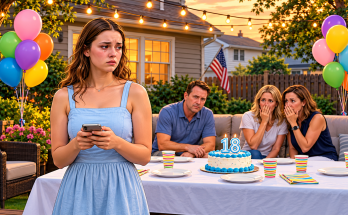
My eighteenth birthday.
The day I legally became an adult.
The very day they had tried to make me feel so unwanted that I walked away without asking them for anything.
Suddenly, I wondered whether that had been exactly what they wanted.
The next morning, I arrived at the café twenty minutes early.
My hands trembled as I stirred a coffee I had no intention of drinking.
At exactly ten o’clock, a woman entered wearing a navy-blue cardigan and carrying a worn leather handbag.
She stopped just inside the doorway.
Our eyes met.
I knew immediately.
It was like looking at an older version of myself.
She covered her mouth with one hand.
“Emma?”
I stood.
“Caroline?”
She crossed the room slowly, almost as though she feared I might disappear.
Then she wrapped her arms around me.
I had imagined what meeting my biological mother might feel like.
Anger.
Confusion.
Resentment.
But when Caroline held me, all I felt was the overwhelming grief of nineteen stolen years.
We cried together beside that little café table while strangers politely looked away.
Finally, we sat down.
Caroline reached into her handbag and removed a thick folder.
“I brought everything I could find.”
Inside were photographs, old letters, legal documents, and a faded hospital bracelet.
There were pictures of me as a newborn.
Pictures of Caroline holding me in a small bedroom.
Pictures of my grandmother smiling beside my crib.
I stared at one photograph for a long time.
My grandmother was kissing my forehead.
On the back, someone had written:
Our little Emma. May you always know you are loved.
My vision blurred.
“She loved you so much,” Caroline whispered.
I wiped my face.
“Why did you believe I died?”
Her expression changed.
“I was seventeen, Emma. Your grandmother was helping me raise you. But when you were three months old, I became very sick and spent several weeks in the hospital.”
She paused.
“While I was recovering, Margaret and Robert offered to care for you temporarily.”
My heart began pounding.
“When I was discharged, Margaret told me you’d developed a serious infection and had died while I was hospitalized.”
I stared at her.
“She told you that?”
Caroline nodded, tears rolling down her cheeks.
“They said the arrangements had already been handled. Your grandmother was overseas visiting relatives, and I was so devastated I could barely function.”
“Didn’t you ask to see my grave?”
“Of course I did. They showed me a grave marker. I later discovered it belonged to another infant, and the name had been temporarily covered for the photograph they gave me.”
A sick feeling twisted through my stomach.
Caroline continued, “By the time your grandmother returned and realized something was wrong, Margaret and Robert had already started legal proceedings using documents that falsely claimed I had consented.”
“Did Grandma know I was alive?”
“Eventually. She found you living with them when you were almost two. She tried to challenge the adoption, but Margaret convinced everyone it would traumatize you to change families.”
I shook my head.
“Then why didn’t Grandma tell me?”
“She wanted to. But your parents threatened to move away and cut off her access to you.”
Caroline looked down at her hands.
“Your grandmother was already ill by then. She believed the best way to protect you was to secure your financial future.”
She pulled out a sealed envelope.
My name was written across the front in elegant handwriting.
To my beloved granddaughter, Emma. Open when you are eighteen.
I stared at it.
“Have you read this?”
“No. It’s yours.”
My fingers trembled as I opened the envelope.
Inside was a three-page letter.
The first sentence shattered my heart.
My dearest Emma, if you are reading this, I hope you have grown into the kind, brave young woman I always believed you would become.
I swallowed the lump in my throat and continued.
There may come a time when you question whether you were loved enough. If that day arrives, please remember that your worth was never determined by how others treated you.
Tears spilled onto the paper.
I have arranged for the family home and the remaining investments from my estate to be held for you in trust. Margaret and Robert may live in the house while you are a minor, but the property is intended for your future, not theirs.
I kept reading.
When you turn eighteen, you have the right to request a full accounting of the trust. You also have the right to decide whether the house should remain occupied by anyone else.
My hands went cold.
At the bottom of the final page was another paragraph.
I fear that some members of our family have confused love with control. Please never believe you must purchase someone’s affection by sacrificing your own happiness.
I lowered the letter.
For several moments, neither Caroline nor I spoke.
Then I asked the question that had been building inside me.
“Did my parents know about this letter?”
Caroline nodded.
“They were supposed to give it to you on your eighteenth birthday.”
I stared at her.
My eighteenth birthday.
The day they forbade me from celebrating.
The day they threatened never to welcome me home again.
The day I walked out carrying two duffel bags.
I had believed they were simply cruel.
Now I wondered whether they had been afraid.
Afraid I would discover I owned something they had been treating as theirs.
Afraid I would demand answers.
Afraid their comfortable lives would collapse.
Caroline pulled another document from the folder.
“This is where things get worse.”
It was a financial statement dated six months earlier.
Several transfers were highlighted.
One was for $38,500.
Another was for $22,000.
A third was for $47,000.
All appeared to have been taken from accounts associated with my trust.
“What are these?” I asked.
Caroline’s face hardened.
“The first was for Bethany’s luxury birthday celebration and spa weekend. The second was connected to a car purchase. The third went toward a down payment on a vacation property.”
I felt physically ill.
They had spent money intended for me on Bethany.
And now they wanted fifteen thousand more.
“Are these records enough to prove it?” I asked.
“Not yet. Aunt Denise obtained copies of some statements, but an attorney needs to review the complete records and determine which withdrawals were authorized.”
I nodded slowly.
For the first time, I wasn’t thinking about revenge.
I was thinking about accountability.
Caroline gave me the name of an attorney who specialized in trusts and estate disputes.
Two days later, I sat across from him in his office.
His name was Michael Harris, and he had a calm, deliberate way of speaking that made me feel less overwhelmed.
He examined the documents for nearly an hour.
Finally, he removed his glasses.
“Emma, I need to be very clear. If these records are authentic and the trust terms are what they appear to be, there may have been serious breaches of fiduciary duty.”
“What does that mean?”
“It means the people responsible for protecting your inheritance may have used it for purposes that violated their obligations.”
I stared at him.
“Can I get the house back?”
“Possibly. We first need to verify the deed, trust provisions, and any amendments. We can also demand a formal accounting.”
I took a deep breath.
“Then do it.”
He nodded.
“There’s something else you should understand. Once we formally notify your parents, their attorney may advise them not to contact you directly.”
I thought about the restaurant.
The demands.
The insults.
The nineteen years of lies.
“That’s fine with me.”
Over the following week, Michael began gathering records and preparing the necessary legal requests.
Meanwhile, my parents kept calling.
At first, the messages were angry.
Emma, you’ve caused enough trouble. Call us immediately.
Then they became strangely affectionate.
Sweetheart, we miss you. Let’s talk like a family.
Finally, my mother left a voicemail that made my skin crawl.
“Emma, whatever Caroline has told you, please remember that she’s unstable. We raised you. We sacrificed everything. You owe us the chance to explain.”
I forwarded the recording to Michael.
His response was brief.
“Do not discuss the trust with them. Let me handle communications.”
Then, on Thursday afternoon, something unexpected happened.
Bethany appeared outside my office building.
She was standing near the entrance when I came out for lunch, her eyes red and her expensive handbag clutched against her chest.
“Emma, we need to talk.”
I stopped.
“What are you doing here?”
She looked around nervously.
“Mom and Dad don’t know I came.”
That surprised me.
Bethany had never done anything without their approval.
“What do you want?”
For once, she didn’t insult me.
She didn’t roll her eyes.
She didn’t demand anything.
Instead, she whispered, “I found something in Dad’s office.”
My stomach tightened.
“What?”
She pulled a folded document from her purse.
“I wasn’t supposed to see it.”
I glanced at the paper.
It was a letter from a bank regarding a loan application.
The applicant’s name was Robert Crawford.
The collateral listed was a residential property.
My childhood home’s address.
My heart began racing.
“Bethany, where did you get this?”
She looked close to tears.
“Dad was screaming at Mom last night. He said if you found out about the mortgage, we could lose everything.”
I stared at her.
“What mortgage?”
Bethany swallowed.
“Emma, they’ve been borrowing money against that house for years.”
I looked down at the document again.
A figure near the bottom caught my attention.
Outstanding loan balance: $312,000.
My blood went cold.
My parents had apparently borrowed hundreds of thousands of dollars against a property my grandmother intended for me.
But Bethany wasn’t finished.
She reached into her bag and pulled out a second envelope.
“There’s something else,” she whispered. “I found this behind Dad’s filing cabinet.”
Inside was a photocopy of a document bearing my name.
A signature appeared at the bottom.
Emma Elizabeth Crawford.
I stared at it.
“I never signed this.”
Bethany nodded slowly.
“I know.”
The document was dated three months after my eighteenth birthday.
It appeared to authorize a transfer of my interest in the property.
My hands began shaking.
“Bethany, what is this?”
Her voice broke.
“Mom told Dad she could copy your signature from your old school paperwork. She said nobody would ever question it.”
I looked at my sister.
For the first time, she seemed genuinely afraid.
Then she whispered something that changed the entire situation.
“Emma, they’re planning to sell the house next month. Dad already found a buyer. And there’s one more thing you need to know.”
I could barely breathe.
“What?”
Bethany looked straight into my eyes.
“They’re going to tell the bank you agreed to everything. And if you try to stop them, Mom says she has proof that you stole money from the family.”
I froze.
“Proof?”
Bethany nodded, tears streaming down her face.
“She made it up, Emma. I watched her do it.”
And standing there outside my office, holding documents that could destroy my parents’ carefully constructed lies, I realized the greatest betrayal of my life might finally become the evidence that would bring them down.
But I had no idea that the very next morning, my father would arrive in Chicago with the police, accusing me of a crime I had never committed………
TO BE CONTINUED IN LAST PART…