Part 1: At my brother’s engagement, his fiancée poured vintage Cabernet down my thrift store dress while laughing; his future mother-in-law dragged me to the vendor table as if I were the help; my own brother watched and turned his back; by 6:05, I had officially ended their event, and I was done being their silent ATM. I was dragged to the vendor table by his future mother-in-law as if I were a helper. My own brother turned away while observing. I had officially ended their event by 6:05. and that I was no longer their silent ATM.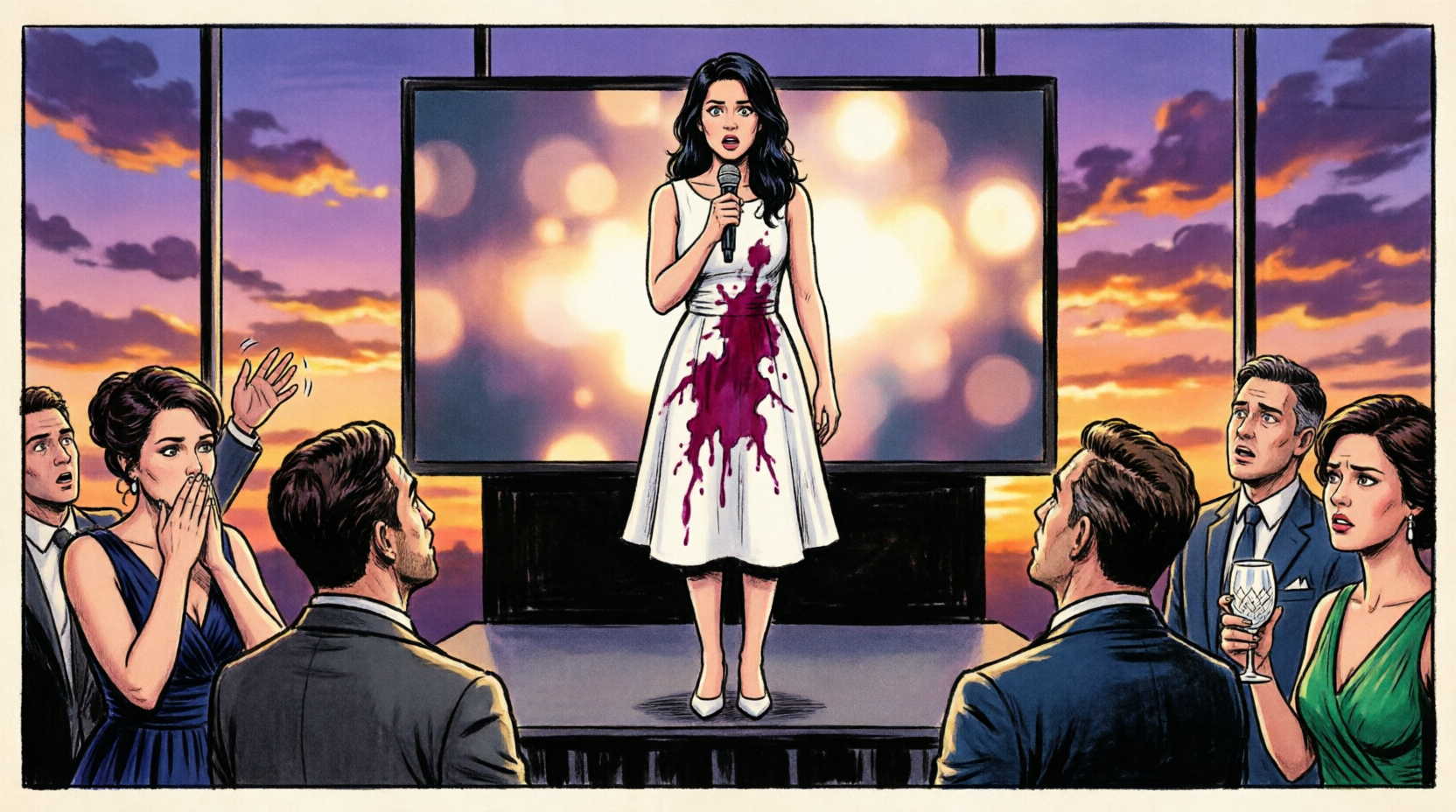 “You shouldn’t have come. The smell of those cheap clothes is ruining my party.”
Those were the last words my brother’s fiancée whispered into my ear before she lifted her wrist with perfect elegance and poured an entire glass of vintage Cabernet down the front of my white dress.
The wine hit me like a slap. At first, it was warm, then instantly cold as the air touched the soaked fabric. I heard it before I fully felt it—the heavy splash of expensive wine spilling down my chest, the soft patter as it hit the floor, and the sharp little gasps from the guests standing nearby.
The music stumbled. Even the DJ missed a beat because he had turned to look. Around us, conversations thinned into a silence so complete I could hear myself breathe.
Bianca stepped back slightly and watched the stain spread across my dress like dark red ink. Her perfectly painted mouth curved into a small, satisfied smile, the kind she probably practiced before fake apologies and winning arguments.
There was something specific in her eyes. Not just cruelty. Pleasure. She was waiting for me to break, to cry, to tremble, to apologize for existing in her perfect room.
I gave her nothing. I didn’t flinch. I didn’t reach for the glass. I didn’t cover the stain. I didn’t even look down. I only looked at her.
Then I checked my watch. 6:02 p.m. Three minutes, I decided. By 6:05, this entire party—this engagement celebration, this polished little fantasy, this carefully staged performance of success—would be finished. Legally. Quietly, if they behaved. Loudly, if they didn’t.
Strangely, I felt calm. As calm as if I were sitting in my office reviewing a balance sheet instead of standing in the middle of a ballroom with wine dripping into my shoes.
Someone gasped behind Bianca. One of her bridesmaids, all glitter and spray tan, stared with her mouth open. A guest reached for a napkin, then stopped, unsure whether helping me would make her socially unsafe.
The crowd wasn’t only watching what Bianca had done. They were waiting to see what I would do. The poor sister had been attacked by the golden bride. This was supposed to be the moment I cracked.
Bianca gave a light, tinkling laugh, the kind that belonged over brunch drinks and cruel gossip.
“Oh dear,” she said dramatically. “Look at that. What a shame.”
She snapped her fingers at a passing waiter without even turning to him.
“Napkin. Maybe club soda too. Though I doubt it’ll help that fabric. It looks like polyester.”
Her eyes dragged over me with lazy contempt. Then she turned her back as if I no longer existed, opening her arms to receive the shocked comfort of her bridesmaids as though she were the injured party.
I stood alone, soaked in wine, silent in the center of the room.
The ballroom at Obsidian Point had been created to impress. High ceilings. Crystal chandeliers dripping golden light. Wide windows facing the ocean as the sunset painted it pink. Tall glass vases filled with white roses and eucalyptus. Candles floating in shallow bowls. Light reflected everywhere.
I had approved the last renovation myself. I knew every beam, every wall panel, every upgraded bulb. But to them, I was not the owner of that room. I was the stain inside it.
That was when Denise, my brother’s future mother-in-law, stepped in. Denise always moved like every room belonged to her. Short, sharp steps. Heels clicking like warnings. Red nails flashing at the end of each finger. She worked in Human Resources at a mid-sized tech company, which might sound harmless unless you have ever met someone who truly enjoys saying, “We’ve decided to go in another direction.”
“Sweetheart,” she murmured as she reached me, her voice sugary enough for public display but sharp underneath, “let’s get you out of everyone’s view, yes?”
Her fingers closed around my upper arm. Stronger than they looked. Her smile stayed perfect for the watching guests. To them, she probably looked like she was helping.
“We can’t have you standing there looking like a crime scene during the first dance,” she whispered.
She didn’t wait for me to answer. She turned and dragged me with her. I let her. Not because I couldn’t pull away. Because I was watching the room.
My brother, Caleb, stood ten feet away with champagne in his hand. The bubbles caught the chandelier light and made the glass glow. He had seen everything. He had watched Bianca walk toward me, smile, lean in, and pour wine down my dress. He had watched Denise grab my arm like I was an intern who needed to be removed from a corporate event. He had watched. That mattered.
As Denise marched me past him, I looked at Caleb. Really looked. He met my eyes. His face held discomfort, pride, and stubbornness all at once. For one second, our gaze locked. Then he raised his glass, took a slow sip, and deliberately turned away.
Something inside me hardened. Not like a snap. More like ice forming slowly from the center of my chest outward.
Denise dragged me past the family table with its oversized flowers and gold-script place cards. Past the bar where guests held delicate glasses filled with expensive sparkling drinks. Past relatives who suddenly found the floor fascinating.
We reached the swinging metal doors at the far end of the ballroom. She shoved one open with her hip and pulled me into a small hidden area near the kitchen entrance, where the vendor table had been set up behind a decorative partition and a giant potted palm.
The DJ sat there with headphones around his neck and a half-eaten sandwich in his hand. The photographer was changing lenses. A bartender leaned against the wall, scrolling on his phone until the next rush.
This was where the staff rested. Where people ate quickly, breathed for two minutes, and rolled their eyes about guests who treated them like machines. To someone like Denise, it was the perfect place to hide a problem no important person should have to see.
She pulled out a shaky metal chair and pointed at it like she was sending me to detention.
“Stay here,” she said.
Then she smoothed her dress, making sure her appearance was still perfect.
“And please try not to speak to anyone important. We’re being generous by letting you stay after that little… accident.”
It had not been an accident. We both knew it. I sat down anyway.
“Good,” she said briskly, already turning back toward the ballroom. “Someone will bring you… something.”
The metal door swung shut behind her with a hollow clang. For a moment, all I heard was the hum of the industrial dishwasher and the muffled bass from the ballroom.
The DJ gave me an awkward half-smile, his eyes flicking to the stain on my dress before he quickly looked away. The photographer seemed like she wanted to say something kind, but my expression must have stopped her.
I didn’t feel ashamed. I didn’t feel embarrassed. I felt awake.
Through the gap between the palm and the partition, I could see the ballroom. From here, I was nearly invisible. Hidden in the shadows. Put with the help.
What Bianca and Denise did not understand—what my brother had never cared enough to ask—was that this was exactly where my power lived.
I watched Caleb lift his glass. Champagne flashed under the chandelier. He laughed and bumped fists with a friend, glowing in the attention. My brother had grown into charm. Sharp jaw. Easy smile. Tailored suit. In school, he had been the golden boy—athletic, adored, praised by teachers, bragged about by relatives.
I was the one people asked to take the photo, not the one they wanted in it. In Caleb’s mind, my place had always been just outside the frame. Useful. Quiet. Invisible.
Memories moved through me. Birthdays I planned while he took credit. Holidays where I washed dishes alone while he entertained the living room. Arguments where my parents said, “You know your brother doesn’t mean it. You’re stronger. You can handle it.”
None of them had ever considered that one day I might stop wanting to handle it.
Bianca stood in the middle of the dance floor, glowing under the lights, her dress sparkling, her hair arranged in perfect waves. She laughed with her head thrown back, one hand on her chest like she was delighted by her own happiness.
To anyone else, she might have looked like a shallow mean girl who had gone too far. But I knew better. This was not random cruelty. It was strategy.
I had built my career studying numbers, contracts, and leverage. Eventually, I learned to read people the same way: assets, liabilities, risks, pressure points. Power moving from one hand to another.
People like Bianca don’t attack at random. They calculate.
When she entered this room—this venue she could never afford on her own salary, surrounded by people whose lives looked smoother than hers—she must have felt that familiar pinch of insecurity. Buried under makeup and designer fabric, maybe, but still there.
Insecure people don’t always shrink. Sometimes they try to consume.
She had scanned the room the way a predator scans a herd. Not for the strongest. For the easiest. She saw my parents, dressed better than usual, glowing with pride and nervous energy. She saw Caleb, her ticket into the world she wanted. She saw relatives, coworkers, friends. Then she saw me.
My dress had cost twelve dollars at a thrift store. I loved it because it fit well and had pockets. To Bianca, cheap meant pathetic. I was quiet. Reserved. Alone. In her mind, I was an easy target. No visible power. No obvious allies.
If she pushed me down in front of everyone, she wouldn’t just be cruel. She would be climbing.
Dominance is a primitive language, and Bianca spoke it fluently. She was so focused on what I looked like that she never asked what I owned. She saw my thrift-store dress and decided I was beneath her. She saw me at the vendor table and assumed I belonged with the staff. And she made the fatal mistake of believing quiet meant weak.
I unfolded the linen napkin in front of me and placed it neatly across my lap. Not to clean the wine. That could wait.
I checked my watch again. 6:04. Time to correct her calculation.