PART 1 The cake arrived before the shame did. It was white, enormous, decorated with red icing flowers and a phrase written in crooked letters that made the entire auditorium stop and stare: “Congratulations, son. Your real mom came back for you.” Claudia did not rise from her seat. She did not scream. She did not throw anything. She only gripped the handbag resting on her lap, that same worn purse where she kept tissues, folded receipts, and a photo of Emiliano at four years old, his face smeared with chocolate at a school fair. On stage, Emiliano stood in a black graduation gown and a navy blue mortarboard. At nineteen, he held the highest GPA in his class and a partial scholarship to study engineering in Monterrey. For Claudia, that day was more than a graduation. It was proof that every double shift, every sleepless night, every patched shoe, and every meal stretched thin with beans had truly been worth it. She had raised him since he was two weeks old. Her sister, Renata, had left him one early morning at the family home in Iztapalapa, wrapped in a green blanket printed with bunnies. She arrived wearing makeup, carrying a small suitcase, her eyes completely dry. “Keep him for a few days, Clau. I can’t handle this. I’m dying in here,” she had said. Those “few days” turned into nineteen years. Claudia was twenty-three, working at a beauty salon near the Ermita metro station, and had just enrolled in courses to open her own shop. She had simple plans, but they were hers. That night, she quietly set them aside. She learned to prepare bottles, to bring down a fever with cool cloths, to buy diapers one by one at the corner store, and to lie to Emiliano when there was no money for toys. “Not right now, my love. Next payday.” Renata would show up every so often. She arrived wearing dark sunglasses, expensive perfume, and shopping bags from malls Claudia could never afford. She took selfies with Emiliano, hugged him for ten minutes, then left claiming she was busy. On social media, she wrote: “My beautiful boy, my driving force.” But she did not know what he was allergic to. She did not know he slept with a nightlight on until he was eight. She did not know he cried for a week after being cut from the soccer team. That day, Renata entered the auditorium like a soap opera star. She wore a fitted white dress, high heels, and a flawless smile. Beside her walked Gerardo, a man with an expensive watch and a look of complete confusion. Behind them came Doña Elvira and Don Manuel, Claudia and Renata’s parents, carrying the cake as if it were a wonderful surprise. 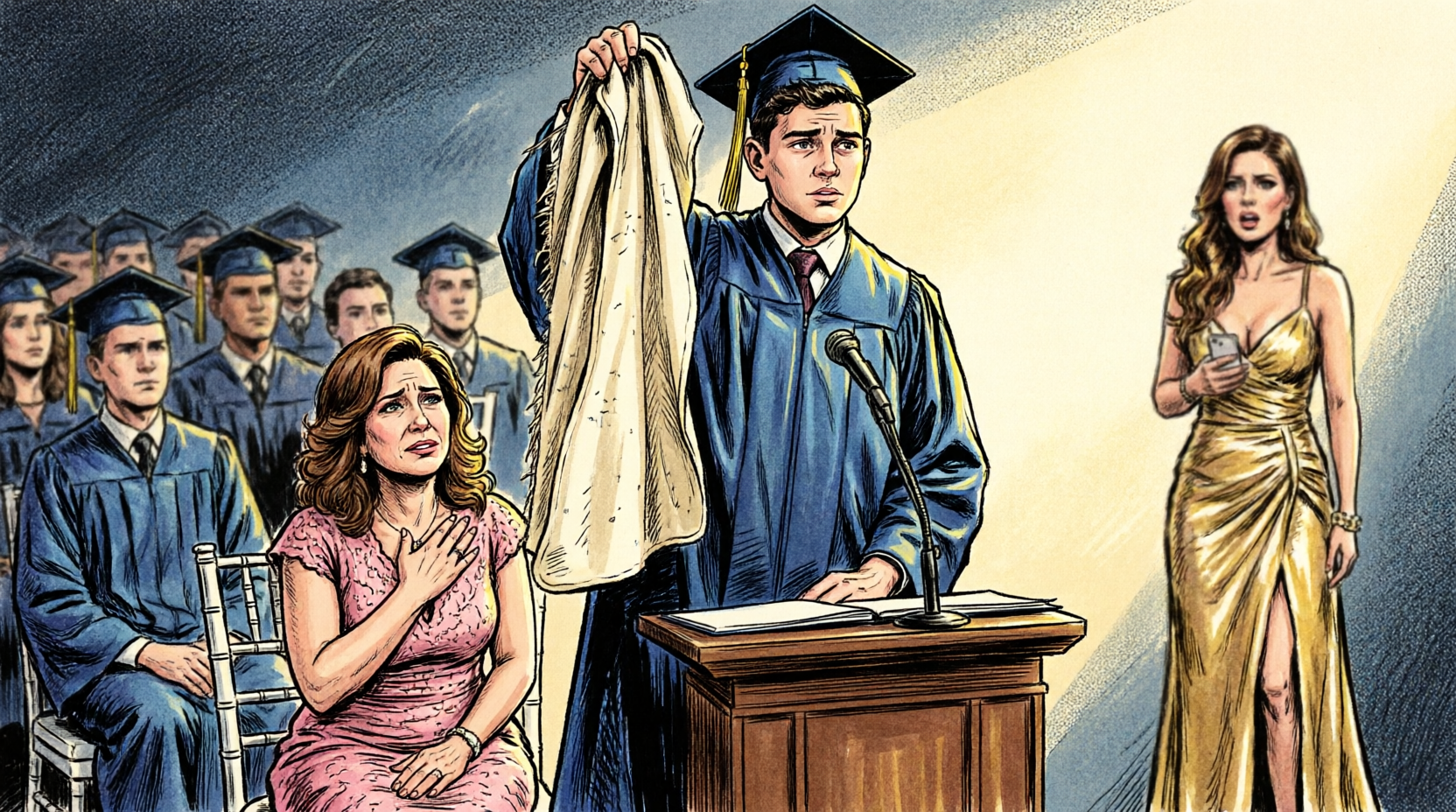 Renata walked up to Emiliano and opened her arms. “My baby, your mom is finally back.” Emiliano did not move. He only searched the crowd for Claudia. Then Renata approached her sister and touched her shoulder with a confidence that stung. “Thank you for taking care of him for me, Clau. Truly. You were like his second mom… or well, like his trusted nanny.” The word “nanny” hit harder than a slap. Claudia felt her face burn, but she did not respond. Emiliano kept looking at her from the stage, serious and steady, as if asking her to wait. Then they announced the student with the highest GPA. Emiliano stepped up to the microphone. Renata pulled out her phone to record. But he folded the speech he had prepared, tucked it into his gown, and spoke in a clear voice: “Before I talk about my future, everyone here is going to know who stood by me when my real mother decided to disappear.” In that instant, Claudia understood that no one would be able to stop what was coming.
Renata walked up to Emiliano and opened her arms. “My baby, your mom is finally back.” Emiliano did not move. He only searched the crowd for Claudia. Then Renata approached her sister and touched her shoulder with a confidence that stung. “Thank you for taking care of him for me, Clau. Truly. You were like his second mom… or well, like his trusted nanny.” The word “nanny” hit harder than a slap. Claudia felt her face burn, but she did not respond. Emiliano kept looking at her from the stage, serious and steady, as if asking her to wait. Then they announced the student with the highest GPA. Emiliano stepped up to the microphone. Renata pulled out her phone to record. But he folded the speech he had prepared, tucked it into his gown, and spoke in a clear voice: “Before I talk about my future, everyone here is going to know who stood by me when my real mother decided to disappear.” In that instant, Claudia understood that no one would be able to stop what was coming.PART 2 The silence fell so heavily that even the principal stopped smiling. Parents who had been recording lowered their phones. Teachers exchanged glances. Some students, still in their caps and gowns, turned toward Renata, who remained standing with the cake behind her, feigning a calm she no longer possessed. Emiliano took a deep breath. He did not look at Renata. He looked at Claudia. “When I was two weeks old, a woman left me in a house with a green blanket and a nearly empty diaper bag. She left no money. She left no instructions. She did not even leave a note with a doctor’s appointment.” Claudia felt her throat tighten. Doña Elvira murmured something but did not dare raise her voice. “The person who held me that night was twenty-three years old,” Emiliano continued. “She was not rich. She was not ready. She had never given birth to a baby. But she got up the next day and decided to stay.” Renata lowered her phone. Gerardo glanced at her sideways. “That woman worked cutting hair, doing nails, cleaning houses, and selling gelatin outside a middle school. She bought my uniforms in installments. She took me to the doctor on public buses. She taught me to read with old magazines. She waited outside my entrance exams whispering prayers, even though she claimed she was not very religious.” A murmur rippled through the auditorium. Claudia was already crying silently. Her friend Marta, sitting beside her, took her hand. She knew all too well what that woman had endured. She had seen her arrive at the salon with Emiliano asleep in a stroller, attending clients with one eye on her scissors and the other on the makeshift crib. Emiliano reached under his gown. He pulled out a worn green blanket with frayed edges. He held it high. “This was my first blanket. The one I had when I was left behind. Claudia kept it all these years alongside my report cards, my hospital bracelets, my diplomas, and a letter I wrote when I was six.” He paused. His voice barely cracked. “In that letter I wrote: ‘Mom Claudia, thank you for not leaving.’” Renata took a step toward him. “Emiliano, get down from there. You don’t have to make a scene.” He looked at her for the first time. Not with hatred. With a sadness that left her frozen. “It’s not a scene. It’s my life.” Doña Elvira stood up, nervous. “Son, don’t humiliate your mother. She was young. She didn’t know what she was doing.” Emiliano gripped the blanket tighter. “Claudia was young too, Grandma.” That sentence made several people let out a quiet gasp. Don Manuel closed his eyes. For years he had repeated that Renata needed understanding, that Claudia was stronger, that the family supported each other. But he had never said out loud that he had burdened one daughter with the other’s life without ever asking if she could handle it. Emiliano now pulled out a brown envelope, folded in half. Claudia recognized it instantly. She felt a chill. It was a letter she had kept in a shoebox, at the back of her closet. A letter written by Renata when she left for Cancún with a photographer who promised connections, travel, and a life far from diapers. Claudia had never wanted to show it to Emiliano. She did not want to plant resentment in him. But he had found it. “A week ago, while looking for photos for the graduation video, I found this,” Emiliano said. Renata turned pale.
“Don’t read that.” But he had already opened the page. “‘Claudia, don’t look for me. I’m not made to be a mother. You were always the responsible one. Take care of him. When I can, I’ll send something. Don’t tell the boy I abandoned him; tell him I left to work for him.’” The entire auditorium froze. Gerardo stepped back. “You wrote that?” he asked, almost voiceless. Renata tried to smile, but her mouth trembled. “It was a hard time. I was depressed. No one knows what I went through.” Claudia finally stood up. She did not yell. She did not insult. She simply rose to her feet with red eyes and the weary dignity of a woman who had swallowed too much. “I never denied that you were scared, Renata,” she said. “But while you were scared on beaches, at parties, and in other people’s apartments, I was scared that your son would stop breathing when he had a fever. I cried too. I felt alone too. The difference is that I did not leave him.” Several mothers in the audience began to nod. Renata clenched her jaw. “Don’t come here trying to make me look like a monster. You got attached because you wanted to.” Claudia let out a sad laugh. “I didn’t get attached to a houseplant, Renata. I raised a child.” Emiliano stepped down from the stage with the blanket in one hand and the letter in the other. The entire auditorium followed his movements. It seemed he was heading straight for Claudia, but Renata stepped in his way. “I am your mother,” she said, her smile gone. “I brought you into this world. No one can take that away from me.” Emiliano stopped. “Yes. You brought me into this world. But we still need everyone to know why you came back today of all days.” Renata’s eyes widened. For the first time, her fear was completely visible. “I don’t know what you’re talking about.” Emiliano pulled another document from the inner pocket of his gown. It was a printed sheet bearing the stamps of a notary office in Puebla. “Three days ago, Attorney Arriaga called me. He told me that my grandfather Ignacio, your father, left a trust fund in my name before he passed away. A fund that was to be released when I turned nineteen and finished high school.” Claudia felt the floor shift beneath her. She knew nothing about it. Don Manuel pressed a hand to his forehead. Doña Elvira began to cry. “It was for his education,” she murmured. “Your grandfather wanted to make sure you wouldn’t miss out on college.” Emiliano looked at his grandparents. “And why did no one tell me?” Doña Elvira did not answer. Don Manuel lowered his head.
Renata raised her voice, desperate. “Because you were a minor. Because Claudia doesn’t know how to handle money. Because someone had to protect him.” Gerardo looked at her as if he were meeting her for the first time. “You told me you had paid for his school all these years,” he said. “You told me Claudia kept him from you, that she stole your son, and that today you were going to get him back to build a family with me.” The murmurs turned to outrage. A woman in the second row said, “What a terrible mother.” Renata heard it and broke down. “Everyone judges me, but no one knows what it’s like to carry a motherhood you never asked for!” Claudia took a step toward her. “No one is judging you for being scared at twenty. They’re judging you for coming back now that money appeared, a rich fiancé showed up, and there’s a pretty photo for Facebook.” The blow was clean. Renata could not respond. Emiliano raised the notary document. “I also know you went to the office last week. You asked if you could claim the fund as my biological mother. You claimed I lived under your care.” Gerardo slowly removed his engagement ring. The sound of the metal hitting his palm echoed too loudly. “Renata, let’s go,” she said, trying to take his arm. He stepped away. “No. I’m leaving. You can stay with your lies.” Doña Elvira lost her strength and the cake slipped from her hands. The box hit the floor. The icing crushed. The words “your real mom” smeared against the auditorium’s mosaic tiles, as if the phrase itself had grown tired of pretending. Emiliano walked to Claudia. This time, no one stepped in between. He handed her the green blanket. “This was always yours too,” he told her. “Because you were the one who covered me when I was cold.” Claudia hugged him. At first she tried to hold back, but she couldn’t. She cried with her whole body, the way women cry when they have been strong for years because they were never allowed to break. Emiliano held her. He was already taller than her. But in that embrace, he was still the boy who sought her out after every school festival, his eyes asking if he had done well. “You did well, mijo,” Claudia whispered, though no one had asked. Renata stood alone in the middle of the aisle. No one insulted her. That was worse.
The teachers resumed the ceremony with difficulty. When they called Emiliano to receive his diploma, he went back up, but before taking it he asked for one more minute. The principal hesitated. Then he nodded. Emiliano took the microphone. “I graduated today for many reasons. For my teachers, for my friends, for myself. But above all, for the woman who signed as my guardian when the world refused to call her mom.” Claudia covered her mouth. “That is why this diploma will not stay in my room. It will hang in my mom Claudia’s salon, so every client who walks in knows that a woman can raise with love what another abandoned with excuses.” The applause was overwhelming. It was not polite. It was the kind of applause that feels like justice. Renata left before the ceremony ended. Doña Elvira wanted to follow her, but Don Manuel stopped her. “No,” he said, his voice broken. “This time we are not going to burden Claudia with another guilt.” Later, in the courtyard, many parents approached Claudia. Some hugged her. Others told her they had always seen her running to meetings, her hands smelling of dye or acetone, but with a notebook ready to write everything down. Emiliano placed the diploma in a blue folder. Then he took out a pen. On the university data sheet, where it read “mother or guardian,” he slowly wrote: Claudia Ramírez. Claudia saw it and shook her head, crying. “You don’t have to do that to defend me.” Emiliano barely smiled. “I’m not doing it to defend you. I’m doing it because it’s the truth.” That night, in her small apartment in Iztapalapa, Claudia opened the shoebox where she kept Emiliano’s life. The green blanket returned to its place. Renata’s letter lay beside it. But this time, it no longer felt like a hidden wound. It felt like a trial overcome. Emiliano had left next to the box a copy of his original speech, the one he never read. On the first page was a sentence written in black ink: “Blood brings you into the world, but love decides who stays.” Claudia closed her eyes and pressed that sheet to her chest. For nineteen years they had called her aunt, guardian, caretaker, nanny. But that night, when Emiliano walked into the kitchen and said, “Mom, I made coffee,” Claudia understood that no surname, no cake, and no lie could ever take away what she had built with sleepless nights. Because there are women who give birth once. And there are others who are born as mothers every dawn, when they choose to stay.