I paid for my mother’s seventieth birthday.
I canceled the luxury upgrades.
I walked away.
I thought that was the ending.
I was wrong.
That night was only the first crack.
The collapse came afterward.
And when it finally happened, it buried secrets that had been hidden for decades.
Sarah sat beside me on the couch after the children went to bed.
The house was quiet.
Too quiet.
My phone had not stopped vibrating for hours.
Texts.
Calls.
Voicemails.
Accusations.
Threats.
Guilt.
The family group chat looked like a battlefield.
Brenda wrote:
“You humiliated Mom.”
My father wrote:
“You have no respect.”
An uncle wrote:
“Family disagreements should stay private.”
A cousin wrote:
“You could have handled this differently.”
Not one person asked why my children had been treated that way.
Not one.
Sarah stared at the messages.
Then she looked at me.
“You see it now?”
I rubbed my face.
For the first time in years, I couldn’t defend them.
I couldn’t make excuses.
I couldn’t invent reasons.
Because there weren’t any.
Emily appeared in the hallway.
She was supposed to be asleep.
Instead she stood there holding her stuffed rabbit.
“Dad?”
I swallowed.
“Yeah, sweetheart?”
She hesitated.
Then asked the question that broke me.
“Did Grandma not want us there?”
The room felt suddenly smaller.
Sarah looked down.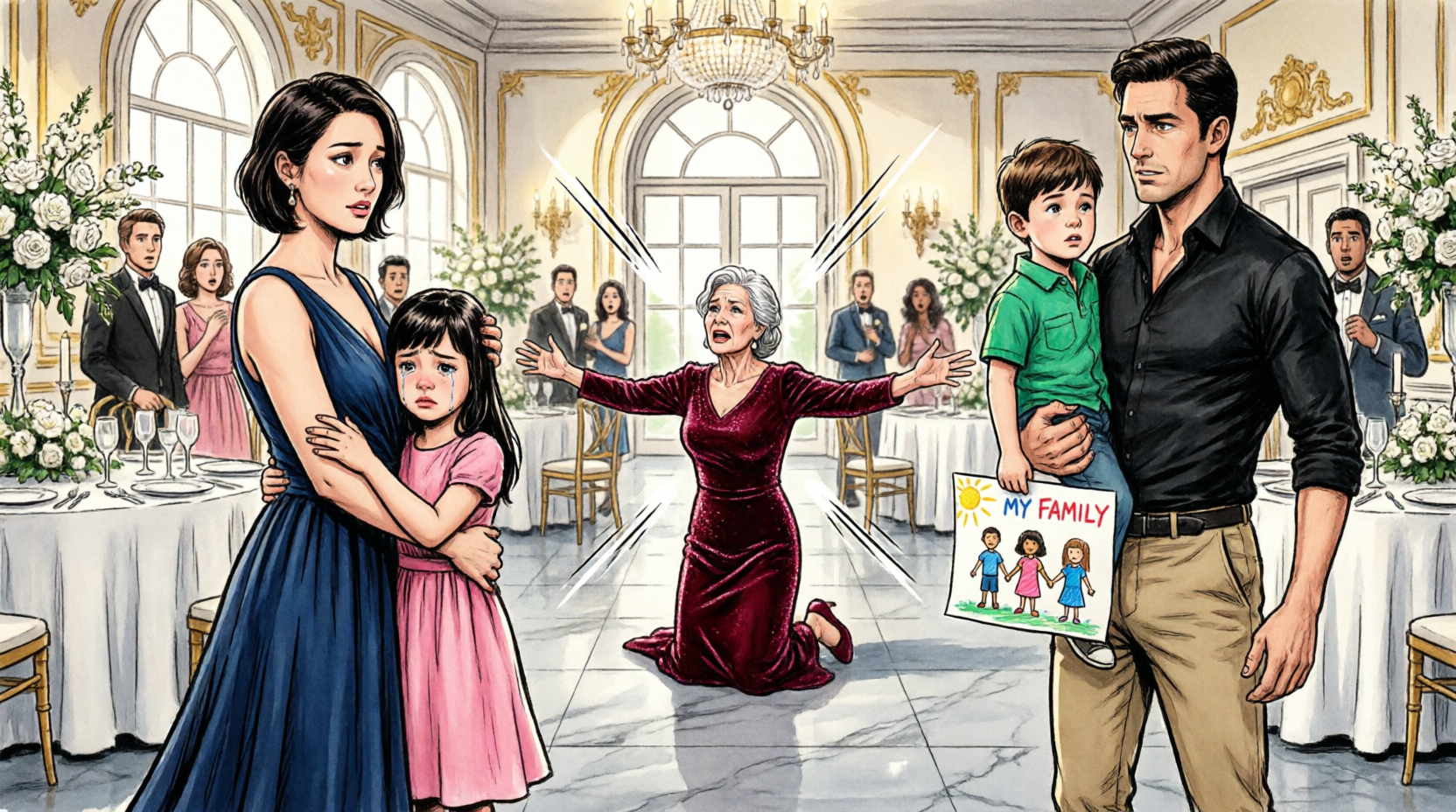
I couldn’t answer immediately.
Because children deserve honesty.
But they also deserve protection.
Emily waited.
“I don’t know,” I finally said softly.
“But I know this.”
She looked up.
“You always belong with us.”
Her eyes filled with tears.
She nodded.
Then she quietly returned to bed.
I sat frozen long after she left.
Because children remember moments adults forget.
And I knew she would remember that night forever.
The flowerpots.
The corner.
The shame.
The realization.
The place they had assigned her.
I promised myself something then.
No one would ever make my children feel small again.
Not while I was alive.
The next morning the war officially began.
My mother arrived at our house before eight.
She looked exhausted.
Her makeup was gone.
Her eyes were swollen.
For a moment she looked less like the woman who had hurt us and more like someone’s frightened grandmother.
Sarah answered the door.
My mother immediately started crying.
“I need to talk to Kenneth.”
I stepped outside.
She grabbed my hands.
“Please.”
I slowly pulled away.
“What do you want?”
“You took everything away.”
I laughed.
Not because it was funny.
Because it was unbelievable.
“Everything?”
“Your father is furious.”
“Interesting.”
“Brenda is struggling.”
I stared.
Still nothing.
Not one word about Emily.
Not one word about Noah.
Not one apology.
Only money.
Only consequences.
Only inconvenience.
“You came here because the payments stopped.”
Her face fell.
“That’s not fair.”
“It is exactly fair.”
She began crying harder.
“You don’t understand.”
“No,” I said.
“I finally do.”
For the first time in my life, I walked away from her while she was still talking.
And for the first time in my life, I didn’t feel guilty.
Three days later my lawyer called.
“Kenneth, there’s something you need to see.”
I drove to his office immediately.
He slid a folder across the desk.
“What is this?”
“Property records.”
I frowned.
“The cabin?”
“Yes.”
I opened the folder.
At first nothing seemed unusual.
Then I noticed signatures.
Dates.
Transfers.
Applications.
Names.
My stomach tightened.
“What am I looking at?”
My lawyer leaned back.
“Your parents have been attempting to use your cabin as collateral.”
I froze.
“What?”
“They don’t own it.”
“I know.”
“But they represented themselves as owners on multiple documents.”
The room became silent.
I felt cold.
Very cold.
“How long?”
He pointed to the dates.
Three years.
Three years.
Three years they had been telling people the property belonged to them.
Three years they had been leveraging it for loans.
Three years they had been building an entire fantasy around something they never owned.
My lawyer sighed.
“This gets worse.”
I stared.
“Worse?”
He nodded.
Then handed me another file.
I opened it.
And everything changed.
Because this file wasn’t about the cabin.
It was about me.
More specifically…
my college fund.
A fund my grandparents had created.
A fund I had never received.
My heart pounded.
“What is this?”
My lawyer folded his hands.
“I think your grandfather intended you to know eventually.”
I blinked.
“What?”
“Kenneth…”
He paused.
“Your grandparents left money specifically for you.”
I felt the blood drain from my face.
“No.”
“They did.”
“That’s impossible.”
“It isn’t.”
I looked through pages.
Account records.
Trust documents.
Signatures.
Withdrawals.
My mother’s signature.
My father’s signature.
My hands started shaking.
The money had disappeared.
Years ago.
Long before college.
Long before marriage.
Long before children.
Gone.
Completely gone.
I stared at the figures.
The amount was enormous.
Not life-changing rich.
But enough.
Enough for tuition.
Enough for a home.
Enough for a start.
Enough for opportunities I never had.
Enough to change everything.
“What happened?”
My lawyer’s expression darkened.
“Based on the records…”
He stopped.
“Your parents used it.”
The world tilted.
Suddenly every struggle I remembered looked different.
Every second job.
Every student loan.
Every sacrifice.
Every year of financial pressure.
I had believed life was hard because life is hard.
Now I was staring at evidence that someone had secretly removed my safety net before I even knew it existed.
And those people were my parents.
I drove home in silence.
I don’t remember the trip.
I only remember sitting in my driveway afterward.
Unable to move.
Unable to think.
Unable to breathe normally.
Sarah found me there nearly thirty minutes later.
She opened the passenger door.
And one look at my face told her something was wrong.
“What happened?”
I handed her the folder.
She read.
Slowly.
Carefully.
Then she looked at me.
And I saw anger.
Real anger.
The kind Sarah almost never showed.
“They stole from you.”
I nodded.
She closed the folder.
“They stole from our children.”
That hit harder.
Because she was right.
This wasn’t just my loss anymore.
It affected Emily.
Noah.
The future.
The opportunities.
Everything.
That night I didn’t sleep.
I sat at the kitchen table until sunrise.
Remembering.
Questioning.
Replaying decades.
Every memory felt different.
Every conversation sounded different.
Every sacrifice looked different.
And one question kept returning.
Why?
The answer arrived two weeks later.
When my aunt Linda called.
“Can we meet?”
I almost said no.
But something in her voice stopped me.
We met at a small café across town.
She looked nervous.
Older than I remembered.
Tired.
As if she had been carrying something heavy for years.
She wrapped both hands around her coffee.
Then finally spoke.
“There’s something you need to know.”
I waited.
She took a deep breath.
“Your grandfather knew.”
My heart skipped.
“Knew what?”
“About how they treated you.”
I stared.
“He knew?”
She nodded.
“He saw it.”
The café seemed to disappear around me.
“Why didn’t he stop it?”
“He tried.”
I leaned forward.
“What do you mean?”
And then she told me a story I had never heard.
A story buried beneath decades of family silence.
A story about favoritism.
Jealousy.
Resentment.
And one decision that poisoned everything.
Years earlier…
before I was born…
my father had failed repeatedly in business.
Failed badly.
Debt.
Bad investments.
Bad decisions.
My grandparents rescued him over and over.
But eventually they stopped.
They believed he needed accountability.
My father never forgave them.
Then I was born.
And according to Aunt Linda…
my grandfather adored me.
Completely.
Openly.
Proudly.
And my father hated it.
Not me.
The attention.
The approval.
The love he felt he never received.
When Brenda was born, things worsened.
My mother became obsessed with protecting her.
Excusing her.
Defending her.
Elevating her.
The golden child was created.
And I became the convenient provider.
The responsible one.
The dependable one.
The one expected to give.
Forever.
Without complaint.
Without reward.
Without recognition.
Without end.
Tears rolled down Aunt Linda’s cheeks.
“He left that money for you because he knew.”
“Knew what?”
She squeezed my hand.
“That one day you’d need proof you mattered.”
I broke.
Right there in the café.
At forty years old.
I cried harder than I had cried in decades.
Not because of the money.
Because of the sentence.
Proof you mattered.
A grandfather had spent years watching me be diminished.
And had quietly left behind evidence that someone loved me enough to see it.
The healing didn’t happen immediately.
Nothing does.
Real healing is slow.
Messy.
Painful.
But something shifted after that.
I stopped chasing approval.
I stopped defending people who hurt me.
I stopped auditioning for love.
Months passed.
Then a year.
Then another.
Life became calmer.
Lighter.
Healthier.
Emily smiled more.
Noah laughed more.
Sarah looked happier than she had in years.
Our house felt peaceful.
For the first time, family gatherings weren’t tense.
Because there weren’t any.
At least not with them.
We built new traditions.
New holidays.
New memories.
A new table.
Exactly like I promised.
Then one autumn afternoon, my phone rang.
The caller ID showed Brenda.
I almost ignored it.
Almost.
But curiosity won.
“Hello?”
Silence.
Then crying.
Not fake crying.
Not manipulative crying.
Real crying.
I didn’t speak.
Eventually she did.
“Dad’s in the hospital.”
I closed my eyes.
Years had passed.
Age had arrived.
Reality had arrived.
Consequences had arrived.
“What happened?”
“Heart failure.”
I sat quietly.
Brenda sounded different.
Smaller somehow.
Life had humbled her.
“We don’t know how much time he has.”
I thanked her.
Then hung up.
For a long time I sat alone.
Thinking.
Remembering.
Questioning.
Eventually I visited.
The hospital room smelled sterile and sad.
Machines beeped softly.
My father looked older than I imagined possible.
Smaller too.
He opened his eyes when I entered.
For several seconds neither of us spoke.
Then he whispered:
“You came.”
“Yes.”
His eyes filled with tears.
I had never seen my father cry.
Not once.
Not ever.
“I’m sorry.”
The words barely escaped him.
I stared.
Because for years I imagined hearing those words.
And now that they existed…
they didn’t fix anything.
They didn’t erase flowerpots.
They didn’t erase favoritism.
They didn’t erase stolen opportunities.
They didn’t erase childhood wounds.
But they mattered.
Because they were real.
“I’m sorry,” he repeated.
And for the first time…
I believed him.
We talked for hours.
Longer than we ever had.
No shouting.
No blame.
No excuses.
Just truth.
Raw truth.
The kind people save until it’s almost too late.
Before I left, he looked toward the window.
Then quietly said:
“You built a better family than I did.”
I couldn’t answer.
Because my throat closed.
When he passed away months later, those were among the last meaningful words he ever spoke to me.
Years later, on my mother’s eightieth birthday, something unexpected happened.
Emily was eighteen.
Noah was sixteen.
Strong.
Confident.
Kind.
Everything I hoped they’d become.
My mother asked if she could see them.
Not me.
Them.
The meeting happened in a small restaurant.
No banquet hall.
No decorations.
No audience.
No performance.
Just people.
My mother looked at Emily.
Then began crying.
“I’m sorry.”
Emily listened quietly.
My mother turned toward Noah.
“I’m sorry.”
Then she looked at both of them.
“I was wrong.”
For a long moment nobody spoke.
Finally Emily smiled gently.
Not because she forgot.
Not because she excused it.
But because forgiveness and access are different things.
And wise people know the difference.
When dinner ended, my mother hugged them.
Then watched them leave.
I saw something in her eyes.
Regret.
The deepest kind.
The kind that arrives too late to change the past.
But not too late to acknowledge it.
That night Emily asked me something.
“Dad?”
“Yeah?”
“Do you ever wish it happened differently?”
I thought about the flowerpots.
The humiliation.
The betrayal.
The secrets.
The lost years.
The stolen trust.
Then I looked around our home.
At Sarah.
At Noah.
At Emily.
At the life we built ourselves.
And I smiled.
“No.”
She looked surprised.
“Really?”
I nodded.
“Because if I hadn’t learned where I wasn’t valued…”
I paused.
“…I might never have learned where I was.”
Years ago I paid for a birthday party.
I thought I was buying a celebration.
Instead I bought a revelation.
The flowerpots were never the real story.
The real story was what happened afterward.
A man stopped begging for a seat.
A husband finally listened to his wife.
A father chose his children.
A family built something healthier than what came before.
And in the end, that little table beside the plants became the place where everything changed.
Because sometimes the worst seat in the room is the one that finally shows you where you truly belong.
And once you know that…
you never sit in the shadows again.
PART 4 — THE LETTER THAT SHOULD NEVER HAVE EXISTED
Years passed after my father’s funeral.
Life settled into something peaceful.
Not perfect.
No family is perfect.
But peaceful.
The kind of peace that comes when you stop fighting battles that were never yours to win.
Sarah and I celebrated our twentieth wedding anniversary.
Emily left for college.
Noah started driving.
The house grew quieter every year.
Sometimes I would catch myself walking past Emily’s empty room and smiling.
Sometimes I would hear Noah’s laughter from the garage and remember the little boy who once hid a birthday card behind his back because his grandmother made him feel unwanted.
Time moved forward.
The wounds became scars.
The scars stopped hurting every day.
And eventually I believed the story was over.
Then one rainy Tuesday afternoon, a package arrived.
No return address.
No note.
Just a small cardboard box.
I almost threw it away.
Almost.
But something made me open it.
Inside was a single envelope.
Yellowed with age.
Folded carefully.
My name was written across the front.
Not in my mother’s handwriting.
Not in my father’s.
Not Brenda’s.
My hands froze.
Because I recognized it immediately.
My grandfather’s handwriting.
I hadn’t seen it in nearly twenty years.
For a moment I simply stared.
Unable to breathe.
Unable to move.
Sarah found me standing in the kitchen.
“What is it?”
I handed her the envelope.
Her eyes widened.
“Oh my God.”
I slowly opened it.
The paper crackled with age.
A letter.
Several pages.
Written shortly before his death.
A letter I had never received.
A letter nobody was ever supposed to hide.
My hands trembled as I began reading.
“Dear Kenneth,
If you are reading this, then either I finally found the courage to give it to you…
or someone failed to stop the truth from reaching you.”
I stopped.
Sarah covered her mouth.
I continued.
“First, understand something.
Nothing that happened in this family was ever your fault.
Not your responsibilities.
Not your sacrifices.
Not the burdens placed on your shoulders.
Those belonged to the adults who should have protected you.”
My vision blurred.
I kept reading.
“You were a child who learned too early that love had conditions.
You learned that being useful earned approval.
You learned that giving was safer than asking.
I watched it happen.
I regret every day that I did not stop it sooner.”
A tear landed on the page.
Then another.
The words became harder to read.
“Your father believes strength means being needed.
Your mother believes love means protecting weakness.
Together they created a family system that rewarded dependence and punished responsibility.”
Sarah sat down slowly.
She was crying too.
The letter continued for page after page.
Stories.
Memories.
Truths.
Things my grandfather had noticed.
Things nobody had ever said aloud.
And then I reached the final page.
The page that changed everything.
“There is one more thing you deserve to know.”
My stomach tightened.
The room felt colder.
The rain outside seemed louder.
“If your mother ever tells you the truth, forgive her.
If she never does, understand that shame is sometimes stronger than honesty.”
I frowned.
Then continued reading.
“Brenda is not the reason things happened the way they did.”
I blinked.
What?
My eyes moved faster.
“She benefited from it.
But she did not create it.”
I kept reading.
Then came the sentence that nearly stopped my heart.
“The reason your mother favored Brenda began long before either of you understood.”
I sat down.
Slowly.
Carefully.
Because suddenly I felt dizzy.
The next paragraph revealed a secret hidden for more than forty years.
A secret that explained almost everything.
And yet somehow made everything worse.
According to my grandfather…
before I was born, my mother lost a child.
A daughter.
The pregnancy ended late.
Late enough that she had already chosen a name.
Already imagined a future.
Already fallen in love.
The loss shattered her.
Completely.
Years later Brenda was born.
Another daughter.
And according to my grandfather, my mother never truly separated the two.
Part of her wasn’t seeing Brenda.
Part of her was seeing the child she lost.
The child she couldn’t save.
The child she spent decades grieving.
I stared at the page.
Unable to process it.
Unable to understand.
Unable to reconcile the information with everything I knew.
Sarah whispered:
“Oh my God.”
I continued reading.
“Your mother never received help.
Never spoke about it.
Never healed.
Instead she buried the grief and built her entire identity around protecting Brenda.
The result damaged both children.”
I closed my eyes.
Because suddenly memories looked different.
Not better.
Not excused.
Different.
Like finding a hidden room inside a house you’ve lived in your entire life.
Suddenly walls make sense.
Doors make sense.
Strange sounds make sense.
The structure becomes clearer.
The pain doesn’t disappear.
But the mystery does.
I finished the letter in silence.
When I reached the final line, I broke down completely.
Not from anger.
Not from betrayal.
From sadness.
Pure sadness.
Because everyone in the story had lost something.
My mother lost a child.
My father lost his pride.
Brenda lost accountability.
And I lost a childhood.
Nobody won.
Not really.
The next day I drove to see my mother.
She was eighty-one now.
Frail.
Slower.
Much quieter than the woman who once ruled family gatherings like a queen.
When she opened the door, she looked surprised.
“Kenneth?”
I held up the letter.
Her face immediately changed.
The color disappeared.
For several seconds neither of us spoke.
Then she whispered:
“Where did you get that?”
“So it’s real?”
Her eyes filled instantly.
And that was all the answer I needed.
She sat down heavily.
Like someone carrying a weight for decades.
A weight she was suddenly too tired to hold.
“You weren’t supposed to find it.”
I laughed softly.
Not because it was funny.
Because every secret in our family seemed to come with those words.
I sat across from her.
The letter between us.
For a long time neither of us moved.
Finally she spoke.
“The baby was named Lily.”
The room became silent.
Not a television silence.
Not a movie silence.
A real silence.
The kind created by grief.
The kind that feels sacred.
I listened.
And for the first time in my entire life…
my mother told the truth.
Not the edited version.
Not the family version.
Not the guilt version.
The truth.
She talked for hours.
About the pregnancy.
The loss.
The depression.
The fear.
The shame.
The years afterward.
And eventually…
about me.
She looked at me with tears streaming down her face.
“You became the strong one.”
I said nothing.
“You never needed me.”
I almost laughed.
Instead I asked:
“What child doesn’t need his mother?”
The question shattered her.
Completely.
She cried harder than I had ever seen.
Because beneath decades of excuses and mistakes…
she finally saw it.
Strength is not the absence of need.
Responsible children still need love.
Independent children still need protection.
Good children still need parents.
And somewhere along the way…
she forgot.
Hours later, as the sun disappeared beyond the windows, she asked a question.
One simple question.
One devastating question.
“Kenny…”
I hadn’t heard that nickname in years.
She swallowed hard.
“Do you think you could have loved me if I had been a better mother?”
The question hit harder than anything else.
Harder than the flowerpots.
Harder than the stolen money.
Harder than the favoritism.
Because it revealed something tragic.
For forty years she believed love had to be earned.
The same lesson she accidentally taught me.
I reached across the table.
And for the first time in decades…
I took her hand.
“Mom.”
She looked up.
“I never stopped loving you.”
She broke completely.
The sob that escaped her sounded ancient.
Like grief finally finding a way out.
And for the first time…
we both mourned.
Not just what happened.
But what should have happened.
The childhood we never had together.
The relationship we never built.
The years we lost.
The people we could have been.
When I left that evening, she walked me to the door.
Slowly.
Carefully.
Before I stepped outside, she stopped me.
“There is one more thing.”
I turned.
She hesitated.
Then disappeared down the hallway.
A minute later she returned carrying an old wooden box.
She handed it to me.
“What is it?”
Her eyes filled again.
“Everything I should have given you years ago.”
I opened it.
And inside…
were hundreds of photographs.
Pictures I had never seen.
Baby pictures.
School pictures.
Birthday pictures.
Baseball games.
Family vacations.
Moments from my childhood.
Carefully preserved.
Protected.
Saved.
For decades.
I looked at her.
Confused.
Heartbroken.
Speechless.
She smiled sadly.
“I always loved you, Kenneth.”
A tear slid down her cheek.
“I was just very bad at showing it.”
And standing there in the doorway…
holding proof that love and damage sometimes exist in the same person…
I realized the story wasn’t about villains.
It never was.
It was about broken people passing wounds forward.
Until somebody finally stopped.
And for the first time in generations…
somebody had.
Me.
And I still had no idea that the photographs hidden inside that wooden box contained one final secret…
a secret that would change how our entire family remembered the past forever……..