“If you tell me no one one more time, I swear you’ll regret ever having me.”
When my son Brandon said those words in our kitchen in a quiet suburb outside Dallas, Texas, I tried to convince myself it was only another angry episode—one more excuse I had held onto for months because I was not ready to admit what had become painfully clear. But that night, I was no longer seeing a lost, confused boy. I was seeing a twenty-three-year-old man who had learned how to turn disappointment into fear. Brandon had always been tall and broad, the kind of person who seemed to take up space the moment he entered a room. As a child, he had been loving, full of energy, and curious about everything. He used to run into the house with dandelions from the backyard and declare them treasure. Somewhere over the years, that little boy vanished. At first, I blamed the divorce. His father, Richard Collins, moved away after our marriage ended. Then I blamed college when Brandon dropped out after just one year. Then I blamed his job problems when he kept losing one position after another. Then I blamed heartbreak when his girlfriend left him. Eventually, there were no excuses left. The truth was much harder to face. Brandon had grown furious at the world, and he expected everyone around him to carry the weight of that fury. Especially me. I defended him for much longer than I should have. I explained away the shouting. I explained away the insults. I explained away the nights he came home drunk and staggering. I explained away the shattered dishes and the holes punched into walls. I explained away the missing money. I explained away every cruel thing he said because I kept telling myself the little boy I loved was still somewhere underneath it all. Sometimes mothers mistake love for endurance. Sometimes we convince ourselves that if we absorb enough hurt, the person hurting us will eventually remember who they used to be. I believed that for years. Then came the night everything changed. I came home drained after a long shift at the elementary school library where I worked. My feet ached. My back ached. My whole body felt heavy. The mortgage payment was due in a week. The electric bill sat unopened on the counter. For years, I had stretched every paycheck as far as it could go just to keep a roof over our heads.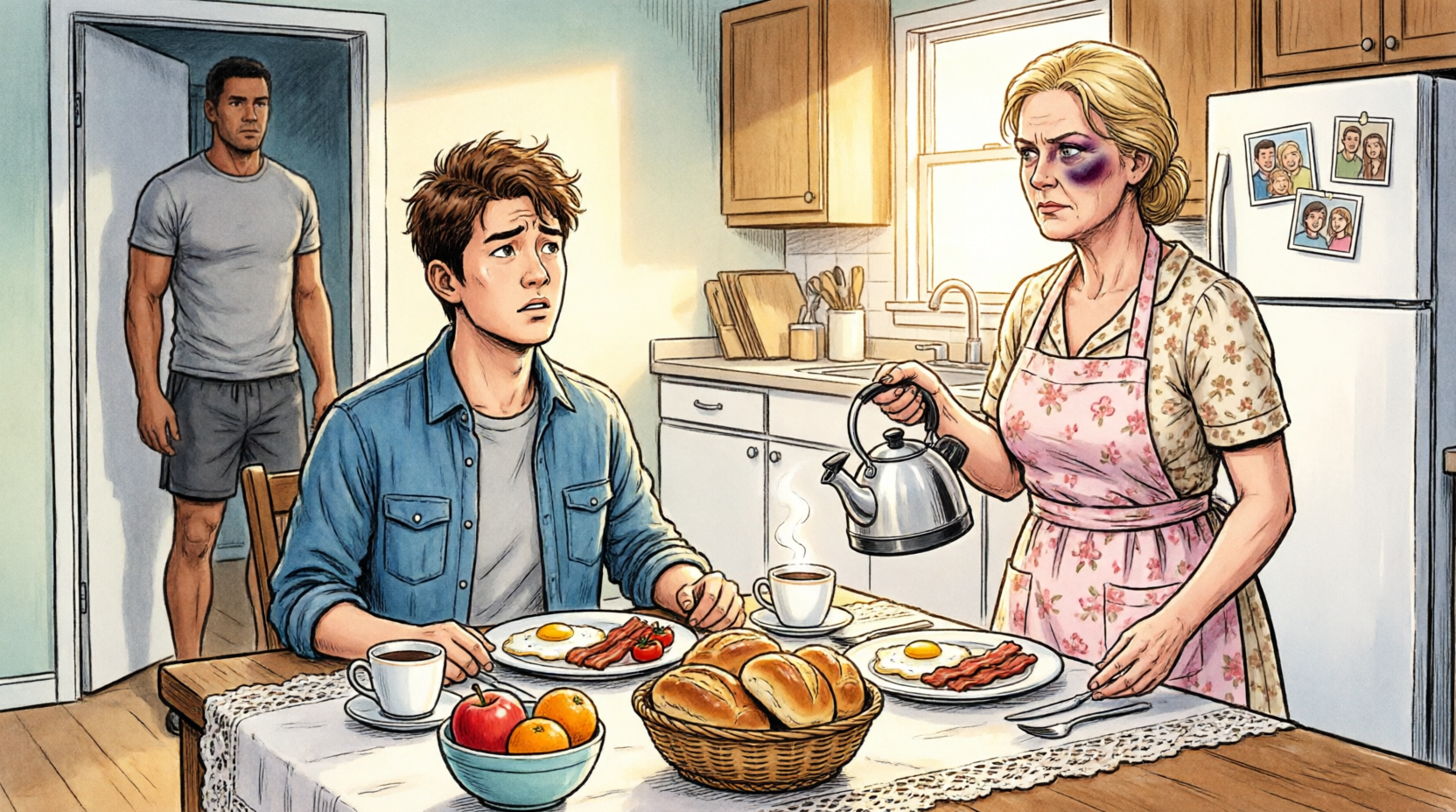 When Brandon came into the kitchen, he did not ask how my day had gone. He did not ask whether I was all right. He asked for money. “Need three hundred bucks,” he said casually. I looked at him. “For what?” “Does it matter?” “Yes.” He rolled his eyes. “Just give it to me.” “No.” The word came out before I had time to soften it. Brandon went still. “No?” “Yes. No.” His jaw tightened. “Since when do you get to tell me no?” I laughed bitterly. “Since I’m the one paying for this house.” His eyes darkened. “That’s funny.” “No, Brandon. What’s funny is that you’re twenty-three years old and still acting like a child.” The kitchen fell silent. I knew at once that I had crossed a line. But for the first time, I did not care. “I’m done,” I said quietly. “I’m not giving you money anymore. Not for alcohol. Not for parties. Not for whatever nonsense you’re wasting it on.” He stared at me. Then he smiled. Not warmly. Not kindly. Coldly. “Don’t talk to me like that.” “I’m talking to you the way I should have years ago.” His face hardened. “Learn your place.” I never saw it coming. The slap cracked across my cheek so sharply that for a second, my mind could not understand what had happened. The pain was not even the worst part. The worst part was the silence that followed. I stood motionless beside the counter. The refrigerator hummed. The clock ticked. Somewhere outside, a dog barked. Every sound felt unnaturally loud. Brandon looked at me. Not with regret. Not with guilt. Only irritation. As though I had made him do it. As though somehow it was my fault. Then he shrugged. He actually shrugged. And walked upstairs. A moment later, his bedroom door slammed. I stayed where I was. One hand pressed against my cheek. That was when I understood something terrifying. I was not safe in my own home.
At 1:17 a.m., I picked up my phone.
I stared at Richard’s number for almost five minutes. We had been divorced for eleven years. We spoke from time to time. Birthdays. Holidays. Family emergencies. Nothing beyond that. I hated the thought of calling him. But I hated what had just happened even more. Finally, I pressed dial. He answered on the third ring. “Rebecca?” His voice was thick with sleep. I opened my mouth. No sound came out. Then I forced the words through the lump in my throat. “Brandon hit me.” Silence. Total silence. For several seconds, all I could hear was his breathing. Then his voice came back. Calm. Controlled. Dangerously calm. “I’m coming.” The call ended. I did not sleep. Instead, I cleaned. I cooked. I thought. By four in the morning, bacon was sizzling in a skillet. Eggs were staying warm in the oven. Fresh biscuits cooled on the counter. Coffee filled the kitchen with a rich, dark smell. I took the embroidered tablecloth from the hall closet. The expensive one. The one saved for holidays and special occasions. I polished the silverware. Set the plates. Folded the napkins. Everything looked perfect. Because this was a special occasion. Not a celebration. A turning point. Just before six, headlights crossed the front windows. Richard had arrived. His hair was grayer now. His shoulders seemed broader. His expression was harder. He stepped inside carrying a leather folder. One look at my face told him everything. His jaw tightened. “Where is he?” “Upstairs.” “Asleep?” I nodded.
Richard placed the folder on the table. His eyes moved over the carefully prepared breakfast.
“You only do this when something important is happening.” I swallowed. “It ends today.” He studied me for a long moment. Then he nodded. “Good.” He opened the folder. Inside were documents. Legal papers. Program brochures. Protection order forms. Resources I had been too frightened to look at before. “Are you sure?” he asked. I closed my eyes. I remembered Brandon at six years old. At ten. At fifteen. Then I remembered the sound of that slap. I opened my eyes. “Yes.” Richard nodded once. “Then we do this properly.” A few minutes later, footsteps sounded overhead. The stairs creaked. Brandon was awake. And he had no idea what was waiting for him. He entered the kitchen yawning. His hair was messy. His confidence was fully intact. Then he saw the breakfast. The tablecloth. The spread. A grin spread across his face. “Well, look at that,” he said. “You finally figured it out.” He reached for a biscuit. Then his eyes landed on Richard. The biscuit slipped from his fingers. “What’s he doing here?” Richard stayed seated. “Sit down, Brandon.” “What?” “Sit.” Something in Richard’s tone made him obey. Reluctantly. Brandon dropped into a chair. “This is ridiculous.” Richard slid the folder toward him. “No. What’s ridiculous is hitting your mother and thinking nothing changes.”
“I didn’t hit her.” “You did.” “It was an argument.” “You hit her.” “It was just a slap.” Richard’s eyes narrowed. “You hear yourself?” Brandon turned to me. “So this is what we’re doing now?” “Yes,” I said. “Seriously?” “Yes.” Richard opened the folder. “This is a temporary protection order.” Brandon laughed. “You’re kidding.” “No.” Richard continued. “This revokes access to your mother’s accounts.” Another document. “This removes you from the vehicle insurance policy.” Another. “This outlines conditions under which you may return to the property.” Then he placed a brochure on top. “A residential treatment program.” Brandon stared at it. “You think I’m crazy?” “No,” I said quietly. “I think you’ve become dangerous.” Those words struck him harder than any slap could have. He stood suddenly. “I’m the problem?” “Yes.”“You have any idea what I’ve been through?” Richard stood too. “You don’t get to use pain as permission to hurt people.” Brandon looked from him to me. His confidence started to crack. For the first time, uncertainty appeared. Then shame. Then fear. “What if I don’t go?” Richard answered immediately. “Then your mother files charges.” The room went silent. I forced myself to speak. “I won’t protect you anymore.” His face collapsed. “You’d do that?” “I should have done it sooner.” For several moments, no one moved. Then Brandon turned around. Without saying another word, he went upstairs. I watched after him. “What happens now?” I whispered. Richard kept his eyes on the staircase.
“Now he decides.”
Ten minutes later, Brandon came back.
A duffel bag hung from his shoulder.
The same bag he had carried on high school football trips.
For one brief second, I saw the little boy again.
Then the moment passed.
He set the bag beside the door.
“I’m not doing this for him,” he muttered.
“You don’t have to,” Richard replied.
Brandon looked at me.
Really looked at me.
Maybe for the first time in years.
And suddenly, his anger looked smaller.
Beneath it was exhaustion.
Regret.
Pain.
“Will you let me come back someday?”
The question almost broke me.
Because it was not truly about the house.
It was about whether I still loved him.
I drew in a deep breath.
“That depends on what happens next.”
His eyes filled.
So did mine.
“I never meant for things to get this bad.”
“But they did.”
He nodded.
“Yes.”
Richard picked up the car keys.
“We leave now.”
Brandon closed his eyes.
Then he whispered two words I thought I might never hear.
“I’ll go.”
There were no dramatic speeches.
No instant miracle.
No perfect reconciliation.
Only truth.
Sometimes truth is harder.
But it lasts longer.
I watched them drive away.
Then I walked back inside.
The silence felt different now.
Not empty.
Peaceful.
For the first time in years, I could breathe inside my own home.
The weeks that followed were hard.
I changed the locks.
Started therapy.
Filed paperwork.
Learned words I had avoided for years.
Abuse.
Boundaries.
Accountability.
Recovery.
Six weeks later, a letter arrived.
The handwriting was unmistakably Brandon’s.
I opened it carefully.
Inside, he had written:
“I don’t know if I deserve another chance. Maybe I don’t. But for the first time in my life, I’m not blaming anyone else for what I did. I hit the person who loved me most. I became someone I never wanted to be. If I ever come home again, I want you to feel safe when you see me.”
I cried as I read those words.
Not because everything was repaired.
It was not.
Recovery does not move in a straight line.
Forgiveness does not happen automatically.
Trust can take years to build again.
But for the first time, truth had entered our family.
And once truth takes a seat at the table, fear loses its place.
Sometimes love is not about enduring everything.
Sometimes it is about drawing a line.
Sometimes the most loving thing a parent can do is refuse to become the place where someone else pours out their darkness.
That morning, sitting alone at a beautifully arranged table covered with an embroidered cloth and surrounded by untouched breakfast, I finally understood something I should have understood years earlier:
A mother can love her child with her whole heart.
And still demand better.
And sometimes, that is exactly what saves them both.
PART 3: THE LETTERS HE NEVER MEANT ME TO READ
Three months after Brandon left, I stopped jumping every time the phone rang.
That may not sound like much.
But when fear has lived inside your home long enough, even silence can feel dangerous.
For years, every unexpected sound had carried tension.
A slammed door.
Heavy footsteps.
A raised voice.
The sharp vibration of a phone on the kitchen counter.
Everything had become a warning.
Now the house felt different.
Not happy.
Not yet.
But calmer.
The kind of calm that arrives after a storm has finally moved beyond the horizon.
I returned to routines I had forgotten.
I planted flowers in the front yard.
I repainted the guest bedroom.
I started attending therapy every Thursday afternoon.
For the first time in years, I talked honestly about things I had hidden from everyone.
Including myself.
One afternoon my therapist asked a question that left me speechless.
“When did you first become afraid of Brandon?”
I opened my mouth.
Then closed it.
Because the answer was not the slap.
The slap had simply been the moment I could no longer deny the truth.
The fear had started years earlier.
Small moments.
Little warnings.
A shattered lamp.
A fist through drywall.
A threat spoken during an argument.
A look in his eyes when anger took control.
The signs had been there all along.
I simply refused to read them.
That realization hurt more than anything else.
Because mothers are supposed to protect their children.
But sometimes we forget we also have to protect ourselves.
The following week another letter arrived.
Then another.
And another.
Brandon wrote every Sunday.
Not because anyone forced him to.
Because he wanted to.
At first the letters were awkward.
Short.
Careful.
As though he wasn’t sure I would even read them.
But gradually they changed.
The walls came down.
The excuses disappeared.
The truth emerged.
One evening I sat at the kitchen table reading a letter that made my hands tremble.
Mom,
I keep thinking about something my counselor asked me.
He asked when I first became angry.
Not angry at you.
Angry at everything.
I thought it started after Dad left.
But I was wrong.
It started years before that.
It started when Grandpa died.
I stared at the page.
My father.
Brandon’s grandfather.
The man who had adored him.
The man whose death had devastated our entire family.
I kept reading.
I never told anyone how much it affected me.
Everybody kept saying I needed to be strong.
So I acted like I was.
But I wasn’t.
I was twelve years old and terrified.
I thought if people I loved could disappear that fast, then nothing was safe.
After that I stopped trusting happiness.
I stopped trusting people.
I started expecting everyone to leave.
Including you.
Tears blurred the words.
Because suddenly pieces of Brandon’s story began fitting together in ways I had never understood before.
Pain does not excuse abuse.
Nothing excuses abuse.
But understanding where darkness begins can help explain how it grows.
Months passed.
Winter arrived.
Then Christmas.
The first Christmas Brandon had ever spent away from home.
I expected it to be heartbreaking.
Instead it was strangely peaceful.
Richard came over.
We cooked together.
Talked for hours.
Shared memories.
For the first time since our divorce, we spoke honestly.
Not about what had gone wrong.
About what had survived.
At one point he looked around the dining room and smiled sadly.
“You know,” he said, “this is the first holiday in years that doesn’t feel like everyone is waiting for something terrible to happen.”
I knew exactly what he meant.
The truth hurt.
But it was still the truth.
A few weeks later Richard called.
“He’s ready.”
My stomach tightened.
“What does that mean?”
“He wants to see you.”
I sat down immediately.
The room suddenly felt smaller.
“When?”
“This weekend.”
For several seconds I couldn’t answer.
Because no matter how many letters we exchanged.
No matter how much progress he made.
Nothing prepares a mother for facing a child who once hurt her.
Nothing.
Saturday arrived cold and gray.
I parked outside the treatment center fifteen minutes early.
Then spent fourteen of those minutes wondering if I should leave.
At exactly two o’clock the door opened.
Brandon stepped outside.
And for a moment I barely recognized him.
Not because he looked different.
Because he carried himself differently.
The arrogance was gone.
The anger was quieter.
His shoulders seemed lighter.
As though he had finally stopped carrying a war inside himself.
Neither of us moved.
Then he walked forward.
Slowly.
Carefully.
Like someone approaching a wounded animal.
“Hi, Mom.”
Two simple words.
Yet they nearly shattered me.
“Hi, Brandon.”
His eyes filled immediately.
Mine did too.
“I don’t expect forgiveness,” he said.
“I know.”
“I don’t expect trust.”
“I know.”
He swallowed hard.
“But I wanted to tell you something face-to-face.”
I waited.
His voice broke.
“I’m sorry.”
Not the casual apologies of the past.
Not the empty promises.
Not the excuses.
A real apology.
The kind that costs something.
The kind that comes from understanding the damage you’ve caused.
He continued.
“I spent years blaming everyone else.”
Tears rolled down his face.
“Dad for leaving.”
“My ex-girlfriend.”
“My bosses.”
“My friends.”
“The world.”
His voice cracked.
“But I never blamed the person responsible.”
He touched his chest.
“Me.”
For a long moment neither of us spoke.
The wind moved through the trees.
Cars passed in the distance.
The world continued turning.
And standing there in that quiet parking lot, I realized something.
This wasn’t the end of our story.
It wasn’t even a new beginning.
It was simply the first honest step.
And sometimes one honest step changes everything.
The years that followed were not perfect.
There were setbacks.
Hard conversations.
Boundaries.
Consequences.
Moments of frustration.
Moments of doubt.
But there was also growth.
Slow growth.
Real growth.
The kind that cannot be faked.
Brandon found steady work.
Completed counseling.
Moved into his own apartment.
Built friendships with healthier people.
Learned how to sit with anger instead of unleashing it.
Learned how to apologize.
Learned how to listen.
Most importantly, he learned that accountability is not punishment.
It is freedom.
Five years later, on a bright spring afternoon, Brandon knocked on my front door carrying something behind his back.
When I opened the door, he smiled.
A genuine smile.
The kind I hadn’t seen since he was a little boy.
Then he revealed what he had been hiding.
A handful of dandelions.
My breath caught.
For a moment neither of us spoke.
“I know they’re just weeds,” he said softly.
I stared at the flowers.
Then at my son.
The boy I thought I had lost forever.
The man who had fought his way back.
“They’re not weeds,” I whispered.
His eyes filled.
“So you remember?”
I nodded.
Every memory returned at once.
The backyard.
The tiny hands.
The proud smile.
The child who once believed dandelions were treasure.
I took the flowers carefully.
As though they were made of glass.
And perhaps they were.
Because some things are fragile.
Trust.
Healing.
Second chances.
But fragile things can still be beautiful.
Brandon pulled me into a hug.
For the first time in many years, I felt completely safe.
And as we stood together beneath the warm Texas sun, holding a handful of ordinary yellow flowers, I finally understood the lesson that had taken both of us years to learn:
Love does not mean accepting everything.
Forgiveness does not erase consequences.
And family is not built by pretending wounds never happened.
Family is built when people face the truth, take responsibility for the harm they caused, and choose—day after difficult day—to become better than they were before.
The breakfast table that morning had not saved my son.
The protection order had not saved my son.
The treatment center had not saved my son.
The thing that saved him was the moment the excuses ended.
The moment truth finally sat down at the table.
And once truth arrived, healing finally had a place to begin.
TEN YEARS LATER
Ten years passed faster than I ever imagined.
One day I was standing in a silent kitchen wondering whether my son would ever find his way back to himself.
The next, I was standing in a crowded community center watching him help someone else’s child do exactly that.
Life has a strange way of moving forward.
Not suddenly.
Not dramatically.
Quietly.
One ordinary day at a time.
By then, Brandon was thirty-three years old.
The anger that once seemed to consume him had long since lost its grip.
Not because life became easier.
Because he finally learned healthier ways to carry pain.
Pain never disappears completely.
Every person carries scars.
The difference is whether those scars become weapons or lessons.
For Brandon, they became lessons.
Years after completing treatment, he returned to school.
Not because anyone forced him to.
Because he wanted a future that looked different from his past.
The journey wasn’t easy.
There were semesters he nearly quit.
Bills that seemed impossible.
Long nights studying after work.
Moments when self-doubt whispered old lies into his ear.
But every time he wanted to give up, he remembered something his counselor had told him years earlier.
“Your past explains you.”
“It does not define you.”
Those words became a foundation.
Brick by brick.
Day by day.
He rebuilt a life that once seemed impossible.
One spring afternoon he invited me to speak at an event.
I almost declined.
Public speaking had never been my strength.
But Brandon insisted.
“Please come.”
“It would mean a lot.”
When I arrived, I discovered the event was hosted by a local recovery and mentorship program.
Hundreds of people filled the auditorium.
Young men.
Parents.
Teachers.
Counselors.
Families carrying stories nobody else could see.
The room buzzed with quiet conversation.
Hope mixed with fear.
Fear mixed with determination.
The same combination that exists in every room where healing begins.
Brandon stood backstage adjusting his tie.
For a moment I simply watched him.
The confidence.
The calmness.
The kindness in his eyes.
Nothing about him resembled the young man who once terrorized our home.
Then he noticed me.
His face brightened immediately.
“Mom.”
The word still sounded different now.
Respectful.
Grateful.
He hugged me.
“You nervous?” I asked.
“A little.”
I smiled.
“Good.”
He laughed.
“That doesn’t help.”
“It means you care.”
The program director stepped onto the stage.
The room gradually quieted.
Then Brandon’s name was announced.
Applause erupted.
Loud.
Warm.
Genuine.
I watched my son walk toward the podium.
For a moment, emotion stole my breath.
Because I remembered another morning.
Another version of Brandon.
One filled with rage.
One filled with blame.
One filled with darkness.
The distance between those two people felt impossible.
Yet somehow he had crossed it.
He reached the microphone.
The applause faded.
Silence settled across the room.
Then he began speaking.
“My name is Brandon Collins.”
His voice was steady.
“And ten years ago, I was the kind of person nobody should have trusted.”
The room became completely still.
“I blamed everyone for my problems.”
“My father.”
“My circumstances.”
“My failures.”
“My heartbreak.”
“The economy.”
“My bad luck.”
He paused.
“But the truth was much simpler.”
“I was hurting people.”
“And I kept convincing myself they deserved it.”
Several people lowered their eyes.
Others nodded slowly.
Recognizing pieces of themselves.
Recognizing pieces of someone they loved.
Brandon continued.
“The hardest lesson I ever learned was this.”
“Pain explains behavior.”
“It doesn’t excuse behavior.”
The room remained silent.
Listening.
Absorbing every word.
Then his gaze moved across the audience until it found me.
For a second his voice trembled.
“Ten years ago, I raised my hand against the person who loved me most.”
My chest tightened.
Even after all those years.
Even after all the healing.
The memory still hurt.
Some wounds become smaller.
They never completely disappear.
Brandon swallowed hard.
“My mother had every reason to walk away forever.”
“Instead, she did something much harder.”
“She loved me enough to stop protecting me from consequences.”
A few people wiped tears from their eyes.
Including me.
“If she had continued making excuses for me, I would probably be dead.”
The words hung in the air.
Raw.
Honest.
True.
“Or in prison.”
“Or still blaming everyone else for a life I refused to change.”
He looked directly at me.
“But she drew a line.”
“And that line saved my life.”
For several seconds the room was completely silent.
Then someone started clapping.
Another person joined.
Then another.
Within moments the entire auditorium stood.
Applauding.
Not for perfection.
Not for success.
For courage.
For honesty.
For growth.
For redemption earned through years of difficult work.
After the event ended, dozens of people approached us.
Parents.
Children.
Grandparents.
People carrying stories similar to ours.
One elderly woman squeezed my hand.
“You gave me hope.”
I shook my head.
“No.”
I looked toward Brandon.
“He did.”
She smiled softly.
“Both of you did.”
That night we went out for dinner.
Nothing fancy.
Just a small restaurant near the river.
The same kind of place we used to visit when Brandon was little.
Halfway through the meal he became unusually quiet.
I noticed immediately.
“What are you thinking about?”
He smiled.
“Honestly?”
“Always.”
He looked out the window.
“I keep thinking about that breakfast.”
My heart skipped.
“The breakfast?”
“The one with the tablecloth.”
For a moment neither of us spoke.
The memory returned vividly.
The coffee.
The biscuits.
The legal papers.
The fear.
The uncertainty.
The moment everything changed.
Brandon stared at his glass.
“You know what I remember most?”
“What?”
“I thought I’d won.”
He laughed sadly.
“I walked downstairs smiling.”
“I thought you’d finally given in.”
He shook his head.
“I had no idea I was actually standing at the edge of losing everything.”
I reached across the table and squeezed his hand.
“But you didn’t lose everything.”
“No.”
His eyes glistened.
“I didn’t.”
Several minutes passed quietly.
Then he reached into his jacket pocket.
“Actually, I brought something.”
“What is it?”
Instead of answering, he handed me a folded envelope.
I opened it carefully.
Inside was a single photograph.
A recent photograph.
Brandon standing beside a group of young men.
All smiling.
All wearing graduation gowns.
“What is this?”
“The first class.”
“The first class of what?”
His smile widened.
“The mentorship program.”
I stared at the picture.
Confused.
Then I noticed the sign behind them.
COLLINS FAMILY RECOVERY SCHOLARSHIP
My eyes widened.
“Brandon…”
He nodded.
The emotion in his voice was impossible to miss.
“We officially funded the first scholarship class.”
I could barely speak.
The scholarship program had been a dream.
A tiny idea discussed years earlier.
A way to help young adults struggling with addiction, anger, and instability access counseling and education.
A way to give others the chance Brandon almost lost.
“You did it.”
His smile trembled.
“We did it.”
I looked at the photograph again.
Then at my son.
Then back at the photograph.
And suddenly I understood something beautiful.
The story had never truly been about a slap.
Or a breakfast.
Or even recovery.
It had been about choice.
The choice to tell the truth.
The choice to accept responsibility.
The choice to change.
The choice to hope.
One choice at a time.
One day at a time.
One life at a time.
As we left the restaurant that evening, the Texas sky glowed with streaks of orange and gold.
The same sky that had watched over our worst days.
The same sky that now watched over our best.
Brandon wrapped an arm around my shoulders.
A simple gesture.
Natural.
Comfortable.
Safe.
And as we walked toward the parking lot together, I realized that the greatest miracle wasn’t that my son had changed.
The greatest miracle was that he chose to keep changing.
Every day.
Year after year.
Long after nobody was watching.
Long after the applause ended.
Long after forgiveness was offered.
Because true redemption isn’t a moment.
It’s a lifetime.
And standing beside the man my son had become, I finally felt something I once thought impossible.
Not relief.
Not pride.
Not even happiness.
Peace.
The kind that arrives when wounds become wisdom.
The kind that arrives when truth wins.
The kind that arrives when both a mother and a son survive the storm.
And finally discover the sunrise waiting on the other side…………👇

