I bought my parents a $425,000 seaside mansion for their 50th anniversary, but when I arrived, my mother was in tears and my father was trembling. My sister’s family had moved in as if they owned the place, and her husband pointed toward the door, yelling, “This is my house, get out!” Then I stepped inside.
I purchased the house quietly, the same way my parents had lived their entire lives. No announcement. No photographers. No emotional speech about how their youngest son had finally earned enough to repay every sacrifice they had ever made. Just a cream-colored mansion by the sea in Newport, Rhode Island, with blue shutters, a wraparound porch, and the Atlantic flashing beyond the dunes. The deed was under my name, but the home was meant for them to live in for the rest of their lives. That was my anniversary gift to them after fifty years of marriage. My mother, Helen Whitaker, cried when I placed the keys in her hand. My father, George, simply stood on the porch staring at the ocean, his mouth slightly open, his aged hands gripping the railing as if he feared the house might disappear. “You already gave us enough, Ethan,” Mom whispered. “No,” I said. “You gave me enough.” For the next three weeks, everything appeared perfect. Then my sister, Vanessa, showed up with her husband, Craig, and their two teenage sons. At first, Mom sounded cheerful when she called. “Your sister wants to stay for a few days,” she said. “The boys love the beach.” A few days turned into two weeks. Then Mom stopped calling me. When I called her, she answered in a whisper. “Ethan, honey, maybe you should come.” That was all she managed to say before the call disconnected. I drove down from Boston that afternoon. When I turned into the long stone driveway, I saw Craig’s black pickup parked crookedly in front of the garage. Beach chairs, coolers, and dirty towels were scattered across the porch. One of the front windows was cracked. Music pounded from inside. Then the shouting reached me. I opened the front door without knocking. My mother stood by the staircase, crying into a dish towel. My father stood near the entry table, shaking so hard that his glasses had slid down his nose. Craig was inches from him, broad-shouldered, red in the face, stabbing one finger through the air. “This is my house now, old man,” Craig yelled. “You and Helen need to pack your things and get out.” Vanessa leaned against the kitchen archway, drinking wine from one of Mom’s crystal glasses. She laughed as if the whole thing were entertainment. “Dad, don’t be dramatic,” she said. “You and Mom don’t need all this space. Craig and I have kids. Ethan won’t care.” Craig pushed a cardboard box toward my father’s feet. “Door’s right there,” he snapped. “Use it.” My father’s lips moved, but nothing came out. That was when I walked in and shut the door behind me. The music continued for half a second before someone in the living room switched it off. Vanessa’s smile vanished. Craig turned around slowly. I looked at the box, at my father’s trembling hands, at my mother’s tear-streaked face, and then back at my sister. “Interesting,” I said quietly. “Tell me again whose house this is.”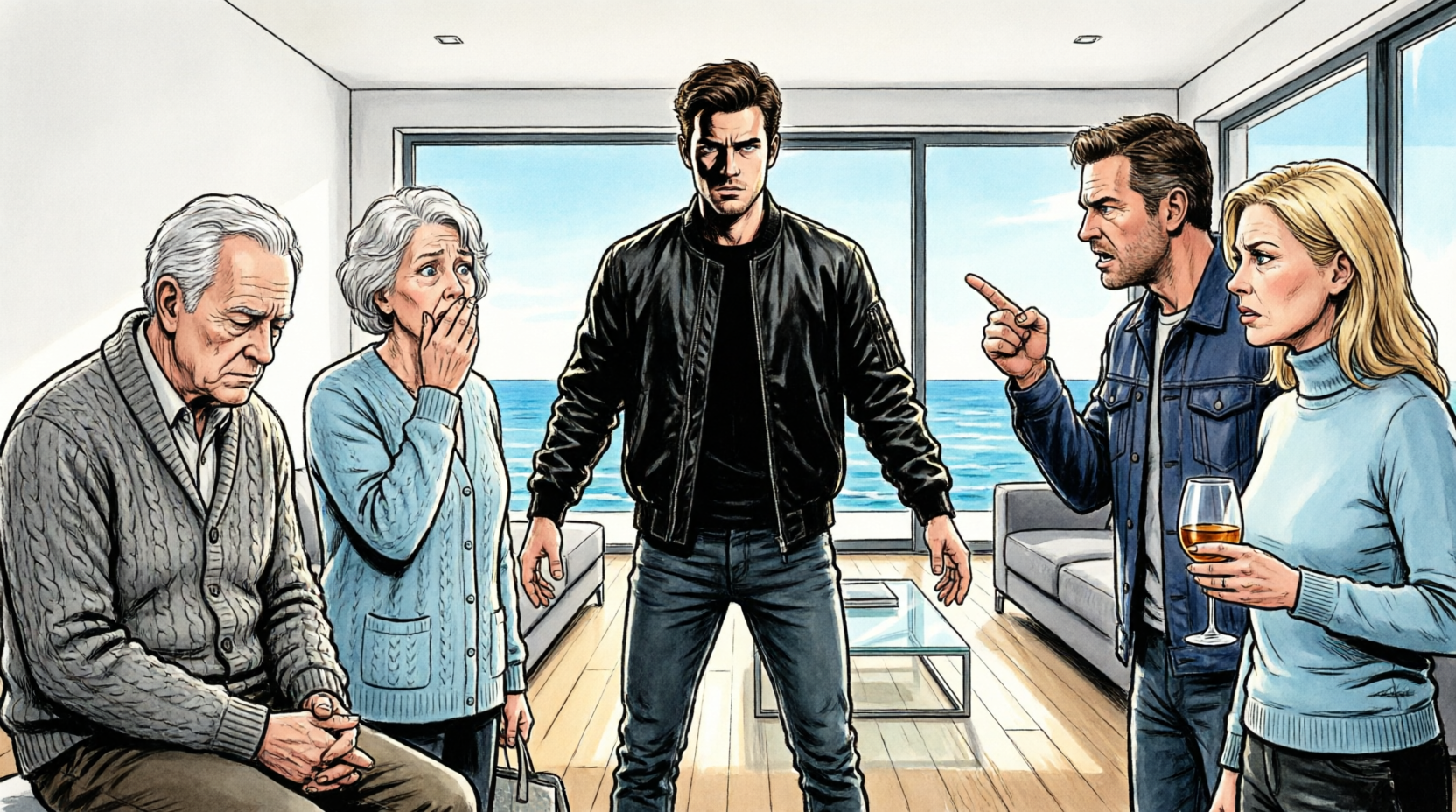 Part 2: Craig was the first to regain himself, or at least he tried to. He pulled his shoulders back and gave me the same arrogant look he used at family dinners whenever he wanted everyone to think he understood business, law, money, and the world better than anyone else present. “Ethan,” he said, forcing out a laugh. “You showed up at a bad time.” “No,” I replied. “Looks like I showed up exactly on time.” Vanessa set her wineglass down with too much force. It clicked against the marble counter. “Don’t start,” she said. “You have no idea what’s been going on.” I looked at my mother. Her eyes were swollen, and there was a bruise-colored shadow around her wrist. It was not dark purple, not fresh enough to make the situation undeniable at a glance, but enough to tell me someone had held her too tightly. My father tried to pull himself upright. “Ethan,” he said, voice faint. “We didn’t want trouble.” Craig gave a sharp snort. “Trouble? The trouble is two old people sitting on a mansion they can’t maintain while their daughter’s family struggles.” “You struggle?” I asked. Vanessa crossed her arms. “We’re not all software executives with Boston condos and private accountants.” I almost laughed. Not because anything was amusing, but because she had always done this. When I earned a scholarship as a kid, she said I was lucky. When I worked three jobs during college, she said I enjoyed pretending to be poor. When I built a company, she said I had forgotten where I came from. Now she was standing inside the house I had bought for our parents, acting as though she were the one who had been wronged. Craig pointed at my father again. “George already agreed they’d move into the guest cottage out back. Then eventually assisted living. We’re just making practical decisions.” My mother’s head snapped up. “We never agreed.” Vanessa rolled her eyes. “Mom, you were confused.” That was enough. I walked past Craig and into the living room. My nephews, Tyler and Mason, sat frozen on the sectional, surrounded by game controllers, soda cans, and pizza boxes. On the mantel, where Mom had placed her anniversary photograph with Dad, someone had pushed the frame aside to make space for a Bluetooth speaker. I pulled out my phone and called the local police. Craig’s face shifted. “Who are you calling?” “The police.” “For what?” Vanessa demanded. “For trespassing, elder intimidation, and whatever else they decide after seeing Mom’s wrist.” Craig stepped toward me. “You don’t want to do that.” I held his stare. “Take one more step.” He stopped. Vanessa’s voice sharpened. “Ethan, don’t be ridiculous. We’re family.” “No,” I said. “Mom and Dad are family. You’re acting like an intruder with our last name.” The police arrived twelve minutes later. By then, Craig had transformed himself into an offended innocent. Vanessa began crying on command, telling the officers she was “only trying to help aging parents transition responsibly.” Then I handed one of the officers a copy of the deed, the occupancy agreement my attorney had drafted, and the security system logs proving Craig had changed the access code two days before. My father finally found his voice. “He told me if I didn’t leave, he’d make sure Helen and I had nowhere to go.” The room went still once more. This time, Vanessa did not laugh.
PART 3: Officer Martinez asked everyone to sit. At first, nobody moved. Craig stayed by the fireplace, his jaw tight, his hands opening and closing like he was restraining one last stupid impulse. Vanessa lingered near the kitchen, her eyes flicking from me to the officers to our parents. Tyler and Mason had fallen silent, their faces pale, no longer looking like smug teenagers enjoying a free vacation at the beach. They looked like children discovering that adults could wreck a room faster than any storm. My mother sat because her knees gave out beneath her. I crossed the room and helped her into Dad’s favorite armchair. Dad sat on the ottoman beside her, still shaking, but now there was anger beneath the tremor. Quiet anger. The kind that had taken seventy-four years to finally show. Officer Martinez stayed calm. That made Craig even more unsettled. “Mr. Whitaker,” she said to my father, “I need you to tell me exactly what happened today.” Dad swallowed. His eyes moved to Vanessa. For one second, I thought he might protect her. That had always been my parents’ weakness. They mistook love for endless pardon. Vanessa learned that young. When she wrecked Mom’s car at nineteen, Dad called it an accident. When she emptied five thousand dollars from their emergency savings at twenty-six, Mom said she must have been desperate. When Craig insulted Dad at Thanksgiving, everyone acted as though they had not heard because “Craig had been drinking.” But today, something in them had cracked. Dad looked away from Vanessa and faced the officer. “Craig said the house was wasted on us,” Dad began. “He said Ethan bought it because he felt guilty and that Ethan would eventually give it to Vanessa anyway.” Vanessa opened her mouth. “Let him speak,” Officer Martinez said. Dad continued. “They came three weeks ago. At first, it was supposed to be a visit. Then Craig started moving things. He put boxes in the garage. He changed the office into a bedroom for their boys. Vanessa said she needed space to work on her lifestyle blog.” Vanessa flushed. “That’s my business.” I said nothing. Dad’s voice became stronger. “Two days ago, Craig changed the door code. Yesterday, he told me I shouldn’t answer calls from Ethan because Ethan would just make me anxious. This morning, Vanessa told Helen to pack her jewelry because she didn’t want it lost when they reorganized the master bedroom.” My mother whispered brokenly, “She said the bedroom suited her better because it faced the ocean.” Vanessa pressed her fingers against her forehead. “Mom, I was trying to make things easier. You can barely manage stairs.” “The master bedroom is on the first floor,” I said. Officer Martinez looked at Vanessa. Vanessa turned her face away. Then Dad said the words that ended the matter. “When I told Craig this was not his home, he grabbed Helen by the wrist and told me to stop acting like a man unless I was ready to be treated like one.” Craig erupted. “That is not what I said!” Officer Martinez turned her head slightly. “Mr. Dalton, lower your voice.” Craig pointed at me. “This is his fault. He waves money around and makes everyone feel small. He bought this place to control the family.” I finally stepped closer to him. “No,” I said. “I bought this place so they could wake up to the ocean after fifty years of waking up before sunrise to survive.” Craig laughed, but panic was already inside it. “You think a deed makes you God?” “No. It makes me the legal owner of this property. And it makes them the only authorized residents besides invited guests. Your invitation ended the moment you threatened them.” The second officer, a younger man named Brooks, went outside to speak with the neighbors. That was when Mrs. Kline from next door appeared on the porch, wearing a cardigan over her gardening clothes and an expression sharp enough to slice wire. She had seen enough. Through the open doorway, I heard her say, “The tall one has been yelling for days. Yesterday the older gentleman was locked out for nearly twenty minutes. I nearly called then.” Vanessa covered her face. Craig stared down at the floor.
A few minutes later, Officer Brooks returned and spoke quietly to Martinez. Then Martinez turned to Craig and Vanessa.
“Mr. Dalton, Mrs. Dalton, you need to gather essential belongings and leave the premises today. Mr. Whitaker has confirmed you are no longer welcome here. Any dispute about ownership or residence can be handled in civil court, but based on the documents provided, you have no right to remain in this home.” Craig’s face darkened. “You’re kicking out a family with children?” Officer Martinez did not blink. “You are being directed to leave a property where you are no longer welcome after allegations of threats and intimidation.” Vanessa’s voice lowered into a hiss. “Ethan, don’t do this.” I looked at her for a long moment. This was my older sister. The girl who had once taught me to ride a bike, then laughed when I fell. The woman who sent Mom flowers on Mother’s Day, then borrowed money from her two weeks later. The daughter who understood exactly how deeply our parents loved her and used that love like a spare key. “I’m not doing anything,” I said. “You did this.” Tears filled her eyes. Real or rehearsed, I no longer cared. They packed while the officers watched. That was when we saw just how far their takeover had gone. Craig had stuffed Dad’s fishing rods into trash bags in the garage. Vanessa had placed Mom’s quilts into plastic bins marked DONATE. In the master bedroom, my parents’ clothes had been shoved into laundry baskets while Vanessa’s dresses hung in the closet. Craig’s shaving kit sat beside Dad’s sink. Their boys had dragged a gaming chair across the hardwood floor in the study, leaving scratches behind. Mom stood in the hallway with one hand pressed to her chest. “I didn’t know they moved your Navy box,” she whispered to Dad. Dad stepped into the study and stopped. The Navy box sat open on the desk. Inside were medals, old letters, photographs from his service, and the folded flag from his brother’s funeral. Someone had carelessly dropped a pile of printer paper on top of it. Dad lifted the flag with both hands. Something in his face changed. For years, Dad had been a gentle man. Not weak. Gentle. Very few people knew the difference. He had built decks in summer heat, fixed engines in winter cold, and never once lifted a hand to anyone in our family. He believed peace was something a man protected by swallowing his pride. But standing there with that flag in his hands, he stopped swallowing. He turned toward Craig. “You will never speak to my wife again,” Dad said. Craig gave a bitter little smile. “George—” “My name,” Dad said, “is Mr. Whitaker to you.” Vanessa cried harder. “Dad, please.” He looked at her next. “And you,” he said, his voice shaking but clear, “will not call your mother for money. You will not send the boys to ask for gifts. You will not tell people we abandoned you. You brought this into our home.” Vanessa looked stunned, like consequences were a language she had never been forced to understand. By sunset, Craig’s truck was loaded. The boys carried out their bags without meeting anyone’s eyes. Vanessa paused near the front steps, gripping her purse. “Where are we supposed to go?” she asked. “To the house you live in,” I said. Craig muttered, “We’re behind on payments.” That caught my attention, but it did not earn my sympathy. “How far behind?” Vanessa glared at him. Craig said nothing.
Later, I learned the truth. Their house in New Jersey was nearing foreclosure. Craig had lost his job months earlier after being caught falsifying expense reports. Vanessa’s online business was mostly staged photos, unpaid bills, and credit cards. They had come to Newport not for a visit, but for a rescue they intended to steal instead of ask for. Craig had convinced Vanessa that if they occupied the mansion long enough, guilt and confusion would finish the job. My parents would move into the guest cottage. Then Vanessa would pressure me to “make things official.” After all, she had children. She had needs. And she had always believed need meant ownership. But the plan collapsed because greed made Craig impatient. He raised his voice too early. He grabbed my mother too hard. He mistook my father’s kindness for surrender. When the truck finally drove away, Vanessa looked back once from the passenger seat. I did not wave. After they left, the house felt huge. Not peaceful yet. Only emptied of danger. Mom stood in the living room, staring at the damage. Crumbs in the rug. Rings on the coffee table. A broken vase by the window. Her anniversary photograph still lying face-down on the mantel. “I’m sorry,” she said. I turned to her. “For what?” “For letting them in.” Dad lowered himself onto the couch. He looked exhausted, older than he had looked that morning. “They’re our daughter,” he said. “We thought we could help without being swallowed.” I sat across from them. “You can love Vanessa,” I said. “But she cannot have keys.” Mom cried again, softly this time. The following week was not dramatic. It was practical. That was what real protection looked like after the shouting stopped. I had the locks replaced. The security code changed. Cameras installed at the driveway and porch. My attorney updated the residency agreement, making it brutally clear that my parents had lifetime use of the house and that no guest could stay longer than ten days without written approval. Mom resisted that last part. “It sounds cold,” she said. “No,” Dad said from the kitchen table. “It sounds necessary.” That was the first time he took my side before she could soften the moment. I hired a local cleaning crew and a handyman to repair the study floor, the cracked window, and the porch railing Craig had damaged while backing a cooler into it. Mrs. Kline brought blueberry muffins and pretended she was not checking on them every morning, though everyone knew she was. The neighbors changed too. People who had once only waved politely now stopped to talk. Mr. Alvarez from two houses down offered to walk the property line with Dad. A retired attorney across the street gave Mom the number for an elder advocacy group. Slowly, the house became what it was always meant to be: not a trophy, not a battleground, but a home. Vanessa called nine times in three days. Mom did not pick up. On the fourth day, Vanessa sent a long text. She said Craig was under pressure. She said the boys were traumatized. She said I had embarrassed her in front of the police. She said Dad had exaggerated. She said Mom knew how emotional he could be. She said family should never involve legal paperwork. Then she wrote: You owe me at least a conversation. Mom read the message at the kitchen table. Her hands trembled, but she did not cry. Dad placed his palm over hers. “You don’t owe her the chance to hurt you twice,” he said. Mom blocked Vanessa’s number herself. For the first time in my life, I watched my mother choose peace without apologizing for it. Three months later, my parents hosted the anniversary party they should have had from the start. Nothing enormous. Just neighbors, a few old friends, my business partner and his wife, and a small jazz trio playing near the porch. Mom wore a pale blue dress. Dad wore a linen jacket and the watch Mom had given him when he retired. The ocean breeze kept lifting her silver hair, and Dad kept smoothing it down like they were newly married. During dinner, Dad stood with a glass of sparkling cider. “I had a speech,” he said. Everyone laughed because the sheet of paper in his hand was obviously blank. He looked at Mom, then at me. “Fifty years ago, Helen married a man with no money, one decent suit, and a used Ford that stalled at traffic lights. She never once made me feel poor.” Mom covered her mouth. Dad continued. “We raised two children. We made mistakes. We forgave too quickly sometimes. We confused keeping peace with having peace.” His eyes found mine. “Our son gave us this house. But more than that, he reminded us that a gift is not something people get to steal just because they want it.” The porch fell quiet except for the sound of the ocean. Dad lifted his glass. “To Helen,” he said. “And to doors that lock.” The laughter came first, then the applause. Mom cried again, but those tears were different. They did not bend her shoulders. They seemed to lift something from her instead. Later that night, after everyone had gone, I found Dad alone on the porch. The moon shone bright over the water. Behind us, the mansion glowed warmly through clean windows. No shouting. No threats. No one standing in the doorway claiming something that was not theirs.
Dad handed me a mug of coffee.
“You know,” he said, “when Craig told me to leave, I almost did.”
I looked at him.
He kept watching the ocean.
“Not because I believed him. Because part of me thought maybe old people are supposed to step aside. Make room. Stop being trouble.”
“You’re not trouble.”
“I know that now.”
We stood together in silence.
Then he said, “I’m proud of you, Ethan.”
I smiled faintly. “For buying a house?”
“No,” he said. “For walking in and not becoming Craig.”
That stayed with me.
Because the truth was, I had wanted to destroy him. Not physically. Not recklessly. But completely. I wanted to bury him under lawsuits, expose every debt, every lie, every failure. I wanted Vanessa to feel small for once.
Some of that happened anyway. Their foreclosure went through. Craig’s reputation did not recover. Vanessa moved into a rental two towns over from the neighborhood where she used to brag about her kitchen renovations. The boys had to change schools. Life did not protect them from consequences.
But I did not chase them.
I protected my parents and stopped there.
A year later, Vanessa sent a letter. Not a text. Not an email. An actual letter written in careful handwriting.
She admitted some things. Not everything. She blamed Craig less than I expected and herself more than I thought she was capable of. She wrote that she had mistaken Mom and Dad’s love for something she could always spend. She asked whether, someday, there might be a way to speak again.
Mom read the letter twice.
Then she folded it and placed it in a drawer.
“Not yet,” she said.
Dad nodded.
Not yes. Not never.
Only not yet.
That was enough.
The seaside house remained theirs. Every morning, Mom opened the blue shutters. Every afternoon, Dad walked down to the beach with his coffee, even during winter, even when the wind cut sharply across the dunes. They learned the rhythm of the tides, the gulls, the foghorns, and the quiet.
On their fifty-first anniversary, I visited again.
This time, when I pulled into the driveway, there were no unfamiliar cars. No boxes on the porch. No broken glass. No shouting from inside.
Mom opened the door before I could knock.
Dad stood behind her, smiling.
“Welcome home,” Mom said.
And for once, no one in that house was afraid of who might walk in next.
PART 3
Officer Martinez did not raise her voice.
That made the room feel even smaller.
Craig stood near the fireplace with his jaw locked tight.
Vanessa stayed by the kitchen archway, one hand still near the wineglass she suddenly seemed ashamed to touch.
My mother sat in Dad’s armchair, holding her bruised wrist against her chest.
My father sat beside her, trembling less now.
Not because he was calm.
Because anger had finally started replacing fear.
Officer Martinez looked at him gently.
“Mr. Whitaker, tell me what happened.”
Dad swallowed.
For one painful second, his eyes moved to Vanessa.
I knew that look.
It was the look of a father deciding whether to protect the child who had just hurt him.
Then Dad looked back at the officer.
“They came here as guests,” he said.
His voice cracked.
“Then they started acting like we were the guests.”
Vanessa whispered, “Dad, don’t.”
But this time, he did.
He told them about Craig changing the door code.
He told them about Vanessa moving Mom’s clothes out of the master closet.
He told them about the guest cottage.
He told them about Craig saying old people should know when to step aside.
Then he said the sentence that made Vanessa go pale.
“He grabbed Helen’s wrist this morning and told me if I didn’t cooperate, he would make sure we had nowhere left to go.”
Craig exploded.
“That is a lie.”
Officer Martinez turned to him.
“Lower your voice.”
Craig pointed at me.
“He’s doing this because he thinks money makes him king.”
I stepped closer.
“No,” I said.
“I’m doing this because you walked into my parents’ peace and tried to turn it into your property.”
The second officer returned from outside with Mrs. Kline, the neighbor.
She had seen Craig yelling.
She had seen Dad locked outside the day before.
She had almost called the police already.
That was the moment Craig understood the house had witnesses.
By sunset, he and Vanessa were packing.
Not everything.
Only what the officers allowed them to take.
Their real home, the one in New Jersey, was nearly in foreclosure.
Craig had lost his job months earlier.
Vanessa’s perfect life online was made of unpaid bills, fake smiles, and credit cards.
They had not come for a visit.
They had come to take over.
My mother watched as Vanessa carried bags down the stairs.
“Why didn’t you tell us you needed help?” Mom asked.
Vanessa stopped.
For a moment, she looked like my sister again.
Then pride returned to her face.
“Because Ethan would have made me beg.”
“No,” I said quietly.
“You were afraid I’d say no to being robbed.”
Craig loaded the truck in silence.
Before leaving, Vanessa looked at Dad.
“You’re really choosing him over me?”
Dad’s eyes filled with tears.
“No,” he said.
“I’m finally choosing your mother and myself.”
That broke something in her.
But it did not change anything.
They left before dark.
The house was quiet afterward.
Too quiet.
Mom walked through every room like she was visiting damage after a storm.
Her quilts had been packed into donation bins.
Dad’s Navy box had been opened.
Their anniversary photo had been turned face-down.
In the study, Dad lifted his folded flag with shaking hands.
Then he turned toward the empty doorway.
“My name is George Whitaker,” he whispered.
“And I am not leaving my home.”
The next weeks were not dramatic.
They were necessary.
I changed the locks.
I added cameras.
I updated the legal agreement.
No guest could stay longer than ten days without written permission.
Mom said it sounded cold.
Dad said, “No, Helen.”
“It sounds safe.”
That was the first time I heard him protect peace out loud.
Vanessa called again and again.
Mom did not answer.
Then came the messages.
She blamed Craig.
She blamed stress.
She blamed me.
She blamed Dad’s age.
She blamed everything except greed.
One night, Mom read a message at the kitchen table and began crying.
Dad took the phone from her hand.
Then he blocked Vanessa’s number himself.
“She can come back into our lives when she learns the difference between love and access,” he said.
Three months later, my parents finally had their anniversary party.
The real one.
There were no speeches about money.
No one mentioned Craig.
No one mentioned Vanessa.
There was music on the porch.
There were neighbors laughing by the railing.
There was Mom in a pale blue dress.
There was Dad in a linen jacket, standing straighter than I had seen him stand in years.
Near sunset, he raised a glass of sparkling cider.
“Fifty years ago,” he said, “Helen married a man with one good suit and a car that stalled at red lights.”
Everyone laughed softly.
“She never made me feel poor.”
Mom covered her mouth.
Dad looked at me next.
“Our son gave us a house.”
Then he paused.
“But more than that, he reminded us that a gift is not something others get to steal simply because they want it.”
The porch went silent.
Then Dad smiled.
“To Helen,” he said.
“And to doors that lock.”
Everyone laughed.
Mom cried.
But those tears did not bend her shoulders.
They lifted something from her.
One year later, Vanessa sent a letter.
Not a text.
Not a demand.
A letter.
She admitted she had been wrong.
Not perfectly.
Not fully.
But enough to show that life had finally taught her something our parents never could.
Mom read it twice.
Then she folded it carefully and placed it in a drawer.
“Not yet,” she said.
Dad nodded.
Not yes.
Not never.
Only not yet.
And that was enough.
The seaside mansion stayed what it was always meant to be.
A home.
Every morning, Mom opened the blue shutters.
Every afternoon, Dad walked down to the beach with his coffee.
Sometimes I visited from Boston and found them sitting together on the porch, saying nothing while the ocean spoke for them.
On their fifty-first anniversary, I drove back to Newport.
There were no strange cars in the driveway.
No boxes on the porch.
No broken glass.
No shouting.
Mom opened the door before I could knock.
Dad stood behind her, smiling.
“Welcome home,” Mom said.
And for the first time in a long time, everyone inside that house believed it.
PART 4
The letter stayed in the drawer for almost six months.
Mom never mentioned it.
Dad never asked about it.
I never brought it up.
Life had finally become peaceful, and none of us wanted to risk inviting chaos back inside.
Then one rainy Tuesday in October, my phone rang.
The caller ID showed Vanessa.
For a moment, I simply stared at the screen.
I had not heard her voice in over a year.
When the ringing stopped, a voicemail appeared.
I almost deleted it.
Instead, I listened.
“Ethan…”
Her voice sounded different.
Smaller.
Not weak.
Just tired.
“I know you probably don’t want to hear from me. Maybe you shouldn’t. But Dad’s birthday is next week, and I don’t know if I’ll ever get another chance. Please call me back.”
That was all.
No demands.
No accusations.
No guilt.
Just a request.
I sat in silence for several minutes afterward.
Then I drove to Newport.
The ocean was rough that afternoon.
Gray waves crashed against the shoreline while wind rattled the porch railings.
Mom was baking when I arrived.
Dad sat at the kitchen table working on a crossword puzzle.
He looked happier than I could ever remember seeing him.
Retirement suited him.
Peace suited him even more.
“Something on your mind?” he asked.
I hadn’t said a word yet.
I smiled.
“You always know.”
“Forty years fixing engines.”
He shrugged.
“You learn how to hear trouble before it starts.”
I sat down.
“Vanessa called.”
The room immediately changed.
Mom stopped stirring.
Dad lowered his pencil.
Neither spoke.
Finally Mom asked quietly.
“What did she want?”
“She wants to see you.”
Dad leaned back.
The kitchen fell silent except for the ticking wall clock.
After a long time, Mom sat across from me.
“She sounds different.”
“You spoke to her?”
Mom nodded.
“She called three weeks ago.”
Dad looked surprised.
“You never told me.”
“She only talked for two minutes.”
Mom stared into her coffee.
“She cried.”
Dad exhaled slowly.
That surprised all of us.
Vanessa cried when she wanted something.
She didn’t cry because she was sorry.
At least not historically.
“What happened?” I asked.
Mom looked toward the window.
“I think life happened.”
A few days later, we learned exactly what she meant.
Craig had left.
Not temporarily.
Not after another argument.
For good.
He moved across the country with another woman.
The foreclosure had gone through.
Most of their savings were gone.
The boys had taken part-time jobs after school.
Vanessa was renting a small apartment.
For the first time in her adult life, nobody was rescuing her.
Nobody was paying the bill.
Nobody was cleaning up the mess.
And according to Mom, she finally understood what that felt like.
Dad listened quietly.
Then he surprised me.
“Invite her.”
Mom blinked.
“So easily?”
“No.”
Dad shook his head.
“Not easily.”
He stared toward the ocean.
“I’m seventy-five years old, Helen.”
The room became still.
“I don’t know how many birthdays I have left.”
Mom reached for his hand.
Dad squeezed hers.
“I don’t want my last memory of my daughter to be a police officer escorting her out of this house.”
The following Saturday, Vanessa arrived alone.
No Craig.
No luxury SUV.
No designer sunglasses.
No expensive handbag.
She drove an old sedan with faded paint and a cracked rear bumper.
When she stepped onto the porch, I barely recognized her.
She looked older.
Not physically.
Life older.
The kind of older that comes from consequences.
For several seconds nobody moved.
Then Mom opened the door.
Vanessa immediately burst into tears.
Real tears.
The kind that leave people unable to speak.
Mom hugged her.
And for the first time since childhood, Vanessa clung to someone instead of performing for them.
Dad stood behind them quietly.
Watching.
Waiting.
When Vanessa finally looked at him, her voice broke.
“I’m sorry.”
Dad didn’t answer immediately.
The silence lasted so long that I thought he might walk away.
Then he stepped forward.
“I know.”
That made her cry harder.
The four of us sat in the living room afterward.
Nobody mentioned the mansion.
Nobody mentioned money.
Nobody mentioned lawyers.
Instead, Vanessa told the truth.
The whole truth.
Or at least more truth than I had ever heard from her.
She admitted she had always been jealous.
Not of the money.
Not of the company.
Not even of the house.
Of attention.
“When Ethan succeeded,” she said quietly, “I felt invisible.”
I looked at her.
She couldn’t meet my eyes.
“When Mom and Dad talked about you, I heard criticism of me.”
Dad frowned.
“We were proud of both of you.”
“I know that now.”
Vanessa wiped her eyes.
“But I didn’t know it then.”
For hours we talked.
Really talked.
Not like families talk at holidays.
Not like families talk when everyone is pretending.
We talked honestly.
About mistakes.
About resentment.
About fear.
About pride.
About all the little wounds people carry for decades until those wounds become part of who they are.
Near sunset, Dad stood and walked onto the porch.
We followed.
The ocean stretched endlessly before us.
Gold sunlight danced across the waves.
Dad rested both hands on the railing.
“This house saved me.”
Vanessa looked confused.
Dad smiled softly.
“Not because it’s beautiful.”
He looked at Mom.
“Because it forced me to stop confusing love with surrender.”
Nobody spoke.
Dad turned toward Vanessa.
“You are our daughter.”
Tears filled her eyes again.
“You always will be.”
Then his expression hardened slightly.
“But being our daughter doesn’t give you ownership of us.”
Vanessa nodded immediately.
“I know.”
“No.”
Dad shook his head.
“I need you to really know.”
She began crying again.
This time she nodded through the tears.
“I do.”
The sun slowly disappeared beyond the horizon.
For the first time in years, the entire family stood together on the porch.
Not fixed.
Not perfect.
But honest.
And sometimes honesty is the first step toward healing.
As darkness settled over the Atlantic, Mom slipped her arm through Dad’s.
Dad smiled.
Vanessa wiped away her tears.
I looked at the house glowing warmly behind us.
The cream-colored seaside mansion.
The gift that had nearly become a battlefield.
The home that revealed everyone’s true character.
The place where my parents finally learned to protect their peace.
And where our family finally learned that forgiveness is not forgetting.
It is remembering everything…
And choosing what deserves another chance.
PART 5
For a while, things were quiet.
Not the fragile kind of quiet that comes before another fight.
Real quiet.
The kind my parents had dreamed about when they first moved into the seaside house.
Winter arrived along the Rhode Island coast.
The tourists disappeared.
The beaches emptied.
The ocean turned steel gray beneath low clouds.
Dad loved it.
Every morning he wrapped himself in a heavy coat, carried a thermos of coffee down to the shoreline, and watched the waves.
Mom called it his “meeting with the Atlantic.”
He never missed it.
Not once.
Then, in late January, something happened that none of us expected.
Dad collapsed.
It happened just after sunrise.
Mrs. Kline found him.
He had been walking back from the beach when his legs suddenly gave out near the dunes.
Fortunately, he never lost consciousness.
Unfortunately, he knew immediately something was wrong.
The ambulance arrived within minutes.
Mom called me from the hospital.
Her voice was shaking.
For one terrifying moment, I thought I was about to lose him.
I drove from Boston faster than I should have.
The entire drive felt endless.
Every red light seemed personal.
Every mile stretched longer than the one before it.
By the time I reached the hospital, Mom was sitting beside Dad’s bed.
Holding his hand.
Trying not to cry.
Dad looked annoyed.
Not sick.
Annoyed.
That alone made me feel slightly better.
The doctor entered a few minutes later.
His expression was serious.
But not tragic.
“There was no stroke,” he explained.
Mom immediately began crying from relief.
The doctor smiled.
“No heart attack either.”
Dad nodded.
“I told you.”
The doctor ignored him.
“You pushed yourself too hard.”
Dad rolled his eyes.
“I’m seventy-five.”
“Exactly.”
The doctor folded his arms.
“Your body would like a vote.”
For the next several weeks, Dad was ordered to rest.
He hated every second of it.
The man had spent his entire life working.
Sitting still felt like punishment.
Mom secretly loved having him trapped in the house.
She spent those weeks cooking meals, making tea, and bossing him around.
Dad complained constantly.
Yet somehow never missed a single meal.
One afternoon, while Dad pretended to read in the living room, Vanessa arrived unexpectedly.
She carried a large cardboard box.
Mom answered the door.
Vanessa looked nervous.
Almost frightened.
“What is that?” Mom asked.
Vanessa swallowed.
“Something Dad should have had years ago.”
Dad overheard.
Within seconds he appeared beside Mom.
Vanessa carried the box inside and set it on the dining room table.
Everyone gathered around.
Then she opened it.
Dad froze.
Inside were dozens of old photographs.
Letters.
Military documents.
Newspaper clippings.
Family records.
And one small leather journal.
Dad stared at it.
His hands began shaking.
Not from age.
From memory.
“Where did you find this?”
Vanessa looked down.
“In Grandma’s attic.”
Dad carefully picked up the journal.
For several moments he could not speak.
Finally he whispered:
“I thought this was gone forever.”
Mom touched his shoulder.
“What is it?”
Dad slowly opened the cover.
Inside was a name.
Thomas Whitaker.
His father.
My grandfather.
The man who had died when Dad was only twenty-two.
Dad sat down heavily.
For the next hour, nobody interrupted him.
He turned pages slowly.
Reading.
Remembering.
Smiling.
Sometimes crying.
The journal contained decades of memories.
Stories.
Advice.
Letters never mailed.
Dreams never shared.
It was as if my grandfather had suddenly returned.
Late that evening, Dad closed the journal.
His eyes were wet.
“You know what the strange thing is?”
Nobody answered.
Dad looked toward the ocean beyond the windows.
“I spent my whole life trying to become him.”
His voice softened.
“But reading this…”
He smiled sadly.
“I finally realized he spent his whole life afraid he wasn’t enough.”
The room fell silent.
Because every person there understood exactly what he meant.
For years Dad had worried about providing.
Protecting.
Building.
Sacrificing.
Always wondering whether he had done enough.
Whether he had been enough.
Now he was discovering his own father carried the same fears.
Mom squeezed his hand.
“You were enough.”
Dad looked at her.
Really looked at her.
Then he smiled.
“I know.”
Those two words seemed simple.
But they carried fifty years of struggle.
Fifty years of doubt.
Fifty years of responsibility.
And finally…
Peace.
Several weeks later, Dad made an announcement.
A shocking one.
He wanted a family dinner.
Not just me.
Not just Mom.
Everyone.
Including Vanessa.
Including Tyler and Mason.
Even if it was uncomfortable.
Even if old wounds still existed.
Mom was skeptical.
I was suspicious.
Vanessa was terrified.
Dad didn’t care.
“I’ve wasted enough years waiting for perfect circumstances.”
That was the end of the discussion.
The dinner was scheduled for March.
Nobody knew exactly how it would go.
Old resentments still existed.
Old mistakes still hurt.
Old scars still remained.
But for the first time, every member of the family agreed to sit at the same table.
And deep down…
All of us sensed something important was coming.
Something bigger than apologies.
Something bigger than forgiveness.
Something that had been waiting quietly beneath the surface for years.
As the date approached, Dad spent more and more time reading his father’s journal.
Making notes.
Writing things down.
Preparing something.
Nobody knew what.
Not even Mom.
Then, three nights before the dinner, I arrived at the house unexpectedly.
I found Dad alone on the porch.
The journal rested on his lap.
The ocean rolled beneath moonlight.
And for the first time in my life…
My father looked nervous.
“What are you planning?” I asked.
Dad smiled.
A strange smile.
One I had never seen before.
Then he patted the journal.
And said six words that made my stomach tighten immediately.
“There’s something all of you need to know.”
PART 6
The family dinner took place on a Saturday evening.
The weather could not have been more different from the day everything fell apart.
No storms.
No shouting.
No police cars.
Only calm ocean air drifting through open windows.
Mom spent the entire day cooking.
Dad spent the entire day pretending he wasn’t nervous.
Neither fooled anyone.
By five o’clock, the dining room table was set.
The same dining room that Craig once tried to claim.
The same house that nearly broke the family apart.
Now every chair was occupied.
Mom sat at one end.
Dad sat at the other.
I sat beside Mom.
Vanessa sat across from me.
Tyler and Mason sat quietly beside their mother.
They looked older.
Not physically.
Emotionally.
Life had aged all three of them.
For a while the conversation stayed simple.
Work.
Weather.
School.
The ocean.
Safe subjects.
Everyone carefully avoiding deeper waters.
Then dinner ended.
Dad stood.
Immediately the room fell silent.
Because everyone knew.
This was why he had gathered us.
The journal sat beneath his arm.
The old leather cover looked even more worn than before.
Dad held it carefully.
Like something sacred.
For several moments he simply looked around the room.
At Mom.
At me.
At Vanessa.
At his grandsons.
His family.
Then he spoke.
“When I was twenty-two years old, my father died.”
Nobody interrupted.
“He worked until the week before his death.”
Dad opened the journal.
“He never talked much about himself.”
A sad smile crossed his face.
“I spent fifty years wishing I had asked more questions.”
The room remained silent.
The only sound was the ocean beyond the windows.
Dad looked down at one page.
Then began reading.
“My greatest fear is not failure.”
His voice trembled slightly.
“It is becoming a burden to the people I love.”
Dad stopped.
Closed his eyes.
Then continued.
“I worry that one day my children will see me as an obligation instead of a blessing.”
Mom quietly wiped away a tear.
Dad turned another page.
“The strange thing about being a parent is that you spend your life worrying whether you’ve done enough.”
His voice became softer.
“You never stop.”
He looked toward me and Vanessa.
“Not when they’re five.”
“Not when they’re twenty-five.”
“Not when they’re fifty.”
Vanessa lowered her eyes.
Dad closed the journal.
Then he surprised all of us.
He sat down.
Not because he was finished.
Because he wanted to talk.
Not perform.
Talk.
“I spent years believing I failed both of you.”
I immediately shook my head.
But Dad raised his hand.
“Let me finish.”
Nobody spoke.
He looked at Vanessa first.
“You always thought Ethan was my favorite.”
Vanessa stared at the table.
Then nodded.
Slowly.
Painfully.
Honestly.
Dad smiled sadly.
“You weren’t jealous of his success.”
Vanessa looked up.
“You were afraid success made him more lovable.”
Tears instantly appeared in her eyes.
Because he was right.
For the first time in her life…
Someone had said it out loud.
Dad looked toward me next.
“And you.”
I frowned.
“What about me?”
Dad laughed softly.
“You spent your entire life trying to earn approval nobody was withholding.”
That hit harder than I expected.
Because it was true.
Every scholarship.
Every promotion.
Every business achievement.
Every milestone.
Part of me had always been trying to prove something.
Trying to become enough.
Trying to earn pride that had already existed.
Mom reached for my hand.
I hadn’t even realized my eyes were wet.
Dad leaned back.
Then came the revelation nobody expected.
Especially me.
“There is one more thing.”
The room immediately became still again.
Dad opened the journal.
Near the back.
A folded document slid free.
Yellowed with age.
Carefully preserved.
Dad unfolded it.
And handed it to me.
I looked down.
Confused.
Then my heart stopped.
It was a deed.
A property deed.
Dated nearly sixty years earlier.
The land where my grandparents once lived.
The land my grandfather lost before Dad was born.
The property that had haunted family stories for generations.
I looked at Dad.
“What is this?”
Dad smiled.
A slow, emotional smile.
“I found something while reading.”
Vanessa looked equally confused.
Dad pointed to the journal.
“My father never lost the property.”
Nobody understood.
Dad continued.
“He sold it temporarily to save the family business.”
I stared at him.
“What?”
“He spent decades secretly buying it back.”
The room exploded with questions.
Dad laughed for the first time all evening.
Then raised both hands.
“Wait.”
Everyone fell silent again.
“He completed the purchase six months before he died.”
Mom gasped.
Vanessa froze.
Tyler and Mason exchanged looks.
I felt like the floor had disappeared beneath me.
“If he got it back…”
Dad nodded.
“He left it to me.”
The room became completely silent.
I already knew what came next.
Or thought I did.
But I was wrong.
Very wrong.
Dad smiled again.
“I never told anyone.”
Mom looked shocked.
“George.”
Dad shrugged.
“I forgot.”
Everyone laughed.
Even Vanessa.
But then Dad’s expression softened.
“The land is worth a lot now.”
“How much?” I asked.
Dad looked at me.
Then at Vanessa.
Then at the boys.
Then at Mom.
Finally he answered.
“Several million dollars.”
Nobody spoke.
Nobody moved.
Nobody breathed.
After everything.
After all the arguments.
After all the greed.
After all the damage.
The family had unknowingly owned a fortune the entire time.
But Dad wasn’t finished.
Not even close.
Because the next words he spoke would change everything.
Not just for Vanessa.
Not just for me.
For every member of the Whitaker family.
For generations.
Dad folded the deed carefully.
Placed it back inside the journal.
Then smiled.
“I’ve already decided what happens to it.”
And suddenly every person at that table sat forward.
Waiting.
Listening.
Knowing the future of the family was about to be rewritten………………👇