Sarah Matthews noted that President Trump has condemned similar attacks against other women in the past
The controversy surrounding mixed martial arts fighter Josh Hokit continues to escalate, with a growing number of political figures, media personalities, athletes, and commentators condemning his remarks about former First Lady Michelle Obama during the White House’s UFC Freedom 250 event. What began as a controversial comment made during a high-profile celebration has quickly evolved into a broader national debate about conspiracy theories, political rhetoric, race, gender, and the responsibilities of public figures in shaping public discourse. Hokit sparked outrage after presenting his chain and medallion to President Donald Trump during the White House-hosted UFC event before repeating the long-debunked conspiracy theory that Michelle Obama “is a man.” The remark was met with immediate backlash across social media and major news outlets, where critics characterized it as both transphobic and racist. The incident has renewed attention on a conspiracy theory that has circulated in fringe corners of the internet for more than a decade despite the complete absence of credible evidence. The claim has repeatedly been debunked by fact-checkers, journalists, and researchers, yet it continues to resurface in online communities that promote misinformation about prominent political figures.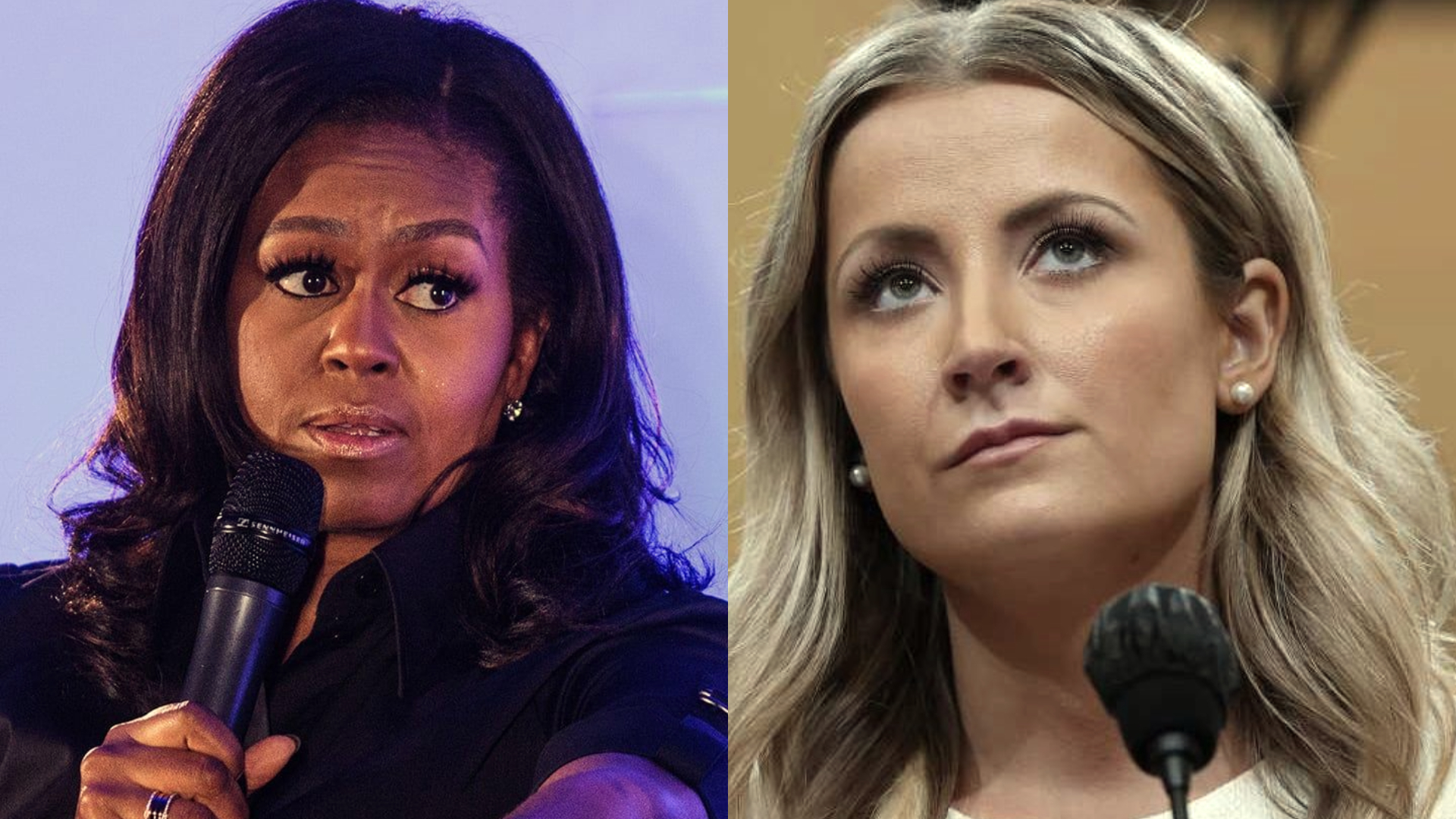 Among the most prominent voices criticizing Hokit was former White House deputy press secretary Sarah Matthews. Appearing on CNN, Matthews defended Michelle Obama and highlighted what she described as the extraordinary level of scrutiny and abuse the former first lady has endured throughout her years in public life. “She has not been the first lady for nearly a decade, and yet she continues to live rent-free in these losers’ heads,” Matthews said. Matthews argued that the persistence of such attacks demonstrates how Michelle Obama remains a uniquely influential and admired public figure. Even years after leaving the White House, Obama continues to command enormous popularity through her bestselling books, public speaking engagements, charitable initiatives, and advocacy work focused on education, health, and civic engagement.
“Michelle Obama has spent years serving as a role model for millions of people around the world,” Matthews said. “The fact that some individuals continue to spread conspiracy theories about her says far more about them than it does about her.” The former Trump administration official also expressed concern over what she viewed as the normalization of increasingly extreme rhetoric in political culture. According to Matthews, public figures who make inflammatory statements often receive attention, media coverage, and social media engagement without facing meaningful consequences. She argued that this dynamic encourages further radicalization and rewards behavior that would once have been widely rejected across ideological lines. Her criticism soon expanded beyond Hokit himself and focused on President Trump, whose silence on the matter has become a growing point of discussion. Matthews noted that Trump has previously condemned similar conspiracy theories targeting other public figures. She pointed specifically to instances in which Trump defended French First Lady Brigitte Macron and conservative commentator Candace Owens against false claims regarding their gender identities.
“We have seen Trump willing to condemn conspiracy theories like this before,” Matthews said. “That’s why his silence here is so striking.” She suggested that Trump’s refusal to address Hokit’s remarks raises legitimate questions about consistency and selective outrage. “It makes you wonder what the difference is between those women and Michelle Obama in his eyes,” Matthews said. “If these claims are unacceptable when directed at some women, they should be unacceptable when directed at all women.” Matthews went even further, arguing that the controversy reflects a broader erosion of standards within modern political discourse. “Look, this is the same president who has shared offensive memes and repeatedly blurred the line between politics and personal attacks,” she said. “There is no expectation of decency coming from this White House anymore.” Her comments quickly circulated online and were widely discussed by political analysts, many of whom noted that criticism of Hokit was emerging from both sides of the political divide. Perhaps most notably, condemnation did not come exclusively from Democratic politicians or liberal commentators. Dave Portnoy, founder of Barstool Sports and a longtime Trump supporter, also criticized Hokit’s comments and argued that political differences do not justify spreading falsehoods about public figures. “I don’t care what your opinion is of the Obamas,” Portnoy said. “I don’t care if you’re conservative or liberal. There are certain things that should just be off-limits. This wasn’t political commentary. It was a personal attack based on a conspiracy theory.”
Portnoy acknowledged that hosting a UFC-themed event at the White House naturally invites larger-than-life personalities and controversial figures. However, he argued that such circumstances make it even more important for leaders to establish clear boundaries. “When something like this happens at an event connected to the White House, it reflects on everyone involved,” he said. “Trump should denounce it.” His criticism drew significant attention because Portnoy is often viewed as sympathetic to Trump and conservative causes. As a result, his remarks were seen by many observers as evidence that opposition to Hokit’s comments extends well beyond traditional partisan divisions. The UFC itself has also sought to distance the organization from the controversy. UFC President Dana White addressed the issue during an interview with Time magazine, making it clear that he did not support attacks against family members of public figures. “People who are famous are going to face criticism,” White said. “That’s part of public life. But I am completely against saying nasty and false things about people’s families.” White’s statement was widely interpreted as an effort to separate the UFC brand from the remarks while reaffirming a basic standard of respect. The UFC has spent years attempting to expand its mainstream appeal and cultivate relationships with major sponsors, media partners, and political leaders. Analysts noted that controversies involving fighters can complicate those efforts, particularly when they generate accusations of racism, misogyny, or discrimination. Meanwhile, Democratic lawmakers reacted with far less restraint. Representative Melanie Stansbury of New Mexico delivered one of the most viral responses to the controversy after posting a sharply worded message on X. “The dude who puked on himself live on TV during his weigh-in is hurling insults at the former First Lady now?” she wrote. Her comment quickly accumulated thousands of shares, likes, and reposts, becoming one of the most widely circulated reactions online.
Several other Democratic lawmakers echoed similar sentiments, arguing that the incident demonstrated how conspiracy theories have become increasingly normalized within segments of American political culture.
Civil rights organizations and advocacy groups also weighed in, warning that attacks directed at Michelle Obama frequently contain both racial and gender-based elements.
For years, scholars and activists have documented the disproportionate hostility faced by Black women in public life. Michelle Obama has often been cited as a prominent example, having endured racist caricatures, sexist insults, and conspiracy theories throughout her time as First Lady and in the years since leaving the White House.
Experts argue that such attacks often seek to undermine women’s legitimacy, authority, and public standing by questioning their identity and humanity.
Political scientists note that conspiracy theories targeting prominent women frequently rely on themes that are distinct from those directed at male public figures. Rather than focusing solely on policy disagreements, they often involve personal attacks on appearance, gender, family, or character.
The renewed attention surrounding Hokit’s remarks has therefore become about far more than a single controversial statement.
For many observers, the incident represents a broader challenge facing American society: the growing influence of misinformation, the amplification of conspiracy theories through social media, and the increasingly blurred line between entertainment, politics, and public discourse.
Critics argue that when public figures repeat debunked claims without consequence, those ideas can become normalized among audiences who may not realize the allegations have already been disproven. Supporters of stronger accountability measures contend that influential personalities have a responsibility to avoid spreading demonstrably false information, particularly when it targets individuals based on race, gender, or identity.
As the backlash continues, attention is increasingly focused on whether President Trump will address the controversy directly. So far, the White House has not issued a formal response to Hokit’s comments, leaving critics and supporters alike to speculate about whether the administration intends to distance itself from the remarks.
Until that happens, the debate is likely to continue.
What began as a single comment during a celebratory UFC event has now evolved into a much larger conversation about conspiracy theories, political responsibility, and the standards of conduct expected from public figures. The growing bipartisan criticism suggests that many Americans—regardless of political affiliation—view the issue as extending beyond ordinary political disagreement and into the realm of personal attacks, misinformation, and the degradation of public discourse itself.