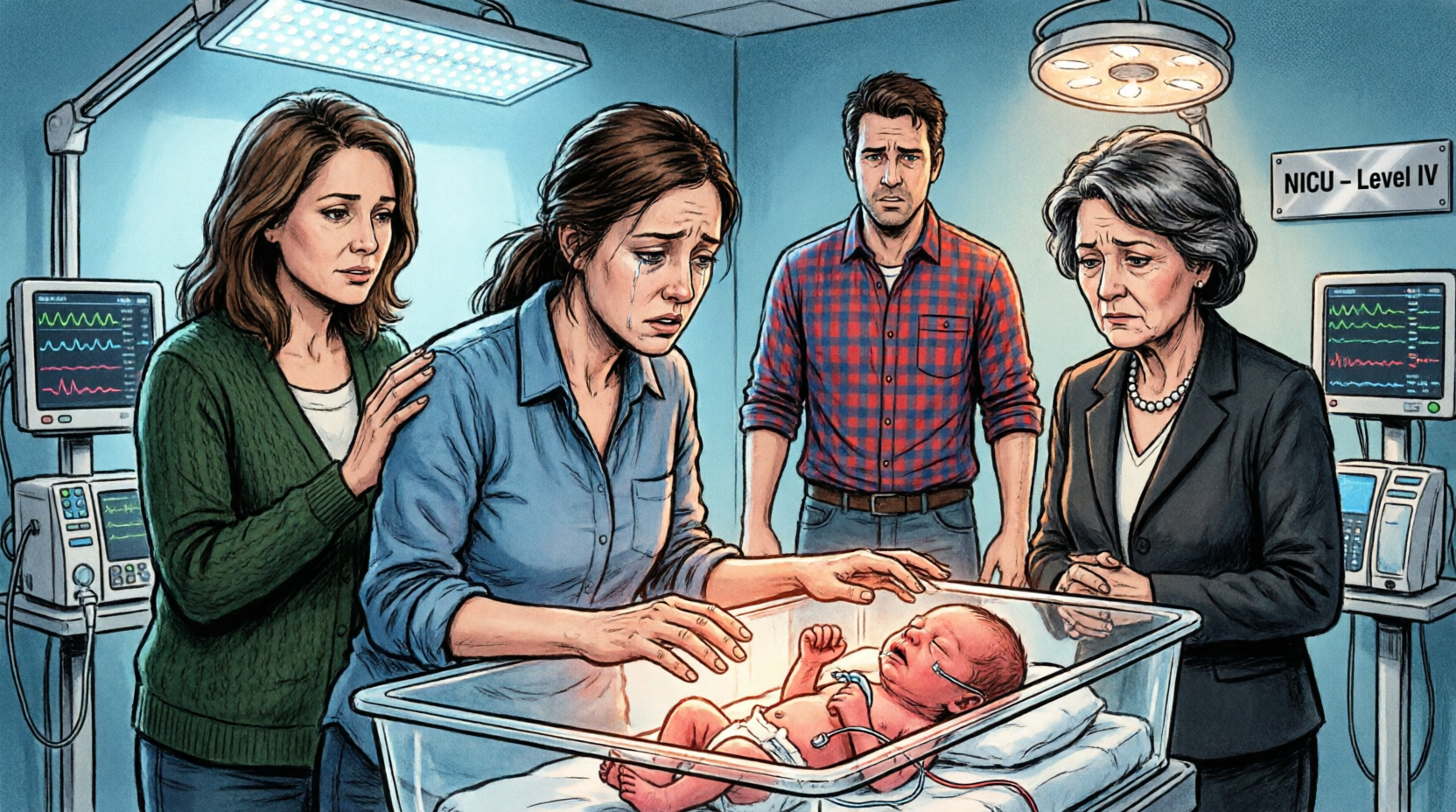
As she tore my premature daughter’s oxygen monitor from the wall, my mother’s comments broke my heart. My sister’s fingers caught my wrist like a trap as I rushed forward. “Don’t,” she growled. The room twisted into terror as my baby’s small chest tried to breathe. And I understood at that frozen moment that my own family members were the ones I feared the most.
The Moment That Shattered Me
My mother’s words cut through me the instant she yanked my premature daughter’s oxygen monitor from the wall.
“These fragile babies don’t deserve to live.”
For a heartbeat, I thought I’d misheard her. The fluorescent lights of the NICU family room hummed softly, nurses moved somewhere down the corridor, yet her words shattered everything. My baby, Lily, lay in the transport bassinet beside me, so small she seemed more like a whispered prayer than a person. Her skin was delicate, her breathing shallow, every tiny movement a struggle she hadn’t chosen but was somehow winning.
I lunged to reconnect the cord, but my older sister, Vanessa, grabbed my wrist so hard I felt my nails dig into my skin.
“Don’t,” she hissed.
“Are you insane?” I shouted, wrenching against her grip. “She needs that!”
My mother, Diane, didn’t flinch. Standing in her tailored beige coat, she acted as if this were a minor dispute over plans, not a question of my child’s survival.
“You need to face reality, Emily,” she said coldly. “That baby is suffering. You’re suffering. A child born this early brings nothing but medical bills, pain, and heartbreak.”
Lily let out a weak, strained cry. It tore straight through me.
A nurse rushed in. “What happened?”
“My mother pulled the monitor!” I yelled.
Vanessa released me, stepping back, her expression stunned. “Emily is overwhelmed,” she said. “She’s been emotional for days.”
“Check my baby!” I screamed.
The room erupted into motion. A nurse lifted Lily, checking her airway, while a doctor reattached the line, giving rapid instructions I could barely follow. My knees nearly gave out.
Then I saw him.
Ryan.
He stood in the doorway, frozen, still wearing his navy construction jacket, his face pale. He had driven three hours from Columbus after I left a single voicemail: “Please come. Something is wrong.”
He scanned the scene, then met my eyes. “Emily,” he said, voice trembling, “what did they do?”
My mother crossed her arms. “This is a family matter.”
Ryan stepped forward, eyes blazing. “No,” he said firmly. “That little girl is my family.”
When the attending physician finally spoke, her tone grave, the room went still. “We need to discuss whether this was accidental—or intentional.”
Minutes later, security separated us.
A guard escorted my mother and Vanessa away while a social worker led Ryan and me into a small consultation office near the NICU. I trembled so badly I could barely hold the paper cup of water they gave me. Ryan sat beside me, one hand on my back, the other holding mine so tightly it hurt—and I welcomed the pain. It kept me anchored.
Dr. Patel, Lily’s neonatologist, sat across from us. “Your daughter is stable,” she said first. I broke down before she could continue.
Ryan pressed his forehead to mine. “She’s okay,” he whispered. “She’s okay.”
But stable wasn’t safe.
Dr. Patel let me catch my breath. “The oxygen monitor was disconnected long enough to cause a dangerous drop, but the team responded quickly. We’ll continue close observation. Based on staff reports and your statement, hospital security filed an incident report and contacted local police.”
Ryan stiffened. “Good.”
“They’ll say I imagined it,” I muttered.
“They can try,” Dr. Patel said gently, “but there are witnesses.”
That night, Ryan booked a hotel across the street; neither of us wanted to leave the hospital. At two a.m., while Lily slept under the careful watch of machines and nurses who suddenly felt more like family than my own, we sat shoulder to shoulder in the dim waiting area.
“I should’ve been here sooner,” he whispered.
“Ryan, don’t,” I said.
“I let her get to me,” he admitted. “When she said I wasn’t good enough for you, no pedigree, no future… I focused on proving her wrong instead of protecting you.”
Months earlier, I had returned to Cincinnati from Columbus for the final weeks of my pregnancy due to complications. Ryan and I had been arguing—first about small things, then deeper wounds: stress, money, pride, distance. My mother exploited every crack. She told me Ryan was unreliable. Told him I needed stability he couldn’t give. By the time Lily arrived seven weeks early, we were barely speaking.
“I let her do the same thing to me,” I admitted. “She said you didn’t want a sick baby. She said if Lily had problems, you’d leave.”
Ryan turned sharply, anger flashing in his eyes. “Emily, I drove through a thunderstorm with half a tank of gas because I thought I might lose both of you. I was never leaving.”
Tears fell again—this time from relief. He pulled me close, and for the first time in months, the walls between us cracked and fell away.
The next morning, police interviewed staff, visitors, Ryan, and me. Security footage showed my mother reaching behind the bassinet—enough to support action.
By noon, an officer returned. “Ms. Carter,” he said firmly, “your mother and sister have been warned not to return. Based on our findings, we recommend seeking an emergency protective order before discharge.”
Ryan answered for us. “We will.”
That evening, a message from Vanessa appeared: You’re destroying this family over a misunderstanding. I knew it wasn’t over—it was just changing shape.
Two weeks later, Lily came home.
She weighed under five pounds, wore a knit cap that nearly swallowed her face, and made soft, determined noises as Ryan buckled her into her car seat, as if she’d already decided the world wouldn’t push her aside. I sat behind her, hand hovering near her chest, terrified that looking away for even a second might be catastrophic.
Ryan drove more cautiously than I’d ever seen.
Those two weeks weren’t just about preparing a nursery. We rebuilt the truth. Met a lawyer. Filed the protective order. Changed locks after discovering my mother still had a key. Attended counseling for NICU parents—and then on our own. For the first time, we treated trust as something living, requiring care, honesty, and daily attention.
Our romance wasn’t about flowers or trips. It was Ryan waking at three a.m. with me to feed Lily, learning how to sterilize bottles, rubbing my shoulders when I cried from exhaustion, and saying “I’m here” so often it became the foundation of our home.
A month later, my mother requested a mediated meeting through her lawyer.
“I just want to explain,” she wrote.
Some explanations come too late.
We met in a downtown office. Vanessa was pale, defensive. My mother cried immediately, claiming panic, claiming she wanted to spare Lily a life of suffering. That’s when I realized: she hadn’t been talking about Lily alone. She had been talking about me.
I had been the daughter she deemed too soft, too emotional, too fragile. Choosing Ryan—a kind, steady man indifferent to money or status—was another weakness in her eyes. When Lily arrived early and tiny, my mother decided my daughter belonged in the same cruel category.
I stood, voice firm. “You didn’t protect my daughter. You tried to decide whether she deserved to live.”
Vanessa cried. I looked at her too. “And you helped.”
Neither had an answer.
We left without reconciliation. Some stories heal not through reunion, but through distance, boundaries, and finally speaking the truth aloud.
That night, Ryan rocked Lily in the nursery while I watched. He kissed her forehead and looked at me with the same expression from the hospital doorway—terrified, furious, devoted.
“We’re okay,” he whispered.
I nodded. “Yeah. We are.”
We were—not because the past disappeared, but because we chose each other anyway.