I extended an invitation to my family for Thanksgiving after years of conflict. My mom grinned as my dad gave me a fictitious eviction notice in the middle of supper. “Seven days.” I maintained my composure. Until my best buddy gave him an envelope, which, upon reading it, erased the color from his face.
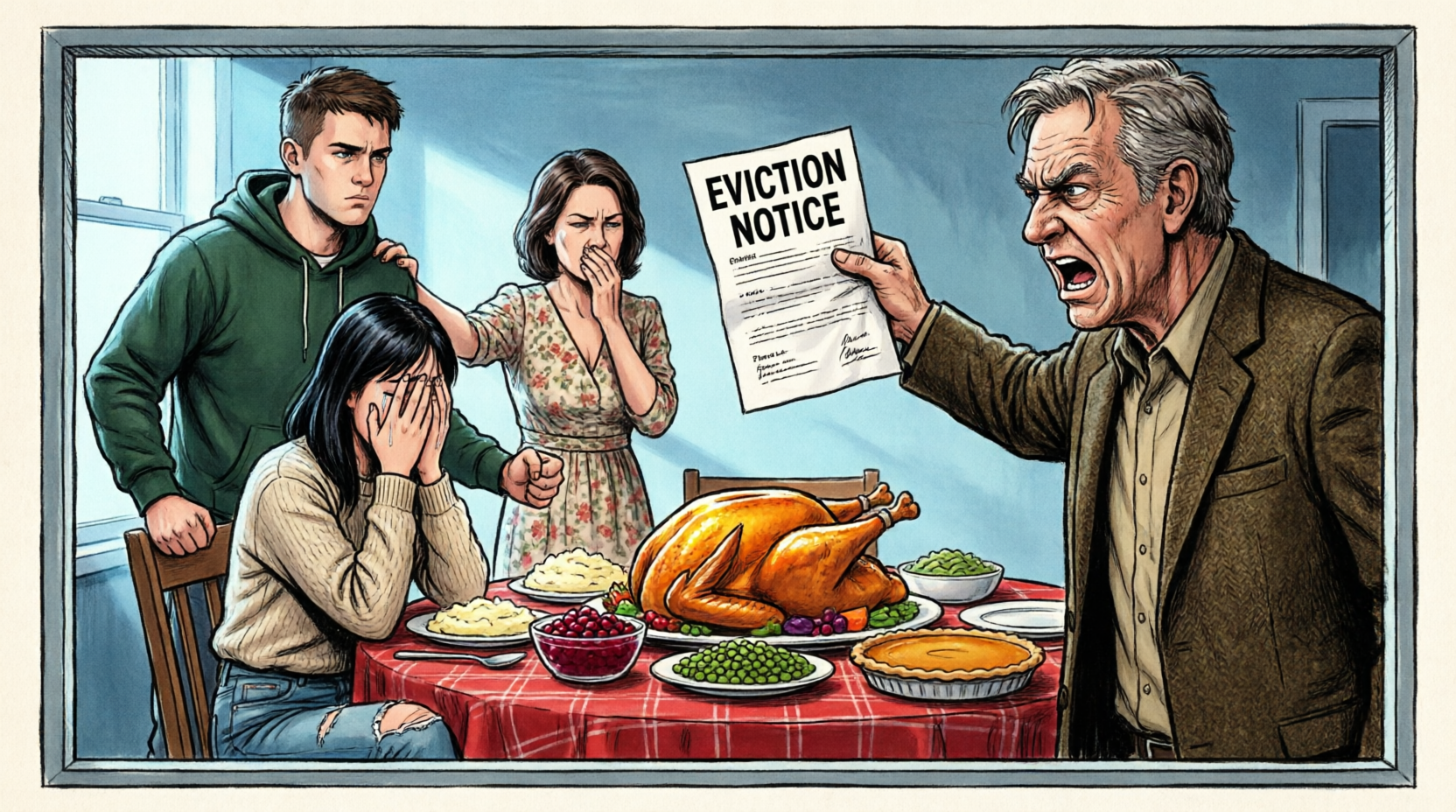
Even after years of tension, I still invited my parents and my brother to Thanksgiving at my house.
That was my first mistake.
The second was believing they might arrive carrying something softer than expectation—something like peace, or at least the willingness to pretend at it for a few hours.
My home sat on the edge of Franklin, Tennessee—a white colonial with a wide porch, dark green shutters, and a dining room that caught candlelight in a way that made everything look steadier than it was. I had bought it four years earlier, after turning a one-room accounting practice into something solid enough to stand on its own. It wasn’t extravagant, but it was mine in every way that mattered—mortgage, deed, decisions. No one else’s name lingered in the margins.
Ownership, I had learned, wasn’t just legal. It was emotional. And my parents had never quite forgiven me for achieving it before my older brother.
Kyle was forty-one and permanently “on the verge” of something that never materialized. Recently separated, always regrouping, always just one break away from turning everything around—at least in his own mind. My father treated him like a delayed return on investment. My mother treated him like a debt the family was morally obligated to keep paying.
And me? I was the one who had “made it,” which in our family meant I had more to give—and less right to say no.
Still, I invited them.
I cooked for two days. Turkey brined and roasted, bourbon-glazed carrots lacquered to perfection, green beans tossed with almonds, my grandmother’s stuffing made exactly the way she wrote it down. I outsourced the pecan pie to a local bakery because I knew my limits. Control didn’t mean doing everything—it meant choosing where to spend your energy.
Mara came early and stayed close. She brought wine, a sharp eye, and the kind of quiet presence that fills a room without demanding it. Officially, she was my neighbor and best friend. Unofficially, she was insurance.
Dinner stayed peaceful for exactly twenty-three minutes.
Then my father reached into his jacket and slid a folded packet across the table like he was finishing a move he’d been planning all evening.
I didn’t touch it right away. I already knew the rhythm of his gestures—the performance of casual authority, the assumption that whatever he handed over would be accepted before it was questioned.
When I finally unfolded it, I almost laughed.
An eviction notice.
Not even a good one. The formatting was wrong, the legal language stitched together from something half-remembered, half-invented. Real details sprinkled just enough to make it feel convincing to someone who didn’t know better.
I looked up.
My mother smiled over the rim of her wine glass, as if she were commenting on the weather. “Seven days,” she said. “Your brother needs this house.”
Silence didn’t fall—it dropped. Heavy. Immediate.
Kyle didn’t look ashamed. He looked relieved. Like someone who had been bracing for a burden and suddenly realized it had already been shifted elsewhere.
Mara leaned back slightly, studying all of them the way she studied witnesses in court—without blinking, without rushing.
“You can’t be serious,” she said, before I could.
My father shrugged, carving into the turkey as if nothing unusual had been said. “When one child is thriving and another is struggling, the family reallocates resources.”
There it was. Not a request. Not even a demand.
A philosophy.
I remember the smell of sage and butter, the faint clink of silverware against plates, the surreal clarity of realizing they believed this—truly believed it. That success made me negotiable. That stability made me available.
They were waiting for me to react. To argue. To raise my voice, give them something emotional to push against.
I didn’t.
I folded the paper carefully, smoothing the crease with my thumb, and set it beside my plate like it belonged there.
The disappointment on my father’s face was almost immediate. Control, for him, depended on disruption.
That’s when Mara reached into her bag.
She didn’t rush. Didn’t dramatize it. Just pulled out a sealed envelope and slid it across the table to him with the same quiet precision he’d used moments earlier.
He opened it.
And the color left his face so quickly it looked like someone had turned off a light behind his skin.
He read the first page. Then the second. Then went back to the first as if the words might rearrange themselves into something less dangerous.
My father had always relied on one simple truth: people who are caught off guard can be managed.
But he wasn’t the only one capable of preparation.
“It’s a probate inquiry and fraud review notice,” Mara said evenly. “Along with a supporting recording from last Thursday.”
Now the silence changed. It wasn’t shock anymore.
It was attention.
“What recording?” Kyle asked, the first crack of uncertainty breaking through his confidence.
Mara didn’t look at him. “The one where your father explains how he plans to remove Claire from this house once the trust clears.”
My father’s chair scraped sharply against the floor as he stood. “You had no right—”
“Oh, I absolutely did,” she replied, calm as ever. “The moment you attempted to initiate a fraudulent transfer tied to a contested estate, it became very much my business.”
Kyle’s confusion deepened. He still thought this was about the house—about me refusing to hand something over.
It wasn’t.
Three months earlier, my aunt Helen had died.
She had been wealthy, meticulous, and widely misunderstood. The kind of woman people called “difficult” because she refused to ignore inconvenient truths. She had supported my father for years—financially, quietly—until she realized that his temporary setbacks had a pattern, and that pattern always ended with Kyle benefiting.
In her final year, she stopped pretending not to notice.
And she started paying attention to me.
I visited. I listened. I handled what needed handling without turning it into a performance. Two weeks before she died, she said something I didn’t fully understand at the time:
“If your father thinks he’s in control, he hasn’t read carefully enough.”
I thought she meant money.
I was wrong.
Her estate plan was more than distribution—it was design.
Control shifted if misuse appeared. Oversight activated if manipulation surfaced. And attempts to reassign property—especially through coercion or fraud—triggered automatic review.
Last Thursday, my father had walked into my house, stood in my hallway, and said—clearly, confidently, and on camera—“Once the trust clears, we’ll push her out. That house should’ve been yours.”
Mara had archived it within minutes.
That was the moment everything changed. Not tonight.
Tonight was just the consequence.
“This is nonsense,” my father said, but the certainty was gone now, replaced with something thinner.
“No,” I said. “This is documentation.”
My mother’s voice sharpened. “You’re humiliating your own father.”
I looked at her, really looked—at the expectation behind her anger, the belief that loyalty meant silence, that family meant compliance.
“No,” I said quietly. “He did that himself.”
The rest unraveled quickly.
My mother cycled through outrage and tears, searching for whichever version might still work. Kyle demanded explanations like confusion could undo reality. My father retreated into technicalities, then into denial, then into something close to panic when Mara mentioned that formal notice had already been filed.
Because charm works best in private.
It collapses under scrutiny.
They left before dessert. No one mentioned the pie.
The week that followed wasn’t dramatic—it was methodical.
Records surfaced. Patterns aligned. Loans that were never repaid. “Gifts” that came with expectations. Years of quiet extraction dressed up as family support.
And alongside all of it, my aunt had documented something else.
Me.
Every visit. Every errand. Every bill paid without being asked. Not as praise—but as contrast.
In one note, written in the same precise handwriting she used for everything, she said:
Claire is the only one acting like family.
That sentence carried more weight than any legal clause.
It clarified intent.
It closed arguments before they could begin.
The legal consequences followed with a kind of inevitability my father had never planned for.
Access was frozen. Authority revoked. Investigations widened.
My mother called me cruel.
But in her vocabulary, “cruel” had always meant “unwilling to be used.”
Kyle came by once, weeks later.
He stood on the porch like a visitor instead of someone who had once expected to live there.
“You knew?” he asked.
“Not everything,” I said.
“But enough.”
“She trusted me with responsibility,” I corrected.
He let out a short, humorless laugh. “Must be nice.”
And there it was—the difference between us, reduced to a single sentence.
He saw inheritance as relief.
I saw it as obligation.
A year later, everything settled.
The trust remained intact, now monitored exactly the way my aunt intended. My father lost access to most of what he had once treated as his. Kyle received enough to get by—but not enough to keep avoiding the consequences of his own choices.
And my house?
It stayed exactly where it was.
Untouched. Uncontested. Entirely mine.
But that wasn’t the real ending.
The real ending wasn’t the envelope, or the look on my father’s face when control slipped out of his hands.
It was quieter than that.
I had opened my door hoping that family still meant something fixed—something automatic.
What I learned instead is that it isn’t.
Blood is just biology.
It doesn’t guarantee loyalty, or respect, or care.
Those things are choices.
Helen chose.
Mara chose.
And, finally—
so did I.