I barely slept that night.
Every time I closed my eyes, I saw Bruce’s handwriting on the back of that photograph.
“Keep this safe. Jeffrey must never know.”
Those seven words disturbed me more than the unauthorized loan application, the credit card statements, or even Monica’s threat to keep my grandchildren away from me.
Bruce and I had been married for forty-three years.
We had shared everything, from financial struggles and parenting disagreements to the devastating moment his doctor told us that his cancer was terminal.
Or at least, I had believed we shared everything.
What could my husband possibly have discovered that he felt compelled to hide from our only son?
And why hadn’t he told me?
At six thirty the following morning, I made myself a cup of coffee, sat at the kitchen table, and searched for the attorney whose name Bruce had written beneath his mysterious message.
Richard Whitmore.
His office was located approximately forty minutes from my house.
According to his professional website, he specialized in estate planning, property disputes, and financial matters involving older adults.
I waited until eight thirty before calling.
A receptionist answered.
“Good morning, Whitmore Legal Associates. How may I help you?”
“My name is Margaret. My late husband, Bruce, apparently met with Mr. Whitmore shortly before his death. I recently discovered something that suggests I need to speak with him.”
She asked for Bruce’s full name.
I gave it to her.
There was a brief silence.
“Mrs. Bennett, could you hold for a moment?”
I agreed.
Less than a minute later, a man’s voice came through the telephone.
“Margaret Bennett?”
“Yes.”
“This is Richard Whitmore. I’ve been expecting to hear from you.”
I nearly dropped my coffee cup.
“Expecting me?”
“Your husband instructed me to wait until you contacted me personally.”
“That was three years ago.”
“I know.”
“Why would he do that?”
“Mrs. Bennett, I think this conversation would be better conducted in person. Are you available this morning?”
I looked at the photograph lying beside my coffee.
“I can be there in an hour.”
“Please bring whatever led you to contact me.”
Before leaving, I called Evelyn.
She insisted on accompanying me.
“You shouldn’t have to hear whatever this is alone,” she said.
For once, I didn’t argue.
As we drove toward Richard’s office, my phone began vibrating inside my handbag.
Jeffrey.
Then Monica.
Then Jeffrey again.
I ignored the calls until a message appeared on my screen.
“Mom, we need to talk before you do something you’ll regret.”
I showed Evelyn.
She shook her head.
“Interesting choice of words from someone who should be apologizing.”
I put my phone on silent.
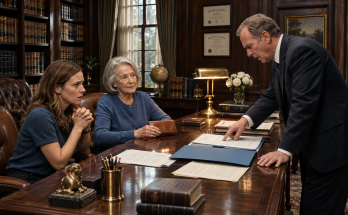
When we arrived, Richard Whitmore greeted us personally.
He was a silver-haired gentleman in his early sixties with a calm voice and an office filled with photographs of his family.
After I explained Evelyn’s presence and gave him permission to speak in front of her, he invited us to sit.
I placed Bruce’s photograph on his desk.
Richard picked it up, examined the handwriting, and sighed.
“I wondered what happened to this.”
“You’ve seen it before?”
“Yes. Your husband brought it with him during our final appointment.”
“Why?”
“Because he intended to put it inside an envelope containing instructions for you.”
My stomach tightened.
“What envelope?”
Richard studied my expression carefully.
“Margaret, did Jeffrey handle any of Bruce’s personal paperwork after his death?”
“Yes. He helped organize his office. He said he wanted to spare me the emotional burden.”
Richard leaned back.
“That explains a great deal.”
He opened a drawer, removed a thick brown folder, and placed it between us.
On the front, written in black ink, was my husband’s name.
BRUCE BENNETT.
Below it was a date.
Fourteen days before his death.
Richard opened the folder.
“Your husband came to see me because he was deeply concerned about your financial security.”
“Bruce always worried about that.”
“This was different.”
He removed several printed documents and turned them toward me.
The first was a bank statement.
I immediately recognized the account.
It was an old savings account Bruce and I had maintained throughout our marriage.
Richard pointed to a series of withdrawals.
“Do you remember authorizing these transactions?”
I adjusted my glasses.
Five thousand dollars.
Seven thousand five hundred dollars.
Twelve thousand dollars.
Another nine thousand.
The withdrawals had taken place during the final year of Bruce’s illness.
“No,” I whispered.
“Bruce didn’t authorize them either.”
I looked up.
“What are you saying?”
“Your husband discovered that someone had been accessing his account and transferring money without his knowledge.”
“Who?”
Richard hesitated.
Then he slid another document across the desk.
The recipient’s name appeared near the bottom.
Jeffrey Bennett.
My son.
My only child.
The little boy I had carried through the emergency room when he broke his arm at seven.
The teenager Bruce and I had stayed awake worrying about whenever he missed curfew.
The young man whose college tuition we had paid by postponing our retirement plans.
I stared at his name until the letters seemed to blur together.
“How much?” I finally asked.
“Over a period of approximately eighteen months, your husband identified $46,800 in questionable transfers.”
Evelyn inhaled sharply beside me.
I couldn’t move.
“Jeffrey told me he was helping his father pay medical bills.”
“That was also what he told Bruce.”
Richard explained that during the final stages of his illness, Bruce had relied on Jeffrey to help with online payments, insurance correspondence, and routine financial tasks.
Bruce trusted him.
Unfortunately, that trust had given Jeffrey access to information he was never supposed to use for his own benefit.
“Did Bruce confront him?”
“Yes.”
“What did Jeffrey say?”
Richard opened another section of the folder.
“Initially, he denied knowing anything about the transfers. Later, he acknowledged borrowing money to cover personal debts.”
“Borrowing?”
“That was the word he used.”
I pressed my trembling hands together.
“Why didn’t Bruce tell me?”
Richard’s expression softened.
“He believed you were already carrying more grief than you could manage. He was dying, Margaret. He knew that. And he couldn’t bear the thought of leaving you with the additional pain of discovering what your son had done.”
Tears rolled down my cheeks.
My husband had known he was running out of time.
While I had been making soup, organizing medication, and praying for another Christmas together, Bruce had been quietly trying to protect me from our own child.
“Did Jeffrey repay the money?”
“Not according to the records Bruce provided.”
I turned toward the window.
Outside, people were walking along the sidewalk, carrying coffee cups, checking their phones, and going about their ordinary lives.
I wondered how the world could continue moving so normally while mine was falling apart.
Then Richard reached for another envelope.
“There’s something else.”
I almost laughed.
Of course there was.
He placed the envelope in front of me.
My name was written across the front in Bruce’s handwriting.
For a moment, I couldn’t bring myself to touch it.
“Your husband asked me to keep this letter until you contacted me. He also prepared a separate set of documents intended to protect certain assets.”
I looked at him.
“What assets?”
“Primarily your home and an investment account.”
“What investment account?”
Richard frowned slightly.
“You didn’t know?”
I shook my head.
He removed another document.
“Bruce maintained a separate investment account for many years. From what he told me, it began with an inheritance from his uncle and grew through regular investments.”
I remembered his uncle Walter.
He had never married, and Bruce had helped care for him during his final years.
I knew Bruce had inherited some money, but I had assumed most of it had gone toward paying our mortgage and preparing for retirement.
“How much is in the account?”
“At the time of Bruce’s death, it was valued at approximately $287,000. We would need current statements to determine its present value.”
I stared at him.
Nearly three hundred thousand dollars.
Money I had never known existed.
Money Bruce had quietly preserved while we lived modestly, drove older cars, and celebrated anniversaries at our favorite little diner.
“Why didn’t he tell me?”
“He intended to. Unfortunately, his health deteriorated faster than expected.”
Richard explained that Bruce had established a trust with me as its primary beneficiary and had taken steps to ensure that Jeffrey could not gain control of those particular assets merely by claiming to act on my behalf.
Jeffrey’s name had been deliberately excluded from any management authority over the trust.
“Bruce was very clear about that,” Richard said.
“He told me, ‘My wife has spent her entire life taking care of other people. I want to make sure nobody can take advantage of that after I’m gone.'”
I covered my mouth.
That sounded exactly like my husband.
Then another thought entered my mind.
“Richard, someone recently tried to apply for a home equity loan against my house.”
His expression changed immediately.
“Tell me everything.”
I explained the credit inquiry, the lender’s response, Monica’s request for photographs of my personal documents, and the paperwork Oliver had discovered in Jeffrey’s desk.
Richard listened carefully.
When I handed him the proposed sale document and the questionable signature, his face became increasingly serious.
“Margaret, have you ever authorized Jeffrey or Monica to sell your home?”
“No.”
“Have you signed a power of attorney giving either of them authority over your property?”
“No. Absolutely not.”
He studied the documents again.
“Then we need to determine exactly what has been submitted and to whom.”
He explained that he would need to review the property records and coordinate with the lender’s fraud investigation, with my authorization.
Then he asked a question that made my heart race.
“Has either of them recently suggested that you’re becoming forgetful?”
I thought about it.
Three months earlier, Monica had complained that I had forgotten which afternoon Stella needed to be picked up from ballet.
Jeffrey had suggested I was having trouble keeping track of my bills.
At Easter, Monica had joked in front of the children that Grandma was getting too old to live alone.
I had laughed along because everyone else was laughing.
Two weeks earlier, Jeffrey had encouraged me to visit a doctor to discuss my memory.
At the time, I thought he was concerned about me.
Now those memories looked entirely different.
“Yes,” I whispered.
“Several times.”
Richard exchanged a look with Evelyn.
“What?” I asked.
“Why are you looking at each other like that?”
He folded his hands.
“I don’t want to speculate beyond what we can establish. But given these documents and the loan application, I think we should investigate whether anyone has attempted to obtain authority over your affairs.”
My mouth went dry.
“They could do that?”
“There are legal safeguards, Margaret. Nobody automatically gains control of your finances simply by saying you’re forgetful. But we should take the situation seriously.”
I looked down at Bruce’s letter.
Suddenly, I desperately wanted to hear his voice.
I carefully opened the envelope.
Inside were three handwritten pages.
The first line nearly broke me.
“My dearest Maggie, if you’re reading this, then I’m sorry I couldn’t stay long enough to explain everything myself.”
Nobody had called me Maggie since Bruce died.
I ran my fingers across the page.
“Forty-three years with you was the greatest privilege of my life. I wish I could have given you forty-three more. There are things I’ve discovered recently that have hurt me more than I know how to describe. Our son has made choices that I cannot excuse, even though I will always love him.”
My tears fell onto the paper.
“I know your heart, Maggie. You will want to forgive him before he even asks. You will want to help him before he learns to help himself. But please remember that loving Jeffrey does not mean giving him permission to destroy everything we’ve built.”
I stopped reading.
Evelyn rested her hand on my shoulder.
After several moments, I continued.
“I have arranged things so that you will have resources of your own. Use them. Travel somewhere beautiful. Buy yourself something extravagant. Eat dinner at a restaurant without worrying about the price. Live, Maggie. Don’t spend the rest of your life apologizing for still being here.”
I could barely see through my tears.
The final paragraph was shorter.
“If Jeffrey ever tries to use my memory to persuade you to give him something, remember this letter. I would never ask you to sacrifice your security for his comfort. I love our son, but I love you too. And you deserve to be protected.”
I lowered the letter onto my lap.
For three years, I had been waiting for some impossible sign from Bruce.
A dream.
A familiar song on the radio.
A sudden feeling that he was standing beside me.
And now, in a quiet attorney’s office on an ordinary morning, my husband had given me something more powerful than any sign.
Permission to live without guilt.
I folded the letter carefully.
“Richard, what do we do next?”
He nodded.
“First, we establish exactly what has happened. Then we make sure nobody can act on your behalf without proper authorization.”
For the next two hours, we worked through documents, account information, and the records I had brought.
Richard recommended that I arrange an independent medical evaluation to document my current cognitive health, secure all sensitive paperwork, and review my existing estate arrangements.
I agreed.
For the first time in days, I felt that I was doing something more useful than crying.
I was protecting myself.
When Evelyn and I finally left the office, my phone displayed seventeen missed calls.
There were also eleven text messages.
Most were from Monica.
One read:
“You’re creating unnecessary problems for everyone.”
Another:
“Jeffrey is your SON. You don’t treat family like criminals.”
And finally:
“If you continue down this road, don’t expect us to be there when you need someone.”
I deleted none of them.
Richard had specifically asked me to preserve every relevant communication.
Then I noticed a voicemail from Jeffrey.
I played it on speaker.
“Mom, listen. Monica is really upset. Things are getting complicated with the house we were buying, and now the lender is asking questions. Please just call me. We can fix this privately. There’s no reason to involve strangers in our family business.”
I listened to it twice.
Not once did he ask whether I was all right.
Not once did he apologize.
Not once did he mention the money he had taken from his dying father.
All he wanted was for the situation to remain private.
I understood why.
Secrets had protected him for years.
That afternoon, after Evelyn dropped me home, I placed Bruce’s letter inside my bedroom safe.
Then I called Jeffrey.
He answered immediately.
“Mom! Finally!”
“We need to talk.”
“That’s what I’ve been trying to tell you.”
“Come over at six. Alone.”
“Monica needs to be there too.”
“No. This conversation is between you and me.”
He hesitated.
“Fine.”
At six o’clock, Jeffrey arrived.
For the first time in years, he knocked instead of letting himself inside.
I opened the door and invited him into the living room.
He looked exhausted.
His shirt was wrinkled, and there were dark circles beneath his eyes.
For a brief moment, I saw the little boy who used to come running to me after a nightmare.
My maternal instincts begged me to comfort him.
But I remembered Bruce’s letter.
I pointed toward the sofa.
“Sit down.”
He obeyed.
I placed the bank statements Richard had given me on the coffee table.
Jeffrey glanced at them.
The color drained from his face.
“Where did you get those?”
“Your father’s attorney.”
He looked toward the front door.
“Mom…”
“Forty-six thousand eight hundred dollars.”
He closed his eyes.
“Let me explain.”
“Please do.”
He rubbed his palms together.
“It was a difficult time. We had debts. Monica wasn’t working as much, and the kids needed things. I was planning to put everything back.”
“Your father was dying.”
“I know.”
“He trusted you.”
“I know!”
“Did you ever intend to repay him?”
Jeffrey looked at the floor.
His silence answered my question.
I felt a fresh wave of grief.
“Your father knew what you did.”
Jeffrey’s shoulders dropped.
“He told you?”
“Not while he was alive.”
“Then how…”
“He left records.”
My son covered his face.
For several minutes, he said nothing.
Then he began crying.
“Mom, I messed up. I know I messed up.”
I sat across from him.
“Was Monica involved?”
He shook his head.
“Not at first.”
“At first?”
“She found out later. When Dad confronted me, I told her we had to stop spending. She got angry because she thought he was being unreasonable.”
I stared at him.
“Unreasonable for wanting his own money?”
Jeffrey didn’t answer.
“And the loan against my house?”
His face tightened again.
“That was Monica’s idea.”
“But you knew.”
“I didn’t know everything.”
“You knew enough.”
He nodded reluctantly.
“She said we could convince you to approve it afterward.”
I felt disgust rise inside me.
“Afterward?”
“Mom, we were desperate.”
“Desperate enough to risk leaving your mother in debt?”
“We wouldn’t have let anything happen to you.”
“Then why did Oliver find paperwork about selling my house?”
Jeffrey looked up sharply.
“Oliver gave you those papers?”
“Don’t you dare blame him.”
“He shouldn’t have gone through my desk!”
“And you shouldn’t have been hiding documents about my property inside it!”
My voice echoed through the room.
Jeffrey fell silent.
I took a deep breath.
“Tell me the truth. Were you planning to move me out of this house?”
He stared at his hands.
“Monica thought a smaller place would be easier for you.”
“What did you think?”
He began crying again.
“I didn’t know what to do.”
“You could have said no.”
He looked at me.
“You don’t understand what it’s like living with her when things go wrong.”
“And you don’t understand what it’s like discovering that your own son helped betray you.”
He had no answer.
I stood and walked toward Bruce’s photograph on the mantel.
“Your father spent his final weeks trying to protect me from you.”
Jeffrey began sobbing.
“Please don’t say that.”
“It’s the truth.”
“I loved Dad.”
“Then you should have treated him better.”
He bent forward, burying his face in his hands.
For years, that sight would have been enough to make me surrender.
I would have hugged him, forgiven everything, offered money, and promised that things would be all right.
But forgiveness without accountability had brought us to this moment.
I wasn’t going to repeat the mistake.
“Jeffrey, I’m not restoring the credit card. I’m not giving you the money for the new house. And I will cooperate with the investigation into the loan application.”
He looked up in horror.
“Mom, I could lose everything.”
“You were willing to risk everything I had.”
He stared at me.
“You’re choosing money over your son?”
“No. I’m choosing not to let my son take any more of my life away from me.”
The room became painfully quiet.
Finally, Jeffrey stood.
“Monica is going to lose her mind.”
“That is not my responsibility.”
He walked toward the door.
Before leaving, he turned back.
“There’s something you should know.”
I waited.
“Monica has been talking to someone about you.”
“Who?”
“A woman she met through a friend. Someone who helps families arrange care for elderly relatives.”
My stomach tightened.
“What kind of care?”
He hesitated.
“She started gathering information about assisted living facilities.”
I felt as though someone had struck me.
“Without discussing it with me?”
“She said you would resist at first.”
“Resist what?”
“Moving.”
“Moving where?”
“I don’t know.”
“Jeffrey!”
He flinched.
“She said once you were somewhere safer, we could deal with the house.”
I closed my eyes.
Safer.
That was the word they were using to disguise what they intended to do.
My home was not unsafe.
I cooked my own meals, maintained my garden, drove my car, paid my bills, volunteered at the library, and cared for two grandchildren whenever their parents needed me.
Yet Monica had apparently been preparing a future in which I would no longer control any of it.
“Did you agree to this?”
Jeffrey’s eyes filled again.
“I didn’t stop her.”
Those four words were worse than any excuse.
He hadn’t stopped her.
He hadn’t protected me.
He hadn’t defended his father’s memory.
He had simply allowed everything to happen because confronting his wife might inconvenience him.
“Leave,” I whispered.
“Mom…”
“Please leave.”
He opened the door and stepped outside.
I locked it behind him.
For nearly an hour, I sat in complete silence.
Then I called Richard and told him everything Jeffrey had revealed.
He asked me to write down the conversation while it was still fresh in my memory.
I did.
That evening, I also received a message from Oliver.
“Grandma, are you okay? Mom took my phone yesterday. I’m using Dad’s old tablet.”
I replied immediately.
“I’m okay, sweetheart. None of this is your fault. I love you and Stella very much.”
A minute later, another message arrived.
“Mom says we’re not allowed to see you because you’re sick.”
I stared at the screen.
“What does she mean?”
Oliver’s reply took several minutes.
“She says you’re confused and doing strange things. She told Aunt Lisa that you don’t remember stuff anymore.”
My heart sank.
Monica was already telling people that I was mentally unwell.
I reassured Oliver that I was safe and that the adults would handle the situation.
Then I called Evelyn.
She arrived twenty minutes later.
Together, we reviewed the messages.
“She’s trying to control the story,” Evelyn said.
I nodded.
“And she’s using my grandchildren to do it.”
The following morning, I made an appointment with my physician.
I also contacted the bank, confirmed that Jeffrey and Monica’s access to my credit card account had been revoked, and arranged to review my financial records with an independent adviser.
Then I did something I hadn’t done in years.
I went out for breakfast by myself.
I ordered French toast, fresh strawberries, and a large coffee.
When the server asked whether I wanted anything else, I ordered a second helping of strawberries.
Such a small thing.
Such an ordinary pleasure.
Yet I found myself smiling.
For years, I had felt guilty spending money on myself while Jeffrey and Monica spent mine without hesitation.
That morning, I enjoyed every bite.
Unfortunately, the peace didn’t last.
When I returned home, a large white envelope was lying inside my mailbox.
There was no return address.
My name had been typed across the front.
I carried it inside and opened it.
The first page was a printed email exchange between Monica and someone whose name I didn’t recognize.
The conversation was dated almost six months earlier.
I read the first message.
“My mother-in-law is becoming increasingly difficult. She’s very attached to her property and refuses to consider downsizing. We believe she would benefit from a structured living environment.”
The response asked whether I had been diagnosed with any condition affecting my independence.
Monica had replied:
“Not officially, but we’re working on getting documentation. My husband is her only child, and we expect him to handle her finances eventually.”
I felt sick.
Another message discussed the possible sale of my home.
Another referred to my retirement income.
And then I found a sentence that made my blood run cold.
“Once she is relocated, we should have enough equity to resolve our financial problems and start fresh.”
I dropped the papers onto the table.
Six months.
They had been discussing my removal from my own home for at least six months.
Long before my birthday.
Long before the rejected credit card.
Long before I changed the locks.
The birthday dinner hadn’t created this situation.
It had simply interrupted their plans.
At the bottom of the envelope was a handwritten note.
“Margaret, there is more. Monica has been lying to Jeffrey too. Please don’t tell her where you got these.”
There was no signature.
Only a telephone number.
I called it immediately.
A woman answered.
“Hello?”
“My name is Margaret Bennett. Someone left an envelope in my mailbox with this number.”
Silence.
Then the woman whispered:
“Oh, thank goodness you called.”
“Who are you?”
“My name is Caroline. I used to be Monica’s closest friend.”
“Why are you sending me these documents?”
“Because I found out what she was planning, and I couldn’t live with myself if I stayed silent.”
“What exactly was she planning?”
Caroline took a shaky breath.
“Mrs. Bennett, the house they told you they wanted to buy isn’t the reason they’re desperate for money.”
I frowned.
“Then what is?”
“Monica owes a substantial amount of money. Jeffrey doesn’t know the full extent of it.”
“How much?”
“I can’t give you an exact figure. But it’s considerably more than she’s admitted to him.”
I sat down slowly.
“Where did the money go?”
Caroline hesitated.
“That’s something I need to show you in person.”
She asked whether we could meet somewhere public the following afternoon.
I agreed.
Before hanging up, she said something that sent a chill through my entire body.
“There’s one more thing you need to understand. Monica didn’t discover Bruce’s private investment account after he died.”
I gripped the telephone.
“What?”
“She knew about it while he was still alive.”
“How could she possibly know?”
“Because Bruce caught her searching through his financial paperwork. She told me about it herself.”
I remembered Monica visiting Bruce during the afternoons when I went grocery shopping or collected his medication.
I remembered how grateful I had been that she was willing to spend time with him.
I remembered telling my friends how lucky I was to have a daughter-in-law who cared.
Now I questioned every one of those visits.
“Why didn’t you tell me sooner?” I asked.
Caroline began crying.
“Because I believed her when she said she was trying to help Jeffrey. I didn’t realize how far she was willing to go.”
Then she added:
“Mrs. Bennett, please be careful. She knows you’ve contacted an attorney. She’s frightened, and when Monica gets frightened, she starts blaming other people.”
After the call ended, I immediately contacted Richard.
He asked me to preserve the envelope and its contents and advised me not to confront Monica about Caroline’s allegations before we could establish what evidence existed.
I promised I wouldn’t.
But less than an hour later, Monica appeared outside my house.
She wasn’t alone.
A woman wearing a navy blazer stood beside her, holding a clipboard.
Monica knocked repeatedly.
“Margaret! Open the door!”
I looked through the window.
“What do you want?”
Her voice suddenly became sweet.
“We’re worried about you. Jeffrey told me you’ve been acting strangely. I brought someone who can help.”
The woman introduced herself through the door and explained that Monica had contacted her to discuss possible senior living arrangements.
I informed her that I had not requested any assistance and had no intention of leaving my home.
Monica immediately interrupted.
“See? This is exactly what I was telling you about. She’s become suspicious of everybody.”
The woman looked uncomfortable.
“Mrs. Bennett, would you prefer that we leave?”
“Yes, please.”
Monica’s expression hardened.
“Margaret, you’re making this unnecessarily difficult.”
I opened the storm door just enough to look directly at her.
“Monica, you are not authorized to make decisions about my home, my finances, or my living arrangements. Do not bring anyone here again without my permission.”
The woman looked at Monica.
“You told me she had agreed to discuss her options.”
“She did! She’s just forgotten!”
I stared at my daughter-in-law.
“No, Monica. I haven’t forgotten anything.”
For the first time, she appeared genuinely frightened.
Perhaps it was the certainty in my voice.
Perhaps it was the realization that I knew more than she expected.
Or perhaps she was finally beginning to understand that the woman she had manipulated for years was no longer cooperating.
The visitor apologized and left.
Monica remained on the porch.
“You think you’re so clever, don’t you?” she hissed.
I said nothing.
“Jeffrey is miserable because of you. The children are upset because of you. Our entire family is falling apart because of you.”
“No, Monica. It’s falling apart because of choices you made.”
She stepped closer to the door.
“You have no idea what you’re doing.”
“Then perhaps you should explain it.”
For a moment, her face changed.
The anger disappeared, replaced by something much colder.
“Bruce couldn’t protect you forever.”
My heart stopped.
“What did you say?”
She appeared to realize immediately that she had said too much.
“Nothing.”
“Monica, what did you mean?”
She turned and hurried down the steps.
I watched her climb into her car and drive away.
Bruce couldn’t protect you forever.
The words repeated inside my head.
How much did she know about his final arrangements?
Had she discovered the trust?
Had Jeffrey helped her search for it?
Was the attempt to borrow against my house their response to discovering that they couldn’t access the money Bruce had protected?
I had questions, but no answers.
Not yet.
That evening, I returned to Bruce’s letter.
I read it slowly, allowing every word to settle into my heart.
Then I noticed something I had overlooked earlier.
Beneath his signature was a tiny handwritten reference.
“Richard has the second envelope, if necessary.”
The second envelope.
I immediately called Richard’s office and left a message.
The next morning, shortly after eight, he returned my call.
“Margaret, I was planning to contact you.”
“Bruce mentioned another envelope.”
“Yes.”
“What’s inside it?”
Richard was quiet for a moment.
“Your husband gave me additional materials shortly before his death. He instructed me to preserve them in case certain circumstances arose.”
“What circumstances?”
“If Jeffrey attempted to obtain control of your finances or property.”
I sat down.
“Richard, I need to see those materials.”
“I agree. Based on what you’ve told me, I believe it’s time we review them together.”
“What did Bruce leave?”
“Several documents, correspondence, and a recording he made during his final week.”
A recording.
My husband’s voice.
After three years of silence, I was going to hear him speak again.
But Richard wasn’t finished.
“Margaret, there’s something important you should prepare yourself for.”
“What?”
“Your husband was aware that someone had been discussing your future living arrangements without your knowledge. He believed there was a much larger plan involving your property and his estate.”
I pressed the telephone against my ear.
“He knew?”
“Yes.”
“Did he know who was behind it?”
Richard paused.
“He named two people in the recording.”
I already knew one of them.
Monica.
But something in Richard’s voice told me the second name would be more devastating than anything I had discovered so far.
“Was it Jeffrey?” I whispered.
“Margaret, I think you should hear Bruce’s words yourself.”
After ending the call, I stood beside my kitchen window, staring at the same driveway I had watched on my sixty-eighth birthday.
Only days earlier, I had been waiting for my family to arrive and celebrate with me.
Now I was preparing to uncover a betrayal that had apparently begun before my husband died.
I looked at the empty chairs around my dining table.
For years, I had mistaken being needed for being loved.
I had confused generosity with obligation.
I had believed that if I gave enough, forgave enough, and sacrificed enough, my family would eventually appreciate everything I had done.
Instead, my kindness had become something they expected to inherit while I was still alive.
But they had made one enormous mistake.
They had assumed that grief made me weak.
They had assumed that age made me incapable.
And they had assumed that because I loved my son, I would never stand against him.
They were wrong.
I picked up my handbag, placed Bruce’s letter inside it, and called Evelyn.
“We’re going back to Richard’s office.”
“Did something happen?”
“Bruce left a recording.”
She was silent for several seconds.
Then she asked, “Are you ready to hear it?”
I looked at our wedding photograph.
“No,” I admitted.
“But I’m going to hear it anyway.”
Forty minutes later, I was sitting across from Richard Whitmore as he placed a small digital recorder on his desk.
He opened the second envelope and removed a document bearing Bruce’s signature.
Then he pressed the play button.
A faint rustling sound filled the room.
Someone coughed.
And suddenly, I heard the voice I had spent three years desperately missing.
“My name is Bruce Bennett. I’m making this recording because I don’t believe I have much time left. If anything happens to my wife, or if anyone attempts to take control of her property, I want the following information to be available.”
I began crying immediately.
Evelyn held my hand.
Bruce continued speaking.
“The money Jeffrey took was not the only thing I discovered. Monica came to see me last Thursday. She made a proposal concerning Margaret’s future, and when I refused, she told me something that made me realize just how far things had gone.”
There was a long pause in the recording.
Then Bruce spoke again.
“What frightened me most wasn’t what Monica suggested. It was discovering who had already agreed to help her.”
Richard looked at me.
I tightened my grip on Evelyn’s hand.
Bruce began speaking the second person’s name.
And in that instant, I understood why my husband had spent his final days preparing to protect me.
Because the person helping Monica was someone I had trusted for more than thirty years.
Someone who had attended Bruce’s funeral.
Someone who had hugged me while I cried.
Someone who still called me regularly to ask whether I needed anything.
And someone who, until that very moment, I would never have imagined capable of betraying me…..
TO BE CONTINUED IN PART 4…