Jeffrey’s silver SUV pulled into my driveway at exactly nine seventeen that morning. Monica was sitting beside him, wearing oversized sunglasses and holding a cup of coffee. Neither of them had brought the children.
I slipped a bookmark between the pages of my paperback and rested it on my lap.
Jeffrey stepped out first, slammed the car door, and walked toward the house with the determined expression of a man who believed someone owed him an explanation.
Monica didn’t even acknowledge me. She marched straight toward the front door, pulled a familiar silver key from her handbag, and pushed it into the lock.
It wouldn’t turn.
She tried again.
Then she pulled it out, examined it, and shoved it back inside.
“What the hell?” she muttered.
“Good morning, Monica,” I said pleasantly.
She turned toward me.
“What’s wrong with your door?”
“Nothing. It’s working perfectly.”
Jeffrey stopped halfway up the porch steps.
“Mom, did you change the locks?”
“Yes.”
For several seconds, neither of them spoke.
Monica removed her sunglasses slowly, revealing eyes that looked more furious than tired.
“You changed the locks without telling us?”
“I wasn’t aware I needed permission to secure my own house.”
Jeffrey rubbed the back of his neck.
“Mom, come on. We’re family. This is ridiculous. Open the door so we can discuss what happened last night.”
“We can discuss it right here.”
Monica looked toward the neighboring houses.
“I’m not having a private family conversation on your front porch.”
“Then you’re welcome to leave.”
Her mouth fell open.
In fourteen years of being my daughter-in-law, Monica had never heard me speak to her that way.
Truthfully, I had never heard myself speak that way either.
For years, whenever she raised her voice, I lowered mine. Whenever Jeffrey became frustrated, I apologized. Whenever someone needed something, I rearranged my entire life to accommodate them.
But sitting on that porch the morning after my sixty-eighth birthday, I discovered something remarkable.
The world did not end when I stopped being agreeable.
Jeffrey climbed the remaining steps.
“Do you have any idea how embarrassing last night was? We had to call Monica’s sister to transfer us money. The restaurant manager was standing right there.”
“That must have been uncomfortable.”
“Uncomfortable? Mom, we looked like idiots!”
“And I ate my birthday dinner alone.”
He opened his mouth, then closed it.
Monica recovered faster.
“Oh, please. You’re seriously doing all of this because we missed one dinner?”
“No, Monica. I’m doing this because I’ve spent three years being treated like an employee who pays for the privilege of working.”
She laughed sharply.
“That’s dramatic.”
“Is it?”
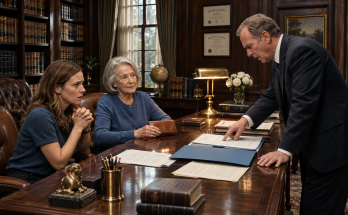
I reached beside my chair and picked up a thick blue folder.
Inside were eight months of credit card statements, copies of bank transfers, receipts for car repairs, orthodontist payments, school expenses, and handwritten notes documenting the money they had promised to repay.
I had stayed awake until nearly midnight gathering everything.
Jeffrey stared at the folder.
“What’s that?”
“An accounting.”
I opened it.
“Four hundred and eighty dollars at a steakhouse in March. Two hundred and seventy-five dollars at a clothing boutique in April. Six hundred dollars for a weekend hotel stay in May. Nearly nine hundred dollars in online purchases last month alone.”
Monica folded her arms.
“Those were family expenses.”
“Your designer handbag was a family expense?”
Her face tightened.
Jeffrey looked at her.
“What handbag?”
“That’s not the point,” she snapped.
“Actually,” I said, “that’s exactly the point.”
I turned another page.
“Over the past eight months, you have charged $18,764.29 to a credit card that was supposed to be reserved for emergencies.”
Jeffrey’s expression changed.
“What?”
“Eighteen thousand, seven hundred sixty-four dollars and twenty-nine cents.”
He turned toward Monica.
“You told me your mother helped with some of those bills.”
Monica glared at him.
“Don’t start blaming me now.”
I watched them exchange looks, and for the first time, I wondered how much my son actually knew about his wife’s spending.
But ignorance was not innocence.
Jeffrey had benefited from every dollar, every dinner, every vacation, and every afternoon I had spent watching his children while he and Monica enjoyed their freedom.
He had never asked how I was managing.
He had simply assumed I would continue.
“From now on,” I told them, closing the folder, “there will be no emergency credit card. There will be no automatic transfers. There will be no borrowing money without an agreement. And you will call before bringing the children here.”
Monica stared at me as though I had announced that I was moving to another planet.
“You can’t just abandon your grandchildren!”
“I’m not abandoning anyone.”
“You know we depend on you!”
“Yes. I’m finally beginning to understand how much.”
Jeffrey sat heavily on the porch railing.
“Mom, we’re going through a difficult period.”
“How long has this difficult period lasted, Jeffrey?”
He didn’t answer.
“Three years? Five years? Since your father died?”
At the mention of Bruce, something flickered across his face.
Monica stepped forward.
“We need you to put the money back into the money market account.”
There it was.
Not an apology.
Not a question about my birthday.
Not a single word about the dinner I had prepared.
The money.
“Why?” I asked.
“Because we have obligations.”
“What obligations?”
She glanced at Jeffrey.
He looked down at his shoes.
“Jeffrey?”
My son sighed.
“We were planning to use some of it.”
“Some of my money?”
“Mom, technically, it was a joint account.”
“Funded almost entirely by me.”
“But we had plans.”
“What plans?”
Neither answered.
I waited.
Finally, Monica took a breath.
“We’ve been looking at a bigger house.”
I stared at her.
“A bigger house?”
“The children need more space. Oliver is getting older, and Stella wants her own bathroom. The neighborhood we’re looking at has excellent schools.”
“And you intended to use my retirement savings to purchase it?”
Jeffrey stood up.
“It’s not like we were going to take everything.”
I felt something inside me turn cold.
“How much?”
“Mom…”
“How much, Jeffrey?”
He glanced at his wife.
“Seventy-five thousand.”
The neighborhood seemed to fall silent around me.
Even the birds in the maple tree appeared to stop singing.
Seventy-five thousand dollars.
Bruce’s life insurance money.
The proceeds from selling the boat he had spent twenty years restoring.
The money intended to keep me comfortable through the remaining years of my life.
They had already assigned it a different purpose.
And they hadn’t even bothered to ask.
“Have you signed anything?” I asked.
Monica looked away.
Jeffrey swallowed.
“We made an offer.”
“Using money you didn’t have?”
“We thought you’d help.”
“You thought I’d help, or you thought I’d never notice?”
Monica suddenly became defensive.
“You have a paid-off house, Social Security, and Dad’s retirement benefits. What exactly do you need all that money for?”
I looked directly into her eyes.
“My future.”
“You’re sixty-eight!”
“Yes, Monica. And I intend to live for quite some time.”
Jeffrey shifted uncomfortably.
“That’s not what she meant.”
“Then perhaps she should explain what she meant.”
Monica grabbed her handbag.
“This is unbelievable. After everything we’ve done for you.”
I almost laughed.
“What have you done for me?”
“We bring the children over. We include you in our lives. We make sure you’re not sitting here alone all the time.”
“Yesterday would suggest otherwise.”
She looked at Jeffrey.
“Let’s go. She’s clearly decided that money matters more than her family.”
I stood up.
“No. I’ve decided that being your family shouldn’t require me to finance your lifestyle.”
Jeffrey’s face hardened.
“Dad would be ashamed of you.”
Those words struck deeper than anything Monica had said.
For a moment, I couldn’t breathe.
My son knew exactly where to aim.
He knew that Bruce’s memory was the most vulnerable part of my heart, and he had used it against me because I refused to give him money.
I looked toward the garden Bruce had planted during the summer before his diagnosis.
The hydrangeas were beginning to bloom.
Then I turned back toward Jeffrey.
“Your father worked forty-one years to make sure I would never have to depend on anyone after he was gone. Don’t you dare use his name to convince me to surrender everything he worked for.”
Jeffrey’s expression softened for half a second.
But Monica was already walking toward the driveway.
“Come on, Jeff. Let her enjoy her money. Apparently, that’s all she needs.”
Before climbing into the SUV, she turned back toward me.
“And don’t expect to see Oliver and Stella anytime soon.”
My heart dropped.
Jeffrey didn’t challenge her.
He didn’t tell her that the children shouldn’t be dragged into an argument between adults.
He simply followed her to the car.
I remained standing on the porch as they drove away.
Only when their vehicle disappeared around the corner did I allow myself to cry.
Not because of the money.
Not because of Monica’s insults.
I cried because my own son had stood in front of me and allowed his wife to use my grandchildren as punishment.
For three years, Oliver and Stella had been the brightest parts of my life.
Oliver loved helping me make pancakes on Saturday mornings. Stella had a special drawer in my kitchen filled with crayons, stickers, and little treasures she collected.
Their photographs covered my refrigerator.
Their muddy footprints still marked the garden path.
And suddenly, I was being told that loving them came with a price.
I went inside, locked the door, and sat in Bruce’s old armchair.
For a moment, I considered calling Jeffrey.
Perhaps I could restore a smaller amount to the account.
Perhaps I could apologize for changing the locks.
Perhaps I could compromise.
Then my eyes landed on our wedding photograph.
Bruce was smiling beside me, his dark hair neatly combed, his hand resting gently against my waist.
I remembered something he had told me during the final weeks of his illness.
“Promise me you won’t spend the rest of your life taking care of everybody except yourself.”
At the time, I had thought he was simply worried about my grief.
Now, I wondered whether he had seen something I had refused to acknowledge.
I put my phone down.
Around noon, my neighbor, Evelyn, knocked on the door.
She was carrying two coffees and a paper bag from the bakery.
“I saw Jeffrey leave this morning,” she said. “Everything all right?”
I intended to tell her that everything was fine.
Instead, I burst into tears.
Evelyn stepped inside, put the coffees on the table, and wrapped her arms around me.
When I finally stopped crying, I told her everything.
The birthday dinner.
The credit card.
The missing gratitude.
The seventy-five thousand dollars.
Monica’s threat about the children.
Evelyn listened without interrupting.
When I finished, she leaned back in her chair.
“Have you checked your credit report lately?”
I frowned.
“My credit report?”
“Yes. And all your financial accounts. Every single one.”
“Why would I need to do that?”
“Because people who feel entitled to your money don’t always wait for permission.”
I wanted to defend Jeffrey.
I wanted to say that my son would never cross that line.
But the words wouldn’t come.
Twenty minutes later, Evelyn was sitting beside me while I opened my laptop.
We reviewed my checking account first.
Everything appeared normal.
Then we checked my savings.
Nothing unexpected.
Finally, I accessed my credit report.
For several minutes, I scrolled through familiar information.
My mortgage, paid off seven years earlier.
The Visa account.
An old department store card I rarely used.
Then I noticed something.
A recent credit inquiry from a lender I didn’t recognize.
The inquiry had been made twelve days earlier.
“What is that?” I whispered.
Evelyn leaned closer.
“Do you recognize the company?”
“No.”
“Have you applied for a loan recently?”
“Absolutely not.”
My fingers began trembling.
We found the lender’s contact information, and I called immediately.
After verifying my identity, the representative transferred me to another department.
I explained that I had discovered a credit inquiry I hadn’t authorized.
There was a long pause.
Then the woman on the phone asked me a question that made my stomach tighten.
“Ma’am, are you referring to the home equity loan application?”
I gripped the edge of the kitchen table.
“The what?”
“The home equity loan application submitted against your residential property.”
Evelyn’s eyes widened.
I struggled to speak.
“How much?”
“According to the information I have here, the requested amount was one hundred and twenty thousand dollars.”
I felt dizzy.
My home.
The home Bruce and I had purchased when Jeffrey was only four years old.
The home where we had celebrated birthdays, Christmas mornings, graduations, and forty years of marriage.
Someone had attempted to borrow $120,000 against it.
“Was the loan approved?” I asked.
“No, ma’am. The application is currently pending further identity and documentation verification.”
For the first time since the call began, I managed to breathe.
“I didn’t apply for any loan.”
The representative’s tone immediately became more serious.
She explained that the application would be flagged and referred to their fraud department. She also advised me to secure my credit information and report the suspected unauthorized activity.
Before hanging up, I asked whether she could tell me who had submitted the application.
She explained that their investigators would need to review the records before releasing further details.
I thanked her and ended the call.
Evelyn reached across the table and squeezed my hand.
“You need an attorney.”
I nodded slowly.
Then I remembered something.
Three weeks earlier, Monica had arrived at my house with a folder of documents.
She had claimed Jeffrey was updating their family’s emergency records and needed copies of my driver’s license, property tax statement, and several other documents.
At the time, I hadn’t questioned her.
She had taken photographs of the paperwork using her phone.
I had even made her coffee while she worked.
The memory made me feel physically sick.
“Evelyn,” I whispered, “I think I know how they got my information.”
She didn’t ask me to explain twice.
Within the hour, I had contacted an attorney, taken steps to freeze my credit, and begun documenting everything I could remember.
At four thirty that afternoon, my phone rang.
It was Jeffrey.
I let it ring three times before answering.
“Mom?”
His voice sounded different.
Gone was the confidence he had displayed on my porch.
“What is it, Jeffrey?”
“Monica said someone from a lending company called her.”
I closed my eyes.
There it was.
Confirmation that she was involved.
“What lending company?”
“Mom, before you get upset, there’s something we need to explain.”
“I’m listening.”
He hesitated.
“It wasn’t supposed to happen like this.”
“What wasn’t?”
“The loan.”
I pressed my hand against my chest.
“You knew?”
“Mom, please…”
“You knew someone was applying for a loan against my house?”
“We were going to talk to you about it.”
“When? After the money arrived?”
“No! That’s not what happened.”
“Then tell me exactly what happened.”
He was silent for several seconds.
Finally, he said, “Monica told me you’d already agreed.”
“And you believed her without asking me?”
“I thought…”
He stopped.
I could hear Monica shouting in the background.
Then the call abruptly ended.
I stared at the phone.
A strange calm settled over me.
Yesterday, I had believed the worst thing my family could do was forget my birthday.
Today, I had discovered that they might have been willing to jeopardize my home.
But the most heartbreaking revelation was still waiting for me.
Shortly after seven that evening, someone knocked on my front door.
I checked through the window and saw Oliver standing on the porch.
My twelve-year-old grandson was alone, wearing his school backpack and holding a crumpled envelope.
I opened the door immediately.
“Oliver? Sweetheart, what are you doing here?”
His eyes were red.
“Grandma, please don’t tell Mom I came.”
I pulled him inside.
“Where are your parents? How did you get here?”
“Mrs. Patterson dropped me off. I told her you were expecting me.”
He looked over his shoulder before unzipping his backpack.
“I heard Mom and Dad fighting after they came home from your house.”
I guided him toward the sofa.
“Whatever they’re arguing about, sweetheart, it’s not your responsibility.”
“But Grandma, they were talking about you.”
He pulled out the envelope.
“I found this in Dad’s desk. Mom told him to get rid of it.”
My hands trembled as I accepted it.
Inside were several printed emails, a real estate document, and a photocopy of a handwritten signature.
My signature.
Except I had never signed that document.
I turned the page.
At the top was the address of my house.
Below it was a proposed sale price.
I stared at the figures, struggling to understand what I was reading.
“Oliver, where exactly did you find this?”
He began crying.
“Grandma, Mom said when you ran out of money, you’d have to move somewhere smaller. She said they could sell this house and everything would be okay.”
I pulled him into my arms.
He buried his face against my shoulder.
“I don’t want you to go away, Grandma.”
“You don’t have to worry about that. I’m not going anywhere.”
But as I looked at the papers scattered across the coffee table, I knew that reassurance was no longer enough.
Someone had been making plans for my property.
Someone had been discussing my future as though I had no right to decide it myself.
And someone had apparently been counting on my silence.
I called Evelyn and asked her to come over while I contacted Oliver’s parents to let them know he was safe.
Then, as I gathered the documents into a folder for my attorney, a small photograph slipped from between the pages.
It showed Bruce sitting at his desk, taken several months before his death.
On the back, in his unmistakable handwriting, were seven words.
“Keep this safe. Jeffrey must never know.”
Beneath those words was the name of an attorney I had never met and a handwritten date from two weeks before Bruce passed away.
I stared at the photograph until my vision blurred.
What had my husband discovered?
Why had he kept it from Jeffrey?
And how had something so personal ended up hidden inside my son’s desk?
I had spent three years believing Bruce had left this world without any unfinished business.
That evening, holding his photograph in my hands, I realized how terribly wrong I might have been.
The credit card was only the beginning.
The loan application was only another piece of the puzzle.
And whatever Bruce had tried to protect me from three years earlier was apparently still happening beneath my own roof, within my own family.
The following morning, I intended to find the attorney whose name was written on that photograph.
I didn’t know what he would tell me.
But for the first time in sixty-eight years, I was prepared to hear the truth, no matter how painful it might be.
Because the woman who had spent her birthday crying over an untouched dinner was gone.
And the woman who had taken her place was no longer willing to be betrayed in the name of family……
TO BE CONTINUED IN PART 3…