PART 5: THE DAY MY FAMILY LOST EVERYTHING THEY TRIED TO STEAL
Eleanor sat quietly across from me while I continued reading my grandfather’s final letter.
“My dear Garrett, I cannot change the mistakes your parents have made, nor can I return the years you spent wondering why you were treated differently. But I can make certain that the things I worked for throughout my life do not become another reward for dishonesty.”
I stopped reading and looked toward Warren.
He was examining the original documents Eleanor had brought into his office.
For nearly twenty minutes, nobody spoke.
Finally, Warren placed his glasses on the table.
“Garrett, your grandfather was more prepared than any of us realized.”
“What exactly did he arrange?”
Eleanor folded her hands.
“After discovering the money your parents had diverted, Everett began reorganizing his remaining assets. He wanted to make certain that nobody could interfere with his final wishes.”
She explained that Grandpa had established a separate trust containing investment accounts, proceeds from previous property transactions, and ownership interests in additional land that my parents apparently knew very little about.
The original documents had been retained securely outside his home.
My grandfather had deliberately kept copies in different locations because he feared someone might attempt to destroy them.
“What’s the estimated value?” I asked.
Warren looked at the financial summaries.
“Subject to updated valuations and verification, approximately $2.8 million, separate from the anticipated five-million-dollar development proceeds.”
I stared at him.
Nearly eight million dollars.
My grandfather, who had repaired his own kitchen appliances, worn the same winter coat for fifteen years, and refused to replace his old pickup truck until it stopped running, had quietly accumulated a remarkable estate.
But what surprised me most wasn’t his wealth.
It was his patience.
While my parents and Rodney had spent years demanding money, Grandpa had spent those same years protecting it from them.
“Who is the beneficiary?” I asked.
Eleanor smiled gently.
“You are, Garrett.”
I lowered my head.
For a moment, I could hear Grandpa’s voice as clearly as if he were standing beside me.
“Money is a tool, Garrett. Never let it become your master.”
He had taught me that when I was seventeen.
I hadn’t understood the full meaning of those words then.
Now I did.
Eleanor removed another document from her case.
“There’s also a written explanation of the decisions concerning your father and brother. Everett wanted there to be no misunderstanding about his intentions.”
I read the statement slowly.
Grandpa had explained the diverted $425,000, his unsuccessful attempts to recover the money, the suspicious withdrawals connected to Rodney, and the pressure he had endured during his final years.
He had documented his reasons for refusing to transfer the property to either of them.
He had also explained why he had still left my father $35,000 and his antique pocket watch.
“I have not forgotten that he is my son,” Grandpa had written. “But being his father does not require me to reward behavior that has caused others unnecessary suffering.”
I leaned back in my chair.
Even after everything my father had done, Grandpa had still loved him.
But he had finally understood that loving someone did not mean surrendering everything to them.
That was the lesson I had struggled to learn my entire life.
“Did Grandpa expect them to destroy the house?” I asked.
Eleanor shook her head.
“He hoped they would never go that far. He was simply afraid they might search the property for documents or attempt to interfere with your ownership.”
I looked down at the letter.
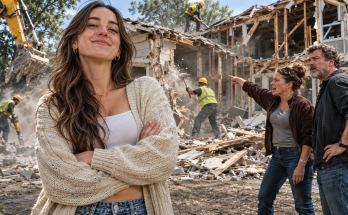
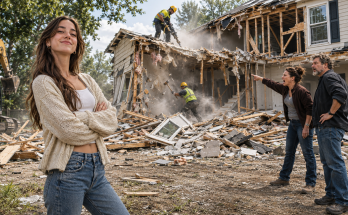
My parents had demolished a house built in 1952, believing that the truth would disappear beneath the rubble.
Instead, they had triggered the very investigation that exposed everything.
The original documents were safe.
The investments were protected.
The development agreement could still move forward.
And the white oak trees Grandpa had refused to sacrifice were still standing.
Everything my family had tried to achieve through dishonesty was slipping through their fingers.
Over the next several weeks, Warren worked with the appropriate professionals to verify the additional estate arrangements and protect my interests.
Investigators continued examining the recent forgery, unauthorized demolition, financial records, and attempted property acquisition.
The historical transactions presented complicated legal questions because so much time had passed, but they provided important context for understanding the family’s recent actions.
Meanwhile, Rodney’s financial situation continued deteriorating.
His business associates stopped returning his calls.
Creditors demanded repayment.
Malcolm Price began cooperating through his attorney, providing communications and records concerning the proposed Evergreen Land Holdings transaction.
Those records revealed that Rodney had expected to obtain control of my property for $300,000 before arranging a much more profitable resale.
He had promised Malcolm a substantial share.
My parents, however, were barely mentioned in the proposed distribution.
The two people who had spent decades sacrificing everything for their favorite son had apparently been little more than convenient participants in his plan.
When Warren explained this to me, I felt a strange sadness.
My mother had defended Rodney every time he failed.
My father had concealed his dishonesty.
Together, they had risked their own home to rescue him.
Yet when Rodney finally saw an opportunity to acquire millions of dollars, he had been prepared to abandon them both.
One Thursday afternoon, Dad called me.
“Garrett, your mother and I need to see you.”
“What happened?”
“We received another notice concerning the house.”
I closed my eyes.
“Have you spoken with an attorney?”
“Yes.”
“And?”
His voice cracked.
“We can’t afford to meet the obligations. We’re going to have to sell.”
I remained silent.
“Your mother wants to ask you something.”
There was movement on the other end of the line.
Then Mom spoke.
“Garrett, sweetheart, we heard about the additional money your grandfather left you.”
I immediately understood where the conversation was going.
“Who told you?”
“Your brother.”
I almost laughed.
Even now, Rodney remained their primary source of information.
“Is it true?” she asked.
“Grandpa made additional arrangements.”
“How much?”
“That’s private.”
She sighed impatiently.
“Garrett, we’re your parents. You shouldn’t keep these things from us.”
“Apparently, keeping financial secrets from family has never bothered you before.”
She went quiet.
Then she began crying.
“Please don’t punish us for the rest of our lives.”
“I’m not punishing you, Mom.”
“We’re going to lose our home!”
“Because you risked it to finance Rodney’s decisions.”
“But you could save it!”
I walked toward the window of my office.
Below me, several trucks were preparing to leave the freight yard.
Men and women were beginning another long day of honest work.
People who trusted me to make responsible decisions.
People whose livelihoods depended on the business I had built without the help Grandpa had intended for me.
“Yes,” I replied. “I probably could.”
My mother’s crying stopped.
“Then you’ll help us?”
“No.”
The silence was immediate.
“What?”
“I won’t pay off Rodney’s obligations. I won’t transfer the inheritance. And I won’t purchase your silence.”
Her voice became angry.
“How can you do this to your own mother?”
“How could you do what you did to your own son?”
She began sobbing again.
“We made mistakes!”
“And I spent decades living with the consequences.”
“Don’t you love us?”
That question would once have destroyed me.
It would have sent me rushing toward my checkbook, desperate to prove that I was a good son.
But not anymore.
“Love isn’t measured by how much money you’re willing to surrender, Mom.”
She hung up.
I sat at my desk for several minutes, remembering how often my parents had used the word family whenever they wanted something from me.
Family meant forgiving Rodney.
Family meant lending money.
Family meant overlooking insults.
Family meant accepting less so someone else could receive more.
Yet when I needed their support, suddenly I was a grown man who had to figure things out for himself.
I had finally realized that their definition of family had never included protecting me.
Several days later, Rodney arrived at my office again.
This time, he didn’t shout.
He didn’t threaten.
He didn’t wear the expensive watch he usually displayed so proudly.
He looked exhausted.
“Can we talk?”
I allowed him inside.
He sat across from my desk and stared at his hands.
“I’ve lost almost everything.”
I said nothing.
“My business is finished. Malcolm won’t speak to me. The lawyers are asking questions I can’t answer.”
“Then answer them truthfully.”
He looked up.
“You really won’t help me?”
“What kind of help do you want?”
“Money.”
I shook my head.
“Rodney, money is the reason you’re sitting here.”
“No, Garrett. Debt is the reason.”
“Dishonesty is the reason.”
His jaw tightened.
“You don’t know what it’s like to fail.”
For several seconds, I simply stared at him.
Then I opened a drawer and removed an old photograph.
It showed me standing beside my first freight truck.
The vehicle was rusted, the paint was faded, and one of the headlights was broken.
My clothes were stained with grease.
I placed the photograph in front of him.
“Do you know where I slept the night before this picture was taken?”
He shook his head.
“Inside that truck. I couldn’t afford a motel room.”
He looked down.
“Do you know what I ate for dinner?”
“No.”
“A can of soup heated at a truck stop.”
I pointed at the photograph.
“That truck broke down three times during my first month. Customers refused to pay me. Banks rejected my applications. I nearly lost everything more times than I can remember.”
Rodney remained silent.
“And while I was struggling, our parents were spending money Grandpa had intended to help me.”
His expression changed.
“I didn’t know about that back then.”
“No. But you knew when you started taking Grandpa’s savings. You knew when you tried to take his property. And you knew when you signed my name.”
He lowered his head.
“You think I’ve never failed?” I continued. “I’ve failed plenty of times. The difference is that I didn’t decide someone else owed me their future because I couldn’t manage my own.”
His eyes filled with tears.
“I just wanted to be successful.”
“Then you should have built something.”
He began crying.
For the first time, my brother looked less like the arrogant man who had demanded millions from me and more like the frightened child my parents had never allowed to experience disappointment.
“I don’t know how to fix this,” he whispered.
“Start by telling the truth.”
“And then?”
“Accept whatever follows.”
He looked at me desperately.
“Would Grandpa really have wanted this?”
I looked at the photograph of our grandfather hanging on my office wall.
“Grandpa wanted you to become a better man. He spent years giving you opportunities to do that.”
I turned back toward Rodney.
“You chose something else.”
He stood slowly.
Before leaving, he placed a small velvet pouch on my desk.
Inside was Grandpa’s antique pocket watch.
“Dad told me to give it back to you,” he said.
I picked it up.
The familiar silver casing was scratched from decades of use.
I remembered Grandpa checking it before dinner, before church, and before we began working on Saturday mornings.
“Why?”
“Dad said he doesn’t deserve it.”
Rodney walked out.
I sat alone, holding the watch.
It had survived everything.
The arguments.
The greed.
The years of deception.
And now it rested in the hands of the person who had never asked for it.
I wound it carefully.
A faint ticking filled the silence.
For the first time in weeks, I smiled.
Several months passed.
The investigations continued, and eventually the recent misconduct resulted in formal legal proceedings.
Rodney faced criminal charges connected to the forged authorization and related fraudulent conduct.
My parents also faced legal consequences arising from their involvement in the unauthorized demolition and associated misrepresentations.
The demolition contractor and its insurers became involved in the civil claims concerning the destruction of the house.
Clifford’s losses were included in the efforts to obtain compensation.
I did not attempt to dictate anyone’s punishment.
I provided the evidence requested, cooperated with the proceedings, and allowed the legal process to take its course.
My mother accused me of betraying the family.
Several relatives contacted me, insisting that I should withdraw my complaints because my parents were elderly.
One aunt even told me that Grandpa would have been ashamed to see his family fighting.
I answered her with a single question.
“Where was everyone when Grandpa was being taken advantage of?”
She had no answer.
Another relative suggested that I should divide the inheritance equally to restore peace.
I declined.
Peace purchased through surrender wasn’t peace.
It was simply another payment demanded by people who refused to change.
As the financial and legal proceedings progressed, Rodney eventually accepted responsibility for several of his actions through a negotiated resolution of the criminal case.
He received a sentence that included incarceration, financial restitution obligations, and supervision following his release.
My parents also reached resolutions concerning their own conduct, with consequences reflecting their respective involvement.
Civil settlements and insurance arrangements addressed a portion of the property damage and Clifford’s losses.
Not everything could be recovered.
Not every historical wrong could be repaired through the courts.
But for the first time in decades, nobody was asking me to pretend that nothing had happened.
My parents eventually sold their house to address their financial obligations.
The beautiful home they had occupied for more than thirty years was emptied room by room.
The expensive furniture disappeared.
The decorative clock came down from the mantel.
The photographs were packed into cardboard boxes.
They moved into a modest apartment.
I did not celebrate.
I did not drive past their house to watch the moving trucks.
I did not call them and laugh.
I knew too well what it felt like to lose a home filled with memories.
One afternoon, Dad contacted me.
“Would you come see our new place?”
I hesitated.
Then I agreed.
Their apartment was small but clean.
There was a narrow balcony overlooking a parking lot and a little kitchen with barely enough space for two people.
Dad was unpacking books when I arrived.
Mom sat beside the window.
She barely acknowledged me.
I helped Dad move a heavy box onto a shelf.
For several minutes, neither of us spoke.
Then he sat down.
“I used to think being a father meant making sure my children had everything they needed.”
I looked at him.
“Somewhere along the way, I decided Rodney needed everything and you needed nothing.”
His eyes became wet.
“I told myself you were strong enough to survive whatever happened.”
I remained silent.
“But that wasn’t love, was it?”
“No, Dad. It wasn’t fair.”
He nodded slowly.
“I wish I could go back.”
“So do I.”
“I wish I could give you those thirty-two years back.”
I looked at his trembling hands.
“You can’t.”
He began crying.
“I know.”
For the first time, he didn’t ask for money.
He didn’t ask me to contact Warren.
He didn’t ask me to protect Rodney.
He simply apologized.
Not for getting caught.
Not for losing the house.
But for being the kind of father who had watched his son struggle and convinced himself that the suffering didn’t matter.
I accepted his apology without pretending that it repaired everything.
“I don’t hate you, Dad.”
He looked up.
“You don’t?”
“No. But trusting you again will take time, and it will require more than words.”
He nodded.
“I understand.”
My mother remained silent throughout most of the conversation.
As I prepared to leave, she finally spoke.
“Your grandfather always did think you were special.”
I turned toward her.
“He thought every person deserved respect.”
She looked down.
“I suppose we forgot that.”
It wasn’t a complete apology.
Perhaps she wasn’t ready to give one.
Perhaps she never would be.
But for once, she hadn’t blamed me for what had happened.
I decided that was enough for that afternoon.
Before leaving, I arranged for groceries to be delivered to their apartment.
I also made sure they had information about local services that could help them manage their practical needs.
I refused to finance Rodney’s debts or restore the lifestyle they had lost.
But I wasn’t going to become cruel simply because they had been cruel to me.
Grandpa had taught me better than that.
Compassion and boundaries could exist together.
The following spring, something wonderful happened.
The revised development agreement received the necessary approvals.
The financial arrangements were completed in accordance with the amended terms.
Grandpa’s white oak trees and the creek were permanently protected through the agreed conservation measures.
The property that had once threatened to tear my family apart was finally going to serve a meaningful purpose.
Warren and I worked with community representatives, architects, and local educators to establish a heritage and vocational learning center on the site of Grandpa’s demolished house.
I committed a substantial portion of the inheritance to supporting its construction and future programs.
The building would offer practical workshops, educational opportunities, local history exhibits, and scholarships for young people interested in skilled trades.
I wanted teenagers who couldn’t afford expensive training to have somewhere they could learn.
I wanted retired machinists, carpenters, mechanics, and electricians to share their knowledge with another generation.
I wanted people to walk through those doors and feel the same sense of belonging I had felt whenever Grandpa handed me a wrench.
The architects incorporated several features inspired by the original house.
Green shutters.
A welcoming porch.
Large windows facing the creek.
And inside the main workshop stood Grandpa’s enormous wooden workbench.
It had been cleaned, repaired, and carefully restored.
The scratches remained.
The small dents remained.
Even the old metal vise remained attached to its original position.
I insisted that nobody remove the marks Grandpa had made throughout his lifetime.
Those imperfections were part of the story.
One of the builders asked whether I wanted the workbench refinished until it looked new.
“Absolutely not,” I replied.
“Why?”
“Because it doesn’t need to look new to be valuable.”
As I said those words, I realized how much they applied to people, too.
We all carry marks from the things we’ve survived.
Those marks don’t make us worthless.
Sometimes, they are proof of everything we have endured.
While construction progressed, I completed the purchase of the little cottage Clifford had selected.
It had two bedrooms, a comfortable front porch, and enough land for the garden he had dreamed about.
I arranged for him to live there without having to worry about rent for the remainder of his life.
The compensation process concerning his original losses was handled separately.
When I handed him the keys, he stared at me in disbelief.
“Garrett, I can’t accept something like this.”
“You can.”
“But why?”
“Because you deserve to feel secure in your own home.”
His eyes filled with tears.
He looked toward Susan, who was already crying.
Then he turned back toward me.
“Your grandfather would be proud of you.”
I smiled.
“I hope so.”
Clifford walked onto the porch and looked across the garden.
“Margaret would’ve loved this place.”
We spent the afternoon carrying boxes inside.
Among his belongings was the recovered photograph album, which had been professionally stabilized and carefully digitized so the surviving pictures would be protected.
He placed it on a shelf beside the window.
Then he showed me a new rocking chair Susan had purchased.
“It isn’t Margaret’s original chair,” he said softly. “But I think she’d like it.”
I sat beside him as the afternoon sunlight warmed the porch.
For a long time, we simply watched the birds.
No discussion of lawyers.
No discussion of money.
No arguments about inheritance.
Just two men who understood that life was about more than the things people could take from us.
Nearly eighteen months after the demolition, the heritage center was finally ready to open.
Above the entrance, a large wooden sign displayed its name.
THE EVERETT MILLER HERITAGE AND LEARNING CENTER
Beneath it were the words my grandfather had spoken to me when I was fourteen.
“A man’s word is the one thing he should never spend carelessly.”
The opening ceremony attracted hundreds of people.
Neighbors.
Local families.
Former machinists.
Teachers.
Young students.
Business owners.
Several of my company’s employees volunteered to help organize the event.
Mrs. Henderson arrived carrying a framed photograph of Grandpa standing beside his original house.
“I thought this belonged here,” she said.
I accepted it gratefully.
“It certainly does.”
Clifford arrived wearing a freshly pressed shirt, accompanied by Susan.
He carried a pot of red geraniums.
“I thought the porch needed these,” he said.
I laughed.
“Grandpa would agree.”
Together, we placed them near the entrance.
There were also rose bushes planted along the walkway, including new plants chosen to resemble the varieties Grandpa had once maintained.
The house itself was gone.
But somehow, standing on that property again, I no longer felt that everything had been lost.
As the ceremony approached, Warren stepped beside me.
“There’s someone at the entrance asking to see you.”
I turned around.
My father stood near the parking area.
Beside him was my mother.
They looked nervous.
Neither had told me they were coming.
Dad held a small cardboard box.
“Garrett?”
I walked toward them.
“We didn’t want to interrupt anything,” he said.
“You’re not interrupting.”
He handed me the box.
Inside were several old photographs of Grandpa, a collection of handwritten notes, and a picture of my father as a young boy standing beside the original house.
“I thought these should be here,” Dad explained.
I looked through them.
“Thank you.”
He glanced toward the new building.
His eyes filled with tears.
“Your grandfather would have loved this.”
Mom looked at the green shutters, the porch, and the people gathering near the entrance.
For several moments, she said nothing.
Then she whispered, “We destroyed something beautiful.”
I looked at her.
It was the first time I had heard her acknowledge the destruction without defending it.
“Yes,” I said quietly. “You did.”
She wiped her eyes.
“We thought the money would solve everything.”
“And did it?”
She shook her head.
“No.”
Then she said something I had waited fifty-eight years to hear.
“I’m sorry, Garrett. Not just about the house. About all of it.”
My throat tightened.
“I spent so many years thinking you didn’t need me because you were capable of taking care of yourself,” she continued. “I never stopped to consider that you might still need a mother.”
I looked away.
There were a thousand things I could have said.
I could have listed every disappointment.
Every cruel remark.
Every birthday Rodney had received more.
Every moment I had been expected to sacrifice.
But standing on the land Grandpa had loved, surrounded by people who had come to celebrate something good, I no longer wanted to spend my life reciting the things that had hurt me.
“I needed you, Mom,” I said. “I just learned to stop asking.”
She began sobbing.
Dad placed an arm around her shoulders.
“I know,” she whispered. “And I’m sorry.”
I embraced her briefly.
It wasn’t an announcement that everything was forgiven.
It wasn’t permission to return to the way things had been.
It was simply an acknowledgment that she was finally beginning to understand.
Whether our relationship could heal would depend on what she did next.
And for once, that responsibility belonged to her.
When it was time for my speech, I stepped onto the small platform in front of the center.
Looking across the audience, I saw Clifford, Susan, Mrs. Henderson, Warren, my employees, and dozens of young people.
My parents stood quietly near the back.
I took Grandpa’s pocket watch from my jacket.
For several seconds, I struggled to find my voice.
Then I began.
“My grandfather built his home on this property in 1952. He was a machinist, a hardworking man, and someone who believed that what you created with your hands mattered less than what you created in the hearts of other people.”
The crowd became silent.
“When I was fourteen, I came here almost every Saturday. My grandfather taught me how to repair engines, sharpen tools, and solve problems. But the most important things he taught me had nothing to do with machinery.”
I looked toward his photograph beside the entrance.
“He taught me that honesty matters even when lying would be easier. He taught me that generosity should never be used as an excuse for entitlement. He taught me that character is what remains when money, reputation, and appearances are stripped away.”
My father lowered his head.
“Eighteen months ago, the original house was deliberately destroyed. At first, I believed I had lost the place where my happiest memories lived.”
I paused.
“But memories don’t live inside bricks. They live inside people.”
Several people began crying.
“My grandfather once refused millions of dollars because accepting the money would have meant destroying these beautiful white oak trees. Some people thought he was foolish.”
I gestured toward the conservation area.
“Today, those trees are still standing. Generations of children will be able to walk beneath them. Families will gather here. Young people will learn skills that could change their futures.”
I held up the pocket watch.
“This watch belonged to a man who understood that time is more valuable than money. Once money is gone, you might earn it again. But once time is gone, nobody can return it.”
I looked directly at the young students seated near the front.
“If you remember anything from today, remember this: Never allow another person’s greed to determine your character. Never confuse your kindness with an obligation to tolerate dishonesty. And never believe that your worth depends on how useful you are to someone else.”
The audience began applauding.
I waited until the sound faded.
“My grandfather left me an inheritance. But the greatest thing he gave me was the ability to recognize what was worth protecting.”
My voice cracked.
“And this place is my way of giving that gift to someone else.”
The applause grew louder.
Clifford stood.
Mrs. Henderson stood.
Warren stood.
Then the entire audience rose to their feet.
I looked toward my parents.
Dad was crying openly.
Mom pressed a tissue against her face.
Neither approached the stage.
Neither asked for recognition.
For perhaps the first time in their lives, they were witnessing something extraordinary without trying to claim a share of it.
After the ribbon was cut, families began entering the center.
Children gathered around the workshop equipment.
Retired tradesmen explained how different tools worked.
Teachers discussed future educational programs.
Visitors studied the photographs documenting the history of Sycamore Drive.
I walked toward Grandpa’s restored workbench.
A teenage boy stood beside it, examining an old wrench.
“Did your grandfather really use this?” he asked.
“Thousands of times.”
“Was he good at fixing things?”
I smiled.
“The best.”
The boy looked at the wrench.
“My dad says I’m not very good at school. But I like fixing bicycles.”
I knelt slightly so I could look him in the eyes.
“There’s more than one way to be intelligent. Keep learning what you love. And don’t let anyone convince you that you aren’t capable of building a good life.”
He smiled.
“Do you think I could learn to fix engines?”
“Of course.”
I handed him the wrench.
As he accepted it, I suddenly remembered standing in that same position forty-four years earlier.
Grandpa had placed a wrench in my hand and made me believe I could do something worthwhile.
Now I was doing the same thing for someone else.
That was when I finally understood what a legacy really meant.
It wasn’t about leaving behind the largest bank account.
It wasn’t about owning the most property.
It wasn’t about making sure your name appeared on expensive buildings.
It was about creating something good that continued long after you were gone.
Late that afternoon, after most visitors had left, I walked alone toward the creek.
The white oak trees stretched above me, their branches moving gently in the breeze.
Sunlight filtered through the leaves.
Birds called from somewhere deep in the woods.
I stopped beside the largest tree and reached into my pocket.
Grandpa’s watch was still ticking.
“I kept my promise,” I whispered.
For a moment, I imagined him standing beside me, wearing his old work clothes, smiling the way he used to when I finally figured out how to repair something without his help.
I imagined him telling me that I had done well.
Not because I had inherited millions.
Not because I had defeated Rodney.
Not because my parents had finally apologized.
But because I had refused to become the kind of person who had hurt me.
Years later, Rodney completed his period of incarceration and began rebuilding his life.
He found modest employment and started addressing his restitution obligations according to the applicable arrangements.
He occasionally wrote to me.
His earliest letters contained excuses.
Later, they contained apologies.
Eventually, one arrived without any request for money.
It said:
“Garrett, I used to think you had everything because life was easier for you. Now I understand that you had everything because you were willing to work for it. I spent my life believing I deserved what other people had. I’m trying to become someone different. I don’t expect you to forgive me. I just wanted you to know.”
I kept that letter.
Not because it erased what he had done.
But because it was the first time my brother had acknowledged responsibility without asking me to rescue him.
I hoped he would continue changing.
Whether he did was his decision.
My relationship with my parents also changed.
We spoke occasionally.
I visited when appropriate.
I offered reasonable practical help when they genuinely needed it.
But the old financial demands were never accepted again.
They gradually learned that access to my life required respecting my boundaries.
And I learned that forgiveness did not require returning to the circumstances that had caused the pain.
Meanwhile, the Everett Miller Heritage and Learning Center continued growing.
Students received scholarships.
Young mechanics completed training programs.
Retired workers found purpose in teaching others.
Community members gathered to share stories, repair furniture, learn new skills, and celebrate the history of the neighborhood.
Clifford became one of our most enthusiastic volunteers.
He taught children how to grow vegetables and care for plants.
Every spring, he brought fresh red geraniums for the porch.
His garden at the cottage became so beautiful that neighbors frequently stopped to admire it.
He always smiled and told them Margaret would have been proud.
Sometimes, he and I sat together beneath the old oak trees, drinking sweet tea and remembering the people we had loved.
One afternoon, he asked me a question.
“Garrett, do you ever wish your parents hadn’t demolished that house?”
I looked toward the center.
“Every day.”
He nodded.
“But would all of this exist if they hadn’t?”
I considered his question.
“Probably not.”
He smiled.
“Your grandfather would’ve found that interesting.”
I laughed.
“He certainly would have.”
I still wished I could walk through Grandpa’s original kitchen.
I still wished I could hear the old porch swing creaking in the afternoon.
I still wished Clifford had never been forced to leave his home.
I would never pretend that the destruction had been necessary or that everything happened for a reason.
Some things happened because people made terrible choices.
But those choices didn’t have to determine the rest of our lives.
We could build something meaningful from what remained.
And that was exactly what we had done.
My parents had spent $14,000 demolishing Grandpa’s house because they believed destroying it would give them control over a five-million-dollar fortune.
Instead, their actions exposed decades of deception, revealed hidden estate arrangements, and ended the pattern of favoritism and manipulation that had controlled my life for fifty-eight years.
Rodney lost the business he had tried to rescue through dishonesty.
My parents lost the lifestyle they had risked to protect him.
And all three lost the ability to use my love for them as a source of unlimited financial support.
But I gained something far more valuable than the inheritance they had tried to steal.
I gained peace.
I gained freedom.
I gained the courage to say no without feeling guilty.
And I gained the opportunity to carry my grandfather’s kindness into the lives of people he would never meet.
Today, above the entrance to the center, Grandpa’s photograph hangs beside a small plaque containing the final words from his letter to me.
“Garrett, never measure your worth by what others demand from you. Measure it by the good you choose to leave behind.”
Every time I read those words, I remember the afternoon my parents called me in Denver.
“The house is gone, and your tenant is out!”
They had sounded so proud.
They believed they had won.
They thought they had destroyed the one thing that stood between them and millions of dollars.
What they didn’t know was that Grandpa had protected far more than a house.
He had protected the truth.
He had protected his legacy.
And, in the end, he had given me the strength to protect myself.
My family demolished a building.
They could not demolish my character.
They could not erase my grandfather’s love.
And they could not destroy the future he had entrusted to me.
The house they reduced to rubble became a place where hundreds of people discovered new beginnings.
The money they tried to steal became an opportunity for children who needed someone to believe in them.
And the grandson they had spent decades treating as though he mattered less became the man who finally understood that he had always been enough.
My parents thought they were destroying my inheritance.
Instead, they destroyed their control over me.
And that was the one thing no amount of money could ever buy back.
THE END.