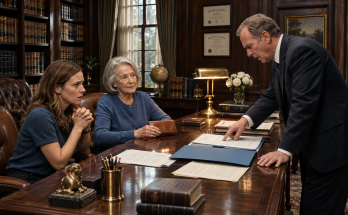
Laura was standing beside her office window when I arrived. On her desk were two thick folders, a sealed envelope, and a photograph of Joyce taken sometime before the cancer had stolen the color from her face. She looked happy in that picture. Happier than I had remembered seeing her in months. Laura closed the office door and asked me to sit down.
“Dale, before we begin, I need you to understand something. Everything your wife did during the final months of her life, she did with a clear mind and a very specific purpose.”
My fingers tightened around the arms of the chair.
“What did she do?”
Laura opened the first folder.
“Your wife knew Jared was waiting for her to die.”
For several seconds, I couldn’t speak. Hearing those words from someone outside our family made them feel infinitely worse.
“Joyce told you that?”
“She did. But she also brought me evidence.”
Laura slid several printed emails across the desk. They were conversations between Jared and Kaitlyn, copies of messages Joyce had discovered when Jared borrowed her laptop and forgot to sign out of his account.
The first message was dated nearly four months before her death.
“Once Mom is gone, Dad won’t know what to do with everything. We’ll have to take control before somebody convinces him to keep the money.”
Another message came from Kaitlyn.
“My dad says the house would sell quickly. We could put Dale somewhere smaller and use the difference toward Longboat.”
Then came the message that made my stomach turn.
Jared had written, “Let’s just get through the funeral first. After that, everything changes.”
I placed the pages on the desk.
Outside the window, people were walking along the sidewalk, carrying coffee and talking on their phones. The world was continuing as though nothing had happened, while everything I believed about my family was collapsing inside that small office.
“Did Joyce read all of these?”
Laura nodded.
“She cried the first time she showed them to me. The second time she came here, she didn’t cry at all. She had already made her decision.”
Laura opened the second folder and turned it toward me.
“Joyce completely revised her estate plan.”
I stared at the documents.
“The Ohio property, her investment accounts, and her other individually owned assets have been placed in a trust for your benefit. The house is yours through survivorship. You have financial security for the rest of your life. Jared has no authority over your property, your finances, or your medical decisions.”
“And his inheritance?”
Laura folded her hands.
“Twenty-five thousand dollars, held in a separate trust. It can be used for education, vocational training, and certain essential expenses approved by an independent trustee. He cannot use it to purchase luxury property, a yacht, or finance his wife’s family.”
I almost laughed.
Twenty-five thousand dollars.
My son had abandoned his career, promised a multimillion-dollar house, and offered his father-in-law a yacht based on money he had never been entitled to receive.
“But there’s something else,” Laura said.
She handed me the sealed envelope.
On the front, written in Joyce’s familiar handwriting, were five words.
For Dale, my forever love.
My hands began shaking before I opened it.
“Dale,
If you’re reading this, I’m sorry I couldn’t stay longer. Forty-one years with you sounded like a lifetime when we were young, but now that I’m leaving, it feels terribly short.
I know you will be lonely. I know you’ll forget to eat breakfast and leave your coffee sitting until it gets cold. I know you’ll probably keep my slippers beside the bed for months.
But what frightens me most is that your kindness might become someone else’s opportunity.
I love our son. I always will. But somewhere along the way, Jared began confusing what we gave him with what we owed him.
Please don’t surrender the life we built simply because someone tells you that being a good father requires it.
You have given enough.
Travel somewhere beautiful. Plant tomatoes again. Fix that porch railing you’ve been complaining about. Buy yourself something ridiculous if you want to.
And please, Dale, live.
Don’t spend the rest of your life waiting to join me.
I’ll be waiting whenever your time comes, but there is no hurry.
All my love,
Joyce.”
I pressed the letter against my chest and cried.
Laura didn’t interrupt me.
For the first time since the funeral, I wasn’t crying only because Joyce was gone. I was crying because even while facing her own death, she had been thinking about how to protect me.
When I finally composed myself, Laura explained that Joyce had recorded a video statement as additional evidence of her wishes and mental capacity.
“She asked me to play it for Jared when the estate arrangements were formally explained.”
“When?”
“Whenever you’re ready.”
I looked down at the letter.
“Tomorrow.”
That afternoon, I called a locksmith. By four o’clock, every exterior lock had been replaced. I contacted my bank, reviewed my financial accounts, changed my passwords, and arranged for future financial correspondence to come directly to me.
Then I went grocery shopping.
It was such an ordinary thing, but walking through the supermarket without Joyce felt like learning how to exist in a different world.
When I returned home, Jared and Kaitlyn were standing on my porch.
Kaitlyn was holding the little brass key.
“Your lock isn’t working,” she announced.
“I know.”
“Did something happen?”
“I changed it.”
Jared frowned.
“Why would you do that?”
“Because it’s my house.”
Kaitlyn exchanged a nervous glance with him.
“We were going to help you organize some of Joyce’s things.”
“I didn’t ask you to.”
Jared stepped closer.
“Dad, you’re making this difficult. We’ve got appointments coming up, and there are documents you need to sign.”
“What documents?”
He hesitated.
“Just financial arrangements. Ronald’s helping us.”
“Then bring them to Laura Young’s office tomorrow morning. Ten o’clock.”
His expression immediately brightened.
“The inheritance meeting?”
“You could call it that.”
Kaitlyn smiled and squeezed his arm.
They left looking happier than they had any right to be.
The following morning, Jared arrived wearing a navy-blue suit. Kaitlyn carried an expensive handbag, and Ronald walked behind them holding a leather portfolio.
Apparently, they believed they were attending a business closing.
Ronald shook my hand.
“Big day for the family, Dale.”
“It certainly is.”
Laura invited everyone into the conference room.
Before she could begin, Ronald placed his portfolio on the table.
“I’ve prepared a preliminary agreement for the Longboat property. Obviously, we’ll need to establish the availability of funds.”
Laura looked at him.
“Mr. Simmons, you are not a beneficiary of this estate.”
“Of course not. I’m here to assist Jared.”
“With what?”
Ronald’s smile weakened.
“A property purchase.”
Laura turned toward Jared.
“Have you made financial commitments based on your mother’s estate?”
Jared laughed awkwardly.
“Nothing we can’t handle once everything is distributed.”
Laura opened the folder.
“Then I recommend you reconsider those commitments immediately.”
She began explaining Joyce’s arrangements.
At first, Jared listened confidently.
Then his smile disappeared.
By the time Laura finished explaining the restrictions on his twenty-five-thousand-dollar trust, his face had turned pale.
“Wait,” he interrupted. “What about the millions?”
“Those assets are held for your father’s benefit.”
“The Ohio land?”
“Also part of the trust.”
“The investment accounts?”
“The same.”
“And the house?”
“Your father owns it.”
Kaitlyn dropped her handbag onto the floor.
Ronald slowly closed his portfolio.
Jared stared at me.
“Dad, tell her this isn’t right.”
I remained silent.
“Mom promised we’d be taken care of!”
Laura adjusted her glasses.
“Your mother paid for your education, helped you purchase your first home, and provided financial assistance on numerous occasions. She did not promise you ownership of her entire estate.”
“This is ridiculous!” Kaitlyn snapped. “We made plans!”
I looked directly at her.
“Yes. I heard those plans on Sunday evening.”
The room went quiet.
Jared swallowed.
“Dad, that wasn’t what you thought.”
“You promised Ronald a yacht.”
Nobody moved.
“You discussed buying his three-million-dollar property. You said I would sign whatever you put in front of me because I could barely make breakfast.”
Ronald looked away.
Kaitlyn suddenly became very interested in the conference table.
Jared shook his head.
“We were just talking.”
“Your mother had been buried for one day.”
He opened his mouth, but no words came out.
Laura reached for her laptop.
“There is one final item your mother requested that we share.”
She turned the screen toward us.
And suddenly, Joyce was there.
My beautiful Joyce.
She was sitting in Laura’s office, wearing the pale blue cardigan I had bought her for our anniversary. Her hair was thinner, and her face showed the exhaustion of someone fighting an impossible battle.
But her eyes were clear.
“Hello, Jared,” she began.
My son froze.
“If you’re watching this, then I’m gone, and you’ve probably discovered that my estate isn’t arranged the way you expected.”
Jared’s face crumpled.
“I want you to know that I love you. Nothing you have done can erase the memory of the little boy who used to climb into my bed during thunderstorms. Nothing can erase the pride I felt watching you graduate or become a husband.”
Joyce took a slow breath.
“But love does not require blindness.”
Kaitlyn looked down.
“I have seen your messages. I know about your plans for your father, our house, and our savings. I know you have discussed my death as though it were the solution to your financial problems.”
Jared covered his mouth.
“You might believe that your father is weak because he is quiet. You might believe that his grief makes him incapable of protecting himself. But the man you are underestimating spent his entire adult life working to give us a home.”
Her voice became stronger.
“Every dollar we accumulated represents something. Overtime. Sacrifice. Missed vacations. Careful decisions. Your father worked in the summer heat while you were enjoying your childhood. He drove old trucks so you could attend college without carrying the burden we once carried.”
Tears filled my eyes.
“You are not entitled to dismantle his life simply because mine has ended.”
Joyce paused.
“The inheritance I am leaving you is an opportunity, not a fortune. I hope you use it to become the man I always believed you could be. Work honestly. Treat people kindly. Take responsibility for your choices.”
Then she leaned slightly toward the camera.
“And Jared, if your first instinct after watching this is to pressure your father into giving you his money, then you have understood absolutely nothing about me.”
The video ended.
Nobody spoke.
For nearly a minute, the only sound in the room was Jared’s breathing.
Finally, he turned toward me.
“Dad, you can still change things, right? It’s your money now. You can help us.”
Those words broke something inside me.
Even after hearing his dying mother’s final message, even after watching her explain the pain he had caused, he was still asking about the money.
I stood up.
“Your mother just told you exactly what she wanted.”
“But we’re in trouble!”
“What kind of trouble?”
Kaitlyn began crying.
Ronald admitted that Jared had already paid a substantial reservation deposit toward the Longboat property using borrowed money. They had also spent heavily on designer furniture, vacations, and other purchases, believing Joyce’s fortune would eventually cover everything.
Jared had quit his job without sufficient savings.
They had built an entire future on my wife’s death.
“Dad, please,” he whispered.
I picked up Joyce’s letter.
“I will always love you, Jared. But I will not pay for the celebration you planned around losing your mother.”
Then I walked out.
Over the following weeks, the phone calls came constantly. First came anger. Then accusations. Then apologies that somehow always ended with requests for financial assistance.
Kaitlyn called me selfish.
Ronald accused me of destroying their business arrangement.
Jared threatened to challenge the estate plan.
Laura calmly explained the strength of Joyce’s documentation. After consulting his own attorney, Jared abandoned the idea.
The reservation agreement fell apart. The furniture orders were canceled where possible. Their expensive lifestyle became impossible to maintain.
Ronald never received his yacht.
And I never signed a single document they brought me.
By September, my house had become a different place.
I repaired the porch railing. I planted tomatoes and watered Joyce’s mint every morning. I took a road trip through the mountains of North Carolina, stopping whenever I saw something beautiful.
I also established a scholarship in Joyce’s memory to help young people pursue vocational education. Laura helped me arrange everything properly.
Joyce had always believed that helping someone build a future was more valuable than simply handing them one.
Nearly a year after her death, on a quiet Saturday morning, someone knocked on my front door.
It was Jared.
He wore faded jeans, work boots, and a shirt bearing the logo of a local supply company.
There was no expensive watch on his wrist.
No fancy car in my driveway.
And Kaitlyn wasn’t with him.
“Can we talk, Dad?”
I stepped aside.
He sat at the kitchen table, but this time he didn’t take Joyce’s crossword chair.
“I got a job,” he said.
“That’s good.”
“It’s nothing like my old position. I’m working in the warehouse while I rebuild.”
I nodded.
He stared at his hands.
“Kaitlyn and I separated. Things got ugly when the money disappeared. We blamed each other for everything.”
“I’m sorry to hear that.”
“Don’t be. I think I needed to see what my life actually was.”
He reached into his jacket and pulled out a small envelope.
“I brought you something.”
Inside was a check for three hundred dollars.
“What’s this?”
“Part of the money you lent me for my car repairs two years ago. I know you probably forgot about it. I didn’t.”
I looked at him carefully.
“Are you asking me for something?”
His eyes filled with tears.
“No, Dad.”
For the first time in a very long time, I believed him.
“I watched Mom’s video again,” he continued. “Laura gave me a copy when I asked. I must have watched it twenty times. At first, all I heard was what she wasn’t giving me. Then one night, I finally heard what she was saying.”
He wiped his face.
“I treated her death like a payday. And I treated you like an obstacle. I don’t know how I became that person.”
I remained quiet.
“I wish I could tell her I’m sorry.”
I looked toward Joyce’s photograph on the kitchen counter.
“So do I, son.”
He began to cry.
Not the desperate tears he had shed in Laura’s office when he discovered the money was unavailable. These were quieter tears, carrying the weight of something he could never undo.
“Do you think she hated me?”
“No,” I answered. “Your mother loved you enough to refuse to let greed become the only thing you lived for.”
He lowered his head.
“Can you forgive me?”
I reached across the table and took his hand.
“I can forgive you. But rebuilding trust will take time.”
He nodded.
“I understand.”
That morning, we made breakfast together.
The toast burned again.
For some reason, we both laughed.
It was the first time I had heard my son laugh without talking about money since Joyce had become ill.
Over the next several months, Jared visited regularly. Sometimes he brought groceries. Sometimes he helped with the garden. Occasionally, we sat on the porch without saying anything.
He never asked about the inheritance again.
On the second anniversary of Joyce’s death, we visited her grave together.
Jared placed a bouquet of white roses beside her headstone.
“I’m working hard, Mom,” he whispered. “I’m trying to become someone you’d be proud of.”
I stepped away to give him a moment alone.
The afternoon sunlight fell across the cemetery, and a gentle breeze moved through the trees. I closed my eyes and remembered Joyce sitting on our screened porch, laughing at my terrible jokes, working on her crossword puzzles, and reminding me that happiness was rarely found in the things people spent their entire lives chasing.
My son had once believed his mother’s greatest gift would arrive after her death in the form of millions of dollars.
He had been wrong.
Her greatest gift was the lesson she left behind.
And mine was the freedom to spend the remainder of my life without sacrificing my dignity to prove my love.
Joyce never left Jared the fortune he wanted.
She left him something far more valuable: a chance to become a better man.
And she left me something no amount of money could ever purchase.
The certainty that, even in her final days, I was loved.
Some inheritances fill bank accounts. Others rebuild broken lives. My wife’s final act accomplished something greater than either.
She protected everything we had built, without giving up hope for the son who had nearly destroyed it.
Because true love is not measured by how much you surrender to someone. Sometimes, the greatest act of love is having the courage to say no.
THE END.