My father entered the room on my birthday, saw my bruised face, and said, “Sweetheart… who did this to you?” My husband grinned and said, “I did,” before I could say anything. Instead of congratulating her, I gave her a sl:ap.
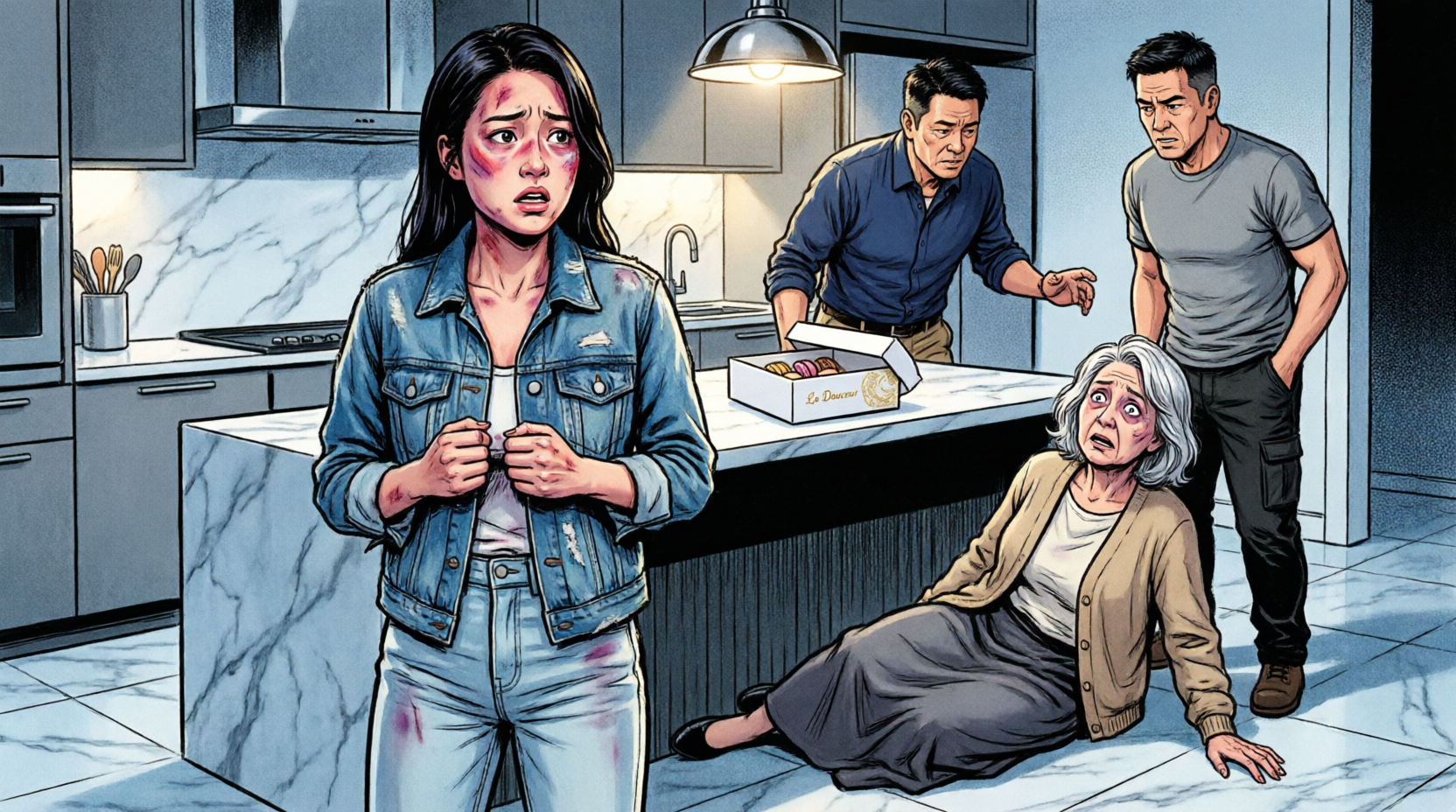
On the morning of my birthday, my father walked through the door, took one look at my face, and froze.
“Sweetheart… what happened to you?”
His voice had lost all its warmth. He was still holding the white bakery box with my favorite strawberry shortcake, but the celebration he had planned vanished the second he saw the bruises—dark shadows beneath layers of makeup that couldn’t quite hide the truth.
I opened my mouth to answer, but Derek spoke first.
He didn’t hesitate. Didn’t even look ashamed.
“I did,” he said, leaning back in his chair with a smug little smile. “Figured a slap was better than a birthday greeting.”
For a second, the room went completely still.
His mother, Linda, let out a small, nervous laugh as if she could smooth it over, as if this were just another awkward moment instead of something ugly and real. I stood there gripping a stack of plates, my hands trembling so badly I thought I might drop them.
Dad set the cake down very carefully on the counter.
He didn’t raise his voice. He didn’t rush.
He simply took off his watch and placed it beside the box, then rolled up his sleeves with slow, deliberate movements.
“Emily,” he said, eyes never leaving Derek, “go outside.”
Something in his tone made my chest tighten. I didn’t argue. I moved.
Out on the porch, I could barely catch my breath. My pulse pounded in my ears as I turned back toward the kitchen window.
Inside, everything shifted.
Derek pushed his chair back too fast, the legs scraping harshly across the tile. Linda stood abruptly, panic replacing her earlier indifference. And then—almost unbelievably—she dropped down and hurried out of the room on her hands and knees, as if instinct alone told her she didn’t want to be anywhere near what was coming.
That was the moment I realized this wasn’t going to end the way I expected.
Dad stepped forward.
Not quickly. Not angrily.
Just… decisively.
He grabbed Derek by the front of his sweater and shoved him back against the wall hard enough to rattle the picture frames. The confidence drained from Derek’s face in an instant, like someone had flipped a switch.
“You hit my daughter?” Dad asked.
Derek tried to push him off. “Hey—calm down—”
Dad didn’t budge.
“You put your hands on her,” he said, voice low and controlled, “and then you joke about it?”
I had never seen him like that. Not loud. Not wild.
Worse—composed.
Like he had already made up his mind.
From the porch, memories crashed into me all at once. The slammed doors. The broken phone Derek replaced the next day like it erased anything. The way he’d grab my wrist just a little too tight. The way I kept telling myself it wasn’t that bad.
The bruises from last night still burned beneath my skin.
He’d been drinking. I’d reminded him my parents were coming. He said I was making him look bad.
Then he hit me.
Linda had watched and told me not to provoke him.
Standing there now, I understood something I had been avoiding for far too long.
This wasn’t something I could fix.
Inside, Derek’s voice cracked. “This is between me and my wife.”
“No,” Dad replied. “You made it everyone’s business the second you decided she was someone you could hurt.”
Linda reappeared in the hallway, clutching her purse, pleading for everyone to calm down. Dad ignored her completely.
Then he looked toward the window—toward me.
“Call the police.”
My hand tightened around my phone.
For a split second, hesitation crept in—not doubt, but something heavier. Shame. The kind that builds quietly over time, convincing you to endure things you never should.
Then Derek looked straight at me and said, cold and sharp:
“If you do this, you’ll regret it.”
And just like that, something inside me shifted.
The fear didn’t disappear.
It changed.
It became resolve.
I stepped back inside, my voice steadier than I felt, and made the call.
The police arrived before noon.
Two officers separated us immediately. One sat with me in the living room while the other took Derek outside. Linda kept interrupting, insisting it was all a misunderstanding, that he was stressed, that I was overreacting.
The officer cut her off cleanly.
“Bruises aren’t a misunderstanding.”
Once I started talking, I couldn’t stop.
Everything came out—the first shove, the controlling behavior, the damage, the fear. I showed them the photos I had hidden away: bruises, broken things, moments I had documented just in case I ever needed proof.
I never thought that day would actually come.
I was wrong.
Derek was arrested that same day.
After the house emptied, the silence felt different.
Not heavy.
Safe.
Dad made coffee like it was any ordinary afternoon. My mom arrived not long after, wrapping me in a blanket even though I wasn’t cold. No one mentioned the birthday anymore.
It didn’t matter.
Being safe was enough.
That night, I went home with them, carrying a small bag and the cake that was never meant to be eaten like this. We sat at the kitchen table, using paper plates, just like when I was a kid.
My face hurt.
But for the first time in a long time, I could breathe.
The months that followed weren’t easy.
There were court dates. Accusations. Attempts to twist the story.
But facts don’t bend forever.
Photos, reports, and records told the truth clearly enough. A protective order was put in place. The divorce went through. Derek eventually accepted a plea deal.
I didn’t go to the final hearing.
I didn’t need to.
I already had what I needed.
Freedom.
A year later, my birthday looked very different.
A small home. Quiet. Mine.
My friend brought balloons. My mom baked the cake. Dad showed up early, smiling this time, and handed me a small box.
Inside was a silver watch.
“For new beginnings,” he said.
I’ve worn it every day since.
People sometimes ask why I stayed as long as I did.
There’s no simple answer.
Because it doesn’t start with violence—not usually. It starts with excuses. With small things you explain away. With moments that don’t feel big enough to leave over.
Until one day, you realize you’ve been shrinking to survive.
And you barely recognize yourself anymore.
I recognize that version of me now.
And she’s no longer the one in control of my life.
If there’s anything worth taking from this, it’s this:
Pay attention to what you’re being asked to tolerate.
Because love doesn’t require you to disappear.