PART 2: THE HOUSE THEY NEVER HAD THE RIGHT TO DESTROY
“Garrett?” my mother finally said. “What exactly do you find so funny?”
I looked down at my shoes and shook my head. For fifty-eight years, I had watched my parents make reckless decisions, expecting someone else to clean up the consequences. But this time, they had crossed a line they couldn’t simply apologize their way out of.
“Dad,” I said calmly, “before you hired that demolition company, did you bother checking who legally owned the house?”
My father scoffed.
“Don’t start with that legal nonsense. Your grandfather was my father. That property belongs to this family.”
“That wasn’t my question.”
“We had every right to clear it,” he insisted. “Besides, Rodney already knows someone interested in buying the land. Once you get home, we’ll sit down and discuss the money like reasonable adults.”
There it was.
They hadn’t demolished Grandpa’s house because they believed it was unsafe. They hadn’t removed Clifford because they were concerned about his well-being. They had destroyed the house because they thought eliminating everything standing on the property would force me to sell.
“Did Rodney help arrange this?” I asked.
Mom hesitated.
“Your brother was only trying to help.”
I laughed again, although this time there was nothing humorous about it.
“Well, I hope all three of you have excellent attorneys.”
My father’s voice immediately changed.
“Are you threatening your own parents?”
“No, Dad. I’m giving you some advice. And considering what you’ve just admitted to doing, it’s probably the most valuable advice you’ll ever receive from me.”
I ended the call before either of them could respond.
Then I immediately called Clifford.
He answered after several rings, and the weakness in his voice made my stomach tighten.
“Garrett? I’m terribly sorry about your house.”
“Clifford, forget the house for a moment. Are you somewhere safe?”
“Yes. My daughter’s here with me.”
“Did they give you any warning?”
There was a long silence.
“Your father came yesterday afternoon. He told me you had authorized the demolition and that I needed to leave before morning. I tried calling you, but he said you were busy and didn’t want to be disturbed.”
I clenched my jaw.
“Did you manage to take everything?”
“Most of my clothes. Some important papers. But I couldn’t get everything out in time.”
His voice cracked.
“My wife’s photographs were still in the bedroom. And the wooden rocking chair she used to sit in. I asked the crew if they could give me another hour, but your brother told them to keep working.”
For a moment, I couldn’t speak.
Clifford’s wife had died eight years earlier. He had once shown me photographs from their fiftieth wedding anniversary, smiling proudly as he described the woman he had spent most of his life loving.
My family had taken those memories from him without a second thought.
“Clifford, listen to me carefully. You haven’t done anything wrong. I’ll make sure you have somewhere comfortable to live, and I’ll take care of whatever expenses you’ve suffered.”
“You don’t owe me anything, Garrett.”
“Yes, I do. You trusted me to provide you with a home.”
After speaking with his daughter and arranging immediate assistance, I called Warren Abbott.
He answered on the second ring.
“Garrett, I was about to call you. How’s Denver?”
“My parents demolished the Sycamore Drive house.”
Silence.
Then Warren spoke slowly.
“Please tell me you’re joking.”
“I wish I were.”
“Was Clifford inside?”
“No. They forced him out yesterday.”
“Did you authorize anything?”
“Absolutely not.”
I heard Warren moving papers around his desk.
“Garrett, do your parents understand what that building was legally connected to?”
“Apparently not.”
“And they don’t know about the final agreement?”
“No.”
Warren exhaled heavily.
“Then they have a much bigger problem than they realize.”
Nearly eighteen months earlier, during the negotiations concerning Grandpa’s wooded acreage, Warren and I had developed an arrangement that protected the things my grandfather had valued most.
The commercial development company agreed to preserve the white oak trees, establish a permanent conservation area along the creek, and dedicate part of the surrounding property to public green space.
But there had been another important condition.
The original residential parcel, including Grandpa’s house, had been transferred into a separate property-holding entity established to protect it and support its long-term preservation.
That entity was managed by me, with formal ownership records, contractual obligations, and insurance arrangements completely separate from my personal assets.
The development agreement also included a substantial financial commitment tied to the preservation and rehabilitation of the original residence.
My parents believed they had destroyed an old family house that stood between them and a fortune.
In reality, they had destroyed property belonging to a separate legal entity, displaced a lawful tenant, and potentially interfered with a multimillion-dollar development agreement.
And they had done it without my permission.
“Warren,” I asked, “how bad could this become?”
“That depends on what they told the demolition contractor, what documents they provided, and whether they misrepresented their authority. We need evidence before reaching conclusions.”
“Get everything.”
“Already working on it.”
I canceled the remainder of my conference and booked the earliest available flight home.
During the next several hours, my phone barely stopped vibrating.
Mom called eleven times.
Dad sent increasingly angry text messages.
Rodney left a voicemail accusing me of abandoning the family over a building that was supposedly worthless.
Then came a message from my mother that made me stare at the screen.
“Your father is extremely upset. When you return, you need to apologize and reimburse us the $14,000. We did this for your benefit.”
I took a screenshot and forwarded it to Warren.
His response arrived less than a minute later.
“Save every message. Do not delete anything.”
By the time I landed in Indiana, it was already dark. I drove directly to Noblesville, gripping the steering wheel tighter with every passing mile.
I had prepared myself for the worst.
But nothing could have prepared me for what I saw.
Grandpa’s house was gone.
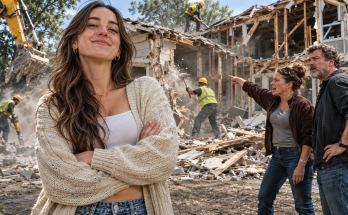
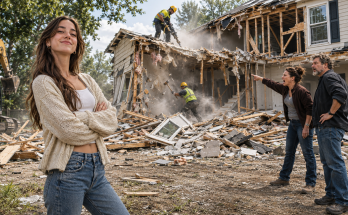
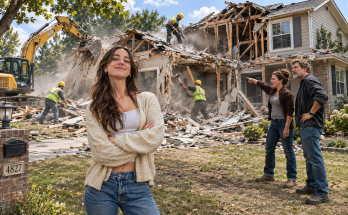
The green shutters, the porch swing, the kitchen where he used to make pancakes on Saturday mornings, and the basement workshop where he had taught me how to repair engines had disappeared beneath an enormous pile of broken timber and shattered bricks.
A section of the foundation remained exposed.
The rose bushes had been crushed.
Clifford’s red geraniums lay scattered across the dirt.
I stepped out of my truck and stood there in complete silence.
For several minutes, I wasn’t a fifty-eight-year-old businessman.
I was fourteen again, riding my bicycle down Sycamore Drive, excited to spend another Saturday with the only person who had ever made me feel truly appreciated.
I remembered Grandpa standing on the porch, wiping grease from his hands and calling my name.
I remembered the smell of freshly cut wood in his workshop.
I remembered the afternoon he told me that a person’s character was revealed by what they did when nobody was watching.
My parents hadn’t merely destroyed a structure.
They had destroyed a place that held generations of memories because they believed money was more important.
“Garrett?”
I turned around.
My grandfather’s longtime neighbor, Mrs. Henderson, was walking toward me with a flashlight.
She was eighty-two years old and had lived next door for nearly four decades.
“Oh, sweetheart,” she whispered. “I’m so sorry.”
She wrapped her arms around me.
For the first time since receiving my mother’s phone call, I felt tears forming in my eyes.
“I tried to stop them,” she continued. “I told your father that he couldn’t possibly have permission. He told me to mind my own business.”
“Did you see what happened?”
“Almost everything.”
She reached into her coat pocket and pulled out her phone.
“My grandson installed security cameras last summer. One of them faces your grandfather’s driveway. I thought you might need the recordings.”
I stared at her.
“Mrs. Henderson, you have footage?”
“Two days’ worth.”
Within minutes, she was showing me videos of my parents and Rodney arriving at the property.
In one recording, Clifford stood beside the driveway, holding a cardboard box while Rodney argued with him.
In another, my father shook hands with a man wearing a construction company’s jacket.
But the most disturbing recording came from the previous evening.
My mother and Rodney were standing near the porch.
Their voices were faint, but several sentences were unmistakably clear.
“Once the house is gone, he won’t have a reason to keep the property,” Rodney said.
Mom answered, “Exactly. He’ll be angry for a few days, but he’ll get over it. He always does.”
Then Rodney laughed.
“And if he doesn’t?”
“He’s your brother. He won’t take us to court.”
I watched the recording twice.
They hadn’t simply made a terrible mistake.
They had counted on my willingness to forgive them.
They had built their entire plan around the belief that I would never hold them accountable.
I thanked Mrs. Henderson, arranged for Warren to receive copies of the recordings, and returned to my truck.
Before leaving, I looked one final time at the ruins.
“You were wrong about me this time,” I whispered.
The following morning, Warren and I met with representatives from the development company and contacted the appropriate authorities regarding the demolition.
The contractor’s owner, a man named Dennis Caldwell, agreed to meet us at his office.
He appeared visibly nervous when Warren placed the property ownership records on his desk.
“Mr. Caldwell,” Warren began, “who instructed your company to demolish this residence?”
“Mr. Miller.”
“Which Mr. Miller?”
“Garrett Miller.”
I leaned forward.
“You and I have never met.”
Dennis looked confused.
“Your father said you were traveling. He brought written authorization.”
Warren and I exchanged a glance.
“May we see it?”
Dennis opened a filing cabinet and removed a folder.
Inside was a copy of an authorization letter stating that I had granted my father permission to arrange the demolition, terminate the residential tenancy, and clear the property in preparation for a future sale.
At the bottom was my name.
And beneath it was a signature that looked remarkably similar to mine.
For several seconds, the room was completely silent.
“That’s not my signature,” I said.
Dennis’s face turned pale.
“Are you certain?”
“Absolutely.”
Warren carefully examined the document.
“Who delivered this?”
“His father and brother. They told me the owner had signed it before leaving town.”
“Did you independently verify that authorization?”
Dennis lowered his eyes.
“No. They seemed legitimate. They had photographs of the house and copies of some property documents.”
Warren requested copies of everything connected to the demolition, including communications, payment records, and submitted documents.
Dennis agreed to cooperate.
As we left his office, Warren stopped beside my truck.
“Garrett, this is no longer simply a family dispute.”
“I know.”
“The apparent forgery changes the situation considerably.”
I nodded.
But something about the signature bothered me.
It looked too accurate to have been written by my father, whose hands had developed a noticeable tremor in recent years.
Someone had taken the time to study my signature.
Someone had obtained a reliable sample.
And I had a terrible feeling I knew who.
That afternoon, my mother invited me to what she called an emergency family meeting.
I almost declined.
Then I realized there was something I wanted to hear directly from them.
When I arrived at my parents’ house, Rodney was already sitting at the dining room table with Dad.
Mom had prepared coffee and a tray of cookies, as though we were gathering to celebrate a birthday.
“Finally,” she said. “We can discuss this properly.”
I remained standing.
Dad pointed toward an empty chair.
“Sit down, Garrett.”
“I won’t be staying long.”
Rodney rolled his eyes.
“Here we go. The dramatic businessman.”
My mother placed a folder on the table.
“We’ve done some research. With the house gone, the property should attract serious buyers. Rodney thinks we can get considerably more than we originally expected.”
“How much?”
Rodney smiled.
“Five million dollars.”
I studied his expression.
Until that moment, I hadn’t known whether they were aware of the development offers.
Now I had my answer.
“How did you learn about the five million?”
Mom waved her hand dismissively.
“That doesn’t matter.”
“It matters to me.”
Dad struck the table with his palm.
“Enough! Your grandfather should have left that money to me. I’m his son. You have a successful business, a comfortable home, and more than enough money. Your brother is struggling. Your mother and I aren’t getting any younger.”
“So you decided to destroy my property?”
“We decided to make you see reason!”
Rodney slid a document toward me.
“We’ve worked out a fair division. Mom and Dad get two million. I get two million. You keep the remaining million.”
I looked at the document.
Then I looked at the three people sitting before me.
“You’re asking me to sign away four million dollars after destroying my grandfather’s house and throwing a seventy-four-year-old man onto the street?”
Mom sighed impatiently.
“Clifford has a daughter. He’ll survive.”
“His wife’s photographs were destroyed.”
“Oh, Garrett. They’re just photographs.”
Something inside me went cold.
I reached into my briefcase and removed copies of the ownership records.
“Before we discuss money, there’s something you need to understand.”
I placed the documents on the table.
“The house you demolished was no longer held in my personal name. It belonged to a separate property-holding entity.”
Rodney frowned.
“What does that mean?”
“It means you destroyed property you had absolutely no legal authority over. You also displaced a lawful tenant and interfered with an existing development agreement.”
My father picked up the paperwork.
His eyes moved rapidly across the pages.
“What development agreement?”
“The one I’ve spent nearly two years negotiating.”
Mom’s smile disappeared.
“You already sold the land?”
“Certain development rights have been negotiated, with protections for Grandpa’s trees and the surrounding property. But the old house was supposed to be preserved.”
Rodney’s face darkened.
“You made a five-million-dollar deal without telling us?”
“It wasn’t your deal to make.”
Dad dropped the paperwork onto the table.
“We’re your family!”
“And Clifford was my responsibility. Grandpa trusted me with that property. You deliberately destroyed it because you thought I owed you money.”
Mom began crying.
“You’re making us sound like criminals.”
I removed the demolition authorization letter from my briefcase.
“Then perhaps one of you can explain this.”
Rodney stopped moving.
Dad stared at the signature.
Mom looked at Rodney.
That single glance told me more than any confession could have.
“Someone signed my name,” I continued. “Someone presented this document to the demolition contractor and claimed I had authorized everything.”
My father slowly turned toward my brother.
“Rodney?”
Rodney pushed his chair backward.
“It’s not what it looks like.”
“Then what does it look like?” I asked.
He stood up.
“We needed the paperwork to get things moving. You would’ve refused if we’d asked you.”
“So you forged my signature?”
“I was helping the family!”
My mother reached for his arm.
“Don’t say anything else.”
I collected my documents.
“That’s probably the first sensible thing you’ve said since this started.”
Dad’s anger vanished.
“Garrett, surely you’re not going to involve the police?”
I looked at him.
“Did you think about Clifford when you ordered him out of his home? Did you think about Grandpa when you watched his house collapse? Did you think about me when you signed documents using my name?”
Nobody answered.
“You’ve spent your entire lives telling me that family means sacrifice. But somehow, I’m always the one expected to sacrifice.”
I walked toward the front door.
Mom followed me into the hallway.
“Please, sweetheart. We can rebuild the house.”
“You can’t rebuild what you’ve destroyed.”
“We’re your parents!”
I stopped and turned around.
“And that should have meant I could trust you.”
I left without another word.
That evening, Warren called with an update.
The development company’s legal team was assessing the damage. Clifford’s tenancy records and losses were being documented. The demolition contractor had supplied additional correspondence.
But Warren had discovered something else.
“Garrett, I need you to come to my office tomorrow morning.”
“What’s happened?”
“We’ve reviewed the emails Rodney exchanged with the contractor. One of the attachments appears to have been sent from another email account.”
“Whose account?”
“Your father’s.”
I rubbed my forehead.
“So Dad was involved in the forged authorization?”
“Possibly. But that’s not the part that concerns me most.”
Warren paused.
“There was another document attached to one of those emails. It’s a proposed purchase agreement for the entire Sycamore Drive property.”
My heart began pounding.
“Who was buying it?”
“A company that was registered only a few weeks ago.”
“Who owns the company?”
“We’re still investigating. But Rodney’s name appears in some of the supporting correspondence.”
I sat down.
“What’s the purchase price?”
“Three hundred thousand dollars.”
I couldn’t believe what I was hearing.
The property rights potentially worth millions were being offered to a newly registered company for a fraction of their value.
“Garrett,” Warren continued, “I don’t think your brother intended to divide the five million dollars with your parents.”
“What are you saying?”
“I think he may have been planning to acquire the property through that company and resell it himself.”
I stared into the darkness outside my living room window.
My parents believed Rodney was helping them secure their retirement.
But if Warren’s suspicions were correct, my brother had been preparing to betray them, too.
Just then, someone began pounding on my front door.
I checked the security camera.
It was my father.
He was alone, wearing the same clothes he had worn at the family meeting. His face looked exhausted, and he was clutching a large brown envelope against his chest.
I opened the door.
“Dad?”
He looked over his shoulder before stepping closer.
“Garrett, I need to tell you something. Your mother doesn’t know I’m here.”
“What happened?”
His hands trembled as he held out the envelope.
“I found this hidden in Rodney’s car. He told us it was paperwork for the demolition, but I recognized your grandfather’s name on one of the pages.”
I accepted the envelope.
Inside were copies of old property surveys, financial statements, and several documents bearing dates from before Grandpa’s death.
Then I found a handwritten letter.
I immediately recognized Grandpa’s handwriting.
It was addressed to Warren Abbott.
The first sentence made the blood drain from my face.
“If anything happens to me before I can complete these arrangements, please make certain Garrett learns what Rodney has been doing.”
I slowly raised my eyes toward my father.
“Where did Rodney get this?”
Dad’s lips began trembling.
“I don’t know, son. But there’s something about your grandfather’s final months that your mother and I never told you.”
Suddenly, the demolished house was no longer the worst thing my family might have done.
And the five-million-dollar inheritance was only the beginning of a secret my grandfather had apparently died trying to expose….
TO BE CONTINUED IN PART 3…