PART 1: The last normal thing my mother ever did before everything changed was hand me a container of chicken soup. Not fancy soup. Not some family recipe written in a cookbook. Just chicken soup in an old plastic container with a blue lid that never seemed to fit correctly. “You’re too skinny,” she said, pushing it into my hands. “Take it and don’t argue.” I laughed because I had heard those words my entire life. My father stood behind her wearing his faded baseball cap. “Listen to your mother,” he said. “She’s been telling me what to do for forty years and somehow I’m still alive.” That was my father. Always a joke ready. Always making difficult days feel lighter. I hugged them both and promised I would come back the following weekend. I meant it. But life has a cruel way of turning ordinary promises into regrets. The next weekend passed. Work became chaotic. A client moved up a deadline. I caught a bad cold. My husband, Michael, worked several extra shifts. My sister Kara called once, but I missed it during a meeting. I texted her afterward: Tell Mom I’ll visit soon. Soon. A harmless word. Or so we think. On Tuesday afternoon, Kara sent another message. Can you stop by Mom and Dad’s house and grab the mail? We’ll be out of town for a few days. There was nothing unusual about the request. Our parents were healthy, stubborn, and independent. I figured it would also ease the guilt I felt for postponing my visit. After work, I stopped at the grocery store and bought seedless grapes, my father’s favorite butter, and a loaf of fresh sourdough bread for Mom. By the time I reached their neighborhood, evening shadows were stretching across the street. Everything looked normal. Their cars were in the driveway. The porch light was on. The little American flag near the mailbox moved gently in the wind. But something felt wrong. The house was too quiet. I rang the doorbell. Nothing. I knocked. “Mom? Dad? It’s me.” No answer. Finally, I used my key and stepped inside. The air felt stale. The television was off. That detail bothered me immediately. My mother hated silence. She always had a cooking show, an old movie, or the weather channel playing in the background. A silent house wasn’t like her. I walked into the living room. Then I saw them. My mother was lying beside the coffee table. My father was stretched out near the couch. For a moment, my brain refused to understand what my eyes were seeing. Then the grocery bag slipped from my hand. Grapes scattered across the floor. “Mom?” I dropped beside her and touched her face. Cold. I rushed to my father and searched desperately for a pulse. At first I felt nothing. Then a faint flutter. Weak. But there. My shaking fingers barely managed to dial 911.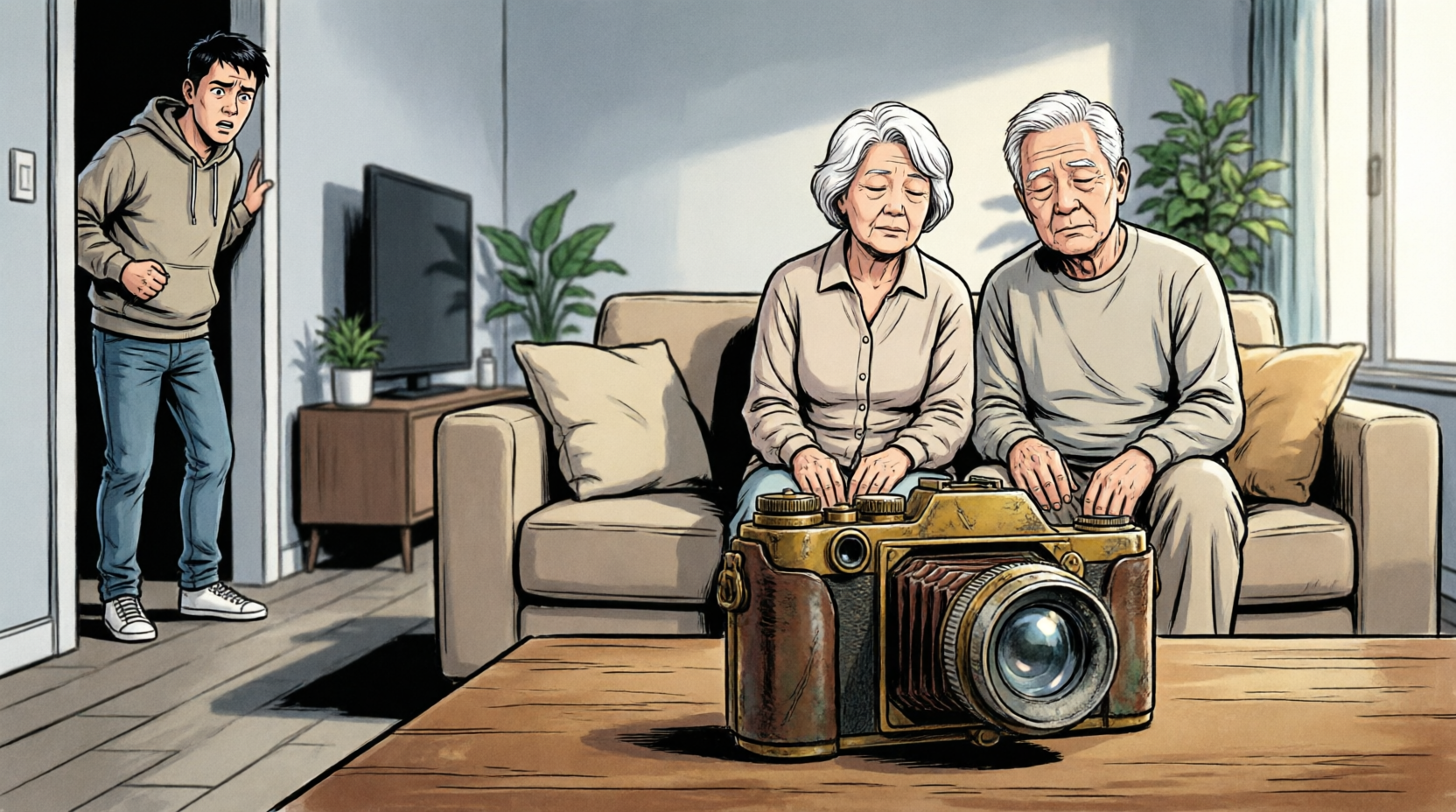 PART 2: The paramedics arrived quickly. Within minutes, both of my parents were loaded into ambulances. At the hospital, doctors worked frantically. Hours later, one finally emerged. “Both are alive,” he said. I nearly collapsed with relief. Then he continued, “We believe they may have consumed a dangerous amount of sleeping medication.” The relief vanished. Someone had given my parents sleeping pills. And enough of them to nearly kill both. The police immediately began asking questions. Who had access to the house? Who had keys? Who had visited recently? At first, none of it made sense. My parents didn’t have enemies. They were the kind of people who lent tools to neighbors and remembered everyone’s birthdays. But the questions kept coming. And soon, so did the answers. A week later, Michael returned to the house to collect some personal items. That night he called me. “Come home,” he said. His voice sounded strange. Controlled. Serious. When I arrived, he was sitting at the kitchen table with Kara beside him. A laptop sat open. “There’s something you need to see,” he said. He explained that while checking the porch, he had found the memory card inside my father’s old doorbell camera. The app had stopped working months ago. But the camera had continued recording locally. Michael inserted the card into the computer. Then he pressed play. The footage showed my parents’ front porch the night before they were found unconscious. A man walked toward the door carrying a white pharmacy bag. He didn’t ring the bell. He unlocked the door himself. Kara’s breathing became uneven. I felt my stomach drop. The man entered the house. Thirty minutes later, he came back out. As he turned toward the porch light, his face became visible. It was Daniel. Kara’s husband. Nobody spoke. Nobody moved. The room seemed to freeze. Then Michael handed me an envelope he had found beneath the seat of my father’s truck. My mother’s handwriting covered the front. Emily — Open only if something happens. Inside was a medical form from several days earlier. At the bottom, my mother had written a single sentence. If anything happens to us, look at Daniel first. The detective received the video immediately. What followed happened quickly. Investigators discovered Daniel had been demanding a large loan from my parents. He was drowning in debt. My father refused to help. My mother supported that decision. Police found the pharmacy bag in Daniel’s garage. They found receipts matching medication purchases. They found internet searches about sleeping pills and detection times. The evidence was overwhelming. Daniel was arrested.
PART 3: A few days later, my mother woke up. She couldn’t speak at first, but when I showed her the envelope, tears rolled down her cheeks. She squeezed my hand. Twice. My father woke shortly afterward. When I told him Daniel had been arrested, he simply closed his eyes. Not because he was surprised. Because he was heartbroken. Being hurt by a stranger is painful. Being betrayed by family changes the way you see the world. Kara never defended Daniel. She never asked us to forgive him. Instead, she blamed herself. “I brought him into this family,” she kept saying. But my mother refused to let her carry that burden. Even while recovering, she wrote a message on a notepad: He fooled you too. Eventually Daniel pleaded guilty. The legal process ended. But the damage remained. My parents survived. Yet things were different. My father walked slower. My mother locked the doors during the day. The spare key hidden outside disappeared forever. Trust did not return as easily as health. Kara divorced Daniel. She moved into a small apartment and slowly rebuilt her relationship with the family. One afternoon, after weeks of distance, my father looked at her and quietly said, “You can come to dinner on Sunday.” Kara cried. Not because everything was fixed. But because a door had finally opened. Even if only a little. Several weeks later, my mother made chicken soup again. Same pot. Same recipe. Same plastic container with the blue lid. When she handed it to me, neither of us laughed. We both remembered the last time. I hugged her tightly. This time I didn’t say I’d visit soon. I looked her directly in the eye. “I’ll be here Sunday.” And I was. Then I came back the next Sunday. And the one after that. Because I learned something that night when grapes rolled across the carpet and my parents lay motionless beneath a lamp. Love is not measured by good intentions. It is measured by showing up. And every time my mother hands me soup now, I take it with both hands.
PART 4: For a long time after that terrible night, our family measured time differently. There was before Daniel. And there was after Daniel. The court proceedings lasted months. Every hearing reopened wounds that had barely begun to heal. Every photograph shown in evidence reminded us how close we had come to losing everything. My parents attended only a few sessions. The doctors advised against unnecessary stress. The emotional strain was slowing their recovery. So most days, Michael and I sat in the courtroom while prosecutors presented evidence piece by piece. The security footage. The pharmacy receipts. The financial records. The internet searches. Each revelation painted a picture that was somehow even worse than we had imagined. Daniel had not acted in a moment of desperation. He had planned everything. Weeks before the poisoning, he had already begun researching medications. He had carefully calculated dosages. He had monitored my parents’ routines. He knew exactly when they would be alone. He knew exactly when Kara would be away. And worst of all, he knew they trusted him. That realization haunted me more than anything else. Trust had opened the door. Trust had invited him inside. Trust had nearly killed them. One evening after a particularly difficult hearing, I found my father sitting alone on his back porch. The sun was setting behind the trees. The same porch where he had waved goodbye to me months earlier. The same porch captured on the camera footage. For several minutes neither of us spoke. Finally he broke the silence. “You know what hurts the most?” I looked at him. He stared into the distance. “I keep trying to remember the good times.” “The birthdays.” “The holidays.” “The fishing trips.” “The backyard barbecues.” His voice cracked. “And now every memory has him standing somewhere in it.” I sat beside him. For a long moment he simply breathed. Then he continued. “I don’t want him to take those memories too.” That sentence stayed with me. Because he was right. Daniel had already taken enough. He had taken our sense of safety. He had taken our trust. He had taken months of our lives. He wasn’t going to take our memories too. That Sunday, our family gathered for dinner. It was the first time everyone had been together since the arrests. The atmosphere felt fragile. Like glass. One wrong word might shatter everything. My mother served chicken soup. Of course she did. Some traditions survive even the worst storms. Kara arrived last. She stood in the doorway holding a pie. Her eyes immediately filled with tears. For a moment nobody moved. Then my mother walked over and hugged her. Neither woman said a word. They simply held each other. The room grew quiet. Michael squeezed my hand beneath the table. And something shifted.
Not healing. Not yet. But perhaps the beginning of healing. There is a difference. Healing is a destination. The beginning is simply choosing to keep walking. Dinner lasted four hours. Stories were shared. Old photographs appeared. My father even laughed once. A real laugh. The kind that filled the room. Everyone stopped talking when they heard it. Not because it was loud. Because we had missed it. After dinner, my mother disappeared into the kitchen. When she returned, she carried a familiar plastic container with a blue lid. The same one. The legendary container that never closed properly. She handed it to Kara. “Take some home.” Kara stared at it. Then at my mother. Then back at the soup. And suddenly she began crying. Not quietly. Not politely. The kind of crying that comes when grief finally runs out of places to hide. My mother hugged her again. “It’s over,” she whispered. “No.” Kara shook her head. “It’s not.” My mother smiled sadly. “No.” “You’re right.” “It isn’t.” “But we’re still here.” Three simple words. We’re still here. Those words became our family’s anchor. Because survival is not a dramatic moment. It’s not a movie ending. It’s not a courtroom verdict. Survival is waking up the next morning. And then the next. And then the next. Choosing life again and again. Months later, Daniel was sentenced. The judge described his actions as a profound betrayal of trust. The sentence was significant. The courtroom remained silent as it was read. Daniel never looked at us. Not once. When everything was over, we walked outside into bright sunlight. The world looked exactly the same. Cars passed. Birds sang. People hurried down sidewalks. Yet everything felt different. A chapter had ended. Not because justice erased the pain. It didn’t. Nothing could. But because the uncertainty was finally over. That evening our family gathered again. No speeches. No celebrations. Just dinner. Just being together. At one point I looked around the table. My father was telling a story. My mother was rolling her eyes at him.
Kara was laughing.
Michael was reaching for another bread roll.
The scene was wonderfully ordinary.
And suddenly I understood something.
For months I had been waiting for life to return to normal.
But normal was gone.
What we had instead was something more valuable.
Perspective.
Every dinner mattered.
Every phone call mattered.
Every visit mattered.
Every hug mattered.
The next Sunday I arrived at my parents’ house before noon.
My mother opened the door.
“You’re early.”
“I know.”
“Everything okay?”
I smiled.
“Yes.”
She studied me for a second.
Then smiled too.
“Good.”
She stepped aside.
“Come in.”
The television was playing in the background.
The kitchen smelled like soup.
My father was arguing with a football commentator.
Everything felt familiar.
Comforting.
Alive.
As I walked inside, I noticed the new doorbell camera mounted beside the front door.
It was larger.
Better.
Impossible to ignore.
My father caught me looking at it.
“Too much?”
I laughed.
“A little.”
He grinned.
“Good.”
For the first time in many months, the laughter came easily.
And as the afternoon sunlight filled the house, I realized something I wish I had understood years earlier.
Love isn’t measured by promises.
It isn’t measured by intentions.
It isn’t measured by how often we say we’ll visit soon.
Love is measured by presence.
By showing up.
By making time before time runs out.
The grapes that scattered across the living-room floor that terrible evening eventually dried and disappeared.
The medical bills were paid.
The court case ended.
The headlines faded.
But the lesson remained.
Every Sunday after that, I showed up.
Sometimes for soup.
Sometimes for coffee.
Sometimes for no reason at all.
Because one ordinary Tuesday taught me something I will carry for the rest of my life.
The people we love most should never have to wait for “soon.”
They deserve today.
And whenever my mother hands me a container of chicken soup now, I take it with both hands.
Then I stay a little longer.
PART 5
For nearly a year, life settled into a rhythm that felt almost peaceful.
Not perfect.
Never perfect.
But peaceful.
The court case was over.
Daniel was gone.
The hospital visits became less frequent.
My parents regained strength one slow day at a time.
The nightmares came less often.
The panic whenever an unknown car stopped in front of the house eventually faded.
Most people would probably call that a happy ending.
I thought so too.
Until the phone call arrived.
It happened on a rainy Thursday evening.
I was cooking dinner when my cellphone rang.
The caller ID showed an unfamiliar number.
Normally I would have ignored it.
Something made me answer.
“Hello?”
For several seconds there was only static.
Then a woman’s voice.
Soft.
Nervous.
“Is this Emily?”
“Yes.”
“My name is Rebecca.”
A pause.
“I think we need to talk about Daniel.”
Every muscle in my body tightened.
The room suddenly felt colder.
“What about him?”
Another pause.
Then she said something that made me nearly drop the phone.
“I was married to him before Kara.”
The knife slipped from my fingers and landed on the counter.
Michael immediately looked up.
I held up a hand.
My heart was racing.
Daniel had never mentioned another marriage.
Not once.
Not to Kara.
Not to my parents.
Not to anyone.
“How did you get my number?”
“I’ve been trying to find your family for months.”
Her voice trembled.
“When I saw the news coverage about the trial, I knew it was him.”
I sat down slowly.
Michael moved closer.
Listening.
Concern filling his face.
“What do you want?”
The answer came immediately.
“To apologize.”
I frowned.
“For what?”
“Because I should have warned someone years ago.”
The silence that followed felt endless.
Rebecca explained everything.
She met Daniel when she was twenty-four.
Charming.
Funny.
Attentive.
The perfect boyfriend.
The perfect husband.
At least in the beginning.
But eventually something changed.
The financial lies started first.
Then manipulation.
Then threats.
Nothing physical.
Nothing obvious.
Just a thousand tiny acts designed to isolate and control.
By the time she finally escaped the marriage, Daniel had accumulated enormous debt in her name.
Destroyed her credit.
Alienated her from friends.
Convinced everyone she was unstable.
“He was good at making people trust him.”
Her voice cracked.
“That’s what made him dangerous.”
I felt sick.
Because every word sounded familiar.
Rebecca told me she had testified during part of Daniel’s divorce proceedings years earlier.
Most of the records were sealed.
Many details never became public.
After the divorce she moved across the country.
She spent years rebuilding her life.
Then one morning she saw Daniel’s face on the news.
The same smile.
The same eyes.
The same calm expression.
Standing beside police officers.
Charged with poisoning his in-laws.
“I knew immediately.”
“Knew what?”
“That he finally went too far.”
After the call ended, I sat quietly for a long time.
Michael wrapped an arm around my shoulders.
Neither of us spoke.
Because there was nothing to say.
Sometimes evil doesn’t arrive wearing a mask.
Sometimes it arrives carrying gifts.
Telling jokes.
Helping with groceries.
Attending family dinners.
That realization hurt more than I wanted to admit.
The following Sunday, I told my parents about Rebecca.
My father listened carefully.
When I finished, he stared into his coffee cup.
Then he sighed.
“I wish we’d known.”
“So do I.”
“But we didn’t.”
My mother reached across the table and squeezed his hand.
For a moment nobody spoke.
Then she surprised all of us.
“You know what?”
We looked at her.
She smiled.
A small smile.
But a genuine one.
“I’m tired of talking about him.”
The room became quiet.
My father raised an eyebrow.
My mother shrugged.
“He took enough already.”
“He doesn’t get Sundays too.”
For a second nobody moved.
Then Kara laughed.
The first real laugh I had heard from her in months.
Soon my father laughed too.
Then Michael.
And finally me.
Because my mother was right.
Daniel had stolen years from all of us.
Fear.
Trust.
Peace.
He didn’t deserve another minute.
That afternoon we pulled old photo albums from the closet.
Thousands of photographs.
Birthdays.
Camping trips.
Christmas mornings.
School concerts.
Family vacations.
My father in ridiculous shorts during the summer of 1998.
My mother refusing to throw away a hairstyle that should never have survived the decade.
Kara and I laughing so hard we could barely breathe.
For hours we sat together remembering.
Not Daniel.
Not courtrooms.
Not hospitals.
Our lives.
The real story.
The one that existed before him.
The one that would continue after him.
As evening approached, my father carried another box from the attic.
Inside were dozens of handwritten letters.
Some from grandparents.
Some from old friends.
Some written by relatives who had long since passed away.
One by one we opened them.
One by one we read them aloud.
The house filled with voices from the past.
People who were gone.
People who had loved us.
People who had helped build the family we sometimes took for granted.
At one point I looked around the room.
The television was off.
The rain tapped softly against the windows.
My mother sat beside Kara.
My father was smiling.
Michael was reading one of the letters aloud.
And suddenly I understood something.
The strongest part of our family wasn’t that we survived tragedy.
It was that we refused to let tragedy become our identity.
We were more than what happened to us.
We were every birthday.
Every holiday.
Every inside joke.
Every bowl of soup.
Every ordinary Sunday.
Long after the dishes were washed and everyone prepared to leave, my mother handed me another container with the familiar blue lid.
I laughed.
“One of these days you’re going to buy a new container.”
She pointed a spoon at me.
“One of these days you’re going to stop criticizing perfection.”
I smiled.
Then hugged her.
A long hug.
The kind that says everything words cannot.
When I finally walked toward the door, she called after me.
“See you next Sunday?”
I looked back.
This time there was no hesitation.
No promise of soon.
No excuse waiting around the corner.
“Absolutely.”
And for the first time since that terrible night, the answer felt less like a promise.
And more like a certainty.
PART 6
The following spring brought something our family had not experienced in a very long time.
Anticipation.
Not anxiety.
Not fear.
Not the dread that had become familiar after the poisoning.
Actual anticipation.
My parents were approaching their forty-fifth wedding anniversary.
Years earlier, they would have celebrated quietly.
A simple dinner.
A homemade cake.
Maybe a photograph in the backyard.
But after everything that had happened, Kara and I wanted to do something special.
Not extravagant.
Not expensive.
Meaningful.
The idea began during one of our Sunday dinners.
My father was telling the same story he had told at least twenty times before.
The story of how he first met my mother.
According to him, she had spilled lemonade on his shoes during a community picnic.
According to my mother, he had been showing off and walked directly into her.
The argument had lasted forty-five years.
Neither had ever surrendered.
“And I still have witnesses,” my father announced dramatically.
“You had witnesses.”
My mother corrected him.
“Most of them are retired in Florida now.”
The table erupted with laughter.
That was when Kara looked at me.
I looked at Kara.
And neither of us needed to say a word.
We had the same idea.
Three days later, planning began.
Secretly.
Carefully.
We contacted relatives.
Old friends.
Former neighbors.
My father’s military buddy from decades ago.
My mother’s college roommate.
People they had not seen in years.
People who had shared pieces of their lives.
The responses started arriving almost immediately.
Many had followed the news about the poisoning.
Many had been afraid to intrude during recovery.
Nearly all of them wanted to come.
One message arrived from a woman named Ruth.
She had lived next door to my parents thirty years earlier.
In her letter she wrote:
“Your parents helped me during the worst year of my life.
They brought groceries when I couldn’t afford food.
They watched my children when I worked double shifts.
They never asked for anything in return.
Please tell them I never forgot.”
My eyes filled with tears as I read it.
Because there were dozens of letters just like that.
Stories I had never heard.
Acts of kindness my parents never mentioned.
Quiet moments that had changed other people’s lives.
As children, Kara and I thought we knew our parents completely.
But the older we became, the more we discovered entire chapters they never talked about.
One afternoon I visited my parents while they were out shopping.
I needed an old photograph for the anniversary slideshow.
While searching through a closet, I found a battered cardboard box.
Inside were hundreds of photographs.
Most were familiar.
Some were not.
Then I found something unexpected.
A journal.
My father’s handwriting covered every page.
At first I intended only to glance through it.
Then I noticed a date.
The week after the poisoning.
My hands froze.
Slowly, I turned the page.
The entry was short.
Very short.
Just a few lines.
But they hit me harder than anything else.
I woke up today.
Still here.
Your mother is still here.
I don’t know why.
I don’t know what happens next.
But I know I am grateful.
I stared at those words for a long time.
The handwriting looked weaker than usual.
Shakier.
As if writing itself had required effort.
There were more entries.
One after another.
Small observations.
Tiny victories.
Today I walked to the mailbox.
Today your mother laughed.
Today Kara smiled again.
Today Emily brought soup even though she hates cooking.
I laughed through my tears.
Then I reached the final entry.
The one written several months later.
It said:
Bad things happened.
They always will.
But good people stayed.
That is what I will remember.
I closed the journal and sat quietly.
Outside, I could hear birds singing.
Traffic in the distance.
An ordinary afternoon.
Yet somehow everything felt different.
Because in that moment I understood something about my father.
He wasn’t strong because he survived.
He was strong because he chose gratitude afterward.
Many people survive.
Not everyone learns how to live again.
The anniversary arrived three weeks later.
We rented a small community hall.
Nothing fancy.
Just a warm room filled with photographs and flowers.
My parents believed they were attending a simple family dinner.
That illusion lasted exactly twelve seconds.
The moment they walked through the doors, dozens of people stood.
Then applauded.
My mother’s hand flew to her mouth.
My father’s jaw literally dropped.
For once in his life, he had no words.
The room exploded with laughter.
One by one, guests approached.
Old friends.
Former coworkers.
Neighbors.
Relatives.
People from different decades of their lives.
Some traveled hundreds of miles.
Some flew across the country.
All because two ordinary people had spent decades quietly helping others.
The evening became something none of us expected.
Not a party.
A celebration of impact.
Story after story filled the room.
A teacher explained how my parents bought winter coats for students without telling anyone.
A neighbor described how my father repaired her roof after a storm.
An elderly man spoke about how my mother visited his wife every week during her battle with illness.
The stories continued for hours.
My parents sat together listening.
Sometimes laughing.
Sometimes crying.
Often both.
Near the end of the evening, Kara stepped onto the small stage.
She looked nervous.
Her voice trembled.
“I spent a long time feeling guilty.”
The room grew quiet.
She looked toward our parents.
“I blamed myself for bringing someone dangerous into our lives.”
My mother immediately shook her head.
But Kara continued.
“Then I realized something.”
She paused.
“The story of our family isn’t about one bad person.”
Tears filled her eyes.
“It’s about everyone who stayed.”
The silence that followed was profound.
Many guests were crying openly.
Including me.
Including Michael.
Even my father was suspiciously busy rubbing his eyes.
Then Kara pointed toward the audience.
“Look around.”
“These people are here because of who Mom and Dad chose to be.”
“Not because of what happened to them.”
“But because of how they treated others.”
My mother began crying.
The unstoppable kind.
The kind that arrives from somewhere deep inside.
My father wrapped an arm around her shoulders.
For a moment neither of them spoke.
Then he finally stood.
The room quieted.
Everyone waited.
He looked around the hall.
At old friends.
At family.
At decades of memories gathered in one place.
Then he smiled.
A genuine smile.
The kind I feared I might never see again after the hospital.
“You know,” he said softly.
“After everything that happened…”
He stopped.
Collected himself.
Then continued.
“I thought our story was ending.”
The room remained silent.
“But tonight…”
His voice cracked.
“Tonight reminds me it was never ending.”
He looked toward my mother.
“It’s still being written.”
There wasn’t a dry eye in the building.
Not one.
Later that night, after everyone had gone home, our family remained behind helping clean up.
The hall was nearly empty.
The flowers were beginning to wilt.
The music had stopped.
Yet none of us seemed eager to leave.
Eventually my mother handed me a familiar plastic container.
The blue lid was still crooked.
Still impossible.
Still somehow surviving.
I laughed.
“So this thing is immortal now?”
My father grinned.
“Just like your mother.”
She swatted his arm.
He laughed.
And for a brief moment, standing there among folding chairs and fading decorations, I realized something.
The greatest miracle wasn’t that my parents survived.
The greatest miracle was that love survived too.
The fear didn’t win.
The betrayal didn’t win.
The pain didn’t win.
Love stayed.
Love endured.
Love sat around Sunday dinner tables.
Love arrived carrying soup.
Love showed up again and again and again.
And as we walked out into the cool night air together, I knew that years from now, when people asked about our family, the poisoning would not be the first thing I remembered.
I would remember the anniversary.
The laughter.
The stories.
The people who stayed.
And two stubborn parents who taught all of us that even after the darkest chapter, life can still write something beautiful…………..👇