My stepbrother screamed, “Choose how you pay or get out!” while I was sitting in the gynecologist’s office with stitches still fresh. When I refused, he struck me so hard I crashed to the floor, pain flaring through my ribs. Then he curled his lip and said, “You think you’re too good for it?” just as the police arrived, horrified.
“Choose how you pay or get out!” my stepbrother yelled as I sat in the gynecologist’s office, stitches still fresh. Silence dropped over the room so suddenly that I could hear the paper sheet beneath my hands wrinkle. I sat on the edge of the examination table, one hand pressed to my lower stomach, the other clutching the paper gown shut over my knees. The fluorescent lights made the room feel painfully clean, painfully white, and far too public for what had just happened. “No,” I said. The word sounded small, but it was the first complete word I had ever said to him without attaching an apology to it. Derek Vance’s expression shifted. His smug smile disappeared. He glanced toward the door, then back to me, his jaw moving as if he were grinding broken glass between his teeth. “You think you’re too good for it?” he sneered. Dr. Amelia Rhodes moved between us. She was in her forties, with a composed face, gray-blond hair twisted into a tight bun, and an ID badge clipped to her white coat. “Sir, you need to leave this room now.” Derek gave a single laugh. “This is family business.” “I said leave.” He moved before I could even brace myself. His hand struck my face so hard that the room tilted sideways. My shoulder slammed into the metal step beneath the exam table. Then my ribs hit the floor, and a sharp burst of pain ripped through me. I tasted blood. Somewhere over me, a nurse screamed. Derek loomed above me, breathing heavily. “She lies. She always lies.” I folded around my ribs, trying not to sob, because crying had always made him angrier at home. But this was not home. This was a clinic in Columbus, Ohio, with hallway cameras, nurses at the front desk, and a doctor who had already examined the bruises I had tried to dismiss. Dr. Rhodes seized the wall phone. “Security. Now. And call 911.” Derek turned toward her. “You don’t know what she did.” “I know what I saw,” Dr. Rhodes said, her voice trembling but controlled. The door flew open. Two security guards rushed inside, with Nurse Callie Freeman right behind them. She knelt beside me and placed a cautious hand near my shoulder. “Madison, stay with me. Don’t move.” Derek stepped backward toward the corner, still yelling. “She owes me! She’s been living under my mother’s roof for free!” A few minutes later, red and blue lights flashed through the narrow window. When the officers entered, their faces hardened as they saw me on the floor, blood on my lip, one side of my face already swelling. Officer Grant Miller pointed at Derek. “Hands where I can see them.” For the first time in years, Derek looked uncertain. And for the first time in years, I understood that someone else had heard him.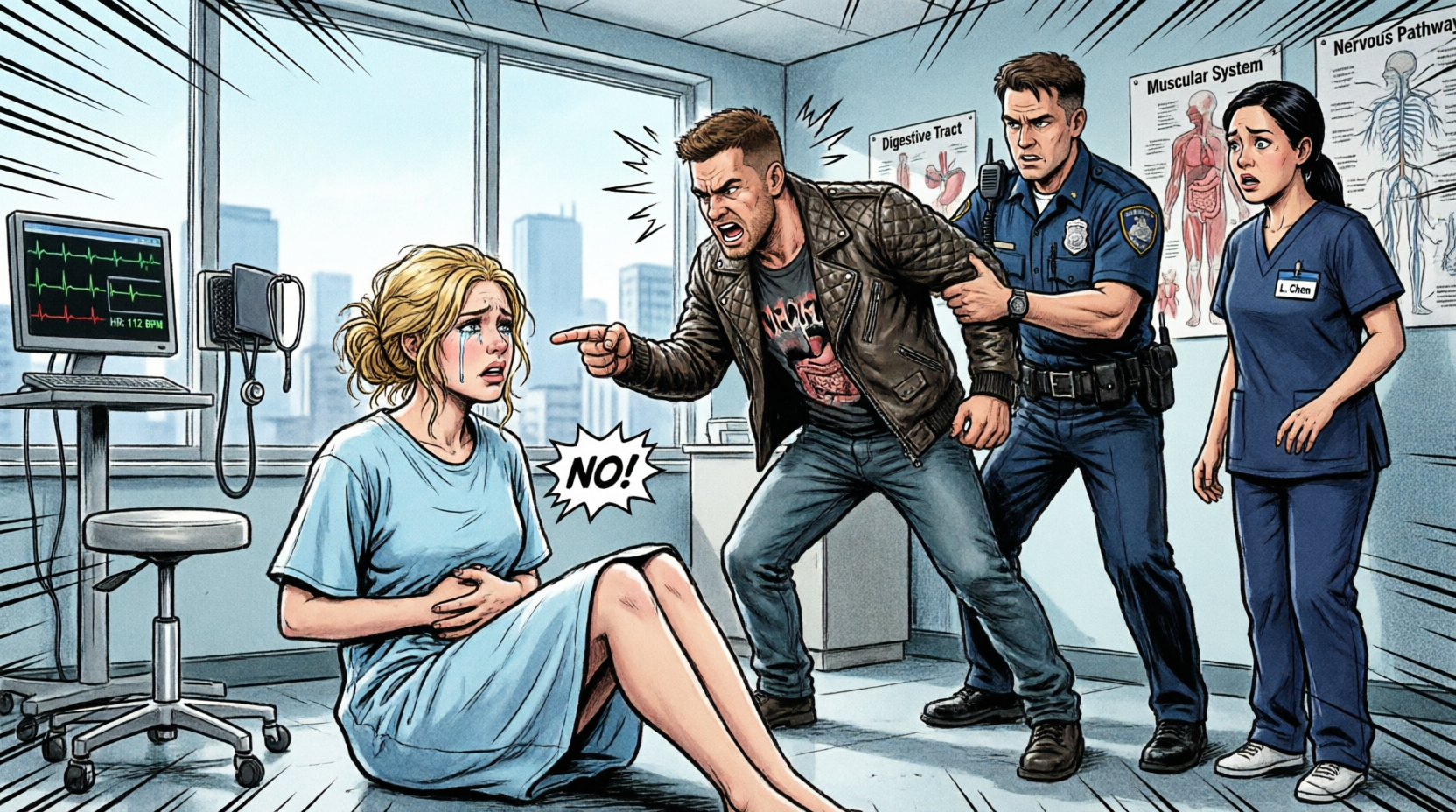
Part 2
Officer Grant Miller did not shout. He had no reason to.
“Hands where I can see them,” he repeated.
Derek raised his hands halfway, palms exposed, but he kept talking. “This is ridiculous. She’s dramatic. Ask anyone. She makes things up.”
Officer Miller moved closer while his partner, Officer Elena Ruiz, stepped toward Dr. Rhodes and me. The room felt crowded now, filled with uniforms, medical workers, and the harsh scent of antiseptic. I wanted to crawl beneath the exam table and vanish, but Nurse Callie kept her hand steady near my shoulder.
“Madison,” Officer Ruiz said softly, crouching until her eyes were level with mine. “Can you tell me if you feel safe with him in the room?”
My throat locked.
Derek laughed. “She can’t even answer because she knows—”
“Sir,” Officer Miller cut in, “do not speak to her.”
Derek’s mouth closed at once, but his eyes stayed fixed on me. They were cold, threatening eyes. The kind that had trained me to say the correct thing before help could reach me.
Dr. Rhodes answered first. “She does not feel safe. I documented injuries today. I also heard him threaten her. Several staff members did.”
Derek’s face flushed red. “You’re violating privacy laws.”
“No,” Dr. Rhodes said. “I’m reporting violence.”
Officer Miller turned Derek around and locked handcuffs around his wrists. The click of the metal was quiet, but it split my life in two: before and after.
Derek twisted his head toward me. “You’re dead to Mom after this.”
I flinched.
Officer Ruiz saw it. Her expression tightened. “Get him out.”
As they escorted him past the doorway, patients and staff watched from the hall. Derek tried to keep his posture proud, but his wrists were trapped behind his back, and for once, he had to move where someone else ordered him to go.
The second he was gone, I began shaking.
Not crying. Not screaming. Just shaking so violently that my teeth clicked together.
Dr. Rhodes sent me for X-rays to check my ribs. Nurse Callie helped me into a wheelchair because standing made white sparks flash behind my eyes. Every motion tugged at the fresh stitches, and shame burned even hotter than pain. I kept murmuring, “I’m sorry,” even though no one had blamed me for anything.
“You don’t need to apologize,” Callie said.
But apologies were the way I had survived Derek Vance for four years.
He was thirty-one, eight years older than I was, and my mother’s stepson from her second marriage. After his father died, Derek remained in the house “temporarily.” Temporary became forever. My mother, Linda, worked night shifts as a dispatcher and acted as if she did not see the way Derek controlled the grocery money, my car keys, my phone, my clothes, and even the people I was allowed to talk to.
He called it discipline.
I called it trying to breathe through a locked door.
When Officer Ruiz returned, she carried a small notebook. “Madison, we can take your statement here or at the hospital. Dr. Rhodes recommends further evaluation.”
“Hospital,” Dr. Rhodes said firmly.
I nodded.
Officer Ruiz lowered her voice. “There may be an emergency protection order available. We can explain it when you’re ready.”
I looked toward the hallway where Derek had disappeared.
For once, being ready did not matter.
He was gone.
And I was still alive.
PART 3
At Riverside Methodist Hospital, they placed me in a room where the curtain did not close all the way.
At first, that unsettled me. I wanted solid walls. Locks. A ceiling that did not buzz. I wanted a place Derek could not storm into with his heavy footsteps and familiar fury. But every few minutes, a nurse walked by. A doctor checked the computer outside the room. Officer Elena Ruiz remained near the entrance with her arms crossed, not hovering, not looking at me like I was guilty, just there.
Presence felt different when it was not dangerous.
The X-rays showed two bruised ribs, but nothing was broken. The doctor, Dr. Marcus Bell, explained everything carefully, as though I were a person allowed to make choices about my own body. He examined the swelling on my cheek, the cut inside my lip, and the stitches from the procedure I had gone to the clinic for that morning. He did not ask questions that hid judgment underneath them. He asked what had happened, when it had happened, and whether I wanted to speak with someone from the hospital’s victim assistance program.
I said yes before fear could answer instead.
The advocate arrived forty minutes later. Her name was Hannah Brooks. She was fifty, Black, soft-voiced, wearing silver hoop earrings and carrying a canvas bag stuffed with folders. She pulled a chair near my bed and asked for permission before sitting.
That one question nearly made me fall apart.
“Madison, you are twenty-three, correct?”
“Yes.”
“And Derek Vance is your stepbrother?”
“My stepfather’s son,” I said. “My stepfather died three years ago.”
“Does Derek live with you?”
“Yes. With me and my mother.”
Hannah wrote it down. “Has he threatened you before today?”
My eyes shifted to Officer Ruiz, then back to the blanket covering my knees.
Hannah noticed. “You can speak freely. Officer Ruiz is here because Derek was arrested for what happened at the clinic. You are not in trouble.”
Those words felt impossible to believe.
I stared down at my hands. Dried blood was trapped beneath one fingernail. “He controls things. Money. The car. My phone sometimes. He tells my mom I’m unstable. Lazy. Ungrateful. He says because I live there, I owe the house.”
“What does he mean by owe?”
My stomach twisted painfully.
“He makes me pay for everything in ways he chooses,” I said quietly. “Cleaning. Errands. Giving him my paycheck. Letting him decide where I go. If I refuse, he locks me out or tells my mother I stole from him. He breaks my things. He scares me until I agree.”
Hannah’s pen paused for half a second before moving again. “Did your mother know?”
I wanted to say she had not.
The truth hurt more.
“She knew enough,” I whispered.
Officer Ruiz looked down at her notebook, but I saw her jaw tighten.
I told them about the hallway cameras Derek had put up “for security,” except one faced my bedroom door. I told them about the day he took my debit card and claimed he was teaching me responsibility. I told them about sleeping inside my friend Sophie’s car for two nights after he locked me out in February, then returning because my mother called crying and begged me not to humiliate the family.
I did not tell them everything. Some things stayed wedged behind my ribs, heavier than the bruises. But I said enough.
Hannah helped me request an emergency protection order from the hospital. Officer Ruiz photographed my visible injuries with my permission. Dr. Bell added medical notes. Dr. Rhodes from the clinic had already forwarded her incident report, including the exact words Derek had shouted before hitting me.
Choose how you pay or get out.
On paper, the words looked less like a private threat and more like evidence.
At 6:17 p.m., my mother called.
Her name lit up my phone screen: Mom.
I watched it ring until it stopped.
Then she called again.
Hannah said, “You don’t have to answer.”
That sentence felt strange too. Most of my life had been shaped by things I had to do.
On the third call, I answered and turned on speaker because Officer Ruiz gave a small nod that it was smart.
“Madison?” My mother sounded breathless. “What did you do?”
Not Are you okay?
Not Where are you?
What did you do?
I shut my eyes. “Derek hit me in a doctor’s office.”
“He said you provoked him.”
My chest pulled tight. “There were witnesses.”
“He’s in jail, Madison. Jail. Do you understand what this could do to him?”
Officer Ruiz’s face became still.
I looked at Hannah. She gave the smallest nod, not telling me what words to use, just reminding me that I had the right to use them.
“He did it to himself,” I said.
Silence followed.
Then my mother lowered her voice. “You need to come home and fix this before it gets worse.”
I almost laughed, but all that came out was a broken breath. “I’m not coming home.”
“Don’t be ridiculous. Where will you go?”
I had no answer.
For a moment, the old fear surged through me. I pictured the house on Marlowe Avenue: beige siding, the cracked porch step, Derek’s truck in the driveway like a guard dog. My bedroom with a hollow-core door that would not lock. My mother’s exhausted face turning away from everything she refused to see.
Then Hannah placed a pamphlet on the blanket. Emergency shelter. Legal aid. Counseling. Transportation assistance.
Not a perfect solution.
But a solution.
“I’ll figure it out,” I said.
My mother’s voice sharpened. “You are making a mistake.”
“No,” I said, and this time the word came more easily. “I made a mistake staying quiet.”
I ended the call before she could respond.
That night, I did not return home. Hannah found me a place at a confidential shelter outside the city. Officer Ruiz followed the shelter van for the first few miles, then exited with a quick flash of her lights. I watched the patrol car disappear through the back window and cried silently.
The shelter was not dramatic. It was a converted two-story house with soft lamps, donated furniture, and laminated rules posted clearly. No visitors. No sharing the address. Quiet hours after ten. Label your food.
A woman named Tessa gave me sweatpants, a toothbrush, and a room with a real lock.
When the door clicked shut behind me, I sat on the bed and listened.
No footsteps outside.
No yelling.
No doorknob turning.
Only the low sound of women talking in the kitchen and rain tapping against the window.
The next morning, the court approved a temporary protection order. Derek was not allowed to contact me or come near my workplace, the clinic, the shelter, or my mother’s house if I was there. Hannah warned me that the order did not magically make me safe. Paper could not block fists. But it gave police a reason to move faster if he tried.
Derek’s first hearing took place two days later.
I appeared by video from a room at the shelter. My cheek was still swollen in yellow and purple shades, and every breath reminded me of the floor. On the screen, Derek wore an orange jail uniform and the same expression he used whenever a cashier made him wait too long.
His public defender asked the court for low bail.
The prosecutor brought up the clinic witnesses, the medical evidence, the recorded 911 call, and Derek’s statement inside the room. She also mentioned prior calls to my mother’s address, including two incidents where neighbors had reported shouting.
The judge set conditions Derek hated.
No contact.
No weapons.
No returning to the home while I collected my belongings with a police escort.
Derek stared into the courtroom camera like he wanted to reach through the screen.
I did not look away.
Three weeks later, I returned to the house with Officer Ruiz and another officer. My mother stood on the porch in a cardigan, arms folded tightly over her chest.
“You brought police to my home,” she said.
“I brought police to protect me,” I replied.
She looked older than I remembered, but not gentler. “Derek’s lawyer says you exaggerated.”
“Derek’s lawyer wasn’t there.”
Her lips trembled. For one irrational second, I thought she might apologize.
Instead, she said, “I don’t know who you are anymore.”
I stepped past her into the house. “Neither did I.”
My room seemed smaller. Derek had searched through it after the arrest; drawers were hanging open, and a framed photo of me from high school graduation lay cracked on the carpet. I packed clothing, documents, my birth certificate, my Social Security card, two pairs of shoes, and a shoebox filled with letters from my grandmother.
From the hallway, my mother said, “He’s family.”
I folded a sweater with slow hands. “So was I.”
She had nothing to say.
The case did not end quickly. Real life almost never offers clean endings by Friday. Derek’s attorney tried to turn it into a family disagreement. He argued stress, grief, misunderstanding, provocation. But Dr. Rhodes testified plainly. Nurse Callie testified. Security footage from the clinic hallway showed Derek forcing himself into the exam room after he had been told to wait outside. Audio from the front desk phone caught enough of his shouting to make the courtroom fall silent.
I gave my statement in person.
My hands shook so much that the paper rattled. The prosecutor offered to read it for me, but I refused.
I had spent years letting other people speak over me.
Not that day.
I told the judge about control that did not always leave marks on skin. I told her about fear becoming normal. I told her about the clinic floor, the slap, the pain burning through my ribs, and the strange relief of watching police officers look horrified instead of doubtful.
Derek did not say he was sorry. He stared down at the table.
Maybe he believed silence looked dignified.
To me, it looked like planning.
Months later, he pleaded guilty to reduced charges: assault, menacing, and violation-related conduct connected to coercive threats. His sentence included jail time already served, probation, required counseling, fines, and a longer protection order. It was not the dramatic ending people imagine. The earth did not swallow him. He did not admit every act of cruelty. He did not break down crying.
But the court record carried his name.
And mine was no longer buried inside the version of events he had created.
I moved into a small studio apartment over a bakery in Westerville. The walls were thin, the radiator hissed, and the kitchen had only two drawers, one of which jammed unless I pulled it from the right angle. I loved it so fiercely that it embarrassed me. Every bill belonged to me. Every key belonged to me. Every silence was mine.
Sophie helped me move in a secondhand couch. Hannah connected me with counseling. Dr. Rhodes sent a card through the advocate’s office that simply said, You were very brave. Nurse Callie added a smiley face and three exclamation points.
I kept that card on my refrigerator.
My mother sent messages for months.
Some were furious.
Some were tearful.
Some accused me of destroying the family.
One message, sent at 2:03 a.m. in November, said: I should have protected you.
I read it twelve times.
Then I turned the phone face down and waited until morning to answer.
When I finally replied, I wrote: Yes, you should have.
Nothing else.
One year after the clinic, I went back to Dr. Rhodes for a routine appointment. The same building. The same parking lot. The same sliding glass doors.
My hands turned cold before I even reached the reception desk.
Nurse Callie noticed me first. Her eyes widened, then softened. “Madison Harper?”
I smiled faintly. “Hi.”
She came around the desk and hugged me only after I nodded yes.
The exam room was not the same one. Even so, I looked at the floor. I remembered the slap, the fall, the sharp white burst of pain, and Derek’s voice soaked in contempt.
You think you’re too good for it?
Back then, I had not believed I was too good for anything. I had only known I was exhausted.
Dr. Rhodes came in with my chart and paused when she saw me standing beside the window instead of sitting on the table.
“No rush,” she said.
I laughed quietly. “You always say exactly the right thing.”
“No,” she replied. “I just try not to say the wrong one.”
The appointment was ordinary. That was its own victory. Blood pressure. Questions. Follow-up. No emergency. No police. No one screaming outside the door.
When I left, I paused in the lobby.
A young woman sat near the entrance wearing sunglasses indoors, her foot tapping too quickly. A man beside her scrolled on his phone, his knee angled toward her like a barrier. I did not know her story. I did not create one in my head. But when her eyes flicked toward mine, I held her gaze for one second longer than strangers usually do.
Not pity.
Recognition.
Outside, the air was cold and bright. I walked to my car, unlocked it, and sat behind the wheel with both hands resting on nothing.
For a moment, I allowed myself to remember the sound of handcuffs locking around Derek’s wrists.
Then I started the engine and drove away.
Not because the past was gone.
Because I could.
PART 4
The first time Madison Harper slept through an entire night without waking up to listen for footsteps, she cried when she opened her eyes.
Not because she was sad.
Because the room was still quiet.
Because sunlight was touching the cheap curtains of her studio apartment.
Because no one had pounded on her door.
Because no one had called her name like an accusation.
Because no one had demanded payment for the crime of existing.
For several minutes, she lay perfectly still beneath the thrift-store comforter and stared at the ceiling.
The radiator hissed beside the window.
Somewhere below her, the bakery ovens had already started.
Warm air carried the faint smell of cinnamon, sugar, and bread through the old floorboards.
Madison pressed one hand against her ribs.
They no longer hurt.
Not the way they had after the clinic.
Not the way they had when every breath felt like punishment.
But sometimes her body remembered before her mind did.
Sometimes her ribs tightened when a man raised his voice on the street.
Sometimes her stomach cramped when someone knocked too hard.
Sometimes she caught herself apologizing to furniture after bumping into it.
Healing, Hannah had told her, was not a straight road.
It was a staircase in the dark.
Some days you climbed.
Some days you sat on the step and breathed.
Madison had hated that answer at first.
She wanted healing to be a door she could walk through once.
She wanted freedom to erase everything behind her.
But freedom did not erase memory.
It gave her space to survive it.
That morning, one year and three months after Derek Vance hit her in Dr. Rhodes’s exam room, Madison stood in her tiny kitchen and made coffee.
She owned only one mug she truly liked.
It was yellow, chipped near the handle, with faded blue letters that said, Small Steps Still Count.
Sophie had bought it for her at a flea market.
Madison had laughed when she saw it.
Then she had cried into Sophie’s shoulder in the parking lot.
Now she held that mug with both hands and looked at the calendar on the fridge.
A red circle surrounded the date.
March 18.
Final protection order review hearing.
The words made her coffee taste bitter.
The original protection order had been extended after Derek’s guilty plea.
But his probation officer had filed a violation report two months earlier.
Derek had not contacted Madison directly.
He was too careful for that.
Instead, he had used other people.
An old neighbor.
A cousin from his father’s side.
A fake social media account with no photo.
A message left through Madison’s mother that sounded almost innocent unless someone knew Derek.
Tell Madison she can stop pretending forever.
That was all.
No threat.
No profanity.
No direct violence.
Just Derek’s shadow passing over the wall.
Hannah had told her to report it anyway.
Officer Ruiz had agreed.
The prosecutor had agreed.
Derek’s lawyer had argued that Madison was “overinterpreting ordinary family communication.”
Madison had sat in the courtroom with her hands locked around the yellow mug she had brought from home.
She had wanted to stand and scream.
There was nothing ordinary about a man who knew exactly how to make fear sound polite.
Today, the judge would decide whether to keep the order in place for five more years.
Five years.
Madison had repeated the number to herself so often it had lost shape.
Five years of legal distance.
Five years of police having a clear reason to intervene.
Five years of not having to explain from the beginning every time Derek tried to bend the world around his anger.
Her phone buzzed on the counter.
She flinched.
Then she hated herself for flinching.
The screen showed Sophie’s name.
You awake?
Madison typed back.
Unfortunately.
Sophie replied immediately.
I’m downstairs.
Madison blinked.
Then another message appeared.
With muffins.
Madison looked toward the floor like she could see through it.
The bakery downstairs opened at six.
Sophie lived twenty minutes away.
Which meant Sophie had gotten up before dawn just to make sure Madison did not go to court alone.
Madison opened the door three minutes later wearing black pants, a gray sweater, and the anxious expression she had tried to hide with mascara.
Sophie stood in the hallway with a paper bag in one hand and two coffees in a cardboard tray.
Her red curls were piled on top of her head.
Her coat was buttoned wrong.
She looked furious at the world and soft only for Madison.
“Breakfast,” Sophie announced.
“I made coffee.”
“Yours tastes like emotional damage.”
Madison gave a weak laugh.
Sophie stepped inside and looked her over carefully.
Not pity.
Inventory.
The kind of look best friends gave when they were checking whether someone was about to fall apart.
“You slept?” Sophie asked.
“A little.”
“Nightmares?”
“Only one.”
“That’s fewer than last time.”
“Small steps still count.”
Sophie pointed at the mug. “Exactly.”
They ate muffins standing in the kitchen because Madison only had one chair that did not wobble.
Sophie talked about ordinary things.
A rude customer at the bookstore where she worked.
Her cat knocking a plant into the sink.
A new true crime podcast she had abandoned because the host mispronounced Ohio three different ways.
Madison listened and let the normalness wrap around her.
Normal had become medicine.
At 8:15, Hannah arrived.
She wore a navy coat and carried her canvas bag.
She greeted Madison with a hug after asking permission.
Then she placed a folder on the counter.
“I printed the timeline again,” Hannah said.
Madison looked at the folder.
Her stomach folded inward.
“I know what happened.”
“I know you do.”
“I hate reading it.”
“I know that too.”
Sophie leaned against the counter. “Do we need to read it?”
Hannah’s face was kind but firm. “Not all of it. Just enough so Madison remembers that this is not one incident. It is a pattern.”
A pattern.
That word had saved Madison in ways she still did not fully understand.
For years, Derek had convinced her every cruelty was separate.
One locked door.
One taken card.
One insult.
One shove.
One threat.
One slap.
One demand.
One apology he forced from her afterward.
One more day.
One more reason not to tell.
But Hannah had taken all those scattered pieces and arranged them into a shape.
Control.
Coercion.
Isolation.
Financial abuse.
Physical violence.
Witnessed assault.
Retaliation.
Violation by proxy.
A pattern did not ask Madison whether she had been perfect.
A pattern asked who had power and how they used it.
Madison opened the folder.
The first page began with the clinic.
She read the first line.
March 3, 2025.
Derek Vance entered the examination room without patient consent.
Her vision blurred.
She closed the folder.
“I can’t.”
Hannah nodded. “Then don’t. I’ll carry the facts today.”
Madison swallowed hard. “What if the judge thinks I’m dragging this out?”
Sophie’s face sharpened. “Then the judge can come talk to me.”
Hannah almost smiled. “The judge has the record. The clinic witnesses. The conviction. The violation report. Your mother’s message. Officer Ruiz’s statement. The shelter advocate’s notes.”
Madison looked down. “My mother’s message.”
The apartment went quiet.
Linda Harper had become the wound Madison did not know how to treat.
Derek had been the obvious danger.
Linda was more complicated.
Linda sent apologies that sounded real until they became requests.
I should have protected you.
Then:
Please don’t make things worse for Derek.
Then:
I’m alone in this house now.
Then:
He lost his father too.
Then:
Can’t you forgive enough to move forward?
Madison had stopped answering most of them.
But two months earlier, Linda had sent the message Hannah had printed for court.
Derek says you can stop pretending forever.
Madison had stared at those words until they blurred.
Then she had sent one reply.
Do not pass messages from him to me again.
Linda had responded:
I was only trying to help.
That was the sentence that broke something final in Madison.
Trying to help whom?
She had typed it, but never sent it.
At 9:02, they left for court.
Sophie drove.
Hannah sat in the back seat, reviewing papers quietly.
Madison sat in the passenger seat and watched Columbus move past the windows.
Gas stations.
Bare trees.
A school bus.
A woman walking a golden retriever.
A man laughing into his phone outside a coffee shop.
Life continued so shamelessly around pain.
Madison used to resent that.
Now she found comfort in it.
The world had not ended when hers did.
That meant there was still somewhere to go.
The courthouse steps were gray and wet from morning rain.
Madison paused at the bottom.
Her lungs tightened.
Sophie touched her sleeve.
“Remember what we practiced.”
Madison inhaled for four counts.
Held it.
Exhaled for six.
Again.
Again.
Then she climbed.
Inside, the hallway smelled like floor polish and old paper.
People sat on benches with folders clutched in their hands.
Some looked angry.
Some looked bored.
Some looked terrified.
Madison wondered how many invisible stories were sitting in that hall.
Officer Elena Ruiz was waiting near courtroom 4B.
She wore plain clothes today, a dark blazer over a white shirt, but Madison recognized her immediately.
Officer Ruiz smiled gently.
“Good morning, Madison.”
“Hi.”
“How are you holding up?”
Madison almost lied.
Then she remembered she did not have to.
“Badly.”
Officer Ruiz nodded. “That’s honest.”
“Is he here?”
“Yes.”
The hallway seemed to tilt.
Sophie moved closer.
Hannah said quietly, “He cannot approach you.”
Madison nodded.
But her body had never cared much about court rules.
They entered the courtroom together.
Derek sat at the defense table in a charcoal suit.
His hair was cut shorter than before.
His beard was trimmed.
He looked cleaner than Madison remembered.
Respectable.
That was the word that made her stomach twist.
Derek had always been good at looking respectable when someone important was watching.
His mother had once called him “a little rough around the edges.”
Neighbors called him helpful because he shoveled snow from the sidewalk after storms.
At church, before her stepfather died, people said Derek had a strong presence.
Madison had learned that strong presence could mean different things depending on whether doors were open or closed.
Derek did not turn around when she entered.
But his shoulders changed.
He knew she was there.
Madison sat behind the prosecutor.
Sophie sat on one side of her.
Hannah sat on the other.
Officer Ruiz took a seat nearby.
For the first time in her life, Madison entered a room Derek occupied and did not sit alone.
The judge entered at 9:41.
Everyone stood.
The hearing began with language Madison had heard before but still struggled to understand fully.
Motions.
Probation compliance.
Protective order extension.
Contact by third party.
Credible threat.
Pattern of coercive conduct.
Derek’s attorney stood first.
He was polished and silver-haired, with a voice like expensive furniture.
“Your Honor,” he said, “Mr. Vance has complied with the central terms of the order. He has not contacted Ms. Harper directly. He has maintained employment. He has attended mandated counseling. He has paid fines. The defense believes an extension of this length is punitive rather than protective.”
Punitive.
Madison felt Sophie stiffen beside her.
Derek looked down at the table, almost humble.
The attorney continued.
“This family has already been fractured. My client made a mistake, accepted responsibility, and is attempting to rebuild his life.”
Madison stared at the back of Derek’s head.
A mistake.
As if his hand had slipped.
As if his cruelty had been an accident that lasted four years.
As if rebuilding his life required access to hers.
The prosecutor rose.
Her name was Carla Nguyen.
She was small, precise, and terrifying in the quietest way.
“Your Honor, this case has never been about one isolated outburst,” she said.
Madison breathed in.
Carla lifted a folder.
“It began with a witnessed assault in a medical setting, immediately after the defendant issued a coercive demand. That assault occurred while Ms. Harper was physically vulnerable, recovering from a procedure, and under medical care. Since then, the defendant has used indirect communication to frighten her while preserving plausible deniability.”
Derek’s lawyer objected.
The judge allowed Carla to continue.
Carla read Linda’s message aloud.
Derek says you can stop pretending forever.
The words landed hard in the courtroom.
Derek finally moved.
Only slightly.
His hand tightened around a pen.
Carla looked toward the judge.
“That message was not random. It was delivered through the petitioner’s mother. It followed months of pressure from family members. It mirrors the defendant’s established pattern of minimizing, controlling, and threatening the petitioner while making her appear unreasonable if she reacts.”
Madison’s eyes burned.
For so long, people had asked why she was afraid.
Carla explained it without asking Madison to bleed again.
Then the judge asked whether Madison wished to speak.
The room narrowed.
Sophie whispered, “You don’t have to.”
Hannah whispered, “You can.”
Madison stood.
Her knees trembled.
The prosecutor stepped aside.
Madison walked to the podium.
The wood was scratched at the edges.
A microphone waited in front of her.
She looked at the judge first.
Not Derek.
Not his lawyer.
The judge.
“My name is Madison Harper,” she began.
Her voice shook.
She continued anyway.
“I used to think safety meant not making Derek angry.”
The courtroom went very still.
“I measured my days by his mood. I changed how I walked through my own house. I hid money in coat pockets. I slept with my phone under my pillow when he let me keep it. I learned which floorboards creaked. I learned how to apologize before I knew what I had supposedly done.”
Derek’s attorney shifted.
Madison kept going.
“When he hit me in the clinic, it was the first time other people saw what I had been living with. I know he wants this court to believe that because he has not walked up to me directly, I am safe now. But Derek has always known how to make other people carry his threats.”
She swallowed.
“My mother sent me his words. Maybe she did not understand what she was doing. Maybe she did. But I understood. He wanted me to know he was still watching. Still waiting. Still deciding that my freedom was an insult to him.”
Derek looked up then.
Their eyes met.
For one second, Madison saw the old warning.
Then she saw something else.
Frustration.
Because she was still speaking.
She turned back to the judge.
“I am not asking for revenge. I am asking for distance. I am asking for time to become someone who does not flinch when her phone rings. I am asking this court to understand that peace is not punishment. Peace is the first thing I have ever owned.”
Her voice broke on the last word.
But she did not apologize.
She stepped back.
Sophie was crying silently.
Hannah’s eyes shone.
Officer Ruiz looked down, blinking hard.
Derek’s lawyer began to speak again, but the judge lifted one hand.
“I have heard enough.”
Madison sat.
The judge reviewed the file for several long seconds.
Then she looked at Derek.
“Mr. Vance, compliance is not merely the absence of direct contact. Protective orders exist because some people use indirect pressure as a weapon. Based on the underlying offense, the documented history, the petitioner’s statement, and the recent communication passed through a third party, I find continued protection necessary.”
Madison stopped breathing.
The judge continued.
“The order will be extended for five years.”
Sophie grabbed Madison’s hand.
Madison’s eyes flooded.
The judge’s voice remained firm.
“Mr. Vance, you are prohibited from contacting Ms. Harper directly or indirectly. That includes messages through relatives, friends, neighbors, online accounts, or any other person. Any violation may result in further criminal consequences.”
Derek’s jaw clenched.
The judge leaned forward.
“Do you understand?”
Derek’s voice was low.
“Yes, Your Honor.”
Madison exhaled.
Five years.
Not forever.
But enough to build something.
Outside the courtroom, Madison made it halfway down the hall before her legs gave out.
Sophie and Hannah caught her on either side.
She did not fall.
That mattered too.
PART 5
Linda Harper was waiting outside the courthouse.
Madison saw her before Linda saw Madison.
Her mother stood near the steps in a beige coat, holding her purse with both hands.
Her hair was pulled back.
Her face looked pale in the March light.
For a moment, Madison was nine years old again, waiting for her mother to pick her up after school.
For a moment, she wanted to run into those arms and be someone else.
Then Linda turned.
Their eyes met.
Sophie muttered, “Absolutely not.”
Hannah stepped slightly in front of Madison.
But Madison raised one hand.
“It’s okay.”
It was not okay.
But it was hers to decide.
Linda approached slowly.
Officer Ruiz remained near the courthouse doors, watching.
Linda noticed and looked embarrassed.
That embarrassment hurt Madison more than anger would have.
Even now, Linda was worried about being seen.
“Madison,” Linda said.
“Mom.”
Linda’s mouth trembled.
“I didn’t know the hearing was today until Derek’s attorney called.”
Madison said nothing.
“He said the order was extended.”
“Yes.”
“For five years?”
“Yes.”
Linda looked down at the sidewalk.
“That’s a long time.”
Madison’s voice stayed even.
“Four years was a long time too.”
Linda flinched.
Good, Madison thought.
Then she felt guilty for thinking it.
Then she let herself stop feeling guilty.
Linda took a shaky breath.
“I came because I wanted to talk.”
Sophie crossed her arms. “Funny timing.”
Madison looked at Sophie gently.
Sophie stepped back but stayed close.
Linda’s eyes moved over Madison’s face, searching for something.
Maybe softness.
Maybe the daughter who used to make excuses for everyone.
Maybe the version of Madison who would have hugged her first just to end the discomfort.
That version was not standing on the courthouse steps anymore.
“What do you want to say?” Madison asked.
Linda’s fingers tightened around her purse.
“I’m sorry.”
The words were small.
Barely there.
Madison waited.
Linda’s eyes filled.
“I am sorry,” she repeated.
“I keep trying to explain it to myself. I keep telling myself I was tired. I was working nights. I was grieving. Derek was angry after his father died. The house felt impossible. Everything felt impossible.”
Madison listened.
“But none of that protected you,” Linda whispered.
“No.”
Linda covered her mouth.
“I saw things.”
Madison’s throat tightened.
“I know.”
“I saw him take your keys once.”
“More than once.”
“I heard him call you names.”
“Worse than names.”
Linda nodded quickly, crying now.
“I told myself siblings fight.”
“We are not siblings.”
“I know.”
“You let him say we were whenever it made his behavior easier to excuse.”
Linda’s face crumpled.
That sentence had been waiting inside Madison for years.
Now that it was out, she felt both lighter and cruel.
Linda reached toward her.
Madison stepped back.
Linda froze.
“I’m not ready for that,” Madison said.
Linda lowered her hand.
“Okay.”
The word surprised Madison.
Linda had rarely accepted boundaries without making them sound like punishment.
“I don’t expect you to forgive me,” Linda said.
“Good.”
Linda nodded again, taking the hit.
“I started seeing someone.”
Madison blinked.
“A counselor,” Linda clarified.
“My supervisor gave me a referral. After you stopped answering, I couldn’t sleep. I kept hearing what you wrote.”
Madison remembered the message.
Yes, you should have.
Linda wiped her face.
“I hated you for writing that.”
Madison’s chest hardened.
Linda hurried on.
“Not because it was wrong. Because it was true.”
The wind moved between them.
Cars hissed over wet pavement.
A man in a suit hurried past them without looking.
Linda reached into her purse.
Sophie stiffened.
Linda noticed and pulled out only a folded envelope.
“I brought this.”
Madison did not take it.
“What is it?”
“Your grandmother’s ring.”
Madison stared.
“Derek said he threw it away.”
“He didn’t. He pawned it.”
The world seemed to sharpen.
Madison remembered the ring.
Small gold band.
Tiny blue stone.
Her grandmother had left it to her in a handwritten note.
Derek had taken it during one of his “cleaning days,” when he stormed through her bedroom throwing things into trash bags because he said she lived like a burden.
Madison had searched for weeks.
He had laughed when she cried.
Linda’s voice shook.
“I found the pawn receipt in his old jacket. I bought it back.”
Madison’s anger rose so fast she almost choked on it.
“You knew he took it?”
“Not then.”
“But later.”
Linda looked ashamed.
“Yes.”
“And you didn’t tell me.”
“I wanted to fix it first.”
“No,” Madison said.
Her voice cut through the air.
“You wanted to avoid telling me one more thing you knew.”
Linda closed her eyes.
“Yes.”
The honesty disarmed Madison more than any excuse could have.
Linda held out the envelope.
Madison took it carefully.
Inside was a small ring box.
Inside that was the ring.
For a moment, the courthouse disappeared.
Madison was twelve, sitting on her grandmother’s porch, watching wrinkled hands knead dough.
Her grandmother had been the only person who ever told Madison that gentleness was not weakness.
Madison closed the box.
“Thank you for returning it.”
Linda nodded.
“I’m selling the house.”
Madison looked up sharply.
“What?”
“I can’t live there anymore.”
“Because of Derek?”
“Because of me.”
Linda’s mouth twisted.
“Every room reminds me of what I ignored. I thought staying there made me loyal. But I think I was hiding in the same place I let you disappear.”
Madison did not know what to do with that.
Part of her wanted to comfort Linda.
Part of her wanted to scream until her throat tore.
Part of her wanted to ask why this version of her mother had arrived so late.
“What do you want from me?” Madison asked.
Linda’s answer came slowly.
“Nothing today.”
Madison searched her face.
Linda continued.
“I want to earn the right to ask for coffee someday. Not today. Not soon unless you want. I just wanted to stand here and say the truth without making you take care of me afterward.”
Madison’s eyes burned.
That was new.
So new it hurt.
“I don’t know if I can have you in my life,” Madison said.
Linda nodded, crying silently.
“I know.”
“I don’t know if I want to.”
“I know.”
“I love you,” Madison said, and the words came out like broken glass.
Linda covered her mouth again.
“But love didn’t keep me safe.”
Linda bowed her head.
“No. It didn’t.”
Madison slipped the ring box into her coat pocket.
Then she stepped back.
“I need to go.”
Linda nodded.
Madison turned toward Sophie and Hannah.
After three steps, Linda called softly behind her.
“Madison?”
Madison stopped but did not turn.
“I should have chosen you.”
Madison closed her eyes.
Then she kept walking.
That night, Madison placed her grandmother’s ring on the windowsill above the radiator.
She did not put it on.
Not yet.
Some things needed to return to the room before they returned to the body.
She made tea.
She ignored three text messages from her mother.
Then she answered one from Officer Ruiz.
Order filed.
Copies sent.
Call if anything happens.
Madison typed:
Thank you for being there.
Officer Ruiz replied:
You did the hard part.
Madison stared at that sentence for a long time.
Then she wrote it on a sticky note and put it beside Dr. Rhodes’s card on the refrigerator.
You did the hard part.
Small steps still count.
You were very brave.
Her fridge had become a wall of witnesses.
PART 6
Spring arrived slowly.
Not all at once.
First came rain.
Then mud.
Then stubborn green shoots near the sidewalk.
Then one morning Madison walked past a tree outside the bakery and saw white blossoms opening like tiny flags of surrender.
She stopped beneath them.
People moved around her.
A cyclist cursed at a car.
A delivery truck beeped as it backed up.
Someone’s dog barked at nothing.
Madison stood there with her face tilted upward and understood something simple.
The tree had not asked permission to bloom again.
That thought stayed with her all day.
At work, she taped receipts to invoices at the small dental billing office where Sophie’s aunt had helped her get hired.
It was not glamorous work.
Madison entered codes, called insurance companies, corrected addresses, and drank too much weak office coffee.
She loved it.
No one yelled if she asked a question.
No one took her paycheck.
No one told her she owed them for driving her to work.
Her supervisor, Mrs. Patel, was direct but fair.
When Madison made a mistake, Mrs. Patel showed her how to fix it and moved on.
The first time that happened, Madison had gone to the bathroom and cried quietly in a stall.
Criticism without cruelty felt so unfamiliar that her body mistook it for danger.
By May, she had saved $1,200.
She kept the money in a separate account Derek had never touched.
Every time she looked at the balance, she felt the strange thrill of ownership.
On a Friday afternoon, Mrs. Patel stopped by her desk.
“Madison, do you have a minute?”
Madison’s stomach dropped automatically.
“Yes.”
Mrs. Patel gestured toward her office.
Inside, the desk was covered with organized chaos.
Color-coded folders.
A photo of Mrs. Patel’s grandchildren.
A plant that refused to die despite neglect.
Mrs. Patel sat and folded her hands.
“You’re very good with difficult calls.”
Madison blinked.
“I am?”
“Yes. You stay calm. You listen. You document carefully. You don’t escalate people, but you don’t let them bully you either.”
Madison almost laughed at the irony.
“I used to be bad at that second part.”
Mrs. Patel’s expression softened, but she did not pry.
“There’s a training program opening for patient account coordination. It pays more. More responsibility. I think you should apply.”
Madison stared at her.
“You think I could do that?”
“I do not say things I do not mean.”
That sounded exactly like Mrs. Patel.
Madison took the application home.
She placed it on the kitchen table.
Then she circled it for two days like it might bite.
On Sunday, Sophie came over and found her staring at it.
“You’re applying,” Sophie said.
“I don’t know.”
“You’re applying.”
“What if I’m not ready?”
Sophie picked up the form and waved it once.
“Madison, nobody is ever completely ready. Some people just have the audacity to apply anyway.”
Madison smiled despite herself.
“Is audacity a job qualification?”
“It should be.”
They filled out the application together.
When Madison reached the section asking for goals, she froze.
Goals.
For years, her goal had been surviving until bedtime.
Then surviving morning.
Then surviving Derek’s mood.
Now a blank line asked what she wanted next.
Sophie leaned over.
“Write the truth.”
Madison held the pen tightly.
Then she wrote:
I want to build a stable life and help people feel less afraid when they ask for help.
Sophie read it.
Her eyes softened.
“That’s perfect.”
Madison submitted the application Monday morning.
On Wednesday, her mother called.
Madison watched the phone ring.
She still had Linda’s contact saved as Mom.
She did not know whether that was hope or habit.
After the third ring, she answered.
“Hello.”
Linda sounded careful.
“Hi, Madison. Is now okay?”
That was new too.
Madison looked around her apartment.
No one else was there.
The windows were open.
Evening air moved through the curtains.
“It’s okay for five minutes.”
“Thank you.”
Linda paused.
“I wanted to tell you before someone else did. Derek’s probation officer called me.”
Madison’s grip tightened.
“What happened?”
“He’s moving.”
The apartment went still.
“Where?”
“Dayton. He got a job with someone his counselor knows.”
Madison did not speak.
“He is not allowed to contact you. I know that. I told the officer I would not pass anything from him again.”
Madison closed her eyes.
“And?”
“And Derek asked about the house sale. Through the officer. Not to me directly.”
Madison’s skin prickled.
“What does he want?”
“He thinks he is entitled to part of it.”
Madison let out a dry laugh.
“Of course he does.”
“The house was in my name,” Linda said.
“After Robert died, yes. Derek has no ownership.”
“Are you sure?”
“I checked with a lawyer.”
Madison sat down slowly.
Linda had checked with a lawyer.
Not asked Derek.
Not guessed.
Not surrendered.
Checked.
“What did the lawyer say?”
“That Derek has no claim.”
Madison heard papers rustling.
“I also changed the locks.”
Her throat tightened.
“When?”
“Last week.”
“Why?”
Linda’s voice shook.
“Because I finally understood that locks are not insults.”
Madison looked toward her own apartment door.
Three locks.
One chain.
A doorstop Sophie had bought her.
No one had mocked her for needing them.
“They are boundaries,” Linda said.
Madison whispered, “Yes.”
Linda breathed unsteadily.
“I’m learning that late.”
Madison did not absolve her.
She did not say it was okay.
But she stayed on the phone for the full five minutes.
When the call ended, she sat quietly for a long time.
Then she took her grandmother’s ring from the windowsill.
She slid it onto her finger.
It was slightly loose.
She curled her hand into a fist and held it against her heart.
Derek violated the order in July.
Not with a phone call.
Not with a message.
Not by showing up at Madison’s apartment.
He violated it with a box.
It arrived at the dental billing office on a Tuesday, delivered by a courier who asked for Madison Harper by name.
The box was small, brown, and taped neatly.
No return address.
Madison’s hands went cold before she touched it.
Mrs. Patel saw her face and said, “Do not open it.”
The office became quiet………..👇