“You’re banned from the family beach house forever,” my stepmother informed me over the phone. I’ve replaced every lock! She chuckled. I calmly replied, “Thanks for letting me know.” She was unaware that my mother had previously left me the house in a hidden trust.
The first thing that drew my attention was the way the fading sunlight danced across the glass of my apartment window.
It had been one of those draining, soul-sapping days when the city felt like an unforgiving machine, grinding me down before discarding me. My laptop sat open on the kitchen counter, the screen dimly glowing with an unfinished email, while I lingered by the window, phone pressed to my ear. Outside, the Boston skyline sliced jagged silhouettes against a sky streaked with orange and pink. In that fleeting moment of stillness, the one voice I least wanted to hear shattered the quiet with icy satisfaction.
“You’re banned from the family beach house—permanently.”
The words came from Diana Crawford, my stepmother, sharp and almost gleeful in her cruelty. My fingers clenched around the phone. I caught my reflection in the glass: dark hair twisted into a messy bun, a sweater slipping off one shoulder, the faint lines of exhaustion etched on my face. From below, the distant hum of traffic drifted up like a muted soundtrack.
“What?” I said slowly, letting the word hang in the air.
“I’ve changed all the locks,” she said, each syllable drawn out, as though savoring her victory. “Do not even think about setting foot inside. This is exactly what you deserve for ruining your sister’s graduation party.”
A quiet laugh almost escaped me. “You mean the party I was never invited to?” I asked evenly.
She let out an exaggerated huff. “Oh, don’t start pretending you’re the victim now.”
“The same party where you told everyone I was too busy to attend?” I replied, voice steady. Years of dealing with Diana had taught me: anger only fueled her. Every emotional reaction was ammunition.
Her laughter crackled through the line. “Everyone knows you’re envious of Madeline and her accomplishments,” she said smugly. “You will never set foot in that beach house again. I made sure of it.”
Jealousy had always been her favorite accusation. It arrived the moment she married my father and became part of our lives, and she wielded it whenever she wanted to twist reality in her favor.
In the window’s reflection, the image of the beach house superimposed itself over the skyline: the wide porch, the pale railing worn smooth by countless hands, the endless Atlantic glimmering beyond the dunes.
I could almost hear my mother’s laughter, drifting like a warm breeze through my memory:
“Look at that wave, Rebecca. I swear it’s bigger than you were when you were five.”
I blinked, returning to the present.
“The house isn’t yours to ban me from,” I said quietly.
“Oh, but it is,” Diana shot back instantly. “Your father signed it over to me last month. It belongs to me now, and I don’t want you anywhere near it.”
A faint, almost ironic smile tugged at my lips.
“Thank you for letting me know about the locks,” I said.
A pause. “What does that mean?”
I had already ended the call.
The silence afterward was unexpectedly soothing. Outside, the city continued its restless hum, but inside my apartment, the air felt still. I moved down the hallway toward my small home office.
I knelt beside an old metal file cabinet and pulled open the bottom drawer. Inside, a thick manila envelope waited, sealed years ago with tape now yellowed by time. My mother’s precise handwriting stretched across the front:
REBECCA. BEACH HOUSE DOCUMENTS. IMPORTANT.
The word “IMPORTANT” had been underlined three times.
I carried the envelope to my desk and carefully opened it. Inside were neatly organized papers: the trust my mother had established shortly before her passing, and the official deed to the beach house in Cape Ann, Massachusetts.
My chest tightened as I traced her signature with my fingertip. She had anticipated this moment all along.
Years ago, I had sat by her hospital bed as she struggled to speak, weighed down by her illness. The room smelled faintly of antiseptic, but she insisted the window remain slightly open, imagining the ocean breeze.
“Rebecca,” she whispered, squeezing my hand. “The beach house is our family’s legacy. My parents built it, and we raised you there every summer.”
I had tried to urge her to focus on treatment rather than property, but she shook her head with quiet determination.
“Diana has wanted that house from the moment she stepped inside,” my mother said softly. “She sees it as a prize, not a home. I will not let her take it.”
Her longtime attorney, Evelyn Porter, stood nearby, explaining the trust’s structure as my mother signed the final pages. At the time, the legal details felt opaque, but one truth was clear: the house would always be mine.
My phone buzzed, pulling me back to the present. A message from Diana glared across the screen:
“I’ve already told the local police you’re not allowed on the property. Don’t embarrass yourself trying to break in.”
I stared at the text before forwarding it to Evelyn with a short note.
Her reply arrived almost instantly: “It’s time to handle this properly.”
Another message followed, this one from a different number: Madeline.
“Mom said you tried to ruin my party,” it read. “You were never really part of this family anyway.”
I set the phone down and exhaled.
Madeline had been ten when her mother married my father. At first shy and reserved, she had gradually been molded by Diana into a mirror of herself. Every accomplishment I had achieved seemed to be overshadowed by something Madeline demanded attention for: an award I earned became a mere prelude to her dance recital; praise from teachers shifted to her upcoming project.
After my mother passed, the imbalance only worsened.
My phone rang again. This time it was my father. “Rebecca,” he said wearily. “Please don’t make this harder.”
There was no question about what Diana had said or whether it was true. He went straight to asking me to stay silent.
“Diana is just trying to keep peace in the family,” he continued. “Maybe banning you was extreme, but some distance might help.”
I looked down at the trust documents spread across my desk.
“The beach house belongs to me,” I said quietly. “Mom placed it in a trust before she died.”
He hesitated. I could hear the faint clink of a glass on his end.
“Diana told me you weren’t interested in the house,” he said slowly. “She claimed you never visited and didn’t want the responsibility.”
I drew a quiet breath.
“I’ll handle it,” I said, then ended the call.
An hour later, I booked a flight to Logan Airport for the next morning.
Dense fog rolled along the Massachusetts coast as my car navigated the narrow road to the house. Through the mist, the familiar outline of the building rose against the ocean.
But something felt off.
The railing had been replaced with sleek modern panels; security cameras lined the corners of the roof. A red luxury sedan filled the driveway, where my mother once kept a small wooden garden shed.
Before I could step out of the car, the front door burst open.
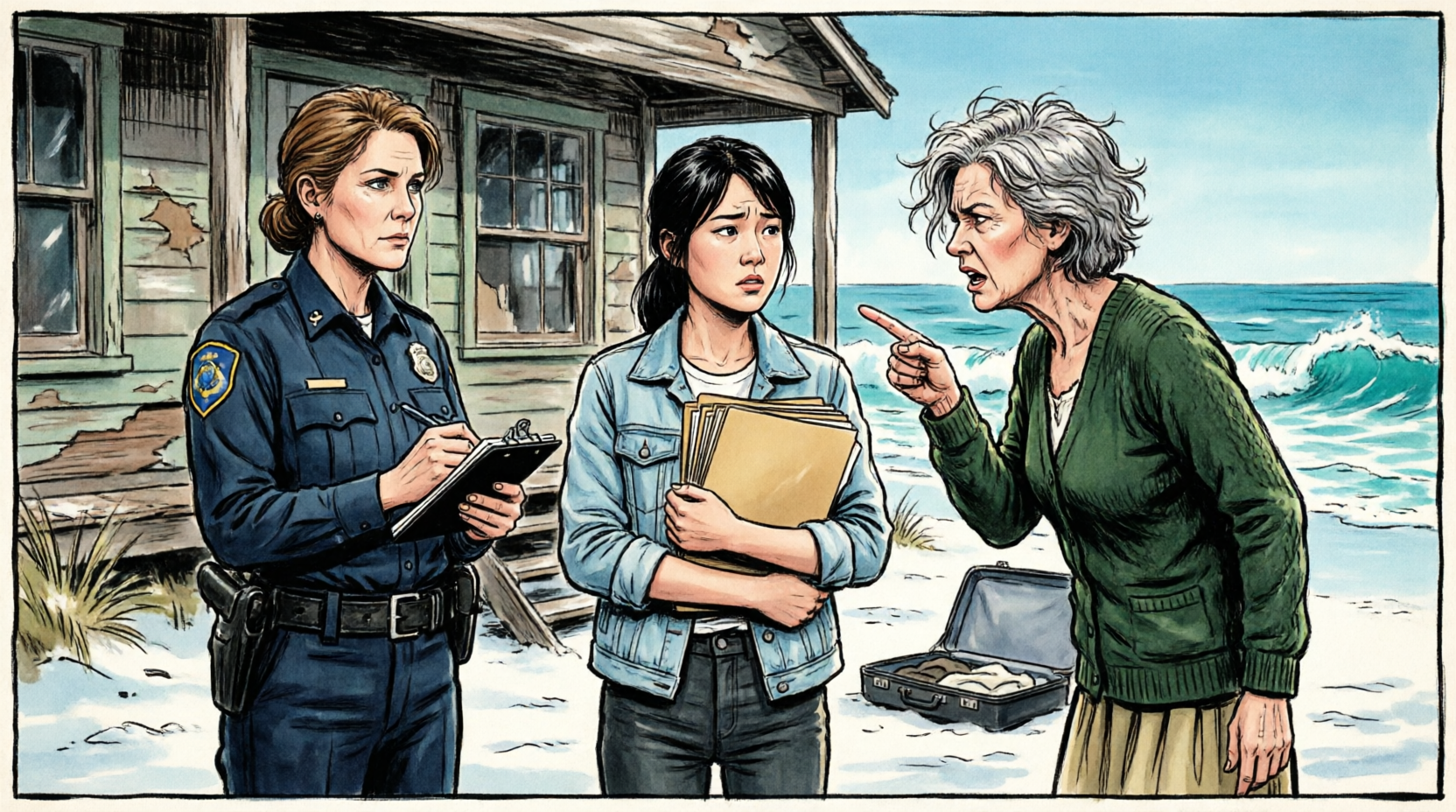
Diana stormed toward me in designer athleisure, Madeline close behind, phone raised and recording.
“I told you not to come here!” Diana yelled.
“Go ahead and call the police,” I replied calmly, pulling my suitcase from the trunk. “I already did.”
At that exact moment, two patrol cars turned onto the driveway.
One officer approached with measured professionalism.
“Mrs. Crawford,” he said, “we received your complaint about trespassing.”
“Yes!” she snapped. “That woman has no right to be here.”
The officer opened a folder.
“There seems to be some confusion,” he said. “According to documents from attorney Evelyn Porter, this property legally belongs to Miss Rebecca Hale.”
Diana froze.
“That’s impossible,” she insisted. “My husband signed the deed over to me.”
“The property was placed in an irrevocable trust by the previous owner,” the officer explained. “Your husband could not transfer ownership of something he did not legally own.”
Madeline slowly lowered her phone.
I stepped forward and handed over the original documents. “My mother established the trust before she passed,” I said.
At that moment, my father appeared on the porch, pale and bewildered.
“You knew about this?” I asked.
He shook his head. “Your mother never explained the details,” he admitted.
Diana’s face twisted in rage. “You manipulated him!” she spat.
The officer spoke firmly. “Miss Hale has full legal ownership. Any attempt to block her access could have legal consequences.”
Diana’s color drained.
Minutes later, her lawyer arrived, reviewed the papers, and left without comment. The trust was airtight.
Diana stormed off toward her car, Madeline hesitated, then followed.
The house fell silent again, broken only by the steady crash of waves.
Over the next weeks, I restored the home piece by piece—repainting the porch railing, rehanging old family photographs Diana had hidden in the attic. My father began visiting occasionally, slowly realizing how many lies he had accepted.
One afternoon, Madeline returned, holding a bundle of letters.
“They’re from your mom,” she said awkwardly. “She wrote them before she died but never gave them to you.”
Inside, my mother spoke of the future she hoped I would build, of the courage she knew I carried even when I doubted myself.
Months later, I found another envelope beneath the porch swing. Inside, one final message:
The house is just a symbol. The real legacy is having the courage to protect what matters.
As the sun sank over the Atlantic and waves rolled endlessly toward the shore, I finally understood.
The beach house had never been mere property. It was our family’s story—and now, at last, it was safe.
THE END

