In court, my husband said, “Take your kid and go to hell.” As assets were enumerated, he grinned—until a sealed will disclosed a $32 million estate. Everything changed, including custody, when my name was called.
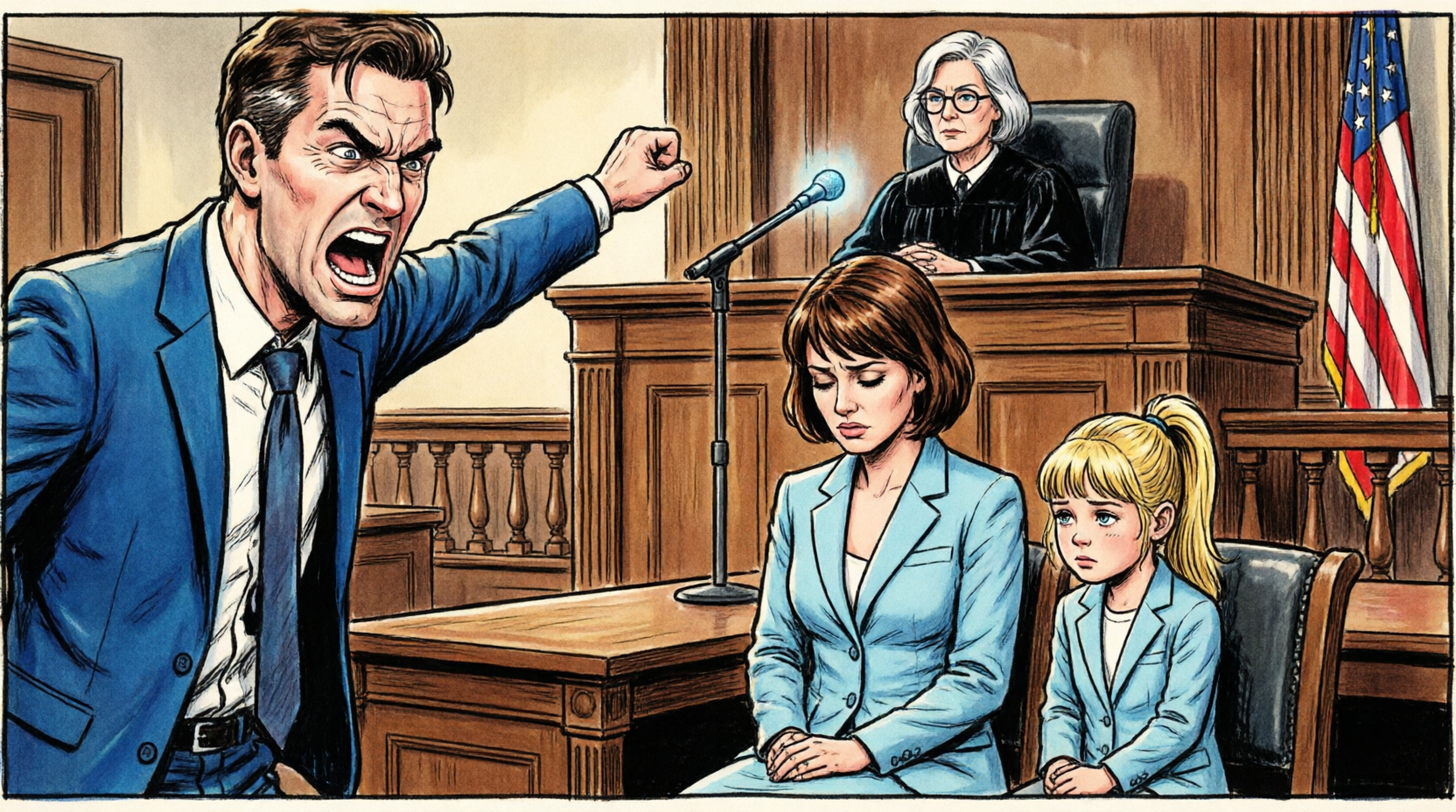
The words shattered across the courtroom like thrown glass.
“Take your kid and get out of my life.”
He didn’t murmur it under his breath, the way people do when they want to hide venom. He hurled it openly—sharp, deliberate—so it ricocheted off the paneled walls and landed in every lap, every notebook, every attentive ear. Even the court clerk, fingers frozen above the keyboard, paused as though the sound had cleaved the air itself.
I kept my gaze fixed on the table before me, its polished surface dulled by decades of elbows and paperwork. Tiny scratches marred the wood, faint lines like old anxieties etched into the finish. I traced one with my eyes as though it mattered more than the insult my husband had just thrown across the room.
My daughter sat pressed close, her knee brushing mine. Her small hand—warm, trembling—clutched the sleeve of my blazer as if fabric could form a bridge across an impossible chasm. She had been remarkably brave all morning. Quiet. Too quiet for a child who should have been thinking about cartoons and snacks, not custody agreements and courtroom procedure. Every few minutes, she tugged at my sleeve, silently asking the same question: Are you here? Are we okay?
The judge, a woman with silver hair coiled into a precise twist and glasses perched low on her nose, didn’t bang her gavel. She didn’t raise her voice. She simply regarded my husband the way one regards a man yelling in a library, expecting applause.
“Lower your voice, sir,” she said, calm and firm.
He didn’t apologize. He didn’t even feign regret. He leaned back in his chair, settling as though the room, the furniture, and everyone in it existed solely to witness his indignation. His jaw flexed once, twice, grinding on some invisible tension.
He had already delivered all his blows over the past months. That I was worthless. That I had never contributed. That the house, the business, the savings—everything—was his. That our daughter had been “turned against him,” as if a child could be tuned like a radio.
Today was supposed to be the final hearing.
Simple. Quick. Signatures and paperwork. A neat ribbon tied around the chaos so he could leave and claim he had “handled it,” just as he claimed to handle everything else.
At least, that was his assumption.
I listened as his lawyer—smooth, polished, practiced in making self-interest sound reasonable—began listing the assets my husband intended to keep. It sounded like a shopping list: the house, business accounts, retirement funds, investments, the vacation property his parents had supposedly “helped with,” as though that phrase erased the years I had spent holding everything together.
My husband reclined in his practiced posture: shoulders relaxed, chin slightly raised, one arm draped over the chair. A faint smirk lingered at the corner of his mouth, the expression of a man already rehearsing victory.
I had seen that smirk before.
In our kitchen, when he told me the numbers didn’t matter because he “handled the important parts.” In the hospital waiting room when our daughter was born, as I begged him to stay and he cited meetings, treating labor as an inconvenience. At dinner parties, when he joked I “didn’t understand business,” and everyone laughed because laughter is easier than discomfort.
The judge listened without interruption. She wrote slowly, deliberately. She didn’t appear impressed or irritated. She appeared experienced, a woman who had long learned that patience doesn’t equal agreement.
When his lawyer finished, he planted both hands on the table, punctuating his argument.
“Your Honor, as previously submitted, we request the division detailed in the final declarations. My client has been the primary financial provider in this marriage, and—”
The judge lifted a hand. Not sharply. Just finally.
“One moment,” she said, reaching for a thick, sealed folder on the bench—official, crisp, almost new. It hadn’t been obvious at the start. Or perhaps it had blended into the stack of ordinary files.
Something subtle shifted in the room, like a change in wind. The judge adjusted her glasses. The folder’s seal caught the light, pristine and white.
My husband tapped his pen once against the table, annoyed. Then again. The tiny sound scraped against my nerves because I knew it well. That tapping meant he still assumed time belonged to him.
“Your Honor,” his attorney said, smile fixed, “we believed all financial disclosures had already been finalized.”
The judge didn’t reply immediately. She opened the folder carefully, paper brushing against paper, each sound amplified in the silence.
She glanced at the first page. Then up—not at my husband, not at his lawyer.
At me.
It wasn’t suspicion. Not accusation. It was something rarer: recognition without prior familiarity. Consideration. As if she had just been handed one missing puzzle piece and was checking if it fit.
My stomach tightened. My pulse throbbed in my throat. Beside me, my daughter’s fingers clenched my sleeve, feeling tension she couldn’t yet name.
The judge returned to the document.
“This filing,” she said evenly, “was submitted early this morning by the estate attorney of the late Eleanor Whitaker.”
My husband frowned, unfamiliar with the name. He whispered to his attorney, whose mouth twitched in polite dismissal.
He had never known her.
But I had.
The name landed in my chest like a weight. Eleanor Whitaker. Even after years, even after life moved on, the memory hit like it had just happened.
My husband shifted impatiently. He expected the hearing to follow the script he had written. He had lunch with a client afterward, a fact he had shared not for my benefit, but to remind me I was merely an item on his schedule.
Instead, the judge turned the page.
“Ms. Whitaker’s estate attorney has submitted documents confirming a beneficiary designation finalized three weeks before Ms. Whitaker’s death.”
His lawyer raised an eyebrow.
“Your Honor, I fail to see the relevance to these divorce proceedings.”
The judge’s voice carried for the first time a hint of authority.
“It is relevant,” she said, “because the beneficiary named in this document is present in this courtroom.”
A murmur rippled through the gallery. My husband looked around, expecting some stranger to rise. Then he laughed dismissively.
“Probably a clerical error,” he muttered.
I remained still. Years of practice had taught me not to show a flicker of emotion—any reaction could become a weapon in his hands.
But inside me, memories began to ignite. Another office. Another life. Fluorescent lights. Stacks of binders. Eleanor’s voice cutting through chaos with precision. Burnt coffee, printer toner, late nights, the ache of doing the right thing when it cost sleep.
Eleanor Whitaker had once been my supervisor, my mentor, almost family. Before I left Whitaker Consulting to support my husband’s business. Before life revolved around school drop-offs and lunchboxes instead of ledgers and compliance reports.
The judge folded her hands.
“The estate is valued at approximately thirty-two million dollars,” she said.
Silence fell like a heavy curtain.
My husband’s pen stopped. His mouth tightened. Thirty-two million dollars changes the atmosphere instantly. Everyone recalculated, if only subconsciously.
He turned toward me slowly, like a man realizing the ground beneath him was no longer solid.
Not contempt. Not anger.
Uncertainty.
“That’s impossible,” he muttered, voice thin. The swagger was gone. The cruelty gone. Only disbelief remained.
The judge continued.
“Ms. Whitaker revised her estate three weeks before her passing to ensure the person who stood by her during the hardest period of her career would be protected.”
His lawyer leaned forward, cautious.
“Your Honor, surely the beneficiary is a family member or charity?”
The judge shook her head.
“The sole beneficiary is—” She paused, then looked up. “The petitioner in this case.”
Every head turned toward me.
I clasped my hands in my lap, hiding the trembling. My daughter’s fingers tightened, loosened, then clenched again. Hope and fear pulsed through her.
My husband froze.
“No,” he whispered. “No, she wouldn’t—”
The judge’s voice remained calm.
“Ms. Whitaker’s letter states she wished to provide security to the person who demonstrated integrity and loyalty under extreme pressure.”
Integrity. Loyalty. Words my husband wielded only when convenient.
He stared at the folder, as though he could reshape it with will.
Memories surged: Eleanor in her office, sleeves rolled, hair loose, exhausted but steady. Months under federal investigation due to someone else’s errors, clients panicking, employees leaving, competitors circling.
And me, offered a fortune for information to betray her. The kind of offer that could change a life.
I remembered returning to her office and telling her the truth. Her quiet, long look. Then the nod.
“I won’t forget this,” she said.
Life carried me elsewhere—marriage, motherhood, supporting his business. Our worlds separated. Holiday cards faded. Distance claimed its quiet power.
The judge closed the folder.
“Legally,” she said, “that inheritance belongs solely to her.”
The courtroom felt suspended. The balance of my husband’s carefully plotted divorce had shifted.
His attorney recovered first, smooth and calculating.
“Your Honor, separate property aside, it shouldn’t affect marital division.”
The glance he threw my husband said enough: adjust.
For months, my husband acted as if I had no leverage. He portrayed me as dependent, incapable, shaping property division and custody.
The judge turned another page.
“Actually,” she said, “this development affects several claims made earlier.”
My husband frowned.
“How?” he demanded, panic seeping through.
She met his gaze.
“Your filings argued your spouse lacked financial independence, relying solely on your income. That claim informed support and custody requests.”
His jaw twitched. His lawyer tried to interject. The judge’s hand stopped him.
“The court now has proof that the petitioner managed financial operations for a consulting firm under federal investigation, declined unethical compensation, and inherited a separate estate.”
A pause. Relief rose quietly in me, a crack of fresh air in months of smoke.
My husband stared at the table. His confidence, stripped in minutes, looked foreign.
The judge leaned forward.
“Stability,” she said, “is not measured by money alone.”
He looked up, tense.
“It is also measured by judgment.”
Silence held the room. Even the clerk’s typing slowed.
His lawyer spoke smoothly.
“Your Honor, custody was based on financial stability and living conditions. My client seeks the best environment for the child.”
The judge remained unmoved.
“Custody decisions,” she said, “consider the child’s long-term welfare. Financial support matters, yes. But character, judgment, and consistency matter as well.”
My daughter pressed closer, feeling the shift, sensing safety.
The judge reviewed documents, then spoke clearly:
“Primary custody will remain with the mother.”
My husband’s head jerked.
“That’s—” He faltered.
The judge passed the document to the clerk.
“The court encourages both parents to act respectfully,” she said. “The child deserves stability from both.”
He said nothing further. He only stared at the page, as if the morning’s language had become foreign.
Beside me, my daughter’s hand shifted. She still clung to my sleeve, but the grip was no longer frantic. Gentle. Like a child holding a parent’s hand in a crowded park—not from fear, but because she knew exactly where she belonged.
When the judge announced the hearing was over, chairs scraped softly, papers rustled, people rose. There was no dramatic fanfare, no cinematic gasp. Just the quiet closure of a legal proceeding. Yet to me, it felt like the final page of a suffocating chapter.
My husband stood slowly, as if his body had grown heavier since he arrived. He didn’t meet my eyes. His lawyer leaned in, speaking low, but the tight set of my husband’s jaw showed the words offered no relief.
I gathered my purse with hands that had finally stilled, then reached for my daughter.
“Ready?” I whispered.
She nodded, wide-eyed, and slid her hand into mine.
We walked toward the exit.
As we passed him, my husband finally lifted his gaze. His eyes followed us, and in them I saw something tangled.
Not remorse.
Not affection.
Something more like calculation colliding with disbelief.
For years, he had controlled the story of who I was. Now the courtroom had witnessed a different version. Not the quiet woman he dismissed. Not the dependent spouse he belittled. But someone with a history he had never bothered to learn.
Someone with substance.
Someone with credibility.
Someone he could not erase with words.
The hallway outside smelled faintly of disinfectant and aging paper. Fluorescent lights buzzed overhead. People moved around us—attorneys, families, court staff—but I felt oddly removed, as if stepping from one life into another.
My daughter tilted her head toward me, forehead furrowed.
“Is it over?” she asked softly.
The question cut deep. Not just about the courtroom, but all the months of tension: yelling behind closed doors, nights she slipped into my bed for comfort, mornings she watched her father slam doors and leave without a word.
I crouched to meet her gaze.
“The court part is done,” I said gently. “We’re going to be okay.”
She studied me carefully, looking for cracks.
“Are we still moving?”
“Yes,” I said. “We’ll make a home that feels like ours.”
She nodded slowly and leaned her forehead against my shoulder—the quiet, wordless hug of a child carrying emotions too big for words.
I held her close, inhaling the soft scent of her shampoo, that small essence of innocence that clings even amid grown-up chaos.
We walked to the elevator, our steps softened by the hallway runner. The mirrored wall reflected us: me in my blazer, striving for composure; my daughter in her dress, weary-eyed but fragilely hopeful.
As the elevator descended, I felt something inside me loosen, slowly.
But relief is never simple. It doesn’t erase wounds. It only allows space to acknowledge them.
Outside, in the parking lot, my daughter buckled herself in carefully, almost reverently, as though sudden movements could trigger another storm.
I started the car and sat a moment, hands on the wheel, staring at the courthouse steps.
The last time I had felt such silence was years ago in Eleanor’s office, late at night. Everyone else gone, the building hollow. She would sit across from me, files stacked high, and we’d work until numbers blurred together. Sometimes she spoke of her father, how he taught her reputation mattered more than profit. Sometimes she spoke not at all, her mind racing faster than her hands.
I thought suddenly about how she had died. I hadn’t known the details. A call from an unfamiliar lawyer had arrived days ago, but even then my mind resisted processing it. Eleanor had been one of those people you expect to exist somewhere in the world—a lighthouse whose presence you barely notice but feel safer knowing is there.
And now she was gone.
And she had left me something extraordinary.
Thirty-two million dollars.
It didn’t feel like money yet. It felt like a message. A hand stretched across time to steady me when I needed it most.
I drove away as my daughter hummed quietly in the backseat, a tune I didn’t recognize. The city moved on around us—traffic lights, storefronts, pedestrians—ordinary life, while mine had shifted because of a single sealed folder.
At a red light, my phone buzzed. A message from my lawyer: We’ll review next steps soon. Take today and breathe.
I turned it facedown and kept driving.
A few minutes later, my daughter leaned forward.
“Mom?”
“Yes, sweetheart?”
“Why did Dad say that?” Her voice was cautious, careful.
I swallowed, throat tight.
“Sometimes,” I said slowly, “people say cruel things when they’re scared. Or when they lose control.”
She frowned.
“Did we do something wrong?”
“No,” I said firmly. “Nothing here happened because of you. Or me. Or anything you did.”
She leaned back, thoughtful. For several miles, silence filled the car.
I reflected on the early days with my husband, when he had not yet become the man I now recognized in court—or maybe he always had been, and I had loved him too blindly to notice.
He was charming then, effortless. He asked questions, laughed easily, admired my mind. He told me, You’re different. At the time, I didn’t realize different often meant useful.
He spoke of building something big, a business that would make him important. When he asked me to leave Whitaker Consulting to “support us,” it sounded like partnership. Shared ambition.
Eleanor frowned when I mentioned it.
“Are you sure?”
“It’s only temporary,” I said. “He needs help getting started.”
“And then?” she asked.
I hesitated. I didn’t know if freedom would truly exist afterward.
She looked at me, silent, then said, Keep your license active. Keep your skills sharp. Keep your own account.
I had laughed, lightly offended.
“Eleanor, he’s not like that.”
She didn’t argue. She only said, I hope you’re right.
Over the years, I became the invisible scaffolding beneath his ambitions. Balancing books at the kitchen table, baby monitor beside me, client calls, spreadsheets, payroll, invoices—all while the praise went to him.
“You should be proud of me,” he’d say, as if “me” included us both only when it benefited him.
When people asked what I did, he answered.
“She doesn’t work,” he’d laugh. Or, “She stays home,” as if motherhood and quietly managing his business counted for nothing.
Slowly, I stopped correcting him. Every insistence on my value became a fight. Every attempt to be recognized became evidence I was not enough.
The first time he called me useless, it was in the kitchen. The sun turning the counter golden, me stirring sauce, our daughter coloring nearby. He stormed in, angry.
“What’s wrong?” I asked.
“What’s wrong is I’m carrying everything,” he snapped, slamming his briefcase down.
I began to explain.
“That’s not real work,” he cut me off. “Anyone can do that.”
Our daughter froze, crayon in hand.
Something inside me broke that day. But I smiled for her. Mothers do that—they absorb damage meant for no one.
After that, the words came faster. Useless. Lazy. Dependent. He learned the impact and wielded it often.
By the time divorce proceedings began, he had convinced everyone—including himself—that I had floated alongside him, not built beside him.
In mediation, he spoke as though I were invisible.
“She’ll be fine,” he said. “She doesn’t need much.”
I wanted to shout, but shouting only made him calmer. I learned silence, strategy. I collected documents, emails, records—not for revenge, but to protect my daughter.
Even so, fear clung. He had wealth, influence, confidence. According to his version, I was nothing.
Until the judge opened the folder.

